



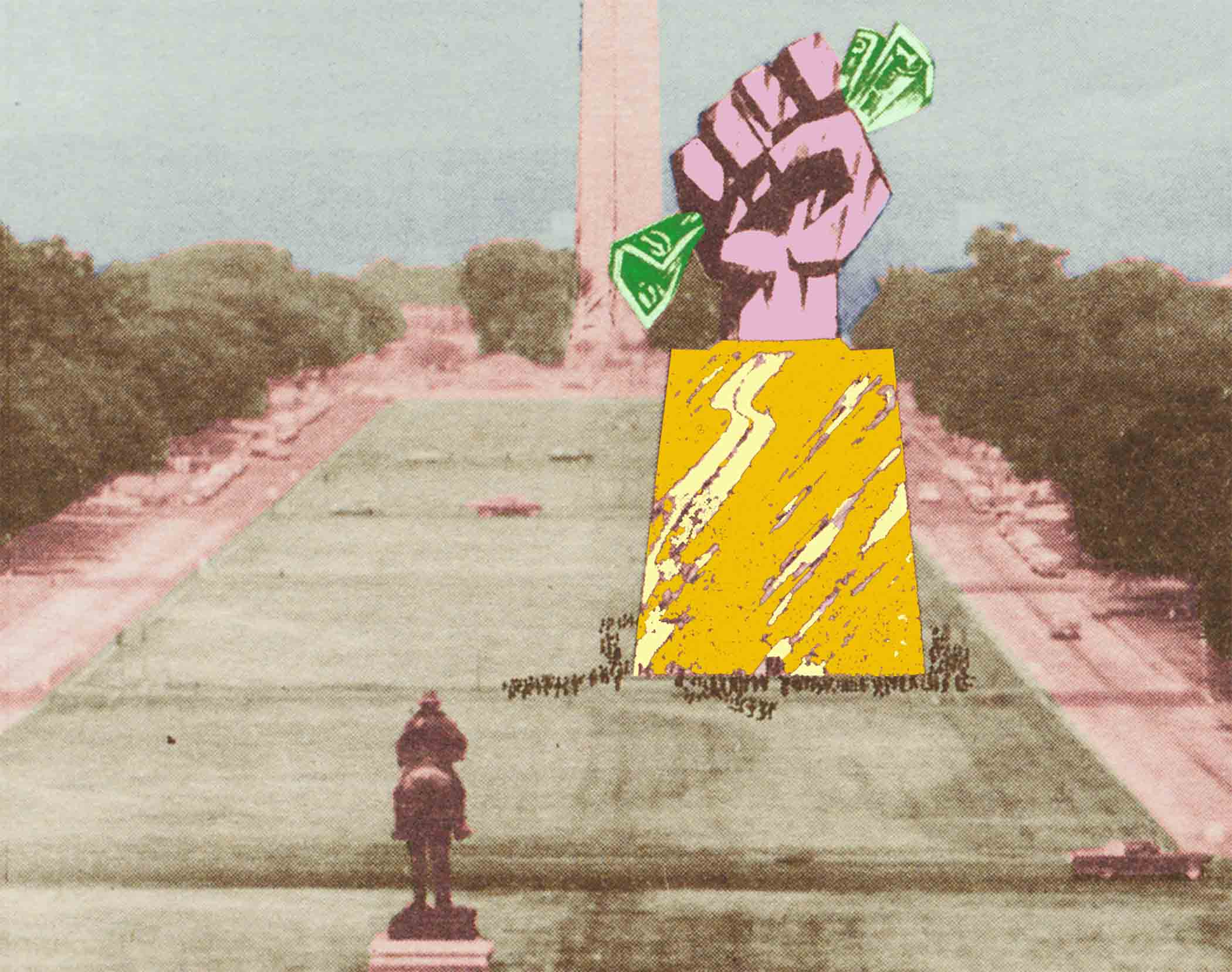
Editor’s note, May 6, 2026: Roughly two and a half years after Richard Nixon resigned the presidency because of the Watergate scandals — which encompassed not only the conviction of Nixon’s vice president on tax evasion charges but also obstruction of justice by both Nixon and members of his staff, articles of impeachment for the illegal escalation of the war in Vietnam, and other perfidies — the Voice had some fun on the always lively “Scenes” pages, by asking readers how best to remember the disgraced POTUS. Someone in the Voice art department at the time cooked up a monument to grabbing cash, an apt memorial for a corrupt Republican then — and now.
We can find no record that President Ford was actually planning a Nixon monument after he had, as the editors back in 1977 noted, already given Nixon a “mercy pardon.” Regardless, the Voice wanted the new Carter administration to start thinking about letting the vox populi weigh in on how Nixon should be remembered. Below, we look at the original column, followed by a celebration of the winners in “Scenes,” two weeks later. —R.C. Baker
→ This article from the archives is part of a series celebrating the Platinum Anniversary — 70 years! — of the Voice. The first issue hit the stands on October 26, 1955. ←
SCENES: Nixon Monument Contest
By Howard Smith & Brian Van der Horst
February 14, 1977
A set of secret documents fell into our hands this week thanks to an outgoing member of the Department of the Interior. All stamped “shred,” they were copies of architectural renderings, budgets, and proposals for a shocking project that almost went through in the last days of the Ford administration: The Nixon Monument.
Ford felt it was the only honorable thing to do. After all, his first act in office was the mercy pardon for his predecessor; so why not match it with a similar compassionate last gesture. Ford believed that if he didn’t push it through, it would obviously never be done under the forthcoming, possibly eight-year-long, Democratic regime. However, his aides convinced him at the last moment that the plan was so controversial that it would make his own passage into retirement a stormy rather than a graceful transition.
We were appalled by these disclosures. To think that such plans were still being made in Washington — and almost came to fruition — without the American Public ever being informed. Certainly Nixon, or any ex-president, no matter what missteps he may have taken, deserves to be honored for all the good things he accomplished. We and all right-thinking Americans would have agreed with Ford that the memory of Richard Milhous Nixon should be preserved for future generations. But it is an outrage to prevent the citizens of this great country from contributing their thoughts as to what shape such a monument should take.

We had heard that the Carter people thought this affair too hot to handle. We want to confront the new administration with this protest: The project should go through. It is our responsibility to our political heritage. But this time, the government should listen to its constituents.
We have decided to open up this column as a forum for what the Nixon monument should be. Please send either a written description or sketch of what you want this honorific edifice to look like to “Scenes,” care of this paper. We’ll publish the best. The person who sends in the most original, inspiring idea will receive a framed portrait of the former president; the second-place winner will receive two portraits and the third, three. None of your entries will be returned — after we close this competition, the entire file of our readers’ ideas will be sent to the appropriate security officials in Washington. ❖
> > > < < <
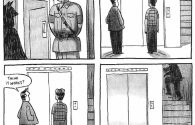
Editor’s note, continued: Two weeks later, the first round of results were in. The winner was a proposed sculpture of a huge doorway towering over the National Mall, an idea from reader Owen Edwards. This represented not one of Aldous Huxley’s “doors of perception,” but something much more earthbound: Around 1:47 a.m., on June 17, 1972, security guard Frank Wills discovered that a door leading into the Watergate complex, which housed within its labyrinthine bulk the headquarters of the Democratic National Committee, had been tampered with for a second time. The first time he noticed it, he’d assumed that the maintenance crew had taped the lock open, and he had removed the tape. After seeing the door taped again when he made his next rounds, he called the police, who caught five burglars red-handed in the DNC offices. Thus, some sloppy covert ops kick-started the Watergate saga. Nixon’s illegal war and penchant for self-dealing certainly chime with the current administration’s actions, but as yet, the body count from President Trump’s extrajudicial conflict in Iran is nowhere near as high as the death toll of American combatants and Vietnamese civilians during Nixon’s five years in the Oval Office. Buttoned-down (though hard-drinking and -cursing) Quaker that he was, however, Nixon could never, ever, in a million years, have dreamt of reaping the seven-figure profits Trump and his family have raked in through overt gifts, questionable business dealings, self-dealing, and influence peddling during Trump 2.0.
SCENES: Nixon Monument Contest II
By Howard Smith & Brian Van der Horst
February 14, 1977
This week, “Scenes” sent 10 of the best ideas for the Nixon Monument to San Clemente for the ex-president’s approval and recommendations. Because of space limitations, we could not show more than the one suggested by Owen Edwards, illustrated above. Among the remaining nine was Richard Sanders Rosenthal’s weathervane, featuring Nixon’s profile crowned with a dollar sign and inscribed “I am not a crook” and “I am a crook” on opposite sides. Another sculptural concept featuring a dollar sign was submitted by a chiropodist, Dr. Gary W. Bravstein. Stephen Powers, Paul Castelli, Thomas Di Roma, and Christine Bunish each designed variations on gigantic tape reels and recording machines. Sonia Jaffe Robbins felt an empty pedestal titled “Expletive Deleted” would be appropriate. And the most popular image, as represented by John Gesner, Paul Slagle, Gloria Crasnick, W.C. Henricksen, and others, centered upon a fist with an upraised middle finger.
We would like to remind you that this contest is still open to citizens of the United States and all the overseas territories. It is important that we receive as much input from the public as possible, for when this edifice is built it should perfectly reflect the character and commemorate the memory of Richard Milhous Nixon. The person who sends in the most original inspiration (write “Scenes,” care of this paper) will receive a framed portrait of our former leader. The second-place winner will receive two portraits, and the third, three. Remember, none of your entries will be returned; after we close this competition, the entire file will be sent to the appropriate FBI officials.
❖ ❖ ❖
Final editor’s note: Watch this space for more freewheeling ’70s ideas about how to honor the dishonorable. —RCB
