





A vaguely bipedal armature topped by a steely cowl greets you at Pirouette: Turning Points in Design, an exhibit of historical industrial design at the Museum of Modern Art. This articulated object might conjure a medieval torture instrument, or perhaps one of H.R. Giger’s biomechanical monsters from ’70s album covers and the “Alien” movie franchise.
But rather than clamp onto your face or burst from your chest, this brass and metal concoction was designed in 1930s Germany to dry your hair, by forcing hot air through hoses and hollow perforated tubes. “Hairdryer” ticks some of this past century’s most telling boxes — elaborate and resource-guzzling gizmos envisioned and manufactured to make daily life on Earth a tad easier … for human beings, at least.
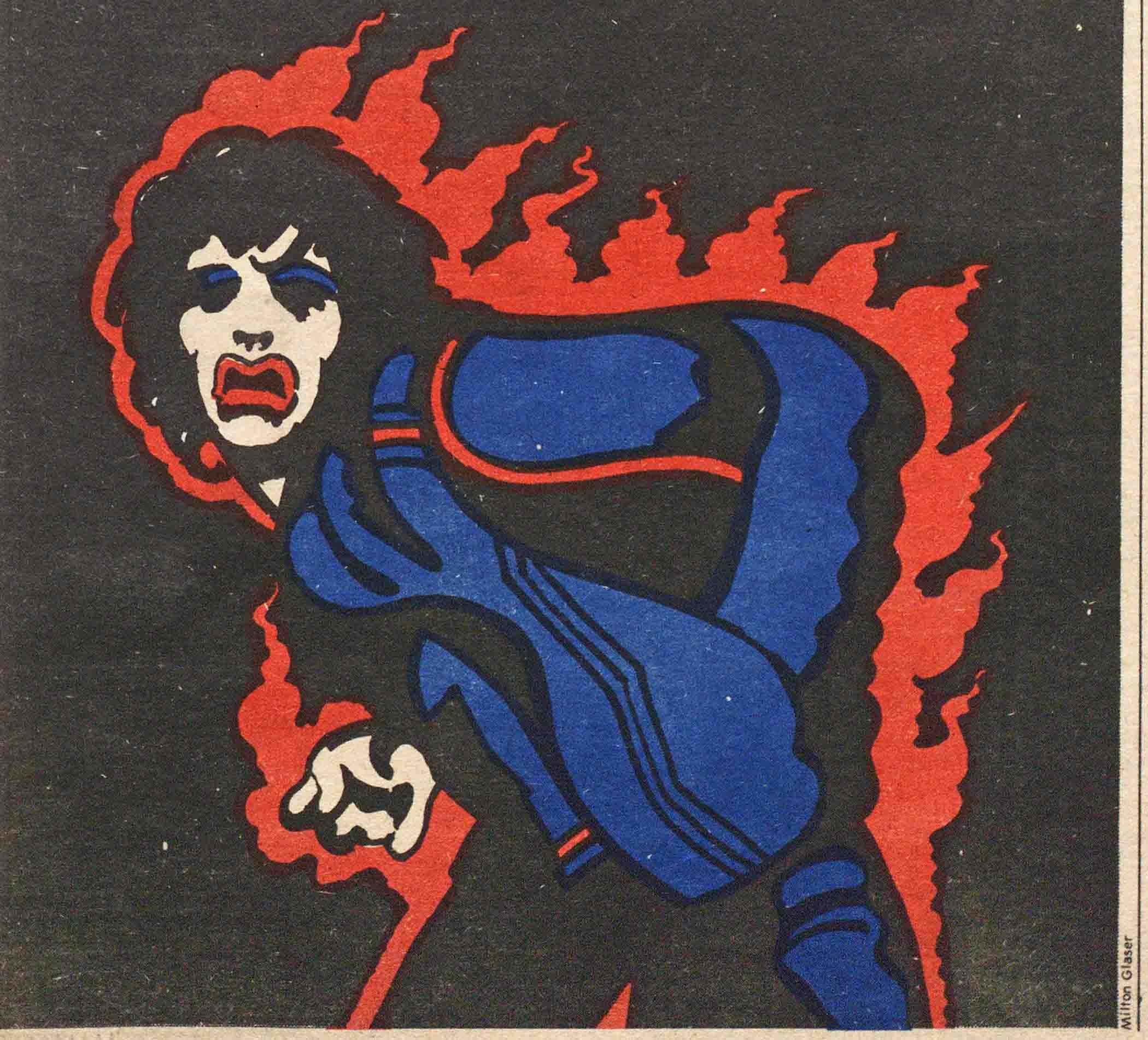
One artifact in the show particularly resonates with us locals: 1976 was America’s Bicentennial year but times were tough in the Big Apple, what with “looming bankruptcy, rising crime, and a garbage collection strike,” as a wall label puts it. Yet, as then governor Hugh Carey pointed out, folks from everywhere else still loved NYC. (Indeed, a quintessential New York movie was remade that year, substituting the Twin Towers for the Empire State Building and Jessica Lange for Fay Wray — but still ending with King Kong’s death by beauty.) Carey’s PR instincts were proven sound after he hired native New Yorker Milton Glaser (1929–2020) to, as the label elucidates, “repair the city’s image. The designer scribbled ‘I ♥ NY’ on a paper napkin while riding in the back of a taxi cab. This doodle would evolve into one of the world’s most recognizable slogans. Glaser explained, ‘The original imagery derived from my memories of carvings in tree trunks where the initials of lovers were combined with a heart.’”
We have simply swapped George Orwell’s all-seeing Big Brother for today’s panopticon of Googly eyes.
Megawatt ideas scrawled on napkins might feel a bit clichéd, but this fascinating exhibition riffs effectively on that concept by also showcasing Margaret E. Knight and Charles B. Stilwell’s “Flat-Bottomed Paper Bags,” circa the 1870s–’80s. For a century and a half, these two Americans’ stolid invention has assured that your brown bag lunch doesn’t roll right off the breakroom table.

Pirouette demonstrates how quickly the future can become nostalgia. Check out the “NASA Graphics Standards Manual,” which features the space agency’s “worm” logo that, per the wall label, was “commissioned in 1975 by the National Endowment for the Arts under the Federal Graphics Improvement program, which sought to modernize US federal agencies. NASA’s employees intensely disliked the worm, deeming it sterile and soulless. They longed for the original 1959 logo, called ‘the meatball’ — a blue planet with stars, aerospace wings, and an orbiting spacecraft. In 1992, NASA reintroduced the meatball and stated that the worm ‘slowly … will die.’ Recently, however, the worm has experienced a nostalgic resurgence both within and outside NASA, appearing on rockets, souvenirs, and even items from a 2017 collection by the fashion label Coach.” Plus ça change!

Fast-forward roughly a decade and you are confronted with an object that has transfigured our age at least as deeply as Gutenberg’s printing press revolutionized the 15th century: the “Macintosh 128K Home Computer.” As we pointed out in a 2009 review of the Mac’s iconic 1984 Super Bowl ad (displayed at MoMA on a screen similar in size to the one originally included with Steve Jobs and Jerry Manock’s boxy plastic innovation), this new concept of a desktop computer for your home, as opposed to some massive mainframe at the office, projected pretensions of liberation, a WYSIWYG contraption that would unleash the average American’s creativity — a sentiment summed up in that Super Bowl ad’s tagline, “On January 24th, Apple Computer will introduce Macintosh. And you’ll see why 1984 won’t be like ‘1984.’” As it turns out, we have simply swapped George Orwell’s all-seeing Big Brother for today’s panopticon of Googly eyes. Orwell, in his 1949 dystopian clarion call, was intuiting something about modernity that W. H. Auden was also divining in his book-length “The Age of Anxiety,” in 1947:
Lies and lethargies police the world
In its periods of peace. What pain taught
Is soon forgotten; we celebrate
What ought to happen as if it were done,
Are blinded by our boasts.…
Both writers were getting a glimpse of that rough beast we now know as social media.
MoMA’s show also includes such esoteric sundries as zero-gravity cups, designed by a space station astronaut in 2008 who wanted to dispense with plastic bags and straws and “recreate how people drink their beverages on Earth,” to regain a “dimension of what it’s like to be a human being” while in orbit. These space-age cups, with bulbous bottoms and labial sippy flanges, land somewhere in the mind between the childish and the devilishly tactile, a sensation akin to that created by surrealist Méret Oppenheim’s 1936 Object, the infamous teacup covered in the speckled fur of a Chinese gazelle, which can be seen on an upper floor at the museum.

The exhibition also answers questions you might not have thought to ask: Who designed that symbol of a vertical line suspended in an open-topped circle that you see on gadgets of all kinds these days? Why, it was the International Electrotechnical Commission (established in Switzerland, in 1906), which in 1973 joined the engineering symbols of one for “On” and zero for “Off,” the combination initially referred to as “Standby” mode. Three decades later, an international committee of scientists and engineers recontextualized the symbol into what we all now know as the power button on your coffeemaker and myriad other devices.
Much of the design here is spare and to the point, such as the Google map pin, created by a Dane, in 2005. Perhaps not surprisingly, it was Yara Said, from war-torn Syria, who fashioned the stark orange field striated by a horizontal black stripe of the “Refugee Flag,” conceived for the 2016 Olympics as a symbol for refugee athletes to compete under. Said has spoken of her own experience of “crossing the sea from Turkey to Greece in a life vest,” adding, “Black and orange is a symbol of solidarity with all these brave souls that had to wear life vests to cross the sea to look for safety in a new country.”
And don’t expect to escape the angst of our too-much-information age. Michele Gauler’s Digital Remains (2006) look something like thicker versions of those round reflectors that edge country roads to warn us of sharp curves and blind intersections, except that they include names, dates, and tombstone epigraphs. The German-born designer notes, “New technologies bring new ways of mourning,” for which she has concocted these “data-storage urns” that include search algorithms to “dig through data, pulling out relevant personal traces,” such as family pictures or fave songs — and maybe even that yearbook picture you’d gone to your grave hoping no one would ever see again. ❖
Pirouette: Turning Points in Design
Museum of Modern Art
11 West 53rd Street
Through October 18