







You always know when the U.S. Open is in town, because the usual 7 train commuter’s working-class wardrobe of jeans, scrubs, sweats, fluorescent safety vests, scuffed Carhartt boots, and sloganeering T-shirts is complemented during the late-August/Labor Day weeks by the jaunty, light-hued tennis shorts and collared pullovers of patrons slumming it to Arthur Ashe Stadium. Major sports events enthrall us through more than just W’s and L’s or X’s and O’s — there are the crowds, footlong hotdogs, dramatic conflicts, passionate hopes, victory’s thrills, defeat’s agonies. But at the heart of it all is the human body in motion, and beginning in the 1930s, Harold Edgerton pioneered stroboscopic flash arrays and other stop-motion innovations to capture the unseen beauty of athletes at play (and, a decade or so later, the terrifying grandeur of an atomic fireball frozen at 1/100,000,000 of a second).
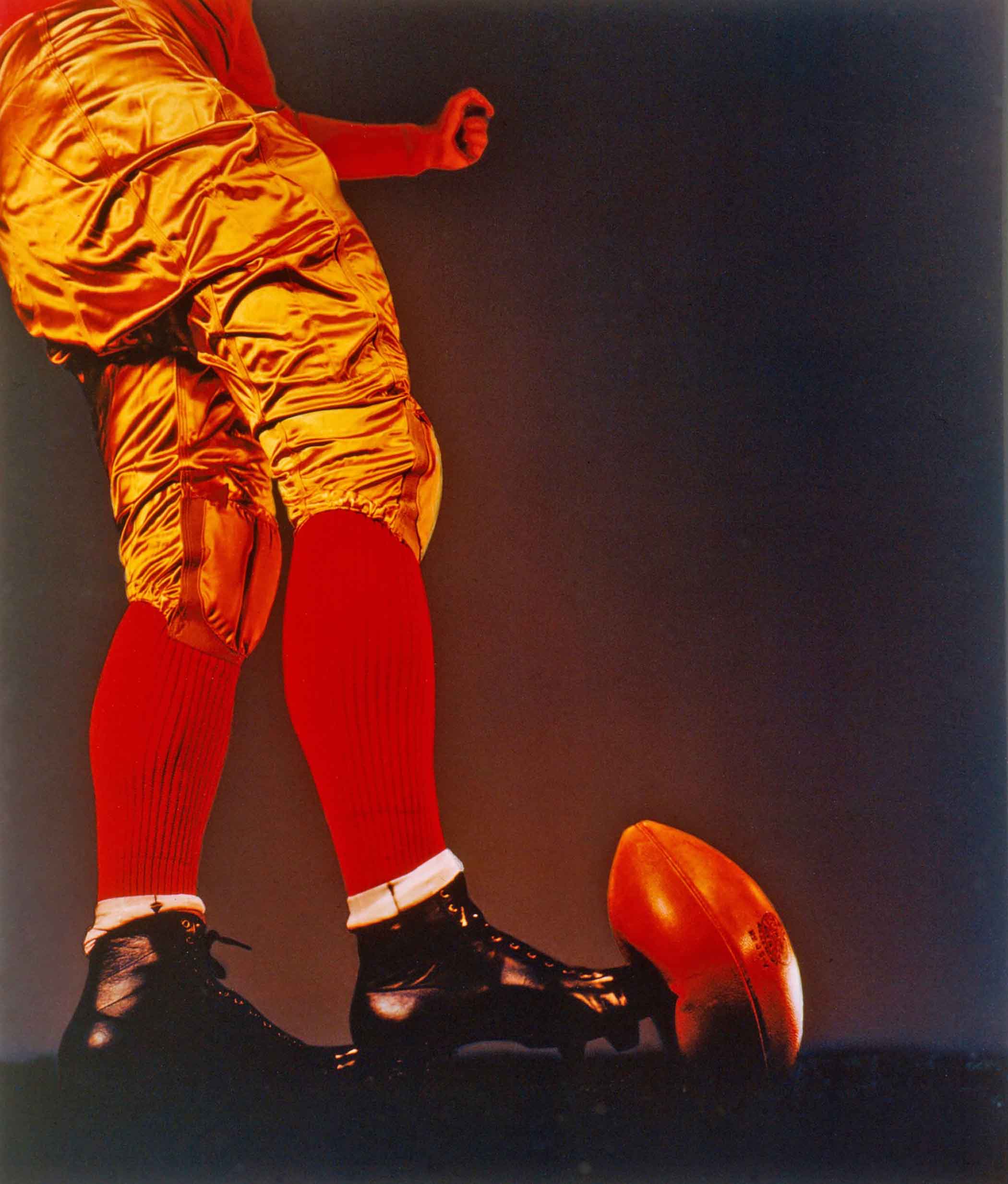
In advance of the Open, and maybe — both Mets and Yankees fans have reason to hope — even a World Series in the fall, Danziger Gallery is featuring a selection of Edgerton’s sports photography. Remember Lucy yanking the football away just as Charlie Brown runs up to kick it, then flops hard on his back? Check out Edgerton’s Football Kick (1938) and note how, as the booted foot makes contact with the ball, the leather deforms as it picks up the energy that will, fractions of a second later, send the ball sailing. These compelling images tell us as much about physics as they do about photography (not surprising, considering that Edgerton was a longtime professor at the Massachusetts Institute of Technology). The pictures on display were taken mostly in the 1930s and ’40s, and while the cultural concept of “modernity” was already getting a bit long in the tooth by that time (and various processes for fixing an image on a light-sensitive substrate had been around for more than a century), Edgerton created dynamic visions that still resonate through their luminous, rhythmic grace.
If the 21st century has brought an ever-mounting blizzard of stats to the baseball diamond, Edgerton’s 1938 silver gelatin print Pitcher Multiflash reveals that the minutest components of a pitcher’s delivery were already available for study the same year Hank Greenberg was hammering 58 homers for the Detroit Tigers. The difference is that, unlike in the digital miasma of our current age, the MIT innovator had a sense of composition and chiaroscuro lighting that transformed twisting muscles, flying horsehide, twirling golf clubs, swooshing tennis rackets, bucking broncos, and all manner of corporeal locomotion into radiantly syncopated visual jazz. ❖