







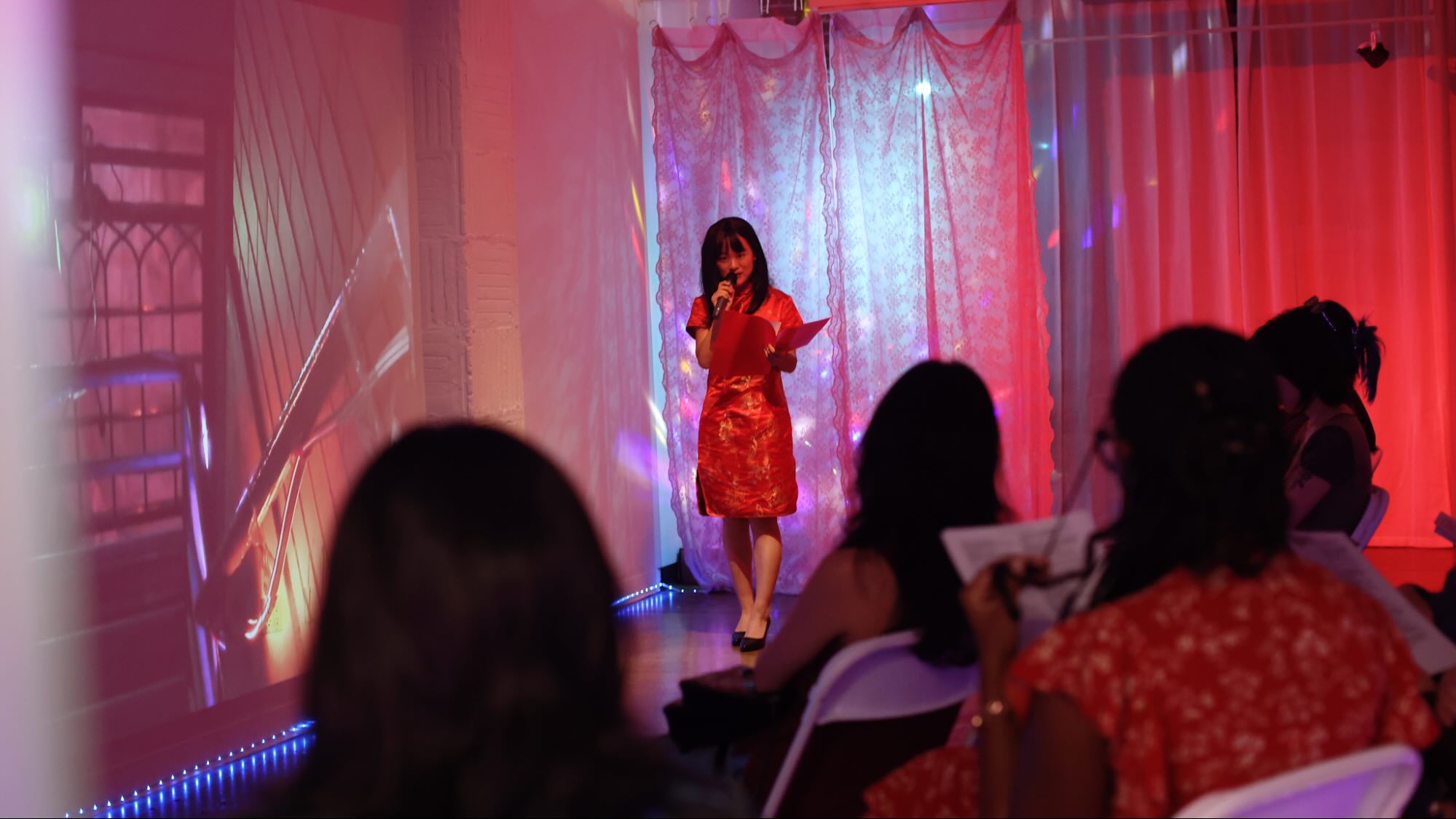
From Repeat After Her to her moving-image, performance, and documentary practices, Ke Zhang is less interested in whether a woman has been “truthfully recorded” than in how she participates in the making of her own image—between the camera, social roles, and self-performance.
Colored light turned New York’s Flohaus Gallery into a massage room without clear boundaries. At its center stood Ke Zhang in a wig, qipao, and high heels. She began with an ordinary instruction from the workplace: “You don’t need to take off your pants. Just pull them down a little.” She enunciated these private, practical phrases in a solemn, dramatically modulated cadence, as though delivering a public address. The audience held an English transcript but remained silent. Some avoided her gaze; others heard the humor but seemed unsure whether they were permitted to laugh. Chinese issued from Zhang’s body while English rested quietly in the viewers’ hands. On July 24, 2026, this solo event—comprising a screening of Massage Baby!, a live performance, and an artist talk with Jenny Jiani Wang—altered only the volume, setting, and audience of the language. Yet once removed from its usual context, the everyday speech of work suddenly disclosed its intimacy, power, and discomfort. The event also sits within a practice that moves between gallery work and professional documentary direction for a project followed by more than three million people across social platforms.
“In many of my works, I place one form inside another,” Zhang says of her method. The forms she borrows, however, are not neutral shells. They are scripts that have already prescribed how women should appear. Public oratory calls for conviction and obedience; ballet demands discipline and grace; K-pop trains bodies to synchronize with the camera; horror knows how a woman ought to become a victim; pornography positions desire in relation to the Asian female body; and the documentary interview promises to extract a legible story from a real person. Zhang enters her body into these systems, then makes it hesitate, overperform, answer back, or deviate at precisely the moment it is expected to cooperate. What concerns her is not simply the condition of women being watched. It is how they act within predetermined images—and how, through those actions, they quietly revise the image itself.
The film theorist Teresa de Lauretis famously described cinema, cultural discourse, and social institutions as “technologies of gender”: gender is produced both through representations of women and through women’s representations of themselves. Zhang’s work takes place in the interval where those two processes refuse to align. Her female figures are never absolutely free, but neither are they blank surfaces awaiting the camera’s definition. They learn roles, manage their appearance, and follow choreographies; they also display boredom, desire, professional judgment, and inconvenient humor. The camera can no longer remain securely outside the scene as an impartial observer. It, too, is drawn into the power relation it records.
Massage Baby! is Zhang’s most intricate development of this method to date. The work grew out of nearly two years of encounters, observations, and conversations with Chinese women working in New York massage parlors. Coco, its central figure, is not a copy of any one woman. She is a composite assembled from multiple people’s speech, gestures, emotions, and working lives, and she is performed by Zhang herself. Within the film, a documentary crew consisting of an English-speaking director(played by Xin Du) and a Mandarin interpreter(played by Erique Huang) attempts to interview Coco, arrange her, and explain her. Information moves unevenly between two languages, while Coco gradually recognizes that the crew is manufacturing an image of “the massage woman” around her.
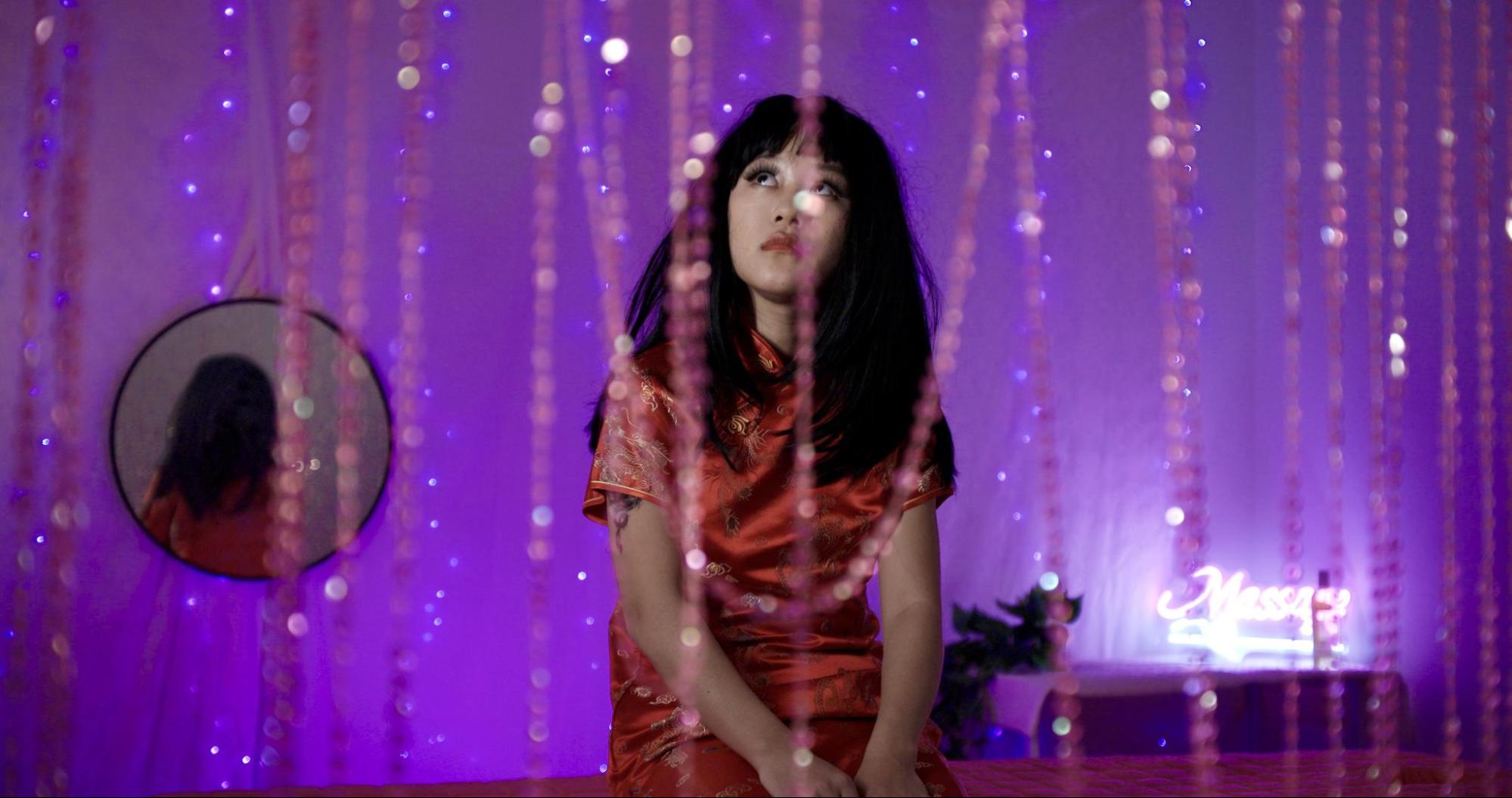
But she does not wait obediently for the filmmakers to complete her portrait. Coco is fascinated by microphones, cameras, and the other equipment on set; she studies the instruments that are studying her. When an interviewer asks about her romantic life, she turns the question around, making the one-way extraction of information into an uncomfortable exchange. The crew believes it has built an attractive massage room, but Coco corrects the set from a worker’s professional perspective. A real workplace, she observes, may be less dreamlike, but it would take hygiene more seriously. The person presumed to require explanation begins explaining the filmmakers instead: their aesthetic fantasy of the massage trade, the inexperience embedded in their questions, and the condescension they have failed to hear in their own voices.
One of the film’s sharpest moments begins with a question that sounds considerate: did she choose this work because she wanted to do it? Coco refuses the freedom the question presumes. There is no wanting or not wanting, she replies; when you do not have money, you do what you can—unlike the filmmakers, who have had the means to study something they love. She neither leaves the frame nor organizes herself into a victim awaiting sympathy. Instead, she calmly identifies the class distance between interviewer and interviewee. Discomfort here is not a failure of communication but the documentary’s most candid material. The camera set out to know Coco; Coco compels it to reveal itself.
This relationship recalls filmmaker and theorist Trinh T. Minh-ha’s idea of “speaking nearby”: approaching another person without claiming possession of her experience or the authority to explain her completely. Zhang’s embodied documentary practice begins from this refusal. Here, “embodied” does not mean more authentic; it means that fieldwork is returned to the artist’s own body, where observation, imitation, performance, and self-implication become part of the documentary method. Rather than standing behind the camera and summarizing the lives of several massage workers, she puts her own body inside a role constituted by working knowledge, social fantasy, and cinematic desire. In doing so, she assumes the risks of misunderstanding and discomfort that accompany imitation. Coco is not a compromise between fact and fiction. She is what remains after the two have contaminated each other—an image grounded in real encounters that also reminds viewers that every “real person” who becomes visible has already passed through choices, performances, and acts of production.
Writing in Hot Coffee Conversations after the Flohaus event, artist and writer Jenny Jiani Wang identified the same departure in Zhang’s work: “Ke Zhang’s films contribute to this broader conversation while departing from its dominant representational frameworks.” Wang locates that departure in Zhang’s movement between staged and documentary modes, where shifting relations of looking and speaking allow subjects to negotiate their own visibility.
Feminist labor scholarship uses the term “intimate labor” for the point at which money meets touch, care, and bodily knowledge. In massage work, self-presentation is itself part of the service. Pressure must be practiced; tone must be adjusted; appearance may shape a client’s judgment; soothing another person’s fatigue or emotion also belongs to the job. One massage worker explained her expertise to Zhang in a spare sentence: “My hands are strong. I trained them.” Here, the hand is not merely a body part exposed to view, but an instrument developed through time and repetition. Labor is not the endpoint of Zhang’s entire practice. It does, however, make the question of how a woman is read especially concrete: her body may be understood as skill, but it may also be interpreted as commodity, desire, or moral identity.
Repeat After Her returns the language that entered the film to a living voice. “Turn over.” “Breathe out.” “I’m coming up.” Inside a massage room, these phrases combine care, technique, and command. In the gallery, the qipao, high heels, formal intonation, and audience’s silence recode them. Performance scholar Diana Taylor calls the transmission of bodily memory through gesture, speech, movement, and repetition the “repertoire,” distinguishing it from the documentary “archive.” Zhang’s performance forces the two to collide. The audience holds a written English record, but hears Chinese breath, pauses, and force that no page can fully preserve. Language passes from the massage workers’ bodies into conversation, through film, and finally out of another woman’s body. Each transfer preserves experience, and each one changes it.
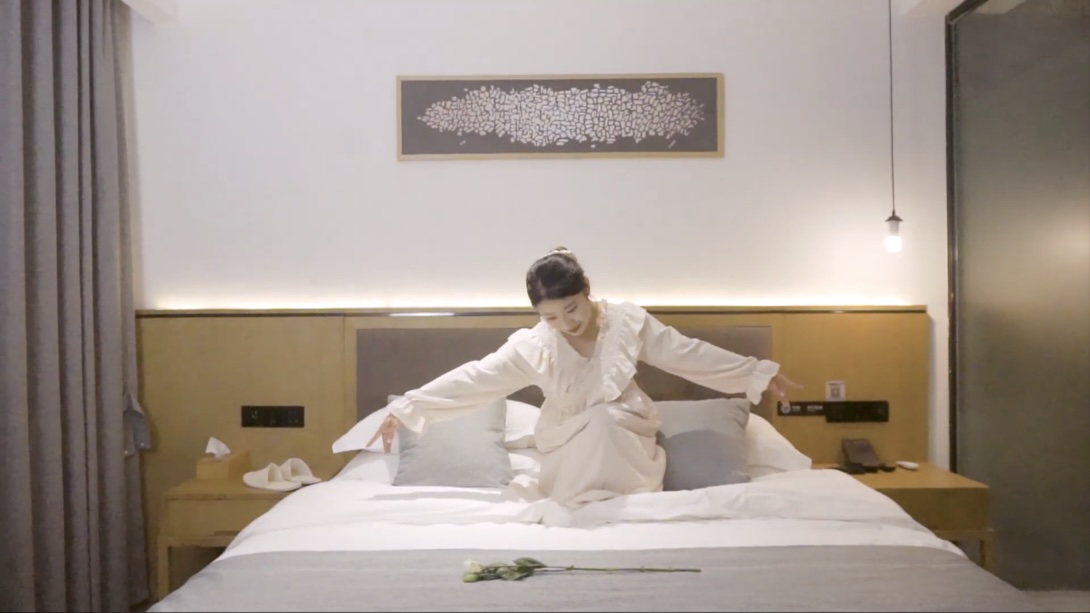
Seen along this path of representation and self-representation, Zhang’s earlier works form an increasingly legible system. Made under the shadow of pandemic quarantine, Fragile Round (2022) follows a ballerina who maintains her composure inside a hotel room, gradually destroys everything around her, and then restores the room under a surveillance camera. Destruction does not bring escape; the orderly image demanded by the institution must be reinstated. The dancer strikes against discipline through violent movement, then reconstructs with her own hands the visual evidence that discipline requires.
The three-channel video Dance Practice (2022) places three images side by side: an empty dance studio, Zhang practicing K-pop alone, and an overhead view of a random-dance crowd. Dance is not treated as simple oppression. Synchronization can be pleasurable, and practice contains active desire. Yet as the solitary body before the mirror gives way to the coordinated movement of the crowd, the body learns how to become immediately recognizable to entertainment media. No camera simply forces the dancer into standardization. She also studies rhythm, angle, and expression, participating in the production of her own visibility.
A Rehearsal for Psycho (1960) (2024) carries that training into the conventions of genre cinema. The famous shower murder in Alfred Hitchcock’s Psycho is rewritten as a woman rehearsing how she will be killed: she adjusts her position, action, and reaction, learning to become a sufficiently convincing victim. Female suffering ceases to be only a narrative event and appears instead as a sequence of poses repeatedly taught by film. If Longing Has a Color, It Must Be Sino-Red (2024), meanwhile, enters the grammar of erotic cinema, dislocating the qipao, massage room, flirtation in English, and the sound of China’s televised Spring Festival Gala. Zhang does not criticize the genre from a safe position outside it. She makes the body inhabit its grammar until the erotic formula begins to fail under repetition, absurdity, and misaddressed desire.
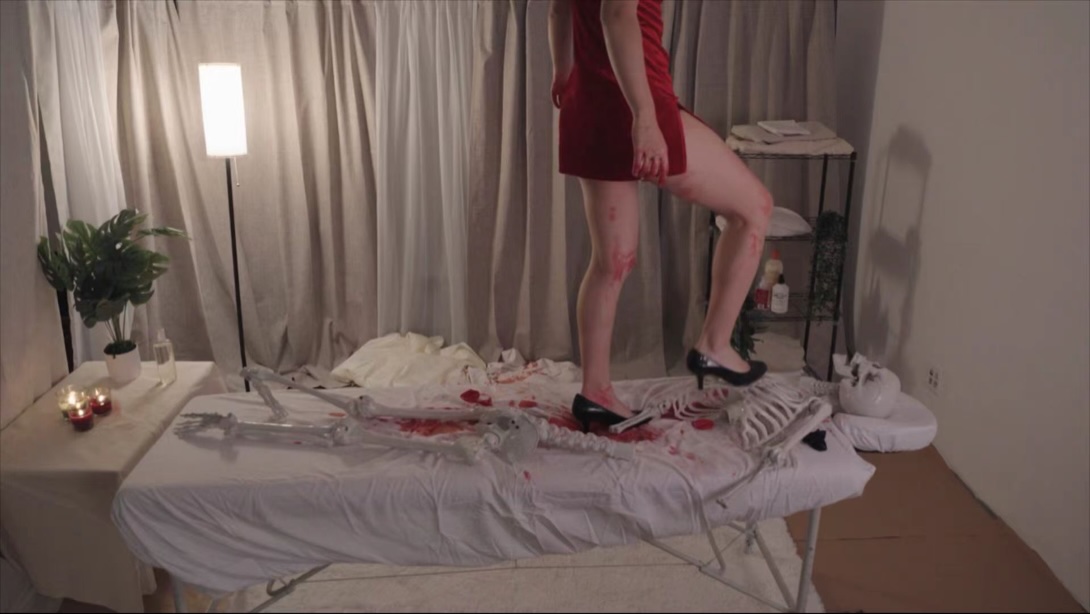
Her repeated use of hotels, bathrooms, massage rooms, and dance studios is no coincidence. Each offers a privacy that is temporary and sequentially occupied. A hotel belongs to its guest only for a limited time. A massage room remains part of a labor system even after its door closes. Mirrors in a dance studio keep the body under continuous self-inspection. A bathroom is private only while a lock temporarily holds; it may be shared by families, institutions, or strangers, and cinema has long trained us to recognize it as a space especially vulnerable to looking and intrusion. Even after the figures leave, these rooms retain their demands upon the body. The performer may be gone, but the choreography continues.
Zhang began dance training at the age of five. She does not usually determine a work’s meaning in theory and then ask a performer to execute it. Instead, she enters a space and feels where the body tightens, where it wants to escape, and where it instinctively corrects its posture; those sensations then determine the camera and the action. Her moving images are tactile in this sense. The lens does not literally touch anything, but the frame always understands the distance between a body and a bed, a wall, a mirror, a set, or another pair of eyes. For Zhang, the body is not a seal that certifies reality. It is the interface where an external image conflicts with an internal sensation.
Feminist moving-image art has long challenged the ways cinema and photography manufacture femininity. Cindy Sherman inserted her own body into female archetypes inherited from popular film; Valie Export used the body and live action to confront the passive position allotted to women on the traditional screen; Trinh T. Minh-ha asked whether documentary possesses the right to organize another person’s life into a complete and credible object. Zhang takes an even more ambiguous position within this lineage. Her figures are neither fixed cinematic types nor authentic subjects waiting to be discovered by documentary. They know they are being watched and make use of that knowledge. They cooperate with the image while producing the friction that prevents it from being completed without remainder.
This helps explain why Massage Baby! continues to change across different exhibition conditions. In Zhang’s MFA thesis exhibition at Columbia University’s Wallach Art Gallery, the 2025 version of the work appeared as a multichannel installation with a massage bed, curtains, and a disposable sheet, reorganizing the viewer’s own bodily position. At Accent Sisters’ solo screening Watched Intimacies, it entered the concentrated temporality of collective viewing. At Flohaus Gallery, language left the screen and became pressure between a live performer and an audience. The movement from installation to screening to performance does not merely restage a finished work; it repeatedly changes who is watching, where they watch from, and whether the watched subject can answer.
Outside the gallery, the same question—how a person negotiates the image being made of her—also structures Zhang’s professional documentary work. She works as a director for MulanDoc, the documentary program of 木兰来了 (“Mulan Is Here”). Across its domestic and international social platforms, the project has built a combined audience of more than three million followers. Zhang oversees early contact with participants, interview research, scripting, field direction, and the shape of the final narrative. Her subjects are generally not trained performers but people telling their lives before a camera for the first time. Much of documentary cannot be arranged in advance; her job is not to force reality to obey a script, but to recognize a new narrative possibility the moment reality departs from it.
The stories Zhang directs often involve people whose lives can easily be compressed into familiar narratives of suffering, resilience, or reinvention. Her directorial skill lies in refusing that compression without surrendering narrative clarity: she builds enough trust for participants to complicate the premise of an interview, then adjusts questions, scenes, and narrative direction in real time. Pauses, contradictions, and unrepeatable reactions are not obstacles to be edited away but evidence of how a participant wants—or does not want—to appear. Short documentaries directed by Zhang have reached tens of millions of views, with individual films receiving more than one million likes. This reach matters not simply as a measure of scale; it demonstrates that Zhang’s responsive, relational approach to documentary can retain its complexity while reaching a mass audience through the compressed format of social media.
In her personal practice, Zhang makes the filming relationship itself a problem, often placing her own body inside the image; in professional documentary work, she converts her sensitivity to that relationship into an executable method from behind the camera. The two practices move at different speeds and address different viewing environments, but both depend on the same judgment of the person before the lens: when to guide and when to step back; when someone is repeating a story society has prepared for her, and when she is beginning to form an expression of her own.
After Repeat After Her ended, the audience still held the English text. It appeared to offer translation and understanding, yet it could not replace the voice, body, and exchanges of glances that had just occupied the room. A private conversation was recorded, entered a film, became another woman’s performance, and finally came to rest in the viewer’s hand. Zhang does not attempt to recover an unchanged, “authentic woman” at the end of this passage. What she reveals instead is that female images are always being made—but that their making is never one-way. When Coco studies the camera, corrects the set, and questions the interviewer; when the dancer restores the room under surveillance; when a voice from the screen returns to a live body, each reminds us that a camera may prescribe how someone appears, but it can never fully determine how she will answer.