







→ This article from the archives is part of a series celebrating the Platinum Anniversary — 70 years! — of the Voice. The first issue hit the stands on October 26, 1955. ←
Editor’s note, January 29, 2026: 50 years ago, under a banner noting that ancient adage “Politics makes strange bedfellows,” investigative reporter Jack Newfield let New Yorkers know that the wife of one of their U.S. senators had signed on, at a salary of $67,500 per year ($384,500 today) to promote art exhibitions in Iran and to provide “public relations counseling” to the Persian nation’s government-owned airlines. As was well-documented at the time, the Shah of Iran was torturing — sometimes to death — tens of thousands of his own citizens. The Shah had risen to power in a 1953 coup supported by the American and British governments, both concerned with keeping Iran’s vast oil reserves out of Communist hands. These deep financial ties helped prop up the increasingly savage regime for decades, even as discontent and outright hatred of the monarch grew among everyday Iranians, anger which would lead to the Shah’s downfall in 1979. Newfield’s reporting is a reminder of the carousel between national politics and nefarious lobbying that has plagued American politics for ages.
Though she once hoped to be a Hollywood actress, Marion Ann Javits (1925–2017) instead married the powerful Republican senator and focused on arts patronage and such business ventures as selling limited-edition prints by leading painters, including, according to her New York Times obit, convincing “the New York Telephone Company to reproduce paintings on the back covers of its directories so that the books could be displayed face down on coffee tables.” When Newfield revealed the connection between her activities in Iran and the fact that her husband was on the Senate Foreign Relations committee, which gave him influence over federal policies concerning Iran, the conflict of interest became glaringly apparent, and a few weeks later she resigned the position and returned the fee. Things have changed so much in our own time that such concern over possible corruption seems positively quaint, as the current president of the United States treats himself to a jet plane, trophies, medals, and buy-ins of his and his family’s digital assets that make the political slush funds of yore look like a penny in the gutter not worth stooping over for. —R.C. Baker
Javits’s Wife, Marion, Has Registered as a Foreign Agent for Iran
By Jack Newfield
January 19, 1976
Marion Javits has registered with the Justice Department as an agent of a foreign government. The nation she is representing is Iran. Iran is a repressive dictatorship, a member of the oil cartel OPEC, and a supporter of Saudi Arabia in the 1973 Yom Kippur war.
Javits’s husband is a member of the Senate Foreign Relations Committee, and perhaps the strongest supporter of Israel in the Senate.
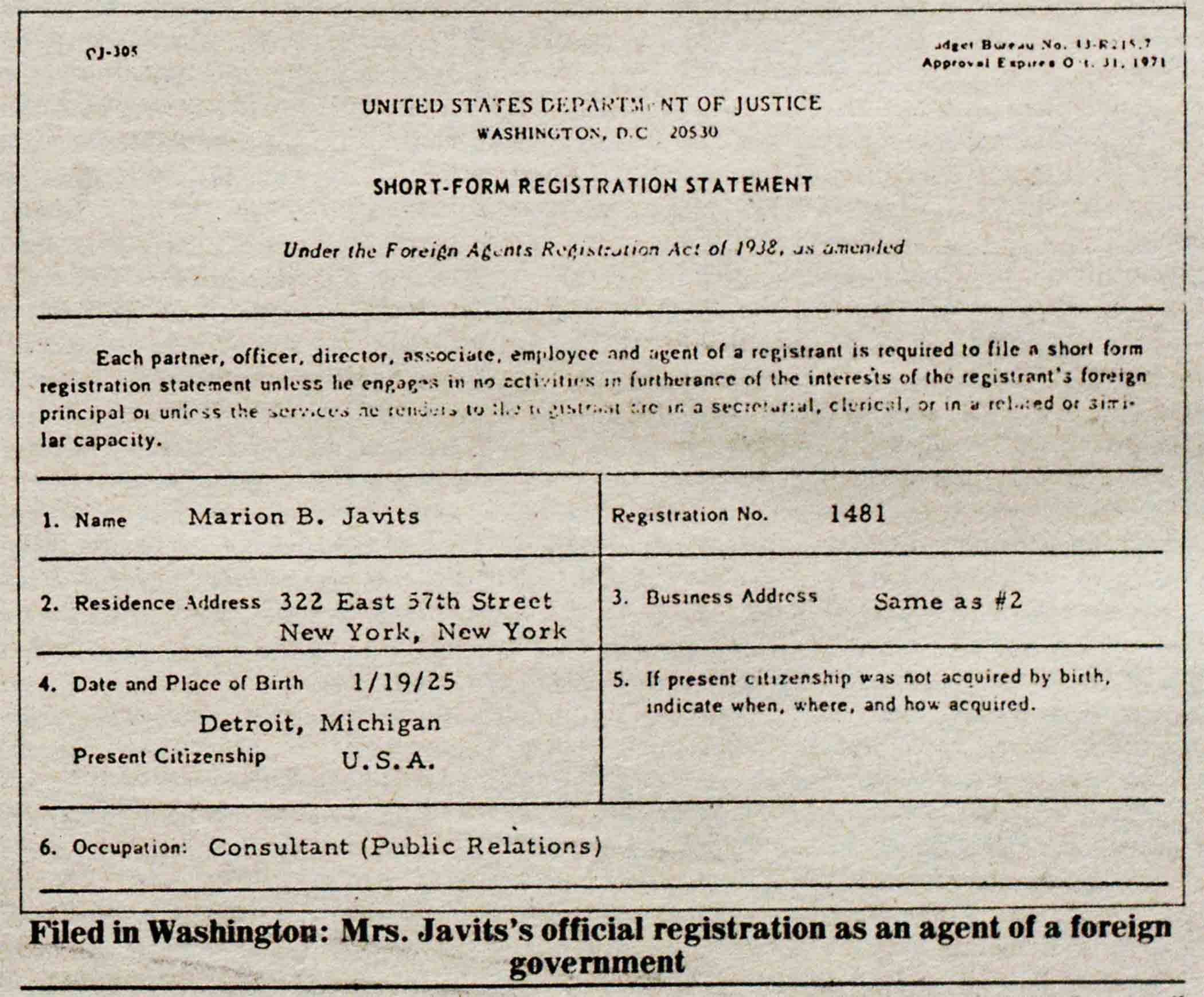
According to documents filed last September by Mrs. Javits under the Foreign Agents Registration Act of 1938, she is being paid $67,500 a year for “public relations counseling” to Iran’s government-owned National Airlines Corporation.
Mrs. Javits is working for the government of Iran through Ruder & Finn, the public relations firm. David Finn told me: “Mrs. Javits is technically a consultant for us. Ruder & Finn signed the contract with the government airline. We pay her $67,500.”‘
What does the senator’s wife do to earn such an income?
“She arranges art exhibitions.”
Anything else?
“She is producing a film on Iran to improve tourism. But that has nothing to do with our contract … Mrs. Javits has worked with us on other accounts.”
Which ones?
“The telephone company and Pan Am airlines.”
How much is Ruder & Finn being paid by Iran?
“That is confidential.”
* * *
The Shah of Iran came to power in 1953, when the CIA helped overthrow the semi-socialist government of premier Mohammed Mossadegh. The current U. S. ambassador to Iran is former CIA director Richard Helms. Today Iran is one of the most brutal tyrannies on the planet, ranking with Chile, Haiti, and South Africa. There is no free press, and a feared secret police known as SAVAK has been accused of torture and of executions without trials.
Martin Ennals, secretary general of Amnesty International, says “No country in the world has a worse record on human rights than Iran.”
Amnesty International estimates there are about 25,000 political prisoners detained in Iran’s jails. An article in Le Monde last August estimated the number of political prisoners “approaches 100,000.”
On March 2, 1975, the Shah dissolved even the paper political parties (the only kind he had tolerated), and declared Iran a one-party nation. The only legal political party is called the “National Resurgence Party.”
In a generally sympathetic cover story on the Shah of Iran on November 4, 1974, Time magazine wrote: “The emperor freely admits that opposition to the monarchy is not tolerated in Iran, and he has methodically repressed dissent…. the secret police, through a large network of informers, have been responsible for making countless arrests of leftists on occasionally vague anti-Shah charges, and for at least 200 executions.
“… To stress the strength of the throne, Iran lays heavy emphasis on kingly privileges. Not only do aides, including the premier, kiss his hand, but peasants also kiss his feet as a mark of respect. When the Shah stands, everyone in his presence also stands until he sits again.”
* * *
Within the 13-nation OPEC oil cartel, Iran is the most hawkish nation. The Shah has fiercely and rigidly argued for keeping oil prices high in the West. He participated in the Arab oil embargo of 1973. Iran is the world’s second greatest oil exporting nation, after Saudi Arabia. In 1975, Iran’s oil export revenues were $20 billion.
On October 31, 1973, at the peak of the Arab oil embargo, Senator Javits said:
“The gas and electric bills of my constituents are going up between 5 and 25 per cent. This is attributable to very material increases — 50 per cent or more — in the price of oil, and that this has been affected by the way in which Arab states in the Middle East are sitting on oil and have jacked up this price…. Now, the American people have clearly shown that they don’t intend to be blackmailed by radical Arab states trying to hold up the world on oil, in order to get the world to do their bidding respecting the extinction of Israel.”
While hawkish on petro-politics, Iran has been relatively moderate towards Israel. Iran is Moslem, but not Arab. The Shah sells oil to Israel. But during the 1973 war, Iran also dispatched six Iranian Air Force C-130 transports to carry Saudi soldiers and equipment to the war against Israel.
Another issue on which the Javits household may have a conflict is the sale of American weaponry to Iran. In 1975, Iran purchased $1 billion in military equipment from the United States. Congresswoman Margaret Heckler and Senator Edward Kennedy have been leading the opposition to arms sales to Iran on the grounds that by withholding these weapons, the West could compel Iran to lower oil prices.
In an article (“Upsetting the Balance in the Middle East”) in the November 22, 1975, New Republic, Tad Szulc wrote:
“Despite formal denials by the State Department, intelligence officials insist that a limited number of Egyptian pilots are being trained in Iran on Phantoms purchased by the Tehran regime. If this is the case, a violation of U.S. law could be involved, possibly forcing an automatic halt in Phantom deliveries to the Iranians. Under the Foreign Military Sales Act of 1973, countries obtaining U.S. equipment may not make it available for use in any way by ‘third’ countries without the consent of the president as communicated to the Congress …”
As a member of the Senate Foreign Relations Committee, Senator Javits could do a lot to cut off armaments to the monarchy his wife promotes.
* * *
Iran’s employment of Marion Javits and Ruder & Finn is not unique. The Arab and oil exporting nations have begun to hire the most politically connected lawyers in America. The government of Algeria has hired the Washington law firm of Clark Clifford and Tom Finney. Clifford was secretary of defense under Johnson, and Finney was an aide to President Kennedy, Eugene McCarthy, and former oil-state Senator Mike Monroney. Clifford also represents Adnan Khashoggi, the Saudi oil millionaire accused of soliciting bribes from American corporations.
When Ghaith Pharon, the son of a Saudi diplomat, tried to buy an interest in Detroit’s Bank of Commonwealth, he hired the Houston law firm of John Connally, former secretary of treasury.
Richard Kleindienst, the former attorney general convicted in the Watergate scandal, represents, for $100,000 a year, the Algerian energy ministry.
The New York City firm of Rogers & Wells represents the Shah of Iran. William Rogers is the former secretary of state under Nixon.
* * *
I tried to reach Marion Javits and her husband for comment. Javits’s New York office said Mrs. Javits was “traveling.” I gave my home phone number and an assistant promised Mrs. Javits would call me. That was last Thursday. I haven’t heard from the Shah’s flack yet.
❖ ❖ ❖


