



The Republican Party has a long history of dubious firsts: Richard Nixon was the first — and, so far, the only — president to resign the office. His replacement, Gerald Ford, was our first unelected president, not having faced the American electorate because Nixon’s original vice president, Spiro Agnew, had been caught up in a bribery scandal and resigned in 1973. A Michigander, Ford was the House minority leader, and ascended to the veep’s office after Nixon nominated him to replace Agnew. Ford was approved by a large majority of his congressional colleagues and later became president, on August 9, 1974, when Nixon resigned rather than face possible impeachment for obstruction of justice, abuse of power, and contempt of Congress.
Ford was a genial, if hard-headed and ham-fisted, conservative — Chevy Chase bolted to comedy stardom in no small part by portraying Ford as the Bumbler in Chief on the inaugural season of Saturday Night Live — and whatever honeymoon the newly elevated president had enjoyed with voters was quickly dashed when he issued a pardon to his disgraced predecessor:
NOW, THEREFORE, I, Gerald R. Ford, President of the United States, pursuant to the pardon power conferred upon me by Article II, Section 2, of the Constitution, have granted and by these presents do grant a full, free, and absolute pardon unto Richard Nixon for all offenses against the United States which he, Richard Nixon, has committed or may have committed or taken part in during the period from January 20, 1969 through August 9, 1974.
IN WITNESS WHEREOF, I have hereunto set my hand this eighth day of September, in the year of our Lord nineteen hundred and seventy-four, and of the Independence of the United States of America the one hundred and ninety-ninth.
A majority of Americans wanted the courts to determine Tricky Dick’s fate, but Ford had calculated that cleanly cutting off what he himself termed “our long national nightmare” would be better for the nation — as well as for his own future political goals, because he didn’t need the drip-drip-drip of revelations about Nixon’s corrupt practices to continue into upcoming election cycles.
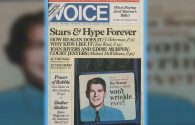
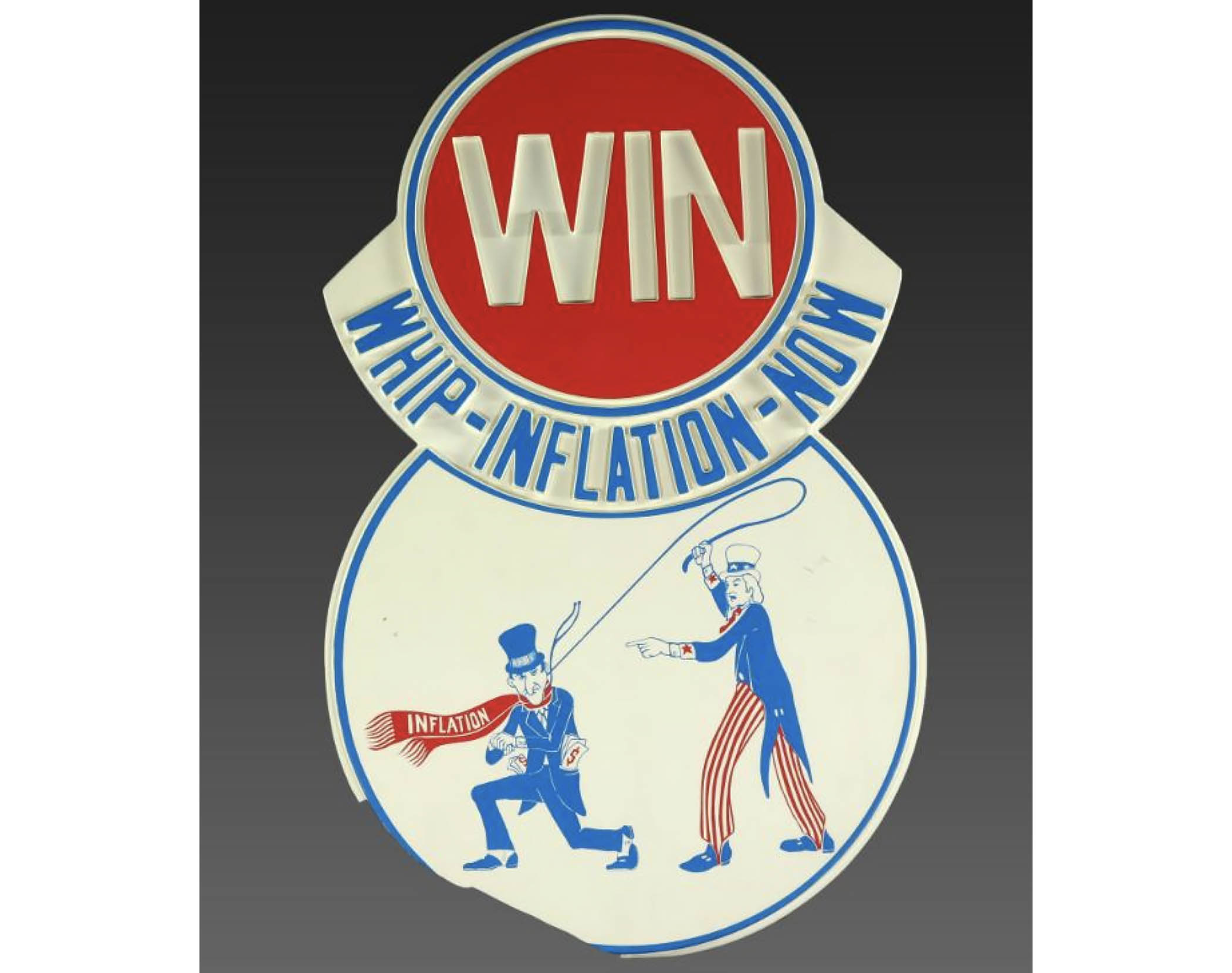
Additionally, Ford was presiding over an economy staggered by inflation. In perhaps one of the least successful PR campaigns ever launched with a presidential address, Ford introduced his “WIN” — “Whip Inflation Now” — campaign, stating, “But I say to you with all sincerity that our inflation, our public enemy number one, will, unless whipped, destroy our country, our homes, our liberties, our property, and finally our national pride, as surely as any well-armed wartime enemy.” Citizens were encouraged to mail in a form that recalled the rallying slogans of World War II — “Dear President Ford: I enlist as an inflation fighter and Energy Saver for the duration. I will do the very best I can for America” — absent that conflict’s existential threat. Many Americans, harried by ever-spiraling prices for kitchen-table basics and gas for their cars, ridiculed the red-and-white WIN buttons and signs the administration touted, turning them upside-down to flip Ford’s earnest and wonky exhortation into such jibes as “No Instant Miracles,” “Need Immediate Money,” and “Nonstop Inflation Merry-Go-Round.”
Despite such travails, Ford kept things bipartisan as he presided over the Bicentennial celebrations, noting in one speech that in 1936, “President Franklin D. Roosevelt, speaking for a mighty nation, reinforced by millions and millions of immigrants who had joined the American adventure, was able to warn the new despotisms: ‘We too, born to freedom, and believing in freedom, are willing to fight to maintain freedom. We, and all others who believe as deeply as we do, would rather die on our feet than live on our knees….’”
Unfortunately, 50 years after Ford praised both a Democratic president and immigrants while also calling out the dangers of authoritarian regimes, we have a POTUS whose rhetoric looks not to America’s long, complex, and by turns noble and flawed history but more to the school playground, as in this recent Truth Social post about the sparsely attended, rain-dampened opening days of the national exposition in Washington, D.C.:
Do you think people appreciate what a fantastic job we did in building and operating the Great American State Fair at the National Mall, packed with happy people, and everybody loving it? Ask yourself this simple question, “DO YOU THINK THAT OBUMA OR SLEEPY JOE BIDEN COULD HAVE DONE IT?” THE ANSWER IS NO!
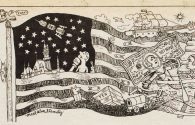
What a difference half a century makes — back in 1976, we had a fairly joyous celebration. Today, we have a convicted felon in the Oval Office, ICE raids, attacks on voting rights, demonization of differences, and high-level obfuscations of evidence in the Epstein scandal. Still, here in Gotham, the Fourth has long included the Macy’s fireworks show (celebrating its golden anniversary as America ponders its semiquincentennial), and the long holiday weekend offers a chance to partake of the city’s world-class culture. In fact, you can combine history, politics, and art at your favorite local museum — there’s the OG American history painting “Washington Crossing the Delaware” at the Met, Jasper Johns’s radiant “Three Flags” at the Whitney, Faith Ringgold’s scabrous “American People Series #20: Die” at the Modern, and the Brooklyn Museum’s kaleidoscopic Drawing America: US@250.
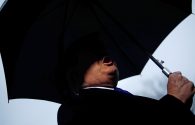
The Bicentennial was overshadowed by Nixon’s perfidious crimes and speeches about democracy from an unelected president, but this week’s celebration feels more raw by far. A little rain must fall into every lifetime, but Trump threatens a deluge. So perhaps the painting that most captures our gloomy moment comes from the United Kingdom, our enemy in 1776 but mostly our ally in the centuries since. Painted in 1946, the year after World War II ended, Francis Bacon’s “Painting” captures an empire in decline. It’s not currently on view at MoMA, so the vehement paint handling does not feel as visceral as in a face-to-face encounter, but the powerful composition of a raw-meat crucifix behind a gibbering powerbroker emerging from the charnel shadow of his own umbrella bristles with the cumulative narrative force of a medium older than any known spoken language.
The Brits still have a king; our 250th anniversary celebration should remind us that we don’t need one. ❖


Correction: This article originally stated that FDR was speaking, in 1936, on the 150th anniversary of the U.S. The 150th birthday celebration actually took place in 1926.