


The military parade in D.C. on Saturday was not fun, for anyone. You could see it on their faces: mugs instead of smiles. You could hear it in their talk. One little girl said, “I want to see him!,” to which her mother replied, “You’ve seen him. He looks the same.” You could hear it in their cheers, which were infrequent and weak. Exceptions included a woman in camo shorts who pushed her way deeper into the crowd — three or four tightly packed rows deep — toward the steel barricades along the road, and went wild any time Fort Bragg was mentioned. And I have to give a nod (because he wouldn’t shut up) to a guy who reminded me of the “Florida man” archetype (bandana on head, blond mustache, ponytail, sleeveless shirt), who had a hard-on for Kentucky’s Fort Campbell. Besides that, most of what you heard was people second-guessing where they chose to stand on Constitution Avenue. “The best you got is what you got,” a leathery man said to a woman basically doing calf raises on the edge of the sidewalk in order to see the procession. Many of us stood on our tiptoes along the route, working up a sweat as the rain held off while the humidity made the temperature soar to over 90 degrees. Take away the Casey Kasem–style announcer (who pronounced Concord, Massachusetts, like Concorde, the airplane) and the backing track to Heart’s “Barracuda” (perhaps no one paid to license the full song, with lyrics), and what you’re left with is columns of soldiers (in garb from the Revolutionary War, the Civil War, WWI, WWII, the Korean War, Vietnam, and the Gulf War, all rented from the Motion Picture Costume Company, in Los Angeles) sauntering and sweating in silence, waiting to hear the dregs of hype the tank operators strained to drum up with waves and outstretched arms. It seemed that the crowd was only enthusiastic when they were ordered to be, as if, without the guy who usually gives the orders (at rallies or to TV show audiences), they had no juice. This all suggested that they were there for one thing only. And when that thing wasn’t speaking to them, their shirts and hats (“Fs Given: 0,” “American,” “Pussy Builds Character”) spoke louder than their voices. Not even a half-naked, diaper-wearing, ultra-young baby — its mother holding it above her head Simba-style, making me fear for its life, not to mention its dignity— could inspire more than abortive chuckles and isolated awws. As Florida man put it, 20 minutes or so into the parade: “Where’s Trumpsky?”

Answer: largely absent. I spent most of the day — from noon till nine — on and around the National Mall, where the Army’s 250th birthday festivities were happening before the parade commenced. I asked a soldier about his howitzer and the heat. “You hot?” I asked. “Scorching,” he replied. I winced as I found myself in the crosshairs of bazookas held by adolescent boys, supervised by men in uniform, overexplaining the mechanics of the weapons. I cringed as the Army drill team gave cheeky thumbs-ups and flexed their biceps after performing coordinated gun-throwing exercises. My thoughts got theoretical after seeing them surround their commanding officer and pretend to aim their bayonets at his neck: Soldiers are trained to follow orders, but one can also wonder if there isn’t sometimes an Oedipal desire to kill the commander.
As fireworks lit up like giant peaches in the sky, it became clear, on the corner of 12th Street NW, how little space was actually being taken up by all this sound and fury.
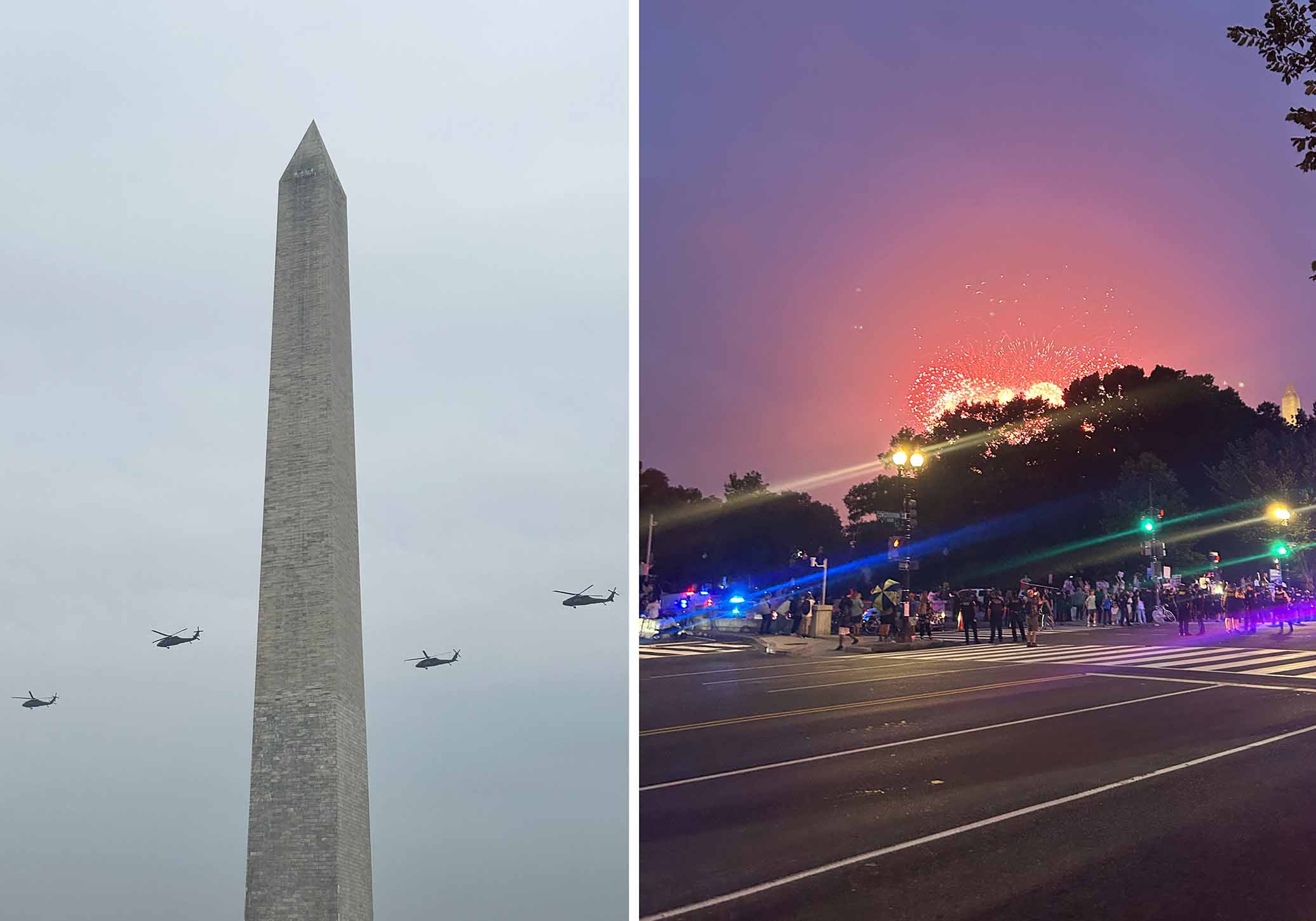
“I’m glad we skipped Warped Tour for this,” someone fiancée-aged but with no ring said to her man as I waited in line to enter the expo grounds. It seemed that whatever joy was around me was brought about by touching objects: Run your hand down the outside of the Apache cockpit, pat the Boston Dynamics robot dog on the head, hold a vintage M1 Garand rifle in your hand and stroke its muzzle while a soldier asks if you have any questions. Ford-tough sensuality. The only laugh I had was when Medal of Honor recipient Command Sergeant Major Matthew O. Williams lost a page of his speech to the wind and had to run across the stage to get it before saying happy birthday to the Army. The only dancing I saw, arrhythmic and crazed, was between a mixed-race couple, as someone named Noah Hicks sang something about small towns. The only government-issued iconography of the president I saw was a banner with his face on it, hanging from the Department of Agriculture’s facade, parallel to a banner of Lincoln’s face. And that was put up for the department’s 163rd anniversary, in May, not for this event. Command Sergeant Major Williams didn’t even wish Trump a happy birthday in his windswept speech. To my ears, only two people did: the vice president, who spoke after the parade, and a country singer named Warren Zeiders, who performed after the president commissioned some West Point graduates. The whole day seemed to be intended to direct fanaticism from the president to the Army, to somehow prove to somebody that the president’s supporters don’t just love him, they love America. But there wasn’t a lot of love, only something like the excited curiosity at a roadshow of antiques, hammered home by people like the greasy, acne’d, stringy-haired man with an overbite who yelled, “YEAHHH, BABY!” whenever a new flock of helicopters flew overhead. And I can’t help but feel an itch in my moral gut that compels me to say that the president’s presence — if not the president himself — appeared humble, almost discreet, his attendance an ornament on the tree instead of the star on top.
If protests are to Trump events as commercials are to TV shows — interruptions that take viewers out of their trances but are ultimately overtaken by the feature presentation — then most of the day in D.C. was pay-per-view, even as “No Kings” protests thrived around the rest of the country. Here, one person held up a “No Kings” sign amidst a splotch of Trumpers on the lawn before the presidential viewing stand, one person was dressed in a red hooded robe as a Margaret Atwood handmaiden, masked like Marvel’s Iron Man, kneeling, hands cuffed with black cloth. A nylon-wrapped sign hung from their neck that read “Lot #86-47” (to 86 someone means to get rid of them; Trump is the 47th U.S. president). Others, demure and scattered, held umbrellas to combat the sun. Unexpectedly, the vista was as copacetic as one of Seurat’s pointillist masterpieces. Even as some attendees began a “USA! USA!” chant on the Washington Monument lawn after the parade ended, it didn’t spread to more than 10 or 20 people, and lasted for maybe 10 seconds.

After the sun set, we filed onto the empty parade route, flashing police car lights refracting through the haze. Canons blasted and fireworks began to rumble. Larger and more aggressive groups of protesters than were on the Mall itself called for a free Palestine, yelled “Fuck Trump!,” and called him a rapist. From the other side came “Fight for Trump” and “Go fuck yourselves!” A few intimate, face-to-face shouting matches popped up, only to devolve into each side calling the other fascist. Police officers stood in a semicircle around the protesters, as some belted insults from atop Jersey barriers, smoked weed, and yelled “Shame.” Others leaned against light poles, waiting for something to happen. As fireworks lit up like giant peaches in the sky, it became clear, on the corner of 12th Street NW, how little space was actually being taken up by all this sound and fury — the roads were wide and empty, the air was finally cool, and the image that stuck with me the most was of a father pushing a stroller full of French fries. The baby walked.
Despite all the press coverage before the parade that framed it as Trump’s personal birthday celebration (with the Army anniversary as an excuse), that was not what it felt like to be there. It did feel, in fact, like it was trying to be a celebration of the U.S. Army. But that celebration was muted, because it didn’t turn out to be a North Korean–style “Dear Leader” celebration of Trump. After Trump is gone, what he’s wrought — whether it’s a tradition of sweeping executive power, an ethos of military bullying, a crusade against education, or a shrinking away from the rest of the world — will be a scar on the nation for a long time to come. But the verve behind it might dissipate, leaving Trump’s followers aimless, fatherless, and feeling that there’s no one to watch over them. Trump and his ilk are like mockingbirds with each other: He says what they think but were previously not emboldened to say; they repeat what he says. Without him, they might once again lose their vocabulary, as happened on Saturday. When the mockingbird in chief is gone, his chicks will have to appoint a new mouthpiece for their hate, change their tune, or fly the nest to become true patriots who discover a love for country beyond the fantasy of a single man. ❖
Ben Gambuzza is a freelance writer, book editor, and researcher in Brooklyn. He is the host of The Best Is Noise on Radio Free Brooklyn.


