







[Editor’s note, September 17, 2025: Almost three decades ago, the Voice‘s lead film critic, J. Hoberman, sat down with Robert Redford to discuss the Hollywood star going behind the camera to direct Quiz Show. Redford revealed not only his vast knowledge of filmmaking but also the depth of his engagement with American history and politics. A marquee star of such movies as All the President’s Men and The Candidate, Redford never shied away from the uglier aspects of American democracy. The actor, director, and producer passed away at his home in Sundance, Utah, yesterday, at the age of 89.]
Robert Redford
August 18, 1936 – September 16, 2025
∴ ∴ ∴ ∴
.
.
.
.
.
Going Down the Tube
Robert Redford’s Quiz Show takes on golden goys, ambitious Jews, and TV’s betrayal of America
By J. Hoberman
September 13, 1994
Who defeated Charles Van Doren? / Which movie won the Oscar for Best Picture in 1955, and why did Herbert Stempel have to pretend that he didn’t know? / What did President Eisenhower call “a terrible thing to do to the public”? / And why should Robert Redford care?
It’s a truism of life in the Global Village that anything that is anything is sure to happen twice — the first time as news, the second time as entertainment (or, increasingly, vice versa).
A great media spectacle defines itself by monopolizing our attention and then returns intermittently to reignite the heavens in a comet blaze of publicity: The big-money TV quiz shows that mesmerized America in the mid 1950s reappeared in all the media a few years later to fascinate anew with the revelation that they had been rigged.
For more than 30 years, the story lay dormant. But next week, the spectacle’s two aspects — crime and punishment — return as one with the release of Robert Redford’s Quiz Show. Indeed, Quiz Show absorbed a rival film treatment of the same material, and it isn’t even the only impending replay. Richard Greenberg’s ambitious drama Night and Her Stars, extensively reviewed when it was staged last spring in Costa Mesa, is scheduled to open at the Manhattan Theater Club in March.
What could the quiz show scandal possibly mean in 1994? Dealing with the mechanics of celebrity and corruption, conspiracy and betrayal, truth and ratings, adulation and shame, the scenario provides a natural history of television — one more opportunity for the media to reflect upon itself and for us to seek our images in the illusory depths of that reflection. Quiz Show resonates with such ’70s Redford projects as Downhill Racer and The Candidate. It’s Ordinary People meets All the President’s Men (appropriately spiked with strategic references to then vice president and future nation-betrayer Richard Nixon) but without the heavy melodrama — the most polished, least sentimental, and best movie that Redford has ever directed
Set in a deftly generic mid ’50s, Quiz Show never traffics in nostalgia, although as entertainingly jaundiced, literate, dialogue-rich, and performer-juiced as it is, the movie has affinities to certain productions of the period — All About Eve, Sunset Boulevard, A Face in the Crowd, Sweet Smell of Success. The mode is glamorously disillusioned. The engagingly primitive backstage manipulation of the TV image, crosscut with the telecast itself, makes it clear from the start that the fix is in. Even so, Quiz Show is surprisingly suspenseful.
Redford is not ordinarily the most available of celebrities, but he’s eager to talk about Quiz Show — as well he might be. Wearing a snug T-shirt and chinos (the previous interviewer was with The Ladies Home Journal), he matches the decor of his relaxed, haute Navajo offices at Radio City, the scandal’s former epicenter. “There’s a personal view here, I can’t deny that,” he says of Quiz Show. “It has to do with my own experience. My life has spanned this time.” Redford associates the quiz shows with his penniless New York period — a struggling actor, he appeared on Play Your Hunch in 1959 — as well as with his appreciation of showbiz corruption.
A trim and weathered 57, Redford has the laconic cowboy look, but he’s more than willing to hold forth on the significance of his subject: “One of the first visibly exposed examples of what really controls our industry — the merchant mentality.” For Redford, the televised Army-McCarthy Hearings of 1954 were “the first time we experienced the critical mass, gathered over one event, brought together by viewing something at the same time.” The deceptive quiz shows that built upon that audience marked “the beginning of the erosion of our public trust,” the prelude to “the Kennedy assassinations, Watergate, Iran-Contra, the Savings & Loans debacle, BCCI, the Clarence Thomas hearings….” In a word, the whole telehistorical gestalt.
Quiz Show shoulders a particular historical burden, although, as a movie, it’s a canny example of applied Jetsonism. (Michael Ballhaus shot the picture; Jon Hutman’s production design is exemplary.) Closer in tone to sociological sci-fi than remembrance of times past, it begins in an automobile showroom — the brand-new deep-green Chrysler 300 gleaming, the Soviet sputnik ominously beeping, Bobby Darin belting his Vegas-ized version of the old Brecht-Weill tune, “Mack the Knife.”
A few minutes later, a montage suggests everyone in New York tuning their vidscreens to watch Herb Stempel play for $3,000 a point on Twenty-One. This is scarcely an exaggeration. Once upon a time, there actually was a moment when America was transfixed by the idea of citizen intellectuals spinning the flax of their arcane knowledge into gold on the air.
By the spring of 1955, nearly a decade into the post-War era, the power of TV was amply apparent. After Disneyland’s three-part series on the erstwhile King of the Wild Frontier created a near insatiable demand for Davy Crockett caps, the price of raccoon pelts rose from 25 cents to $6 a pound while other Crockett spin-offs, ranging from toy rifles and lunch boxes to baby shoes and ladies’ panties, grossed a quick $300 million.
Looking for an appropriate televehicle with which to wage war on Hazel Bishop lipstick, then sponsor of the popular This Is Your Life, Revlon president Charles Revson and his brother Martin were sold on a venerable concept devised and updated by CBS producer Louis G. Cowan. The $64,000 Question was based on the old radio quiz shows of the 1940s, but television amplified the jackpot a thousandfold. Contestants would be brought back for several weeks to build up the stakes (which doubled with each correct answer), and even the losers would receive a consolation Cadillac.
On Tuesday night, June 7, 1955, the show “where knowledge is king and the reward is king size” made its debut. Nearly as impressive as the promised largesse was the mise-en-scène. Delivered with theatrical solemnity by a bank representative and two grim security guards, the questions and answers were deposited in an oversize safe that, years later, was revealed to be a cardboard stage prop. Once the quiz reached the $8,000 level, the set was darkened and the contestant placed in a glass “isolation booth.” As the tension mounted and the winner agonized over whether to risk all in pursuit of the ultimate $64,000, the camera cut to close-ups of anxious family members sweating it out in the studio audience.
Suitably memorialized in Back to the Future, the summer of 1955 was marked by pop culture monuments. No sooner had the Crockett craze peaked than Disneyland itself opened. And as Bill Haley’s prescient “Rock Around the Clock” held the Hit Parade’s No. 1 spot throughout July and August, so The $64,000 Question proved the most dramatic success in the history of American TV. By August, the show had a weekly audience of 47 million — nearly one-third of the total population. CBS was flooded with 20,000 applications per week. Bookmakers quoted odds. Broadway shows were empty on Tuesday nights. Pharmacies had long since run out of Revion Living Lipstick, and the company was reduced to promoting remaining stocks of its Touch and Glow Liquid Makeup Foundation.
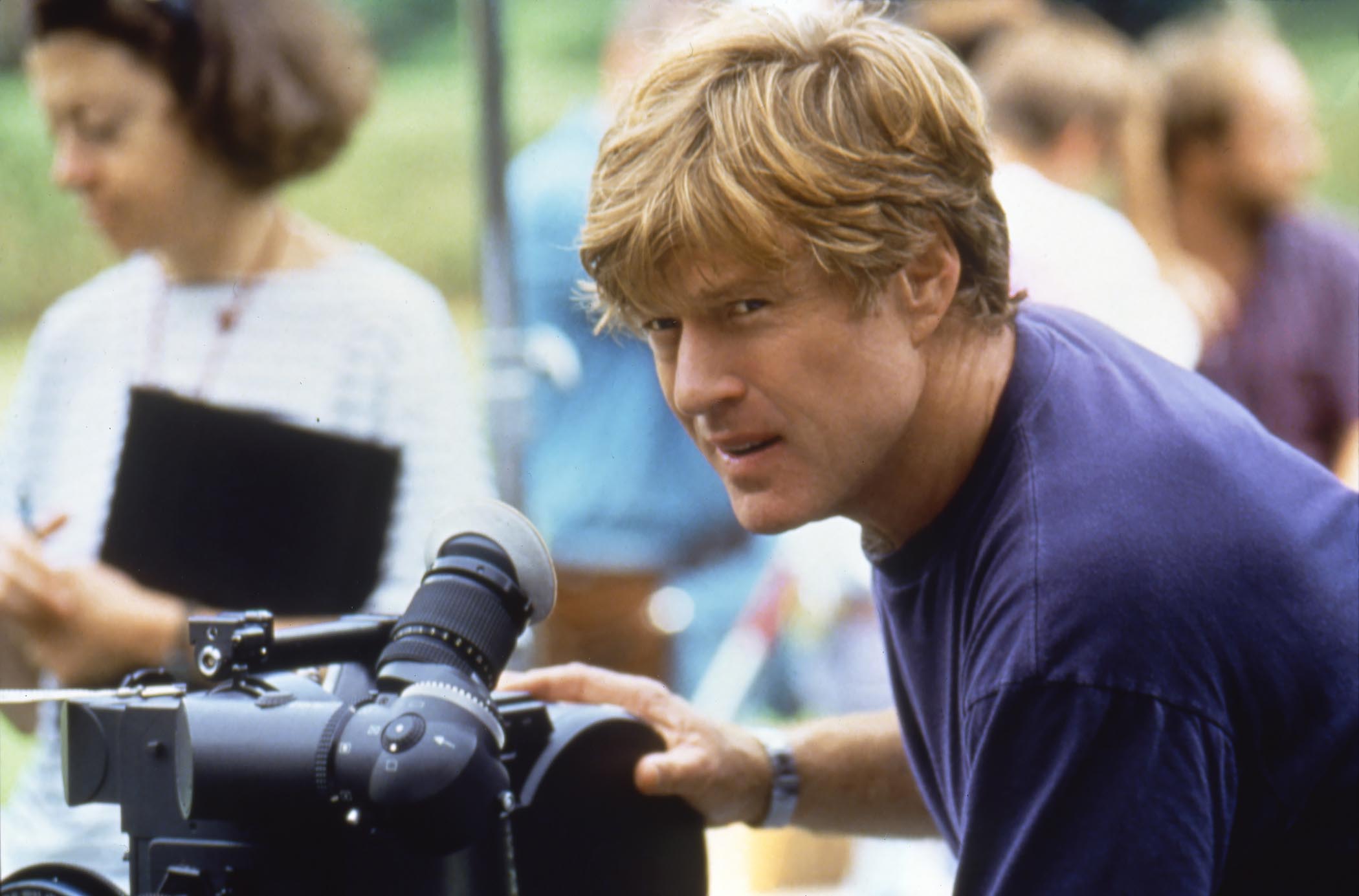
Redford flashes the sly grin of a man whose investigative reporting had brought down a president … at least in our celluloid dream life.
Not since the Depression radio show Amos ‘n’ Andy had a broadcast so mobilized the American people; not until Roots would a single TV program command such rapt attention. The $64,000 Question was more than a hit, it was a phenomenon — an astounding 97 per cent of the television sets in New York City tuned in for one program in October. People were naturally wondering what it meant. Fortune was struck by the “awesome” amount of “heavy thinking” that pundits devoted to a mere TV show: “Seemingly every financial writer in the U.S. has taken the program as a case study from which to explore the effect of taxation on higher-income groups. In a six-part New York Post series on the show, Max Lerner observed portentously that its ability to make ordinary people into national figures overnight ‘has far-reaching implications for politics and power.'”
The $64,000 Question was television as cornucopia. As the U.S. scaled the peak of post-War prosperity (there were a record 8 million new cars sold in 1955, as well as an unprecedented million and a half housing starts), the show materialized like a rapturous collective thought balloon to muse upon this astonishing abundance — as well as demonstrate upward mobility, illustrate the dogma of self-improvement, and testify to the hidden potential of the ordinary American.
Like the members of a Hollywood platoon, quiz show contestants represented a cross section of the body politic, albeit typically cast against type. The first stars included the marine with a taste for French cooking, the cop who loved Shakespeare, the Bronx cobbler rewarded with $32,000 for his amazing knowledge of Italian opera. Kids were also good. Baltimore junior high school student Gloria Lockerman not only won $16,000 for correctly spelling “the belligerent astigmatic anthropologist annihilated innumerable chrysanthemums,” she was invited to address the 1956 Democratic National Convention. Eleven-year-old Patty Duke amassed $32,000 as an expert on singing groups. Air Force test pilot John Glenn first tasted celebrity teamed as a contestant with Eddie Hodges, child star of The Music Man.
The $64,000 Challenge, a quickly conceived sibling designed to further exploit the popularity of The $64,000 Question‘s newly minted winners, elevated incongruity to a ruling principle: Turned down as a contestant in her own field of psychology, 28-year-old Dr. Joyce Brothers reinvented herself as a boxing maven and made $132,000. The $64,000 Challenge was spangled with celebrities and eccentrics — including Xavier Cugat, Lillian Roth, and Larry Rivers. There were, of course, other winners. Louis Cowan parlayed the success of the 64s into the network presidency. Revlon’s revenues quintupled over two years. (At a January 1956 stockholders meeting, a representative of Hazel Bishop haplessly explained that the year’s losses were “due to circumstances beyond our control.”)
Cheap to produce and excellent for sponsor identification, the 64s were cloned by all three networks: The Big Surprise and Do You Trust Your Wife?, Dotto and High Low, Name That Tune and Nothing but the Truth, Can Do and Tic Tac Dough. And then there was Twenty-One, the general-knowledge quiz with an unlimited jackpot. This was the program that, by making contestant Charles Van Doren a national figure and a lifelong recluse — first a supernova and then a black hole in the media universe — provided the subject for Redford’s film.
At the height of the quiz craze in 1956, motivational research guru Ernest Dichter praised The $64,000 Question for showing that randomly selected Americans were often “remarkable individuals.” Unfortunately for Dichter’s thesis, the contestants had not only been carefully screened, it would eventually be revealed that — in a kind of Calvinist showbiz theocracy — the winners were preselected as well. The Revsons closely monitored their show’s ratings, associating any slump with an unpopular champion; to manage the talent, the 64s conducted extensive interviews determining the parameters of a contestant’s knowledge and devised questions accordingly. This technique was subtle, however, compared to the coaching producer Dan Enright initiated with Tic Tac Dough and refined to an art on Twenty-One.
Like TV wrestling, Twenty-One presented contests between heroes and villains. Martin Revson immediately recognized that to do this, the show had to be rigged; everyone else just signed on. This was, after all, the moment of the revised American pantheon. The Cold War was in remission, the climate sufficiently temperate for new archetypes to sprout. By spring 1956, Elvis Presley was an axiom of TV variety shows. In the midst of “Heartbreak Hotel”‘s two-month reign at No. 1, Time reported that this worrisome idol was “packing theaters, fighting off shrieking admirers, disturbing parents, puckering the brows of psychologists, and filling letters-to-the-editor columns with cries of alarm.” By summer’s end, the newsweekly informed its readers of a second “weird new phenomenon loose in the land; a teenage craze for a boyish Hollywood actor named James Dean, who has been dead for 11 months.” It was then that Twenty-One made its debut, Wednesday, September 12, 1956, at 10:30 p.m. on NBC, sponsored by Geritol, “America’s No. I tonic.”
The basic Enright technique was to rehearse selected contestants with questions that would then be asked again on the air. The first designated winner was so dismayed by the practice that he quit the show. Then Enright, who dominates Night and Her Stars as a tele-Mephistopheles, found a more cooperative prospect: Herbert Stempel, a stocky 29-year-old know-it-all from deepest Queens, attending CCNY on the G.I. Bill. (The role was made for John Turturro, who, in Quiz Show, gives Stempel an additional manic edge.)
Enright cast Stempel as the working-class geek with total recall — Stempel was compelled to wear threadbare suits, submit to bad haircuts, and address the show’s MC as “Mr. Barry.” Demolishing all comers, he achieved a brief notoriety as the intellectual equivalent of proletarian sitcom zhlubs like Ralph Kramden or Chester A. Riley. But soon Enright and his associate producer Al Freedman were looking for a more attractive winner and, on December 4, in a show that NBC hyped with regular spot announcements wondering if this would be the night that Stempel broke $100,000, another star was born: Charles Van Doren.
The scion of a distinguished literary family, son and nephew of Pulitzer Prize winners, the 32-year-old Van Doren (played in Quiz Show by Ralph Fiennes) was making $4,400 a year as an English instructor at Columbia, the university where his poet father Mark also taught. Stempel versus Van Doren was a match made in heaven: the Troll versus the Golden Boy. It was the crass, working-class Jew against the elegant, patrician WASP, City College schlepper and Ivy League thoroughbred, an instant replay of the 1956 World Serics in which the regal New York Yankees reasserted themselves over the upstart Brooklyn Bums.
The previous week, Twenty-One producers had arranged several exciting ties. Now, the unbeatable Stempel with his 170 IQ was scheduled to take a dive — instructed by Enright to identify On the Waterfront, rather than Marty (his favorite picture!), as the Oscar-winning best movie of 1955. As he left the set, cast back into nonentity for blowing a question that everybody knew, the unhappy loser thought he heard someone remark, “Now we have a clean-cut intellectual as champion instead of a freak with a sponge memory.” It would not be long before Stempel, after futilely demanding a rematch, came back to blow the whistle — although at first no one cared. To this day, he remains obsessed with Charles Van Doren.
“There’s no protagonist, much less a hero,” points out scriptwriter Paul Attanasio, born a month after the scandal climaxed in 1959. In fact, Quiz Show has two heroes — Van Doren and congressional investigator Richard Goodwin (Rob Morrow), a bright fallen star and a duskier rising one. But Attanasio is correct in considering the project ofibeat. “There’s no violence, there’s no car chase, there’s no romance, there’s no sex, there’s no genre. In a genteel way, this is a very experimental movie.” Certainly Quiz Show followed a torturous road to completion — in some respects recapitulating the narcissistic personalities, affable opportunism, and corporate cowardice that are the movie’s subject.
When he published his memoirs in 1988, former Kennedy aide Goodwin strenuously promoted the chapter about his role as a congressional investigator into the quiz show scandals. (Goodwin, who has never been shy about amplifying his importance in the affair, appears as a minor character in Night and Her Stars.) Accruing additional producers at every stage — including Barry Levinson, who commissioned Attanasio’s script — the project bounced from studio to studio. Redford got involved when Quiz Show was mired at TriStar. Passing through Paramount and Savoy, the project came to rest at Disney, which was developing a similar picture called One for the Money. Failing to persuade Redford to direct its script, the studio agreed to produce Attanasio’s.
Centered on Stempel, One for the Money told the sentimental tale of a little guy who takes on the system. Quiz Show casts Stempel as one of three protagonists, along with Goodwin and Van Doren, but rather than dwell on his suffering and vindication (or even Goodwin’s role as investigator), Redford’s film raises an issue that can scarcely date: the conflict between established, if beleaguered, social values and an ascendant, supremely vulgar, popular culture.
Unafraid to portray class resentment, Redford employs a similarly unflinching ethnic schemata. With the exception of the Van Dorens, the major figures in Quiz Show are all Jews, sensitive to anti-Semitism and scrambling after their piece of the American Dream. It is the brilliantly suspicious Stempel who figures out that Enright has fixed it so that whenever a Jew is on Twenty-One, he loses to a Gentile who then goes on to win more moncy. The movie depicts Jewish as well as Gentile anti-Semitism. (“T’ve observed that condition in my business for a long time,” says Redford.) Neither Goodwin nor Enright can bring himself to champion Stempel — as if both men fear that the crass and “pushy” CCNY student will bring further attention to their own ethnicity.
For Stempel and Goodwin, the privileged Van Doren is the epitome of dazzlingly white, Gentile America. If the humiliated Stempel longs to besmirch Van Doren, the upwardly mobile Goodwin yearns just as much to be accepted by him. It is the showbiz savant Enright, adept at meeting the needs of sponsors and the American public, who understands how to give Van Doren what he wants, and is thus able to corrupt him. As the movie (and the facts) suggest, there may have been no one who felt the yoke of WASP tradition embodied by Mark Van Doren more than his son, who at one point had fled to Paris to write a novel about … parricide.
During the 14 weeks that boyish, personable Charlie appeared on Twenty-One, the show became a smash — moving from Wednesday to Monday nights to challenge CBS’s I Love Lucy. Geritol sales climbed. Van Doren got 2,000 fan letters a week, a total of 500 marriage proposals, and a promotion at Columbia, where students pasted up signs directing visitors to “the smartest man in the world.” Had the professor sold out to TV or merely realized the medium’s potential? The 64s celebrated the average American. In Van Doren — who, by early February made Time‘s cover as “TV’s brightest new face” — Twenty-One produced an attractive young scholar to personify television’s much-vaunted and equally abused mandate to educate the public.
As recently as 1953, popular historian Leo Gurko had written in Heroes, Highbrows and the Popular Mind that “to be suspected of learning or, what is worse, to display it publicly is to invite ridicule.” But did the display of erudition invite ridicule or, more to the point, inspire the fear of ridicule? Gurko argued that professors were regarded as “fogies wrapped up in musty and useless books” — a stereotype telegraphed in Quiz Show by the polite boredom of the senior Van Doren’s students. But in the popular mind, professors were also potentially dangerous, prone to be Jews and commies and queers, an affront to decency and common sense. Democratic candidate Adlai Stevenson’s egghead reputation had precluded his being a man of the people, but the quiz shows successfully domesticated braininess — the 64s locating it in “ordinary people,” Twenty-One making it the province of an artfully shy, telegenically smiling WASP.
Thanks to television, highbrow trivia was worth Big Bucks, and thanks to Charlie Van Doren, intellectuals could be incorporated into the mass culture they were wont to critique. At the climax of a wittily observed birthday picnic at the Van Doren home in Connecticut, Quiz Show‘s Charlie presents his father (played in grand fashion by Paul Scofield) with a humongous TV set. They were better and yet … they were no better.
For Time, Van Doren combined nothing less than “the universal erudition of a Renaissance man with the nerve and cunning of a riverboat gambler and the showmanship of the born actor…. Just by being himself, he has enabled a giveaway show, the crassest of lowbrow entertainments, to whip up a doting mass audience for a new type of TV idol — of all things, an egghead.” Time noted that when Van Doren appeared as a guest on The Steve Allen Show, its rating topped that of the rival Ed Sullivan Show.” Oddly enough, Allen had beaten Sullivan only once before — when one of his guests was Elvis Presley.” The analogy was out: “Many a grateful parent regards [Van Doren] as TV’s own health-restoring antidote to Presley.”
Like TV itself, the quiz show scandal was cataclysmic and trivial.
As a sneering Elvis enacted copulation, so Van Doren’s “weekly torment of concentration” pantomimed cogitation. Coached by Al Freedman, Van Doren performed answers to the questions he had already received. Earphones clamped to head, he sweated and stuttered, rolled his eyes, knit his brow, bit his lip in an agony of concentration. Time was enchanted: “Breathing heavily, Charlie coaxes elusive answers out of odd corners of his brains by talking to himself, muttering little associated fragments of knowledge.” And yet, even then, there was the suspicion that Van Doren’s agony was an act, that he was playing with the audience. “Some viewers get the feeling that he knows most of the answers immediately and simply makes the audience squirm for the money he gets. But Charlie and those who know him best insist that it is actually his technique of ferreting out the answers.”
“I remember watching Van Doren and, as a young actor, thinking, ‘That’s not a really great performance,'” says Redford. “But why didn’t I doubt the show?”
Redford’s notion of a great actor was no doubt closer to James Dean than Charles Van Doren (who was, it should be noted, a talented amateur actor), but Van Doren was playing an equally existential drama. Increasingly uncomfortable as his fame spread and winnings mounted, he pleaded for release.
Finally, on March 12, 1957, with more than half the viewing public tuned in to watch their protracted battle, lawyer Vivienne Nearing beat the Smartest Man in the World, who left the show with the record sum of $129,000. (The next morning, The $64,000 Question announced that it was raising its jackpot to $256,000.) Stempel, who was smart enough to figure out that this was the show where Van Doren would take a dive, lightened his bookie by $10,000. But he was outraged to discover that while he would live out his life as a hapless loser, Van Doren remained a TV superstar — hired by NBC at an enormous $50,000 a year to bring a soupçon of high culture to the viewers of Today.
In a general sense, the quiz show story follows the trajectory of the ’50s. The shows’ heyday marks the 1955-57 period of abundance; their decline and eventual disgrace underscored the traumas that closed out the decade. (In Quiz Show, the chronology and thus the good times are necessarily compressed in such a way as to offer a suitably revisionist look at our official Happy Days.) A psychohistorian might date the recession of 1957-58 to September 4, 1957. The very same day that a jeering mob prevented nine black students from integrating Central High School in Little Rock, Arkansas, the Ford Motor Company unveiled its 1958 Edsel. Lured by months of publicity, 3 million potential customers mobbed Ford showrooms, but by the time events compelled an unwilling Eisenhower to send paratroopers into Little Rock, the Edsel had flopped — at a cost of $350 million.
As unemployment climbed to a postwar high, automobile sales fell to a decade low. Then, on October 4, with the spectacle of American soldiers occupying an American city still before the eyes of the world, the Soviets launched humankind’s first artificial satellite — Sputnik! Within hours, politically ambitious Democratic senators were invoking Pearl Harbor, pointing at the sky and howling that the Free World faced extinction. To add to the national humiliation, the Russians orbited another sputnik a month later, this time with a canine passenger.
Rampant Edselitis! January 1958 polls showed that 82 per cent of the electorate thought the country “behind” the Soviet Union and 61 per cent were willing to “sacrifice” for stronger defense. (Elvis had just received his induction notice.) Worse, European public opinion revealed a weakened confidence in American know-how and the NATO alliance. Meanwhile, former quiz show contestant Reverend Charles Jackson — a Tennessee minister whose category had been “Great Love Stories” — was telling Time, The New York Times, and The Nashville Tennessean that The $64,000 Challenge was fixed.
In March, another contestant on The $64,000 Challenge discovered that his opponent was given “warm-up questions” that were somehow re-asked on the show. The program’s representatives assured him that it was inexplicable coincidence. That spring, amid the negative publicity surrounding Vice-President Nixon’s nightmare tour of Latin America (he was spat upon and his car was stoned in Caracas), a standby contestant on Dotto — the highest-rated daytime show, soon to go prime time — came across a notebook wherein the current champion, Marie Winn, had jotted down answers to the very questions she was even then being posed on the air. Winn disappeared from the show (having subsequently seen the light, she reappeared in 1985 as an expert on the baleful influence of TV with her bestseller, The Plug-In Drug). Her standby was given a $2,666 payoff in an inept cover-up that led sponsor and network to hastily cancel the program.
The Dotto debacle lit the fuse. In August, New York D.A. Frank Hogan began investigating and Herb Stempel reappeared to repudiate his earlier repudiation of his original charges that Twenty-One was fixed — an allegation denied, on the air, by Van Doren, then summer host of Today. That fall, as the novel The Ugly American climbed the bestseller lists, NBC dropped Twenty-One and CBS canceled the 64s. Throughout the first half of 1959, Van Doren and other former contestants, as well as their handlers, perjured themselves before a New York grand jury.
Only a genius would have instructed Stempel to give as his wrong answer On the Waterfront — a movie whose most famous scene is an account of an ex-boxer’s lament for taking a “one-way ticket to Palookaville” by throwing a fight.
Perjury was the crime — not participating in the fix. Most contestants chose to break the law rather than admit that they were less than they seemed. But because, in a virtually unprecedented decision that has never been adequately explained, Judge Mitchell D. Schweitzer sealed the findings, the scandal would not climax until the following autumn.
It was at this point that Goodwin, then an ambitious young lawyer attached to the House Special Subcommittee on Legislative Oversight, entered the picture. In his memoirs, he describes how, amazed by Schweitzer’s actions, he persuaded the subcommittee to continue the probe and was sent to New York to interview the protagonists.
Asked why he thought Schweitzer had sealed the presentment, Redford flashes the sly grin of a man whose investigative reporting had brought down a president … at least in our celluloid dream life: “The real question is whether the network was implicated. NBC managed to engineer things in such a way that it was never culpable.” (Schweitzer resigned from the bench in 1972 — charged with judicial misconduct and conspiracy to obstruct justice in his apparent leniency with known mob figures.)
When the House hearings commenced on October 6, 1959, star witness Stempel was anxious to see his nemesis testify. But Goodwin, who admired Van Doren, persuaded the subcommittee to omit Van Doren’s name from the list of witnesses — until the professor sealed his fate by sending a telegram to the subcommittee that insisted on his innocence. Once subpoenaed, Van Doren admitted what was, at last, obvious: he had been given questions and otherwise coached by the producers of Twenty-One.
Treated with extraordinary sympathy by the subcommittee (a scene Redford stages with hyperrealist clarity), Van Doren was fired first from Columbia and then from the Today show. (Along with 17 other contestants he would eventually receive a suspended sentence for second-degree perjury.) Networks blamed producers, producers blamed sponsors. Louis Cowan was forced to resign as CBS president and the network even briefly banned the deceptive practice of canned laughter. Barry and Enright were banished from TV for more than a decade.
Not all quiz shows were fixed and, even on those that were, not all participants were coached. The process even produced some lasting winners. Revlon decisively beat Hazel Bishop. Mike Wallace survived his stint cohosting The Big Surprise with a chimp named Zippy. Dr. Joyce Brothers not only won $132,000 but went on to become a regular on Johnny Carson’s Tonight Show (and Johnny himself got his break as the host of Whom Do You Trust?). In the movie, it’s the Geritol mogul played by Martin Scorsese who has the last word. The shows will be back, he assures Goodwin, with “easier questions.”
Like TV itself, the quiz show scandal was cataclysmic and trivial: In 1987, when Ronald Reagan still hosted the national media spectacle, cover stories in Time and Newsweek made light of the public dismay that greeted the exposure of the fraud. Reporting on “America’s Newest Obsession,” the success of Wheel of Fortune, Jeopardy, The $100,000 Pyramid, and 30 other game shows, Newsweek noted that “from the perspective of a more cynical, or at least less gullible age, the reaction to the quiz shenanigans seems almost quaintly overwrought.”
Vanna White, the star of our own mid ’80s quiz show revival, was distinguished from Charles Van Doren for not only being safely supply-side but also publicly mute. Still, in reacting some months later to the crisis in ethics precipitated by the near-simultaneous falls of Ivan Boesky, Jim Bakker, and Gary Hart, Time echoed the cra’s sleaziness. Forgetting the consternation of the American people, the newsweekly suavely blamed the victim in rewriting the past to recall that “intellectuals reacted to the TV-show scandals with an outrage that now seems comically disproportionate to the offense.”
Whether public response now seems ridiculous or prescient, the quiz shows involved a national suspension of disbelief — and hardly for the last time. Not the least remarkable aspect of the affair is the amount of time the pretense that the shows were honest was maintained, particularly in view of the numerous citizens involved in the charade. As early as April 1957, around the time Stempel made and recanted charges of fraud, Time began a story on the shows by asking if they were “rigged,” going on to report that “even the chitchat between contestant and quizmaster on Twenty-One and The $64,000 Question is composed and drilled in advance,” and even remarking on the coincidence that “most big winners have been blessed by crucial questions right up their alleys.” But then Time backed off, concluding that something like Van Doren’s defeat could scarcely have been desired.
Even more explicitly, a New York Times Magazine piece appearing in the midst of the 1957-58 season observed that if TV dramas always end the way they should, why not quiz shows? “How long would wrestling have lasted on television without scripts? By the time a man |sic] works his way up to the $64,000 question, the viewer wants him to answer it as surely as he wants the Sheriff to outdraw the heavy. The fact is, of fourteen contestants who have gone for the $64,000 question, only two have missed.”
Allowing both 64 producer Steve Carlin and Twenty-One‘s Dan Enright to “wearily deny” that they ever know enough about the shape of a contestant’s mind to tailor the questions, the Times concluded that “despite diligent research, nobody has yet turned up evidence that the fix is in on any of the big money quizzes.” But then, nobody wanted to. The movie and broadcast industries had only recently undergone a massive purge of com-symp subversives and un-American intellectuals. Wasn’t the public now getting what it had wished?
With “some heat,” Carlin told the Times, “Some people have said our contestants are too good to be true. Well, the typical American has many facets, and those who doubt it show little faith in the American way.” Carlin was stating the truth. The business of America is show business and rigging the shows was business as usual. Particularly on TV, where commercial imperatives are indistinguishable from the principles of dramaturgy, the plot had to be regulated through strategic pauses and interest built up with exciting ties. Some saw the fix as a betrayal of television’s vaunted spontaneity or an exploitation of the medium’s spurious sense of intimacy. But more than dramatizing TV’s potential for deception, the scandal exposed the nature of televisual rhetoric: Was TV primarily a source of information or entertainment? Could the two even be distinguished?
From then on, the U.S. would be ruled by central casting. Emerging in the aftermath of Adlai Stevenson’s crushing defeat, Van Doren was the egghead as Elvis. In his history of the ’50s, David Halberstam logically suggests that Van Doren’s replacement as a TV star was the similarly “young, attractive, upper-class, and diffident” Senator John F. Kennedy. Even then, however, observers recognized that the quiz show premise lived on. Daniel Boorstin’s The Image, published a year into the Kennedy administration, remarked upon “the application of the quiz show format to the so-called ‘Great Debates'” between candidates Kennedy and Nixon. (Of course, if Boorstin had been up on his quiz show trivia, he would have recognized that Nixon had cast himself as the hapless Stempel to Kennedy’s coolly poised Van Doren.)
Like all great media spectacles, the quiz show scandal is a text. A clever novelist might have humiliated Herb Stempel by contriving to have him deliberately miss the question on Marty — particularly as it would be clear to every TV viewer in America that Stempel himself was alter ego to the homely Bronx butcher. But only a genius would have instructed Stempel to give as his wrong answer On the Waterfront — a movie whose most famous scene is an account of an ex-boxer’s lament for taking a “one-way ticket to Palookaville” by throwing a fight. No one knew better than Herbert Stempel, who went on to spend years teaching social studies in the New York City public schools, that he coulda been a contender.
Like most of us, Redford filters history through himself. For him, the quiz show scandal represented “the earliest sign of what has been an ongoing struggle between capitalism and ethics.” Typically, he traces his awareness of class distinction and anti-Semitism to his experiences as a second-grader in a Santa Monica school populated by the children of the rich and their servants. He segues from that to a mention of his father, a CPA who moonlighted as a milkman during the Depression but achieved a measure of prosperity working for Esso after the war.
Redford’s worldview is tinged with alienation — the sense that he could (and should) pass for normal. “I grew up in that kind of privileged place although I wasn’t of that privileged set. I grew up looking like one of those people, but not really being one. I saw how they were perceived … and I found it offensive.” As refined over his career, the Redford persona is that of the cynical idealist whose sense of mischief belies a sober social conscience. A professional Man of the West who has spent much of his life living, with remarkable invisibility, in New York, he’s a prim hipster, an intellectual jock, a serious joker, the star who directs ordinary people but understands the appeal of the rancid golden boy. He refers to Quiz Show as “the fall from grace.” (In Night and Her Stars, the “defeated” Van Doren asks Enright if “we only recognize grace once we’ve fallen from it.”)
Redford has played both Van Doren and Goodwin. With which man does he identify? Is it even a question? Taking Goodwin’s attraction as a given, Redford says he’s fascinated by Van Doren’s perversity — the “dance” between beautiful culprit and ardent investigator, the degree to which Van Doren plays Raskolnikov to Goodwin’s Petrovitch: “Van Doren brings Goodwin in and then he deflects him. He never answers Goodwin’s question. He never says, ‘I did,’ or, ‘I didn’t get the answers.’ He only asks, ‘Do you really think I’d do something like that?'”
Ralph Fiennes reconnoitered Van Doren’s Connecticut home, but Redford made no attempt to contact the now 71-year-old recluse. Having retreated out of camera range to work for The Encyclopedia Britannica and edit worthy literary anthologies, Van Doren has done penance through a kind of middlebrow intellectual public service, yet is still so traumatized that he cannot tour to promote his own books. In any case, Redford says tartly, “the other two” — Goodwin and Stempel, still wanting in! — “were so busy climbing all over you they left teeth marks.” The lust for celebrity is something that Redford experiences only from the other side.
Attanasio suggests that the reason it took Redford so long to cast Van Doren was because he himself “could do every line of it.” Van Doren’s anguished confession speech actually uses the same phrase with which Redford’s character, the 24 karat Hubbell Gardner, begins his short story in The Way We Were: “Everything came too easily.” As did Bill McCoy in The Candidate and Robert Redford in real life, Van Doren experienced the horror of celebrity — his privacy invaded by the press and hounded by the little people. The sense of America as an audience is made grotesquely explicit in the final shot of the chortling quiz show audience, which effectively turns the screen into a mirror.
No less than Van Doren, Redford has had to wonder if he was a fraud. Asked if he has imagined Charles Van Doren’s emotions at having to relive his youthful crime, Redford concedes that Van Doren “may have mixed feelings about being exposed again, but I like to think that he gets more than fair treatment.” Attanasio agrees, pointing out that the movie suggests Van Doren falling into corruption more reluctantly than he may actually have done.
Van Doren is the least developed major character in Night and Her Stars, but he is a veritable psychic battlefield in Quiz Show. Redford reworked Attanasio’s script to put the relationship between the Van Dorens, father and son, at his movie’s center. Charlie’s inability to live up to his father’s expectations is matched by Mark’s failure to grasp what exactly is happening to his son. The burden of being a Van Doren is equaled by the shame that Charlie brings upon his family. The casual infantilization of the son, sneaking a nocturnal wedge of chocolate cake and washing it down with milk slugged from the bottle, sets the table for the ultimate expression of patriarchal anguish. “Your name is mine,” the elder Van Doren thunders when he is at long last compelled to see the nature of Charlie’s deception.
The Van Dorens resemble the tragic WASP families of Ordinary People and A River Runs Through It, not in the depth of their catastrophe (no one dies, although Redford maintains that “there is incredible violence in this picture — there is murder of the soul”), but for their world historic role. Some ideal of intellect and knowledge is consumed before our eyes. An infinite capacity for co-option shimmers in the haze. What’s more, everyone — with the exception of Herb Stempel (who, in the eclipse of One for the Money by Quiz Show, has lost to Van Doren yet again) — has a stake in Van Doren being what he appeared to be.
Why should Redford care? “We really didn’t want him to be guilty,” says the sometime movie star. “We really do have a need for heroes at almost any cost.” ❖