







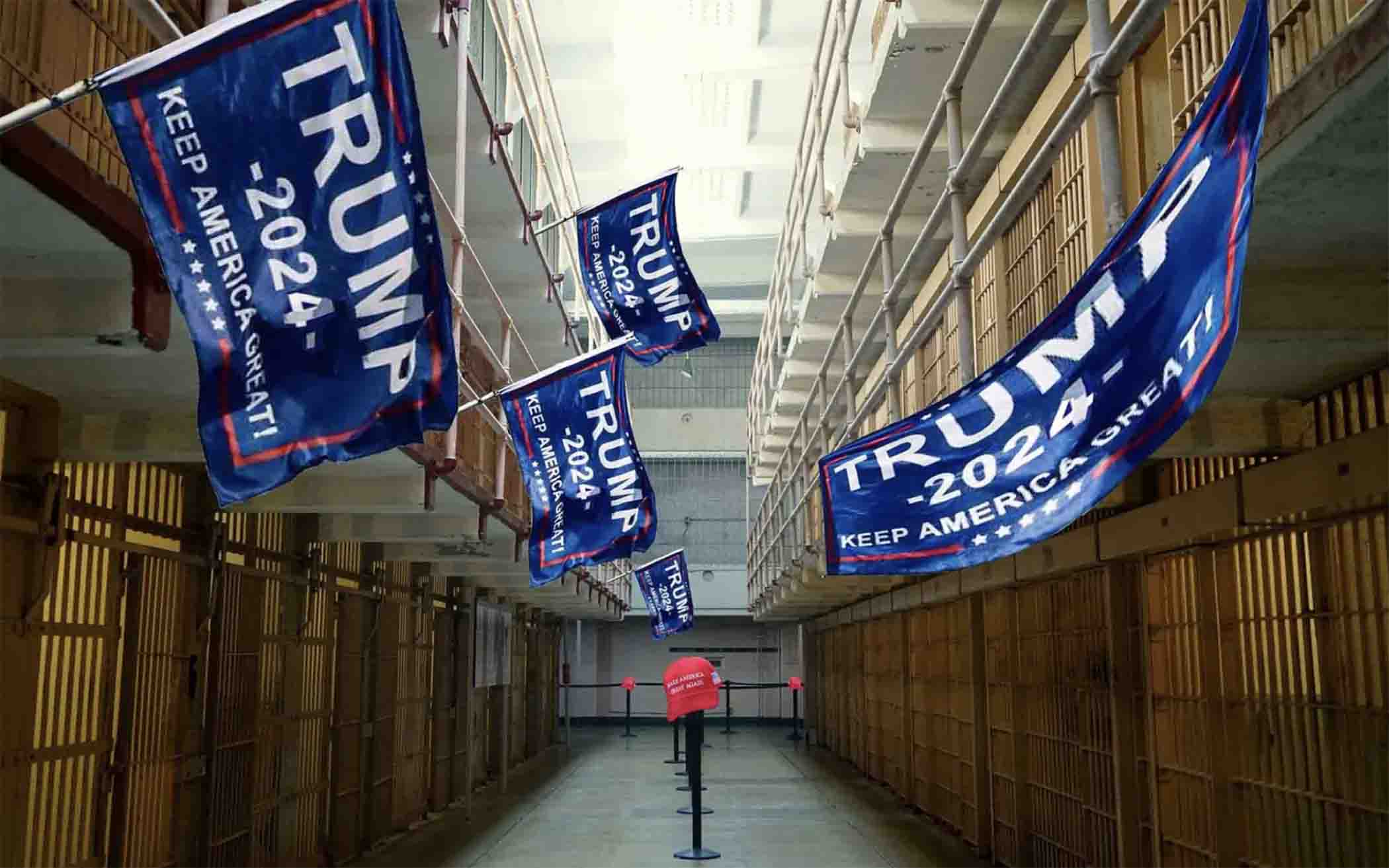
Ricky Kurt Wassenaar, inmate #065155 in the Eyman correctional facility, located in the town of Florence, Arizona, each day gets down on his knees and prays. In his cell, he makes the sign of the cross, clasps his hands together, and thanks the Lord for all that He has done to keep him alive. Sometimes, Wassenaar prays for guidance or assistance in his times of trouble.
Over the past few months, trouble has been a regular occurrence for Ricky. Most recently, on April 5, 2025, he brutally killed three inmates in two separate incidents within eight hours of each other. Six weeks later, the prison industrial complex in the state of Arizona is still reeling from these events.
The accused killer admits to it all. “I did it,” he says, adding, “The roots of these deaths go back to November 5, 2024 —Election Day.”
On that day, Ricky Wassenaar knelt on the concrete floor of his cell and offered up his prayers for two primary reasons. One was that prison authorities reconsider assigning him a cellmate, who was scheduled to move in shortly. Wassenaar was upset to find himself back at the Arizona State Prison Complex (ASPC), in Tucson, after 20 years away in different state penitentiaries, and he was especially angry that they were giving him a “cellie.” Says Wassenaar, “When I arrived at Browning unit, the warden promised me that I would not have a cellie. It was part of a negotiated deal I made with the Arizona Department of Corrections 20 years ago. But then they transferred me to Cimarron, another unit within the prison, with a different warden. They told me, ‘You’re getting a cellmate.’ You have to understand: I’ve been without a cellie for 20 years. I can’t handle all of a sudden having someone in my space, breathing my air, talking when they want to, peeing in my toilet water. I’m not a social person, I’m an introvert. Having a cellie will trigger mental health issues for me. I told them, ‘Don’t do it. There will be consequences if you put someone in this cell with me.’”
Wassenaar’s other main concern in his prayers last November 5 was the election of Donald J. Trump. Ricky was worried. All the TV news reports had polls showing Trump, the Republican Party candidate and former president, lagging behind Kamala Harris, the Democrat. Wassenaar asked God to lead Trump to victory. Then, he says, something unusual happened. He heard a voice say distinctly: “Sacrifice him.”
The inmate was startled. Yes, he prayed every day, but this was the first time, he tells me, that he ever heard a voice.
Reasonable minds might have differing interpretations of what that command meant. Sacrifice him. Wassenaar had no doubt what it meant. He was to kill his new cellmate on behalf of a Donald Trump victory.
Wassenaar is talking to me over the phone. He is allowed a cell phone in his pod, which is somewhat surprising considering that he is currently the most notorious inmate in the entire state of Arizona, and maybe the nation. Ricky likes to talk. He calls me nearly every day. And he has spoken with other journalists. He also considers himself a writer. You can buy a book by Wassenaar on Amazon. Published in 2023, Five Real Prison Stories promises on the back cover to impart tales that “will make you laugh out loud, cringe in horror, shudder with goosebumps, and perhaps even shed a tear,” and also notes that Ricky’s contact info is contained within and that Ricky will “answer all correspondence.” Such conviviality greatly contrasts with Wassenaar’s record. (His book was self-published by his sister, Rhonda; as a convicted felon, Wassenaar is not able to profit from his crimes.)
Within an hour of receiving the command – sacrifice him – Wassenaar’s new cellmate was delivered. His name was Joe Desisto. He was an 81-year-old lifer who, in 2022, was sentenced in Pima County for sexual abuse, molestation of a child, sexual conduct with a minor, and furnishing obscene material to a minor. Desisto unloaded his meager belongings, including his medication packet, and said — as much to himself as to Wassenaar — “Man, I’m old. I’ve had enough of this. I’ve lived long enough, I’m ready to go.”
Says Ricky, “He was practically asking me to take his life. He was some kind of sacrificial lamb.”
Wassenaar is a hardcore desperado, a recidivist criminal who has spent 38 of his 62 years on earth behind bars. Among inmates, his nickname is “Rooster.” His convictions are for robbery, aggravated assault, sexual assault (he denies it), kidnapping, and endangering the lives of prison employees, among other crimes. But he had never killed anyone.
“You think I might have been nervous,” says Wassenaar, “but I wasn’t.”
In ASPC Tucson, there are no bars on the cells. There is rather a metal door punctured with a series of dime-size holes — “Kind of like Swiss cheese,” says Wassenaar. Unless a person is right up next to the door, peeking through one of the holes, there is no way to see inside. That night, Wassenaar waited until Joe Desisto was standing by the bed. The cell was freezing cold; inmates had been complaining about the temperatures all week. Prison authorities had given each inmate an extra blanket. Desisto was shivering. “Here,” said Ricky, “use this blanket.” From behind Desisto, he wrapped the blanket around his shoulders. “Raise your chin,” Ricky said to the old man. He did as asked. “I put my arm under his chin, and I put him in a chokehold. I actually lifted him off the ground. He did not struggle one bit … I went down on my knees and put his upper body on the lower bunk and put all my pressure on the chokehold around his neck.
“I noticed there was a puddle of urine there where he had lost control of his bladder. I dragged him over to the door and I laid him down and checked his pulse. I could hardly believe it when I felt a tiny pulse. So I strangled him with my bare hands. Even though it was cold, I was sweating from the exertion. A drop of sweat off my face dropped on his right cheek, and a little puff came out of his mouth, like maybe his soul was passing from his body. And then he was dead. I pinched his nostrils closed, and because it was so cold, they froze shut.”
Over the phone, I ask Wassenaar, “As you were doing all this, what were you feeling?”
“I was feeling that I was doing a good thing,” he says. “I was doing what I was told. It was supposed to happen. And the proof was that Trump won the election. He won all the swing states, and he won the popular vote. He defied everyone.”
◊ ◊ ◊
Since the reelection of Donald Trump, his administration has aggressively characterized immigrants in the United States as reprobates, rapists, gangsters, and killers. The administration has adopted the amorphous MS-13 gang as the collective boogeyman that all Americans, regardless of where they live, should fear. The president has vowed to deport and/or imprison alleged gang members without due process. The message is chewy like a Trump Steak: If the immigrants do not rape your women and kidnap your children, they will most assuredly eat your cats and dogs.
“I looked at my face, the mug shot. I looked in my eyes. Man, I looked like a madman.”
The president would have you believe that people from other countries make up the majority of America’s criminal class. Not true. In 2022, the Federal Bureau of Prisons (BOP) released data showing that while 15% of the federal prison population were noncitizens, a full three-quarters of them were there only for infractions of immigration laws. A 2023 study by the Cato Institute found that immigrants had a lower incarceration rate than native-born Americans. And it is no secret that among prison inmates in the U.S., the majority are Trump supporters. Last October, the Marshall Project published a survey of 54,000 people behind bars in 785 prisons in 45 states, and found that “Most respondents said they would vote for Trump, and support was particularly strong among White men [60% to 21%]. A substantial minority of Black men said they’d vote for Trump, too, if given the chance.”
Among those Trump supporters is Ricky Wassenaar. In my conversations with the man currently thought to be Desperado No. 1 in the U.S. prison system, he was brutally honest about his recent shocking spate of violence behind bars, and also his unique brand of advocacy for Trump. Wassenaar’s criminal career is as American as apple pie, and his willingness to talk openly from behind bars offers a chilling view inside the mind of a homegrown lifer.
◊ ◊ ◊
After prison authorities discovered the dead body of Joe Desisto in his cell, they slapped cuffs on Wassenaar and led him away to the hole in a separate facility, where he was to be held on a 30-day investigation for homicide. Wassenaar asked to see the Criminal Investigations Unit (CIU). He confessed to everything, including the part about the voice instructing him to kill his cellmate on behalf of Donald Trump.
“Imagine my surprise,” he says, “when three days later, on November 8, they took me back to Cimarron, where I thought I would be charged with a homicide. Instead, they put me back in my cell. I found out from some inmates that the warden ruled that Desisto had died from a heart attack. [According to an article in the Arizona Mirror, the official autopsy stated that the cause of Desisto’s death was “inconclusive.”] Well, damn, I knew my DNA was all over that body. I strangled him with my bare hands and my sweat dropped on his face. I told them about all that.”
Wassenaar was perplexed, bordering on astounded. The prison seemed to be engaged in a cover-up. But he had a more immediate problem: They assigned him another cellmate.
Martin “Marty” Hussak was in prison on a bogus conviction, or at least that’s what he told Wassenaar. “He explained his case to me. I believe he got a raw deal. But nonetheless, he was in my cell. He was scheduled for termination.”
Almost immediately, Marty got bad vibes from Rooster Ricky Wassenaar. According to Wassenaar, Marty contacted a family member and told them to contact the warden ASAP. Said Marty to his sibling, “This guy is going to kill me. Tell them! They need to get me out of here — NOW!” Since Marty had made his request known, it was on the record. If prison authorities ignored Marty’s request, and he was killed, it would look bad. They already had one dead cellie on their hands. They transferred Marty to another cell.
“He got out in the nick of time,” says Wassenaar.
When he saw Marty later, Ricky told him, “God saved you for some reason.”
Prison authorities again told Wassenaar that he was going to be assigned a new cellmate. Ricky stewed in frustration and anger. He prayed every day, asking for guidance. It was during this period that he formulated “the Plan.” The origins of the Plan had been brewing inside his head for a while. Wassenaar had come to see himself as an Avenging Angel. He despised child molesters. There were many convicted child molesters at the facility. For years, he had fantasized about going on a killing rampage in the prison and killing as many pedophiles as possible. The fact that the prison kept forcing unwanted cellmates down his throat caused a bubbling cauldron of anger inside Wassenaar that he used to focus on his plan.
Meanwhile, on April 3, prison authorities assigned Wassenaar a new cellmate. His name was Saul Alvarez, age 51, who had been in the system since 1998, when he received a life sentence for first-degree murder, sexual assault, and kidnapping. “It was no secret that I was going to kill my cellmate,” says Ricky. Of the prison authorities, he says, “They must have wanted that guy to die.”
◊ ◊ ◊
Ricky Wassenaar’s life of crime is a sprawling saga that began in Grand Rapids, Michigan, where he was born and raised. His father was convicted of murder and sent away to prison when Ricky was 2 years old. His single mother was a Christian with a 10th-grade education who taught him to pray. He also had an uncle who was an atheist, who told him, “Only weak people need religion to tell them what to do.” These were the two voices over young Ricky’s shoulders — the Christian and the atheist — beckoning him one way or the other.
Wassenaar’s first arrest was at the age of 17, on larceny and illegal gun possession charges. He was under investigation for another series of crimes and decided to flee to Tucson, where his older brother, Randy, had moved one year earlier. Together, the Wassenaar brothers started robbing drug dealers. In 1986, Ricky was arrested for an armed robbery he claims he did not commit. He went to trial and was found guilty. “My defense lawyer was incompetent,” says Wassenaar. “I actually think that, working together with the prosecutor and the judge, he had me framed for that crime.”
Wassenaar received a sentence of 16 years.
A year later, Ricky went on trial for another armed robbery, one that had occurred before the crime for which he was convicted. This one he says he did do. He was found not guilty. “Innocent of the crime for which I was convicted and guilty on the one where I was acquitted; how could I ever take this so-called justice system seriously after that,” he says.
Somewhere around year eight of his prison sentence, Wassenaar was allowed out on house arrest. He stayed in a home that was an extension of his incarceration, but was able to circulate in the free world. He had a job delivering sandwiches from a high-end sandwich store. The whole time he was out, he was possessed by one thought: “I was going to find that lawyer who bungled my case and kill him. Then I was going to kill the prosecutor and the judge.”
Before he had a chance to locate and slaughter those people, Wassenaar got caught in the act of robbing the Empress Adult Video Center, a Tucson porn shop. Police descended on the scene at 3800 East Speedway, and Ricky fled in his clunky Honda Civic. He was looking for a place to pull over and have a suicidal shootout with the police when he was T-boned by a truck driving at full speed.
Wassenaar woke up in a hospital with tubes in his mouth. He had contusions, broken ribs, a shattered femur, and a concussion. He was a bloody mess. The first thing he saw was a TV in the room with his mug shot up on the screen. It was a local TV news report of the incident. “I looked at my face, the mug shot. I looked in my eyes. Man, I looked like a madman.”
After he recovered, Wassenaar went to trial. He represented himself in court. This is not as outlandish as it might seem. Though Ricky hated school as a kid and rarely attended, while incarcerated he spent nearly all his time in the prison law library. “I studied everything about the law,” he says. “I read the books, learned the case law, learned how to make a legal argument.” The state attorney who prosecuted the case later said that Wassenaar did a credible job as his own counsel, but he lost the case. He was given another 12 years on top of the time he was already serving.
Even before the killing, Wassenaar had realized that the time had come for him to enact “the Plan.”
The incident that first made Ricky Wassenaar famous occurred in 2004. Together with another inmate, Wassenaar took two guards — a male and a female — hostage and held them in a gun tower inside the prison. For 14 days, a stand-off ensued between Wassenaar and the other inmate, both armed, and a SWAT team of national guardsmen. The incident riveted the people of Arizona as it played out on the television news. “What nobody knows,” says Wassenaar, “is that for me, the tower incident was a suicide mission. I fully expected to die. The fact that I did not die during all that is a miracle. God saved me, no question about that.”
Rhonda was flown in from Michigan to help negotiate a resolution to the siege. Ricky said he would release the two guards if it was guaranteed that he would be moved out of Arizona to a prison in a different state. Ricky and his sister believed that if he remained in Arizona, he would forever be under threat from corrections officers who wanted to get revenge for his having taken those guards hostage. Wassenaar also got authorities from ADC to agree that he would not have a cellmate.
In 2005, Wassenaar went on trial for the hostage siege. It was a major media event in the state of Arizona. He was found guilty on 19 counts, including kidnapping, deadly assault by a prisoner, aggravated assault, sexual assault, and first-degree attempted escape. He was given 16 life sentences for his crimes; he was the living definition of a man with nothing to lose.
◊ ◊ ◊
Thirteen years later — on May 28, 2018 — after serving time at facilities in Ohio, New Jersey, and New Mexico, Wassenaar found himself being transferred back to Arizona. Ricky says that the special services officer responsible for transferring inmates from state to state told him, “You’re being transferred back to Arizona so that Chuck Ryan can have his pound of flesh.”
At the time of the tower siege, Charles Ryan was assistant director at ADC. He was appointed director in 2009. Wassenaar believes that he was brought back into the Arizona state system because Ryan was looking to get even for the infamous tower siege back in 2004. In 2019, after a series of scandals and investigations that marred his tenure as director, Ryan retired after having served nearly 40 years in ADC. In 2024, the 74-year-old former director was sentenced to two years’ probation after he consumed half a bottle of tequila and pointed a gun at police officers responding to calls of a disturbance at his home. (Attempts to contact Charles Ryan for this article were not successful.)
Wassenaar says that upon his return to Arizona, the guards took turns acting out a systematic campaign of harassment against him. “It was a contest to see who could mess with me the most — they tampered with my food, my mail, even legal correspondence, which they’re not supposed to open. They made it impossible for me to get a decent night of sleep. But I rarely complained, because at least they honored our contractual agreement that I would not have a cellmate.”
That is, until they transferred him to the Cimarron unit, and Joe Desisto walked into Wassenaar’s cell.
◊ ◊ ◊
When Saul Alvarez was ushered into Wassenaar’s cell as his latest cellmate, on April 3, he announced to Ricky that he was a Mexican national. Wassenaar tells me that he is not racist, but that he prefers to spend time with “my own people.” Alvarez’s nationality did not concern him as much as his political proclivities. When Wassenaar made a casual reference to his support for Trump, Alvarez let it be known that he did not like Trump or his recently appointed “hatchet man,” Elon Musk. “Right away I was pissed off,” says Wassenaar, “but I didn’t say anything. I had already decided that this guy had to go.”
Wassenaar was planning on doing the killing in the cell later that night. For weapons, he had a knife that he had found buried in the prison yard a few weeks earlier. And he had a rock that he’d also retrieved from the yard the previous December, on a day when there was construction going on. He brought the rock back to his cell, cleaned it, and painted a face on it. He even gave it a name: “Rocky,” as in Rocky Rock. It weighed six to eight pounds and fit perfectly in his hand. It would make a potent weapon.
Later that day, at dinner, Wassenaar was approached by a leader of the prison Mexican gang. The gang boss told him, “Look, we’re working on getting that guy transferred out of your cell. He wants to be with his own people, just like you. Don’t do anything, okay? Give us a day or two and we’ll have him out of your hair.”
Ricky agreed. But later that night, he and Alvarez were watching the news on TV, and they got into a discussion about President Donald Trump. Says Wassenaar: “He was talking badly about Trump and Elon Musk, saying they were scam artists, and they are corrupt. I’m trying to convince him, ‘Look, Trump just wants to make America great again. He wants to better the lives of all Americans. He’s working on his legacy. He’s got all the money, he’s done all that. Now he wants to be known as a great man. That’s his main desire. And Musk, he’s a saint. He’s doing it all for free.’ Well, Alvarez, he’s not receptive to any of this. He’s trying to convince me of the opposite, that they’re lowlife scum, stealing nickels and dimes from the elderly. The more he talked, the more emphatic he became.
“I knew right then that he had to go. I prayed about it later and got the green light.”
That night, as Alvarez lay down on the top bunk bed, Wassenaar slipped Rocky Rock into a mesh laundry bag. He stood up and swung his makeshift club, hitting Alvarez in the head. After the first blow, Alvarez instinctively raised his hands, to no avail. Wassenaar clubbed him twice more. The cellmate gurgled blood. “Shut the fuck up,” said Wassenaar. He clubbed the guy four or five more times.
“He was still gurgling blood,” Wassenaar told me. “So I got some plastic wrap from the kosher meal I had that night. I stretched the plastic to make a three- or four-foot rope out of it. I wrapped it around his neck a couple times and tied it off. A tourniquet to shut off the flow of blood to his brain. His body heaved a few times, and then he stopped gurgling. His death occurred at 11:15 that night.”
Even before the killing, Wassenaar had realized that the time had come for him to enact the Plan. He had compiled a list of seven child molesters among the inmates that he was going to kill. He knelt down and consulted with God: “More green lights. Nothing but green lights.”
He didn’t sleep much that night. His brain was on fire. Alvarez was dead in the upper bunk, his skull beaten to a pulp and a plastic tourniquet pulled tight around his neck. Wassenaar had turned the body to face the wall and covered the head with a blanket, so a guard making the rounds with a flashlight would not suspect anything. Who knew what tomorrow might bring?
At 6 a.m. on the morning of April 4, Wassenaar rose and gathered together his weapons: his eight-inch knife and Rocky Rock in its double fishnet laundry bag. Ricky kept these items hidden on his body under his clothing. The cell doors unlocked at 6:40 a.m., and he made his way toward the chow hall.
Wassenaar knew exactly where he would commit his murders. Outside the mess hall was an area known as “the kennel,” where inmates from all the different pods were herded together like cattle before being allowed into the mess hall. Wassenaar had once noted to another inmate, “This would be a great place to do a murder.” He was only joking at the time, but he wasn’t joking now as he arrived in the kennel ready for action.

He was surprised to see that the door to the chow hall was already open. This didn’t usually happen until the entrance door to the kennel was securely shut behind them. It had been Wassenaar’s intention to wait till the entrance door was shut, so the inmates would be trapped in the kennel like lambs to the slaughter. “That way, I would have had my pick of the litter. I could have killed all seven on my list and maybe 10 or 12 total. That was my thinking: I was ready to kill them all. Instead, when I saw the door to the mess hall open, I entered immediately and made my move.”
Ricky saw one of the guys on his list, Thorne Harnage, who was serving a life sentence for sexual conduct with a minor. He swung his mesh bag, hitting Harnage with Rocky Rock in the side of the head. He could see the impact crush that side of the guy’s skull. Then he attacked Donald Lashley, another child sex offender, clubbing him twice in the head before he knew what hit him.
I ask Ricky, “Were you in a rage, your heart pumping?”
“No,” he said. “I was methodical and calm. I was a man on a mission. I had a task to accomplish, and I focused on that.”
In the cafeteria, panic ensued; all of the inmates started running. When Wassenaar turned, he saw that many of the inmates who had been behind him were already gone. He realized the mistake he’d made by not waiting till the kennel door had been securely shut. The inmates were able to escape out the door.
Somebody jumped Ricky, punching him in the head and knocking him off balance. “It was a Native American inmate,” says Wassenaar. “He blindsided me. I had my rock in one hand and the knife in the other. I tried to stab the Indian in the neck. I may have gotten him, I’m not sure. I know I stabbed him somewhere on his body.”
Alarm bells sounded. A phalanx of guards arrived, maybe a dozen. They pummeled Ricky to the ground. One of the guards kneeled on Wassenaar’s back, attempting to apply zip-tie cuffs around his wrists, inadvertently pulling his pants down. “Stop pulling my pants down!” Ricky shouted. The guard kept pulling, and the back of Ricky’s pants slid down and exposed his bare ass. “Stop pulling my pants down you fucking faggot!” The rage in Wassenaar’s voice as he recounts this moment to me is the first time I detect the demonic anger of a hardened killer, someone capable of slaughtering multiple victims in a cold and brutal manner.
The guards strapped Wassenaar into a chair and placed a face mask on him, à la Hannibal Lecter in The Silence of the Lambs. They carted him away and locked him up in a cage the size of a small closet, and left him there in darkness for the next seven or eight hours.
Eventually, investigators interrogated Wassenaar, and he willingly told them everything, including how he killed cellmate Alvarez after their argument over Donald Trump. He wanted them to know the details. He said to the lead investigator, “I told you not to give me a cellmate. I told you I wasn’t psychologically ready for that. If you had listened to me, none of this would have happened. I am what you made me.”
Approximately two weeks later, through a mutual contact, Wassenaar was given my cell phone number. He called me, and we began our dialogue. After he told me all the gruesome details, I asked, “Ricky, is there anything you regret about all this?”
“Yeah, there is. I should have waited until that kennel door was closed, and I would have killed all the child molesters I could get my hands on. I don’t like child molesters.”
Wassenaar is not a tortured soul. He seems to be at peace. He is not losing sleep over what he has done. He no longer has a cellmate, and there are no known plans for prison authorities to assign him one. “If they had only listened to me in the first place,” he repeats several more times.
On the third or fourth day of our interviews, Wassenaar told me that he was finally served with three “tickets,” the official notice of prison violations, in this case, three premeditated homicides. He has not yet been indicted or brought before a judge. No doubt, he soon will be. He will be charged with three murders, or maybe four, if prison authorities are able to determine that old Joe Desisto died at Ricky’s hand and not from natural causes. Wassenaar will likely never be released from prison. Maybe he will be given the death penalty.
Arizona has a long and complex history with the death penalty. There was a time when the state vied with Texas as the preeminent death-penalty jurisdiction. Pima County Attorney Laura Conover has expressed an aversion to capital punishment, but she is largely a political outlier. After a moratorium on executions, the death penalty is once again popular with state politicians. On March 19, 2025, for the first time in two years, the state executed a prisoner, Aaron Gunches, who had been found guilty of murder. Gunches facilitated his death by lethal injection by insisting that his legal counsel drop all appeals so that his execution could take place.
I asked Wassenaar, “If you are sentenced to death, will you insist that the execution go forward and not be delayed or postponed for legal reasons?”
“Hell yes,” he says. “But I don’t want to be put to death by injection. I want a firing squad. I want to die like a warrior. I’m ready whenever they are.”
In prison, the days are long. Wassenaar still prays whenever he can. He derives pleasure from the fact that the current president is in charge. He finds solace in the two things that inspired and partly drove him to commit his recent spate of savage acts: God and Trump. ❖
T.J. English is the author of 10 nonfiction crime books, including, most recently, The Last Kilo, published in 2024 by William Morrow/HarperCollins.
[Editor’s note, October 13, 2025: An earlier version of this story reported that Saul Alvarez was asleep when Ricky Wassenaar attacked him. In subsequent conversations, Wassenaar has claimed that he would never attack a sleeping person and that Alvarez was awake when he was first struck with the rock in the laundry bag.]

