







∼ ∼ ∼ This article is part of a series — At 250, Who Will America Be? — reporting on threats to American democracy as we approach the nation’s Semiquincentennial, on July 4, 2026. ∼ ∼ ∼
Of all the Orwellian statements made by Republicans in support of the Trump administration’s illegal grab-’n’-go deportations of immigrants, none have been more despicably callous than the tourist-like photo that Riley Moore, a freshman representative from West Virginia, posted on X from his mid-April visit to El Salvador’s notoriously brutal CECOT prison.
This is the same prison, of course, where, on March 15, the administration sent well over 200 young Venezuelan and Salvadoran men alleged to be members of violent gangs. Snatched from homes or off the streets, and then shackled, chained, and placed on what were essentially secret flights out of the country, these men were given no chance to contact anyone and no chance to dispute the charges, despite the fact that, according to Reuters, at least 27 of them had upcoming immigration hearings to determine their status. The administration provided no evidence of crimes, no evidence of gang affiliation, and didn’t even list their names.
Human Rights Watch, an organization that monitors abuses around the world, described CECOT in a March 2025 report as “appalling,” with inmates (some of them children) subjected to torture, beatings, incommunicado isolation, pitch-black solitary confinement, inadequate nutrition, and wretched filth. On top of all that, the Salvadoran government — led by Nayib Bukele, the self-professed “coolest dictator in the world” — has promised that no one will ever leave the place. The Trump administration paid six million dollars to Bukele to keep these men locked up until they die — without issuing, it bears repeating, any evidence of criminal behavior.
In fact, an investigation by CBS News, among other outlets, found that three-quarters of the men deported to CECOT have no criminal record, and almost all of the rest have committed only minor offenses, such as drug possession or shoplifting. Additionally, director of Immigration Studies at the libertarian Cato Institute, David J. Bier, reports that at least 50 of these men (out of the 90 for whom border-crossing information was available) were legal immigrants. “These people came to the United States,” he writes, “with advanced U.S. government permission, were vetted and screened before arrival, violated no U.S. immigration law, and the U.S. government turned around and ‘disappeared’ them without due process to a foreign prison.” Federal judge James Boasberg finally agreed, declaring the imprisonment of these men illegal.
Yet there was Riley Moore, posing like a dorky new-hire on a corporate retreat, eager to demonstrate obeisance to his boss: In a sport coat with a pocket handkerchief, he flashes a double thumbs-up and a vapid grin while he stands before an overcrowded cell full of malnourished, shaved-head prisoners who hunch or lie on tiers of steel bunk beds without a mattress in sight. Even the German SS officers in their barbarity didn’t go so far as to be photographed smiling in front of death-camp barracks.
The casual cruelty of the MAGA faithful these days is astonishing. Kristi Noem, secretary of Homeland Security, has made a habit of turning the deportation plan into a game of dress-up, appearing in one video ridiculously costumed as a Border Patrol agent on horseback, and in another wearing ICE gear, glancing back into an alley and suggesting she was part of a team about to make a raid in New York City. With her silver earrings shining and her long hair carefully draped over a bulletproof vest, she blandly informs the viewer that “we’re getting the dirtbags off these streets” — like a lousy actress in a screen test for a role she doesn’t understand in the slightest. (When asked at a Senate hearing to define habeas corpus — an individual’s right to contest the reason for imprisonment — she got it exactly backward: “Habeas corpus,” she told Senator Maggie Hassan, “is a constitutional right that the president has to be able to remove people from this country.”)
The cruelty seemingly has no limit. After Bukele childishly mocked a federal judge’s order to return the abducted Venezuelans to the U.S. — posting on X: “Oopsie … too late” — Secretary of State Marco Rubio, the guy who represents the U.S. to the world, thought the dictator’s heartless comment worthy enough to repost from his own account. White House communications director Steven Cheung approved of the dehumanization too, by doubling down on the mockery, forwarding the “Oopsie” comment with a GIF of Denzel Washington (from Training Day) saying “Boom!”
More cold-blooded commentary was directed at the situation of Kilmar Abrego Garcia, the Salvadoran man legally residing in Maryland who, the White House admitted, had been deported to the CECOT prison by mistake. After the administration initially refused to arrange for his return, Attorney General Pam Bondi stood before the press with a cross hanging prominently from her neck — the Christian symbol of a man who preached charity — and declared, “He’s not coming back,” making dubious claims that Abrego Garcia really was a criminal after all, citing his supposed membership in the MS-13 gang. Trump himself tried to con an interviewer into believing the MS-13 charge by pointing to a digitally altered photo of Abrego Garcia’s tattoos — much like the time in 2019 when Trump displayed a crudely doctored map of Hurricane Dorian’s path to “prove” he’d been right about his false warning to Alabama. Under pressure from Judge Paula Xinis and Democratic senator Chris Van Hollen, the administration eventually did bring Abrego Garcia back to the U.S., now with another set of dubious criminal charges that his lawyers call “preposterous.” With a straight face, Bondi told us, “This is what American justice looks like,” not realizing she was mocking herself.
The architect behind the system of ICE abductions and disappearances is the White House’s deputy chief of staff, Stephen Miller, an anti-immigrant fanatic with a long history of espousing racist propaganda, all of it brought to light in Jean Guerrero’s Hatemonger: Stephen Miller, Donald Trump, and the White Nationalist Agenda. At Duke University, Guerrero recounts, Miller “gained a reputation as a campus troll,” writing a column for the student newspaper in which he ridiculed multiculturalism and Black students. Later, he “cultivated connections” with anti-immigrant groups “bankrolled by Cordelia Scaife May, a bird-loving heiress … who believed the U.S. was ‘being invaded’ by foreigners who ‘breed like hamsters.’” During the first Trump administration, Miller became best known for establishing and defending the heinous practice of separating detained migrant children from their parents.
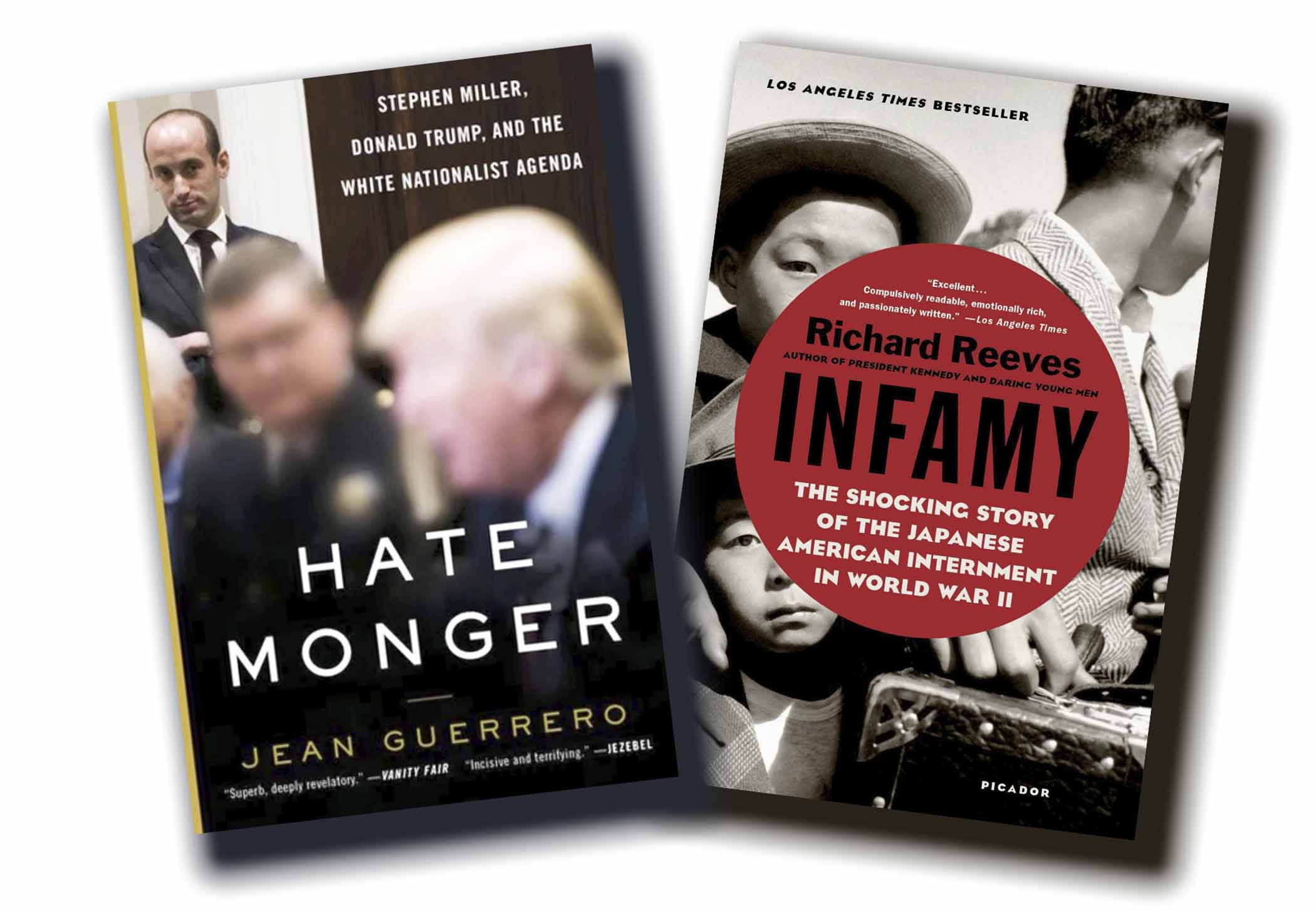
It doesn’t come as a surprise, then, that Miller’s current orchestration of immigrant round-ups echoes (and even emulates) another shameful, openly racist episode of deportation in U.S. history, one that’s vividly described in Richard Reeves’s Infamy: The Shocking Story of the Japanese American Internment in WWII. That story, Reeves writes, is “a look into a dark side of the ‘American Way,’” one in a long line of other abuses, including (from his paragraph-length list) “the treatment of Native Americans … the enslavement of Africans … Jewish quotas … and the excesses of the House Un-American Activities Committee.” Reeves says he decided to write the book “when I saw that my country, not for the first time, began turning on immigrants.” It was published in 2015, the year Trump came down the golden escalator to announce his candidacy for president and declare that Mexico was “sending people that have lots of problems, and they’re bringing those problems with us [sic]. They’re bringing drugs. They’re bringing crime. They’re rapists. And some, I assume, are good people.”
The internment of Japanese Americans began in 1942. On February 19 of that year, a little over two months after the Japanese attack on the American fleet at Pearl Harbor, President Franklin Delano Roosevelt issued Executive Order No. 9066, authorizing the creation of restricted-access military zones. At first glance, this would seem a reasonable measure in a time of war. But, as Reeves explains, it was part of a “craftily worded legal strategy” from the Miller-like figure Karl Bendetsen — a sly, bigoted, ambitious Army colonel who’d been put in charge of clearing out the Japanese, and who, in Reeves’s summation, “could have been a calculating character in a bad spy novel.” The first military zone, Reeves explains, “was all of the West Coast from California to Washington State and a corner of Arizona within two hundred miles of the coast.” It was a designation that gave the president an official reason — a military reason — to evict anyone considered an enemy.
Roosevelt didn’t rush into the decision. As Reeves writes, “he was a man with a lot on his mind … absorbed with the logistics and politics of a two-front war — against the Nazis and the Fascists across the Atlantic and Imperial Japan across the Pacific.” Yet despite reports from experts and government operatives dismissing the risk of “anti-American activities” from the Japanese population, FDR succumbed to the fears of sabotage whipped up by the press and by members of Congress: that Japanese Americans would be loyal to Japan’s militarism based solely on ancestry. That paranoid assertion had become more ridiculous with the twisted, Kafkaesque logic from Bendetsen’s boss, General John DeWitt, who warned that “the very fact that no sabotage has taken place to date is a disturbing and confirming indication that such action will take place.”
Trump would undoubtedly define a “horrible criminal” — laws be damned — as anyone who ever defied or blasphemed him, anyone he considers his political enemy. Such as, say, former FBI director James Comey? Or Bruce Springsteen?
Roosevelt, also “influenced by the news … that Japanese troops were invading Singapore,” issued the order: Remove 120,000 Japanese Americans — two-thirds of whom were U.S. citizens — from the vast, newly designated military zones and send them to remote prison camps, all without trials or hearings. “The matter, if not the manner, was settled,” Reeves writes. “Roosevelt had made it as clear as he could: he did not want to hear any more of this.” The president distanced himself from the entire operation, letting others handle the specifics.
Fueled by war hysteria, racism against the Japanese grew extreme, spreading everywhere. Idaho governor Chase Clark, protesting the possibility of prison camps in his state, said, “The Japs live like rats, breed like rats, and act like rats. I don’t want them coming into Idaho.” Congressman Jed Johnson, of Oklahoma, Reeves writes, “was demanding the sterilization of all American Japanese.” The political cartoonist of PM, a New York City newspaper, drew a malicious racial caricature of the supposed threat, described by Reeves as “multitudes of bucktoothed, squint-eyed Japanese lined up across the entire West Coast to be given packs of dynamite … the artist’s name was Theodor Seuss Geisel, later to become famous writing children’s books under the name Dr. Seuss.” Hatred in the U.S. directed toward the Japanese never reached the same levels toward the two other main adversaries in the war, the Germans and the Italians — which only served to emphasize the long-standing racial animosity many Americans held against Asia. “Suspect German and Italian agents were in Justice Department prisons and camps,” Reeves notes, “but despite DeWitt’s pleadings there was never any serious discussion of mass evacuation.”
Ruthless in establishing the scope of the round-ups, Bendetsen, with Nazi-like fervor, ordered the imprisonment of everyone who had, as the Colonel himself said, “one drop of Japanese blood in them.” This included infants, adopted children, and orphans. One Catholic priest, in charge of an orphanage targeted by federal agents, called Bendetsen “a little Hitler.” FDR’s wife, Eleanor, worked behind the scenes to get her husband to soften the draconian orders, but avoided public displays of sympathy that might be considered unpatriotic in the midst of a war with the Japanese.
Conditions in the camps, many of them located in “deserts, swamps, and other terrible places where few people had ever lived or ever would,” were deplorable. In Manzanar, “a barren, wind-whipped ghost town … in the foothills of the Sierras,” primitive tar-paper shacks (surrounded by barbed wire and gun-toting soldiers) barely qualified as shelters from dust storms and frigid temperatures. Mattresses were straw-filled bags. To use the latrine, prisoners often had to trudge through snow or mud, followed at night by a searchlight. In Oregon, a Portland livestock pavilion became an assembly center, with “more than three thousand people living in stalls built for cattle, hogs, and sheep.”
Stephen Miller is undoubtedly aware of this history. The parallels between then and now are striking. Like FDR, Trump invoked the Alien Enemies Act, which gives the government the power, in wartime, to deport “foreigners.” Trump, without a real war, has concocted one, labeling the border crossings “an invasion,” though the Supreme Court has, for now — in one of its few decisions that thwart the White House — blocked immediate deportations (but not detainment) based on this fabrication.
And just as FDR designated the entire West Coast a military zone in order to make the Japanese American internment quasi-legal, Trump has declared that a 170-square-mile strip of federal land along the southern border with Mexico — spanning California, Arizona, and New Mexico (with an additional section in Texas) — is now a so-called National Defense Area. This permits active-duty personnel stationed on the border (now at a whopping 10,000) to apprehend migrants entering the zone, thereby justifying, via entrapment, the military presence there. More importantly, and more authoritarian, the designation also helps the government avoid violations of the Posse Comitatus Act, which prohibits troops from enforcing domestic policy — precisely what Trump has ordered them to do. A federal magistrate judge in New Mexico has found the scheme specious, dismissing military-trespassing charges against at least 100 migrants who stumbled into the area. But it’s unclear how much of a setback this represents for military involvement at the border. The judge’s dismissals were “without prejudice,” meaning that prosecutors can re-file the charges.
Within the Trump regime, there is also the same Kafkaesque fervor that General DeWitt proffered in 1942 for the internment of innocent, law-abiding Japanese Americans, in which the absence of evidence proves the guilt. In a sworn affidavit filed in federal district court in March, field office director for ICE, Robert L. Cerna, defended his department’s abductions of Venezuelan men by asserting that “the lack of specific information about each individual actually highlights the risk they pose.”
Miller’s white-nationalist drive has also targeted international students — mostly, immigration attorneys report, people of color. By the end of April, the Trump administration had revoked over 1,800 student visas (according to an analysis by the publication Inside Higher Ed), often without providing any reasons at all. More severely, the administration is going after students who have advocated pro-Palestinian positions, calling them a risk to national security, with accusations of antisemitism and ties to Hamas.
This was the charge against three Ph.D. candidates — Rumeysa Ozturk (Tufts), Mahmoud Khalil (Columbia), and Badar Khan Suri (Georgetown) — who were abducted off the street or from their homes by unidentified ICE agents, shackled, taken away in unmarked cars, and imprisoned.
In each case, the evidence of a national security risk was absurd. The truth is, the students had done nothing more than publicly voice legitimate criticism, on humanitarian grounds, of Israel’s ongoing attacks on, and forced starvation of, Gaza civilians. (According to the International Committee of the Red Cross, after Hamas killed 1,200 Israelis on October 7, 2023 — two-thirds of whom were civilians — the Israeli military has killed more than 54,000 Palestinians, including 14,500 children, and wounded over 125,000 people in Gaza.) Ozturk, a Turkish citizen with a student visa, co-authored a single op-ed (signed by 32 others) in the student-run Tufts Daily; Khalil, an Algerian citizen with a green card, helped lead pro-Palestinian protests on campus and negotiated with University officials over activist encampments; and Khan Suri, an Indian national, made a few posts on X critical of Israel’s assaults on Gaza, including the accusation of war crimes for the bombing of hospitals. While it is true that Khan Suri’s father-in-law, Ahmed Yousef, was an adviser to Hamas a decade ago, Khan Suri’s limited contact with him has concerned only family matters. And Yousef himself has been recently critical of Hamas violence. The Trump administration offered no evidence to the contrary.
The imprisonment of these three students received a fair amount of coverage as cases widely considered to be blatant abuses of Constitutional rights, if not human rights, and significant examples of imposed authoritarian terror. But most mainstream outlets failed to mention another aspect of the Trump administration’s authoritarian designs: The students had been sent to private, for-profit prisons contracted by the feds.
These weren’t happenstance occurrences, as ICE falsely claimed in the case of Ozturk, lying about the lack of prison beds in the New England area (she’d been snatched off a street in Somerville, Massachusetts). Her internment in the South Louisiana ICE Processing Center, in Basile — a facility operated by the GEO Group, the largest prison corporation in the U.S. and ICE’s main provider of internment — was a tactical move, an attempt to make her disappear, far away from colleagues and legal help, into a harsh, inaccessible system notorious for its abuses. “Unlike state-run prisons or local jails in states with oversight bodies,” Amanda Hernández explains in an article about the for-profit business of incarceration, “privately operated ICE detention centers are not subject to state inspections or regulations.” When you add the profit motive — keeping the beds filled while limiting costs — the results aren’t surprising: overcrowding, poorly paid staff with minimal training and low morale, rampant maltreatment of prisoners, inhumane conditions, bare-bones services, and a general secrecy that can make it very difficult, even for attorneys, to see or get information about the incarcerated. In a report issued in August 2024 by the Robert F. Kennedy Human Rights organization on for-profit immigration detention centers in Louisiana — operated by both the GEO Group and LaSalle Corrections — the abuse of inmates met the legal definition of torture.
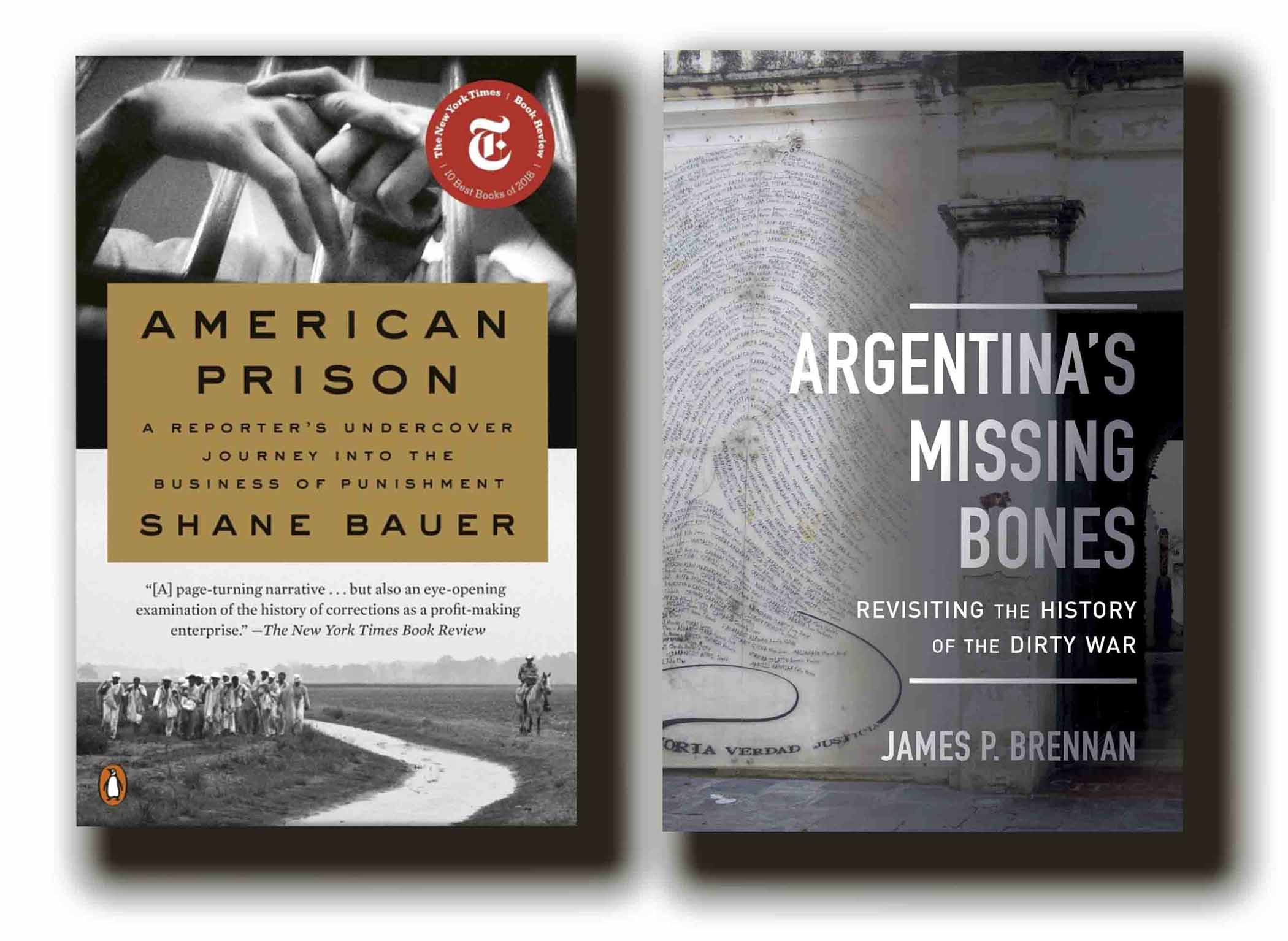
You can get a sense of this black-hole horror in Shane Bauer’s eye-opening American Prison: A Reporter’s Undercover Journey into the Business of Punishment. You might remember Bauer from 2009, as one of three hikers in the mountains of northern Iraq who got too close to the border with Iran and ended up, with his friends, in the hell of Tehran’s Evin prison for two years. That experience led him to write an article for Mother Jones about the American private-prison system, which he developed into the book. To get a firsthand look at things on the inside, Bauer took a job, undercover, as a security guard at a private prison in Winnfield, Louisiana, one managed at the time by Corrections Corporation of America (CCA) and now by LaSalle Corrections. It was one of the prisons called out in the RFK Human Rights report.
To enforce orders for repression — whether on racial, religious, or political grounds — fascist leaders need a lot of help, particularly at the lowest levels.
Bauer’s reporting reveals the place as a nightmare of cruelty and neglect. In one case, a prisoner on suicide watch, believed to possess a handmade knife, is excessively pepper-sprayed. He’s naked, per suicide-watch regulations, and “moaning in panic.” Members of a security team “walk past as if they don’t notice him.” The air burns so much that “cockroaches run around frantically to escape.…”
At one point, “stabbings begin to happen so frequently that … the prison goes on indefinite lockdown.” In one case, cell doors that have remained broken for weeks allow two inmates with a smuggled knife and ice pick to stab a third man 12 times. That victim gets sent to the hospital, but on another day, a man who simply collapses with fluid in his lungs does not. Hospital visits cost the company too much. “CCA,” Bauer writes, “finds ways to minimize its obligation to provide adequate health care.” Basic services, too, hardly exist. Staffing shortages have led to the elimination of the vocational programs and hobby shops. “The big recreation yard,” Bauer writes, “sits empty most of the time: There aren’t enough guards to watch over it.”
But some inmates get exercise in the surrounding woods, in a sadistic game that sounds like something out of the prison drama Cool Hand Luke. One of the three bored guards who handle a pack of bloodhounds tells Bauer, “I turn inmates loose every day and go catch ’em.” The inmates wear “bite suits” for protection, but one day the dogs managed to tear open someone’s throat. The guard keeps a picture of the injury and shows it to Bauer, seemingly with pride. “He was a piece of crap,” the guard says. “I gave him his gear and he didn’t put it on correctly. That’s on him.”
Later, an audit by the American Correctional Association (ACA) to check on conditions finds nothing wrong. “Two well-dressed white men in suits,” Bauer writes, “do not interview any inmates. They do a single loop and they leave.”
Ozturk, imprisoned in a GEO Corp facility for 45 days, and Khan Suri, imprisoned in Texas at a place operated by Emerald Correctional Management for 58 days, both reported, after being released, various instances of inhumane treatment: denial of medical care, denial of contact with loved ones or lawyers, overcrowding, the lack of a bed, dirty holding cells, excessive and painful shackles, and offensive behavior from guards. Khalil, locked up on March 8, remains in the La Salle Detention Facility, in Jena, Louisiana, another GEO Group prison notorious for its abuses. “But a federal judge has ruled that the imprisonment of Khalil is unconstitutional, and is ordering his release unless the Trump administration appeals the decision.”
President Biden had ordered the Department of Justice to end its contracts with private prisons, but not those used by the Department of Homeland Security, which administers ICE. In any case, Trump rescinded Biden’s order in January of this year, and, not surprisingly, plans to increase the federal stake — particularly, ICE’s interest — in the for-profit incarceration industry. Which means, almost certainly, more “disappearances” of brown and Black immigrants, migrants, and international students.
The expanding use of black-hole prisons, including the CECOT snake pit, also might mean disappearances of American citizens. In mid-April, Trump said, “I would love to do that…. Why should it stop just at people who cross the border illegally? We have some horrible criminals, American-grown and born.” Bondi, he said, was “studying the laws.”
Legal experts claim that various parts of the Constitution would prevent such a move, including the Eighth Amendment, which prohibits “cruel and unusual punishments” of criminal defendants. But that cherished document, as well as any rulings from the courts involving that document, mean nothing to this administration. Defiance of the courts, or finding loopholes to work around them, is becoming part of domestic policy. Certainly, no one in the administration seems to consider CECOT “cruel and unusual.” And Trump would undoubtedly define a “horrible criminal” — laws be damned — as anyone who ever defied or blasphemed him, anyone he considers his political enemy. Such as, say, former FBI director James Comey? Or Bruce Springsteen?
Throwing agitators in prison is, of course, a key part of the fascist playbook. In Argentina’s Missing Bones: Revisiting the History of the Dirty War — a look at one of history’s more monstrous episodes of political repression — James P. Brennan, associate professor of history at the University of California, traces such violent methods of control back to the “brutal British counterinsurgency in Ireland in the 1920s,” and to the Nazis’ “Nacht und Nebel” decree of 1941, which “authorized the army and Gestapo to make underground resistance fighters disappear into the ‘night and fog,’ a chilling prequel to Argentina’s dirty war.”
Argentina’s nearly 10-year span of despotic rule began in 1974, under the Peronista regime, and continued, more brutally, after a coup in 1976, under the dictatorship of a military junta, led by General Jorge Rafael Videla. It was the junta, borrowing the tactic from Chile, who fully brought the term “disappearances” into the lexicon of tyranny, as they tried to eliminate Argentina’s political left wing. Brennan defines the “essential character” of that junta as a “terrible triptych: disappearance, detention, and death. People were generally abducted by small bands of civilian-dressed masked men … Abductions took place most frequently in private homes but also in the streets … and even at factory gates.”
Is it so far-fetched to imagine that the Trump administration’s abductions of immigrants could grow to include anyone deemed politically dangerous? Could Argentina be a chilling prequel to Trump II’s own dirty war? Already there are striking parallels to what occurred 50 years ago, right out of that same playbook — such as the abduction of Ozturk, carried out by a half-dozen masked plainclothes ICE agents.
Brennan writes about how the Argentinian junta’s “mechanism of deceit and denial became formulaic. During the worst years of the terror, from 1976 through 1978, individuals with missing family members wrote to the Ministry of Interior, requesting, often pleading, for information about their loved ones.” But, as Brennan explains, a “bureaucratic maze allowed both for the fragmentation of responsibility and a belabored, drawn-out process meant to exhaust the petitioner and discourage continued inquiries. It also maintained the regime’s fiction of legality and rule of law.” Writs of habeas corpus were submitted to the courts, but “the dictatorship oversaw a dismantling of constitutional guarantees of all sorts and, through decree, passed new laws in accordance with its antisubversive fixation, facilitated by an obliging judiciary.”
To enforce orders for repression — whether on racial, religious, or political grounds — fascist leaders need a lot of help, particularly at the lowest levels. “In the end,” Brennan writes, getting to the crux of Argentina’s brutality, “the cravenness and even collaboration of the courts, the complicity or at least silence of the Catholic Church hierarchy and the involvement of business groups notwithstanding, it was the security forces themselves, controlled and coordinated by the Third Army Corps, that perpetrated the violence and carried out the dirty war.”
In studying the Holocaust, historian Daniel Goldhagen highlighted a similar class of functionaries — police battalions — who ultimately enabled the round-ups and massacres of Jews, famously concluding, “German political culture had evolved to the point where an enormous number of ordinary, representative Germans became — and most of the rest of their fellow Germans were fit to be — Hitler’s willing executioners.”
Goldhagen was criticized by other historians for exaggerating the depth of German antisemitism and for claiming it to be Germany’s long-embedded national identity. But his fundamental thesis — that hate toward a particular group can persist and strengthen in a population over generations — seems pretty reasonable. And it might have more relevance in the far shorter history of the United States.
If you replace antisemitism with racism, you will find in America an evolution of hate across the decades very similar to what Goldhagen saw in Germany. Not just hate, but embedded and institutionalized hate. Read Richard Reeves on the internment of Japanese Americans, or read Shane Bauer’s chapters on the history of for-profit prisons, specifically the treatment of Black inmates after the Civil War used for plantation labor, and you’ll be reminded, by gut-wrenching descriptions, of how vicious that hate could get.
And now that evolution has culminated in our present moment, when MAGA bureaucrats in the U.S. government are enacting a white-nationalist policy to erase Black and brown culture, when masked functionaries of ICE and private prisons are committing acts of ethnic cleansing, when a sycophant like Riley Moore earns points by cheering the imprisonment of young Latino men in a death camp, when — to borrow from Goldhagen — an enormous number of ordinary, representative Americans have become Trump’s willing lackeys. ❖
In the Voice’s previous incarnation, Robert Shuster wrote pieces on art, culture, and books. He is the author of the novel To Zenzi.
∼ ∼ ∼
How to Resist the Trump Regime
If you’re an activist leader, or a potential one, see “Fighting the Rerun President’s Dark Vision of Autocracy” for guides on brainstorming, planning, and staging demonstrations.
If you’re looking to get involved in other organized protests, check out:
Indivisible.org, where you can search for groups and events
NoKings.org, the organizer behind the nationwide June 14th protests
MaketheRoadNY, a group based in Queens that supports the immigrant community
FiftyFifty.One, a grassroots movement that provides a list of nationwide events


