



Starting in 1955, the Village Voice wrote (and photographed and illustrated) a crucial slice of journalism’s “first draft of history,” helping to define what post–World War II America was becoming. If you were an artist, writer, performer, filmmaker, musician, social critic, politician — local or national — or just a camp follower of the zeitgeist, you’d eventually find your way downtown.
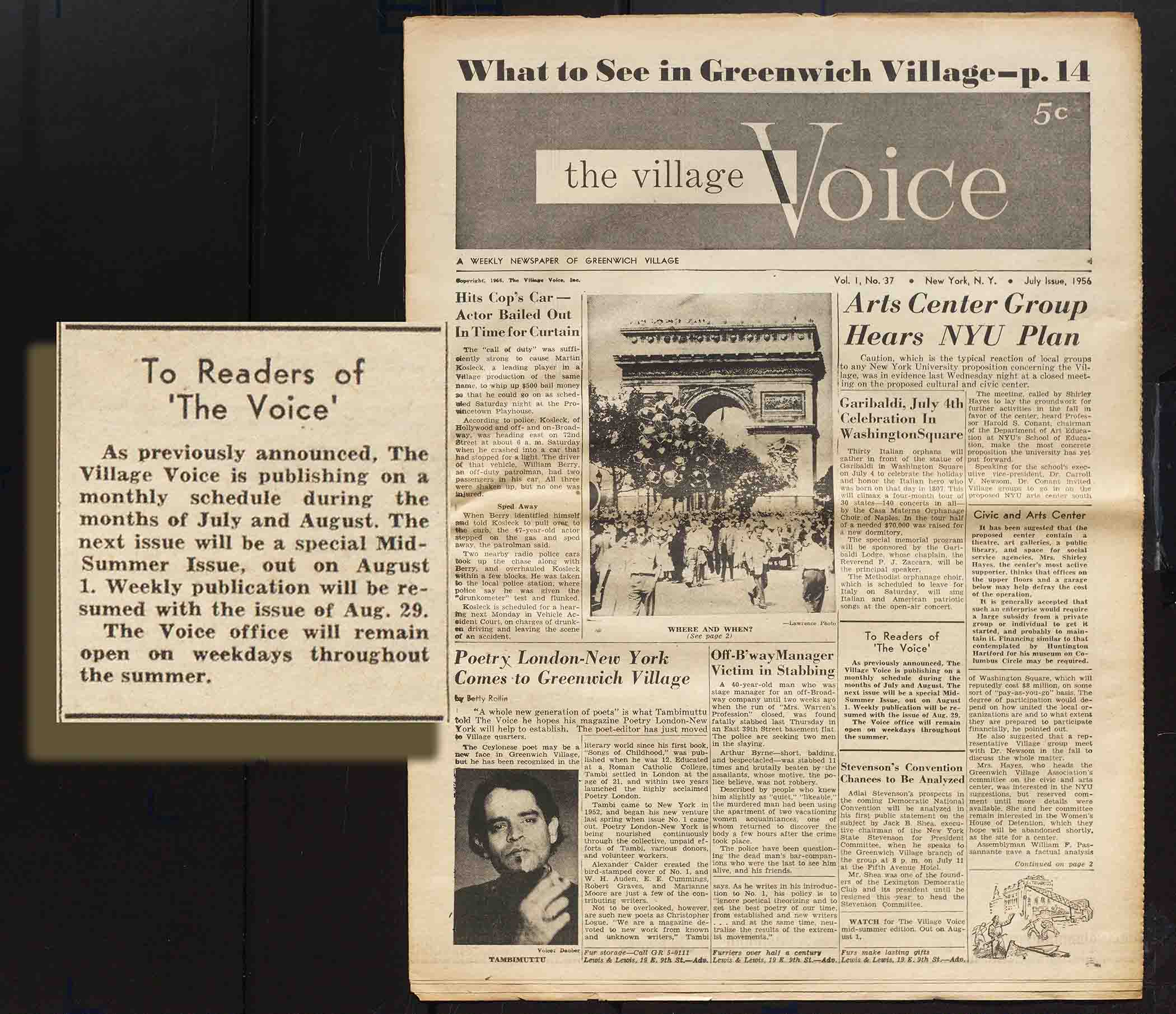
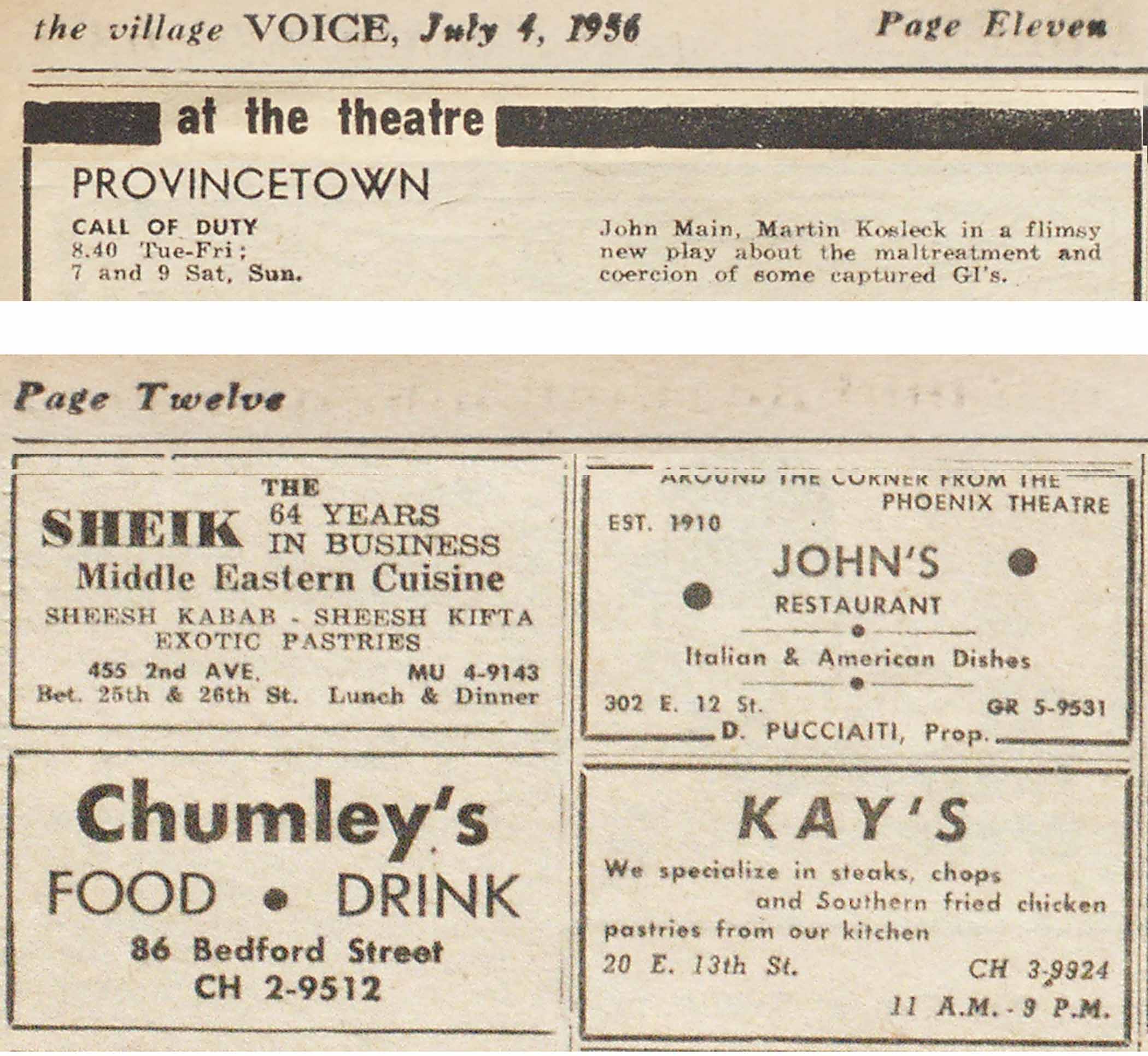
The Voice offices were then at 22 Greenwich Street, and though the writers and editors and business staff could easily traipse off to avant-garde theaters, cutting-edge galleries, and welcoming eateries such as Chumley’s, on Bedford Street, the city could get pretty unbearable in the dog days of summer. On the front page of the July 4, 1956, issue, the editors included this notice:
To Readers of ‘The Voice’
As previously announced, The Village Voice is publishing on a monthly schedule during the months of July and August. The next issue will be a special Mid-Summer Issue, out on August 1. Weekly publication will be resumed with the issue of Aug. 29.
The Voice office will remain open on weekdays throughout the summer.
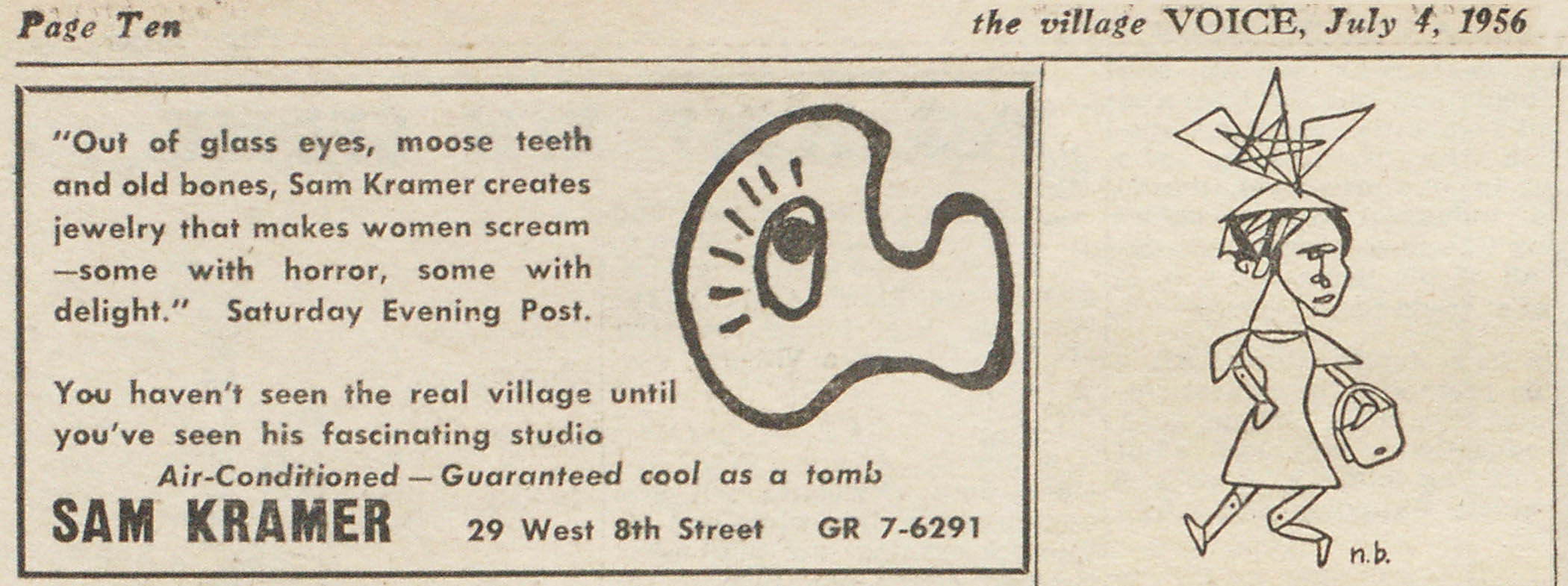
Back then, air conditioning was far from the norm; on page 10 of that edition, the surrealist jeweler Sam Kramer invited Greenwich Village flâneurs and tourists to visit his studio with this come-on: “Air-Conditioned — Guaranteed cool as a tomb.”
As always, a Voice front page was a crazy quilt of culture and current events. For instance, Adlai Stevenson was in town to talk to the local Democrats, presumably to determine if he was fit to once again be the lamb led to slaughter against Dwight Eisenhower, the former World War II supreme commander, who had defeated the Illinois governor in the presidential race in 1952 by double digits. Another story covered Village residents’ concerns about NYU’s expansion plans: “Caution, which is the typical reaction of local groups to any New York University proposition concerning the Village, was in evidence last Wednesday night at a closed meeting on the proposed cultural and civic center.”
But one story especially caught our attention, 70 years later, and we repeat it in its entirety:
Hits Cop’s Car — Actor Bailed Out In Time for Curtain
The “call of duty” was sufficiently strong to cause Martin Kosleck, a leading player in a Village production of the same name, to whip up $500 bail money so that he could go on as scheduled Saturday night at the Provincetown Playhouse.
According to police, Kosleck, of Hollywood and off- and on-Broadway, was heading east on 72nd Street at about 6 a.m. Saturday when he crashed into a car that had stopped for a light. The driver of that vehicle, William Berry, an off-duty patrolman, had two passengers in his car. All three were shaken up, but no one was injured.
Sped Away
When Berry identified himself and told Kosleck to pull over to the curb, the 47-year-old actor stepped on the gas and sped away, the patrolman said.
Two nearby radio police cars took up the chase along with Berry, and overhauled Kosleck within a few blocks. He was taken to the local police station, where police say he was given the “drunkometer” test and flunked.
Kosleck is scheduled for a hearing next Monday in Vehicle Accident Court, on charges of drunken driving and leaving the scene of an accident.
Always curious about unfamiliar actors, artists, musicians, writers, or general scenesters who pop up in these early columns — when the Voice was as much neighborhood tattler as cultural/political arbiter — we looked up Martin Kosleck and discovered that he came by his distrust of authority honestly. Born in Germany in 1904 (he apparently shaved some years off his age in the police report), Kosleck was a rising actor there, but left his homeland when his open antipathy to the Hitler regime caught the attention of Joseph Goebbels, the powerful Reichsminister of Public Enlightenment and Propaganda. Kosleck found his way to America, eventually landing roles in The Merchant of Venice on Broadway and at Warner Bros. studios. According to IMDb, one film critic favorably described him as “the definitive Nazi swine,” and he indeed got his revenge on his early persecutors by portraying Goebbels, in all his sinister loathsomeness, in five different productions, including 1939’s Confessions of a Nazi Spy. Released two years before the attack on Pearl Harbor that drew the U.S. into the worldwide conflict, the film focuses on the anti-democratic “America for Americans” pro-fascist propaganda then in vogue among that generation’s “America First” crowd. Like many expatriate European actors in this and other films of that time, Kosleck performed uncredited, in hopes of preventing retaliation against relatives still in Germany.
A critic in the Los Angeles Daily News opened a review of Confessions with these observations:
Suffice to say Hitler, Goebbels, Goering and others of the party will not like “Confessions of a Nazi Spy.” Warner Bros., however, may rest assured of having done a patriotic service to the American people in making such a picture possible.
For after glimpsing this factual document exposing a terrifying espionage system and stealthy spread of alien propaganda in a peace loving nation, it teaches the thoughtful citizenry of the United States the necessity of awareness. Nothing is impossible in the world of today. Truth is fiction and fiction truth. So the importance of the film at Warners’ Downtown and Hollywood theaters is to stress the fact that one cannot afford to sit back and disregard a danger as not being able to happen to them.
Might not be a bad time to check out an 87-year-old flick. Sounds plenty timely. ❖