




In 1941, media mogul Henry Luce penned “The American Century” for his own Life magazine, opining in his opening lines, “We Americans are unhappy. We are not happy about America. We are not happy about ourselves in relation to America. We are nervous — or gloomy — or apathetic.” By turns imperialistic and idealistic, Luce’s essay fretted over Adolf Hitler’s viciousness abroad and Franklin Roosevelt’s big-government largesse at home, all while cheerleading for America to get into World War II on the side of England. At one point, Luce noted that the U.S. was the “intellectual, scientific and artistic capital of the world,” but he pointedly left out the visual arts by stating, “American jazz, Hollywood movies, American slang, American machines and patented products, are in fact the only things that every community in the world, from Zanzibar to Hamburg, recognizes in common.”
After the war, however, the magazine boosted numerous New York School artists, including a 1949 feature asking, “Jackson Pollock: Is he the greatest living painter in the United States?” Two years later, Life published the famous “Irascibles” photo: 15 artists who were part of a group of painters and sculptors who had sent a letter to the Metropolitan Museum protesting its provincial attitudes toward “advanced art.” The photo featured 14 male painters, including Pollock, Willem de Kooning, Adolph Gottlieb, Robert Motherwell, and Mark Rothko, as well as a lone woman, Hedda Sterne.

Half a decade later, however, the macho mythos of the abstract expressionists was getting a bit long in the tooth. One of the movement’s founders, Arshile Gorky, had hung himself in his Connecticut barn/studio way back in 1948; in 1956, a drunken Pollock had been killed when he crashed his Cadillac; Willem de Kooning, struggling with alcoholism and depression, was soon dating Jack the Dripper’s sexy young girlfriend, who had survived the Caddie smash-up on Long Island.
“Never be too sentimental. Control your emotion, directing it into a strong channel of expression, transposing it into effective sentiment.”
But if the guys were losing some of the mojo that came from Manhattan being the world’s post-war art capital, a quintet of women were receiving a boost from Life. The May 13, 1957, issue offered a four-page feature with the headline:
Women Artists in Ascendance
Young group reflects lively virtues of U.S. painting
One of the largest-circulation weeklies in the country was acknowledging that the American Century, well into prosperous overdrive, was also going to have to contend with a continuation of the gender egalitarianism that had been a hallmark of the war years.
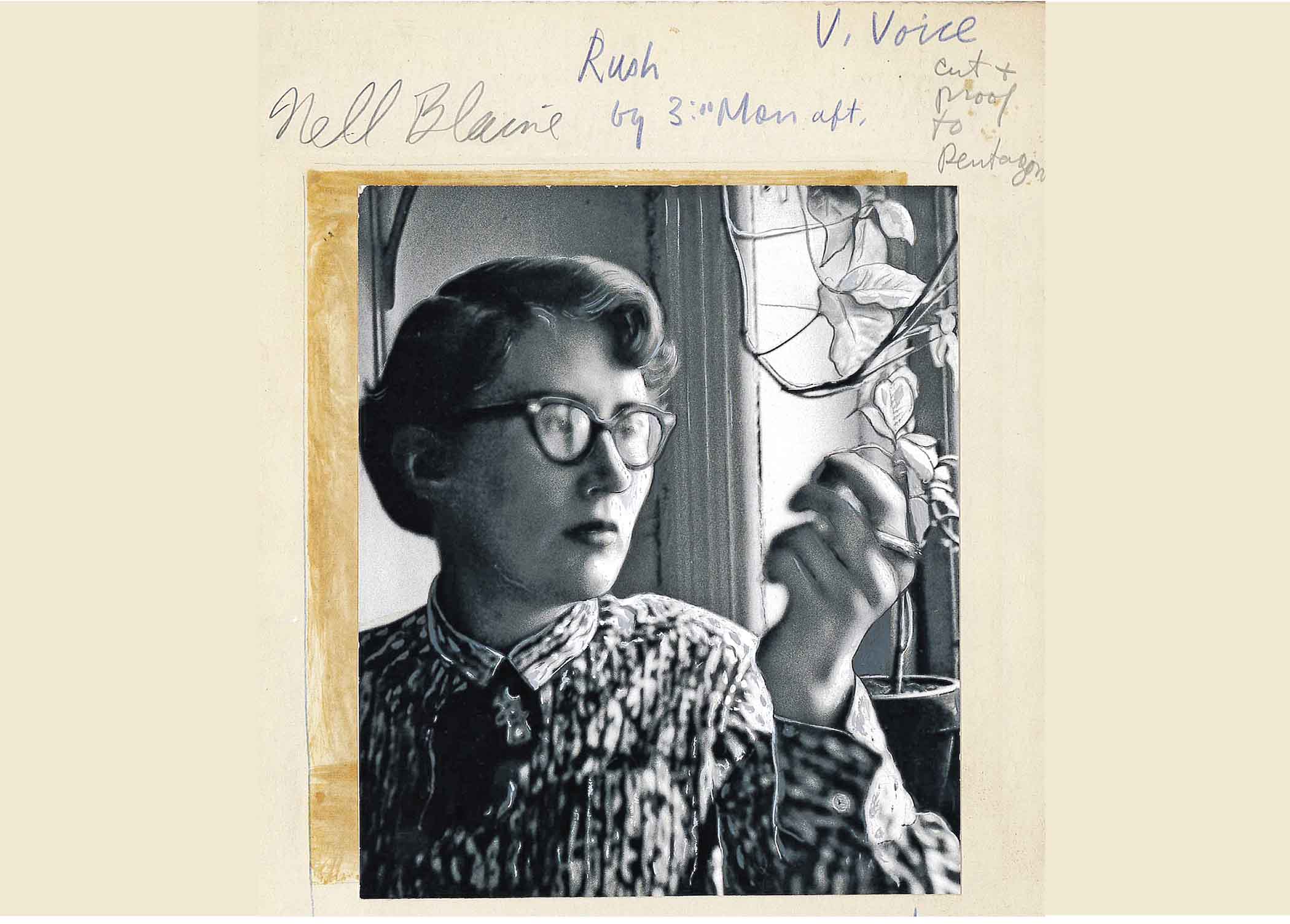
Certainly, three subjects of the article — Joan Mitchell, Grace Hartigan, and Helen Frankenthaler — had for years been holding their own as abstract innovators amid the ab-ex boys’ club. Another painter is pictured sprawled on a chic divan over a caption that informed readers, “Though she works as a New York fashion model, Jane Wilson spends up to eight hours a day painting.” That time in the studio paid off, as Wilson would become known for her atmospheric landscapes. But of the chosen five, it is Nell Blaine — posed sitting on the floor of what looks to be, with its exposed brick and heavy molding, a Village apartment — who comes across as the most downtown-spirited of this NYC-based quintet. Indeed, Blaine, who was born in Richmond, Virginia, in 1922, once told a critic that New York was her “Mecca.” In the Life photo, she is surrounded by her bold still lives and dynamically abstracted figures. The caption reads, in full:
Warmth and light
Enamored of nature and, as she says, “the light around things,” Nell Blaine paints outdoor scenes and still lifes at her windows with the exuberant lines and warm tones of a bouquet. From Richmond, Va., she lives in New York and supports herself by doing layout work and teaching painting.
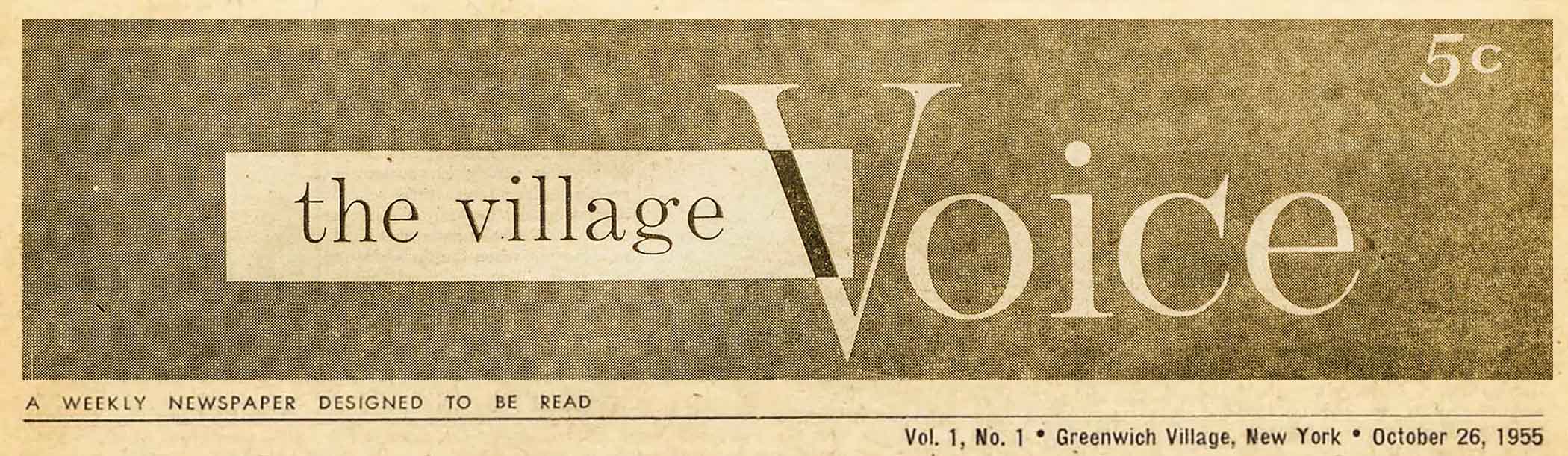
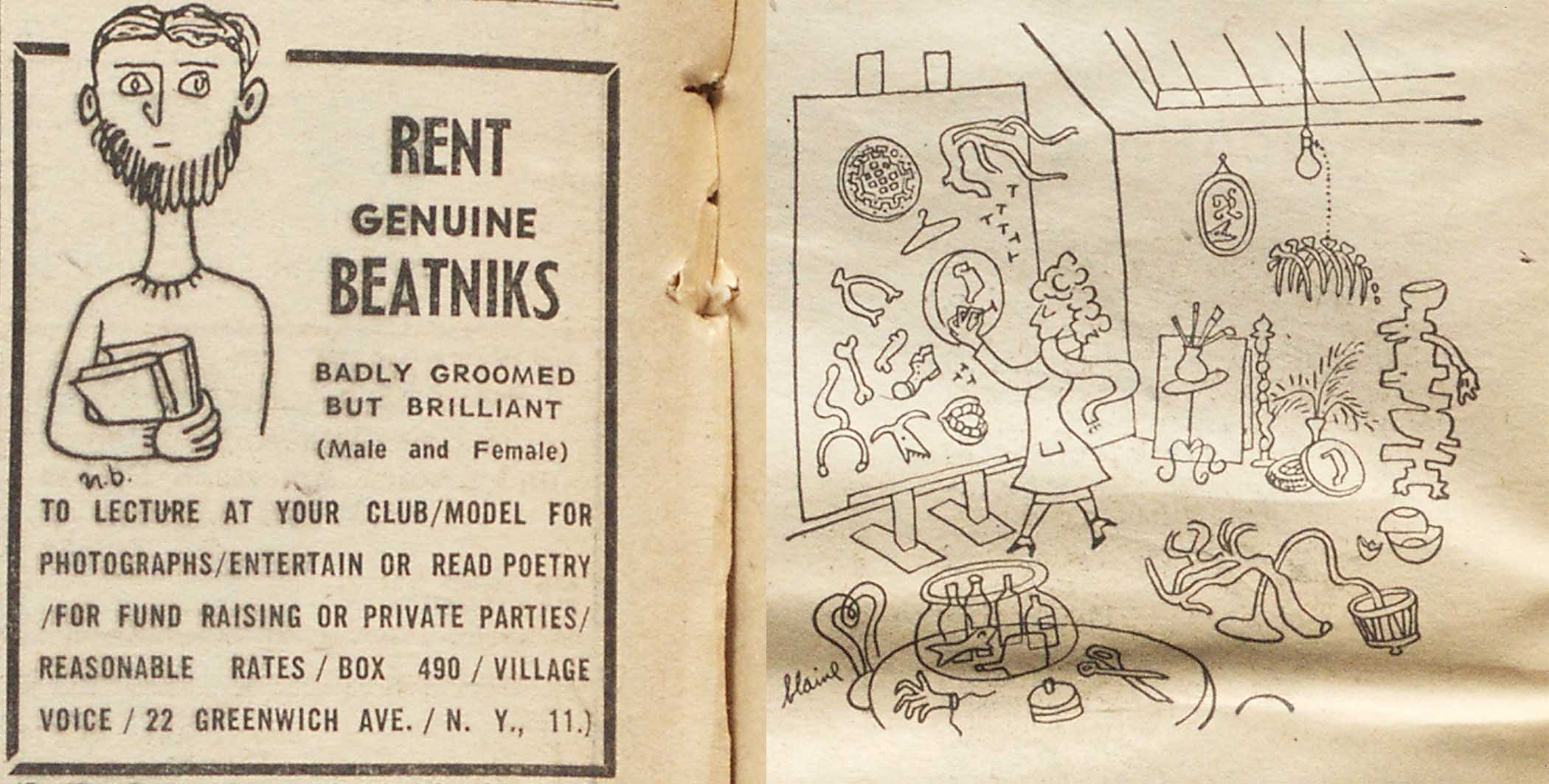
“Layout work” is a bit of an understatement, considering that two years earlier, Blaine had designed the elegant logo for an upstart weekly newspaper, the Village Voice, to which she also contributed copious spot illustrations. By then, Blaine had already gained recognition as a painter, one who had worked relentlessly since arriving in the city the previous decade. In one of her notebooks, she wrote, “The beginning — Dec. 1942,” referring to classes she was taking with the German-born proselyte of abstraction, Hans Hofmann (1880–1966). On the facing page, she wrote, “THE GENERALITIES,” which included such exhortations as:
Must learn to fly in canvas.
Transcend the everyday.
Never be too sentimental. Control your emotion, directing it into a strong channel of expression, transposing it into effective sentiment.
Intensification through opposition.
Believe in your own feelings.
Have sense of freedom always.
Bad experiences are the best experiences.
The coming years would surely test Blaine’s faith in that last notation, but the hard-edged abstractions she created while studying with Hofmann would add compositional dynamism to her later work. This can be clearly seen in the exhibition Gloucester Harbor and Other Works, at Tibor de Nagy (through April 18). In the 1954 watercolor “Gloucester Harbor from Rocky Neck,” the red booms and masts of sailboats stand out as boldly as crosses in a crucifixion scene, offering a baroque contrast to the delicate swathes of blue, green, and beige water. A smaller (17 x 27 inches) ink-wash drawing from 1986, “The Harbor from Banner Hill,” scintillates from the rich black strokes deliniating boats, docks, and buildings against quick, evanescent wisps representing ripples, clouds, and bushes. Blaine’s gestures have a directness that conjures an ambience of lapping water, creaking gunwales, and gentle breezes.
In between these two works, however, came Blaine’s devastating bout with polio, which she contracted while on a painting trip to Greece in 1959. After a stint in an iron lung and confined to a wheelchair, she trained herself to paint with her left hand since she could no longer raise her right to the easel; following a later surgery, she was able to work with her right hand on flat surfaces. A 1960 watercolor done in the hospital, Mt. Sinai Bouquet, shot through with judicious blue-grays amid more flowery colors, reveals Blaine’s iron determination to regain the physical ability to continue limning “the light around things.” In “Elizabeth’s Fruit Bowl and Coconut (Saratoga Springs, NY),” from 1961, both manual and conceptual dexterity are apparent in the gracefully bouncing blue lip of the bowl and bold black swatches that add abstract gusto to the background. That Blaine continued to work in the unforgiving medium of watercolor, which cannot be scraped out or reworked like oils (or erased, like a charcoal drawing), proved that she would not yield to any physical limitations.

Within a few years, with assistance, she was again painting outdoors, and one can only marvel at the breakneck brushstrokes, unexpected — yet harmonious — colors, and shifting focal layers of the 1967 oil painting “Rooftops, 94th Street.” It is obvious that Blaine was still employing such nonobjective concepts from Hofmann as “intensification through opposition” to enliven her realist scenes.

Despite losing the use of her legs, Blaine continued traveling internationally. Two different visions of a friend’s house in Austria are notable for their depictions of the shifting of light sources between rooms, agile evocations of furniture and a draped overcoat, mutable details of artwork on the wall, and audacious slabs of black ink anchoring each composition.
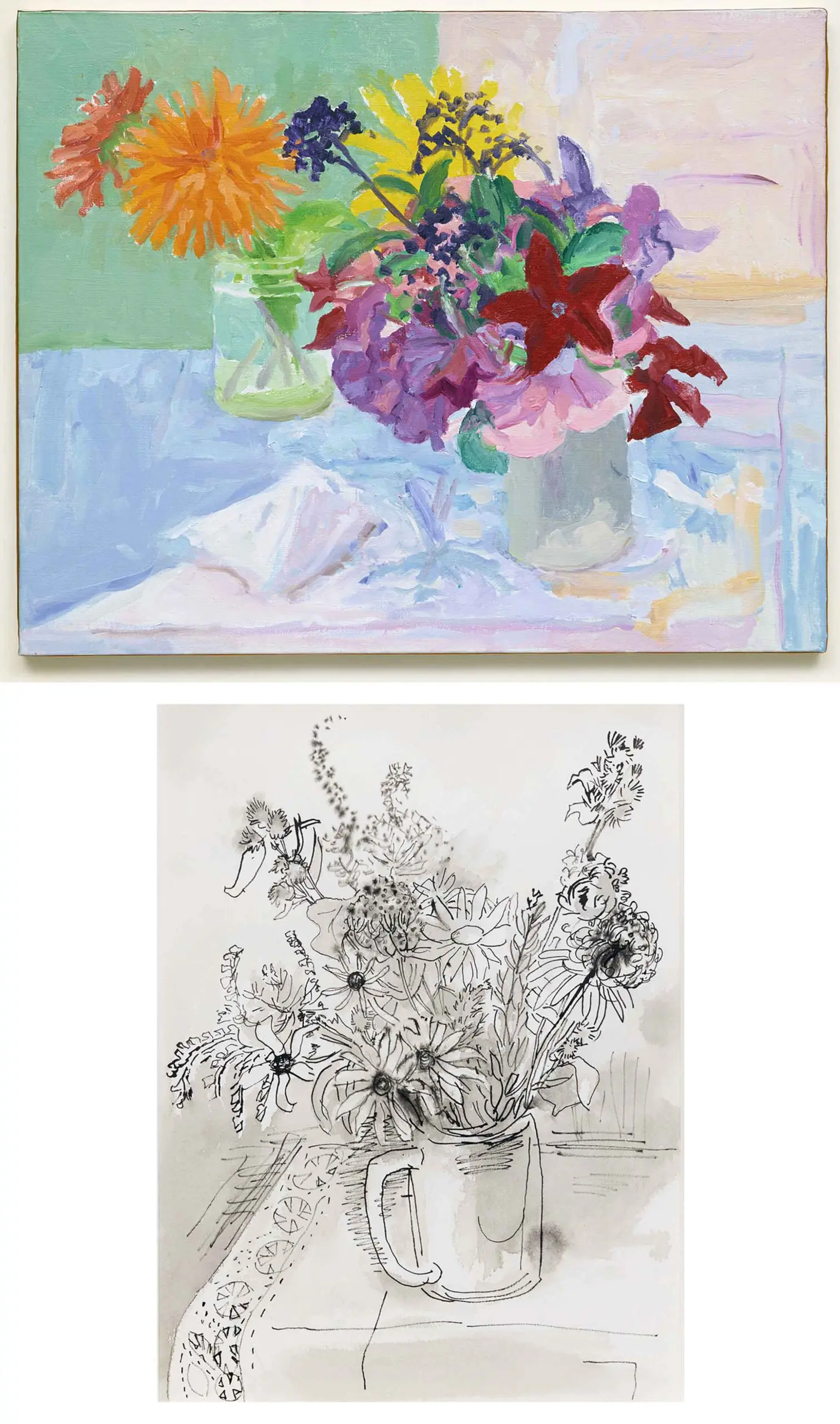
There is a sense of hard-won exuberance throughout these later works. Take a look at the flat squares of green and beige behind the unfurling flowers in the 1986 oil “Orange Burst and Red Star,” or the profusion of plant textures — from dainty fuzz to scratchy burrs to curling leaves to blotty petals (plus a rotating textile design) — in the 1974 ink drawing “West Wharf Bouquet.” Years before, doctors had told Blaine that she would never paint again, but she refused to accept that bleak verdict and focused all of her rehabilitation efforts on her hands and arms. Although she could no longer paint the large canvases that had established her career, smaller-scale work was still well within her grasp. She once said, “I can’t stand up, but I can go on,” and she was as good as her word. The 1996 watercolor “Winter Sun, Riverside” features the gray curve of an avenue, muted green and brown swathes of a city park, and a fiery orange sunset just beyond an icy blue Hudson River. Blaine died later that same year. ❖
Nell Blaine | Gloucester Harbor and other works
Tibor De Nagy
11 Rivington Street
March 14 – April 18, 2026