



Defense Attorney Steven Raiser: Let’s talk more about how the Government did not prove a homicide because what happened on May 1st, 2023 was not a chokehold death. And then we will address the actual cause of death, alluded to by [Medical Examiner] Dr. Harris throughout her testimony, as well as Doctor Chundru, which is a massive sickling crisis, which, according to Dr. Chundru, was brought about by K2 intoxication, schizophrenic break down and the struggle involving a modified chokehold. None of that equals a chokehold death…. Let’s talk about the utter lack of proof that [Jordan Neely] was rendered unconscious by a chokehold. So why is there such an utter lack of evidence presented to prove that Mr. Neely went unconscious at 3:09 in the Vazquez video? Because the truth is he didn’t. And we will go back to the transcript. Dr. Harris expressed her doubt that Mr. Neely was merely rendered unconscious at 3:09.
I asked her: “That he’s dying at 3:09, not merely unconscious?”
ANSWER: “Yes. I believe those represent signs of neurologic damage, those movements.”
QUESTION: “Which you characterized as agonal; correct?”
ANSWER: “Yes.”
QUESTION: “And agonal describes movements around death, not unconsciousness; correct?”
ANSWER: “Yes.”
It is undisputed, members of the jury, that unconsciousness always precedes death in a chokehold case. And their own, Dr. Harris, has doubts of unconsciousness, has doubt of phase one of a chokehold death…. Why would their own expert make such admission? Because there is no support, no proof that [Daniel Penny] rendered Mr. Neely unconscious at 3:09, it is instead irrefutable that Mr. Neely was already dead or dying at that time from another cause. Let’s talk about the chokehold. It is not disputed Danny did not employ a bloodchoke in exactly the manner he was trained. Sergeant Caballer used the word improper to describe the bloodchoke that Danny used. I submit to you, all Sergeant Caballer was trying to convey was that Danny applied something other than a textbook Marine bloodchoke. For that we all agree…. And this is how they [the Marine Corps Martial Arts Program] define a proper bloodchoke. A bloodchoke is performed on the carotid arteries located on both sides of the neck, which carries oxygen enriched blood from the heart to the brain. When executed properly, a bloodchoke takes between 8 to 13 seconds for the aggressor to lose consciousness. The bloodchoke is the preferred choke because its intended effect can be executed quickly, ending the fight.
So the botched, normally quick, clean kill “bloodchoke,” as it were, was laid at the feet of Jordan Neely — a violent, sickly junkie already a dead man walking? That credulity-strained mashup of blame dominated the December 2 closing arguments in the manslaughter trial of ex-Marine Daniel Penny, in Manhattan Criminal Court. Defense attorney Raiser had leaned heavily on the conflicting opinions of forensic experts to hack together an explanation: Penny — who choked Neely to death on a subway train to stop him from terrorizing fellow passengers — wasn’t truly responsible.
Raiser’s defense dredged up a moment of brutal irony from over 40 years ago, one that helped define racially biased arguments in the courtroom, deliberately melodramatized for winning. It also foreshadowed the shocking conclusion of the Penny trial and perpetuated a legacy of enduring injustice. Back then, the late legendary civil rights attorney William M. Kunstler had overheard me fretting about the mumbo jumbo that lawyers passed off as legal justification for subway vigilante Bernhard Goetz systematically gunning down four unarmed African American teenagers aboard a Manhattan train, in 1984. Kunstler, who had been observing closing arguments at Goetz’s 1987 attempted murder trial, brusquely interrupted. Anticipating that Goetz — nicknamed “the goofy headhunter of urban predators” by the now-deceased Harlem activist Elombe Brath — might evade a trip up the Hudson River to the infamous Sing Sing Prison, Kunstler scoffed. “Everyone!” — he blurted out, emoting with Churchillian grandiloquence — “Everyone! — is entitled to a defense, regardless of how incredible or nonsensical and twisted it may sound.”
“You give us nothing! And then you ask us to love this country. America hates Black people and we see it from that jury pool.”
Looking back, Kunstler’s pronouncement hit like a gut punch, forcing me to grapple with the polar opposite of what I expected from that ubiquitous defender of radicals and their causes. Undoubtedly, it was that brutal twist of irony — the sting of an unexpected contradiction in his words — that left me gobsmacked and staggered. Truthfully, Kunstler confided, steadying an arm on this reporter’s shoulder, the irony cut both ways: The same could be said about his racialized courtroom victories, which exonerated many an unpopular Black defendant deemed guilty in the eyes of too many white New Yorkers. You might remember Larry Davis, the South Bronx crack dealer from the 1980s who Kunstler, along with attorney Lynne F. Stewart, got off for the attempted murder of six police officers he shot during a gunfight, arguing, persuasively, that Davis had been set up by rogue white undercover cops he fronted for. A sympathetic jury couldn’t overlook the obvious and ultimately convicted Davis solely of illegal gun possession. The real consequences of Kunstler’s teachable moment, though rooted in challenging systemic injustice, often seemed to shield privileged white defendants from a true reckoning with criminal justice.
During the past six weeks, that emotional jolt struck with even greater relevance as I watched a disturbingly familiar playbook unfold at Daniel Penny’s trial. In an act of shameful advocacy reminiscent of Goetz’s incredible defense — he claimed he shot the young men who had approached him and allegedly demanded $5 because he perceived their alleged aggressive panhandling as an attempted mugging — Penny’s lawyers revived and retooled the same pseudo-scientific rhetoric historically used to justify violence against Black lives. In defining murder down, they craftily tinkered with the theory of the “bloodchoke,” claiming it — rather than Penny’s deadly use of “the collar” (cop jargon for the banned chokehold disproportionately applied to Black suspects) — was what killed Neely. With this inventive defense — implicitly instructing the jury on how to sneak up from behind for a surprise attack on “a crackhead” (as Penny described Neely in a recorded statement he made to police), “put him in a choke,” “put him out,” “put him down,” and, ultimately, get away with killing him — the defense succeeded in selling racially coded junk justice to a controversially selected jury consisting of seven women, five men, and, as the New York Post put it, “at least four people of color.”
Three days before the verdict, Chivona Newsome, co-founder of Black Lives Matter of Greater New York, exposed a painful truth about how race and class dictates whose lives are valued and whose deaths are justified: “I have to hug a father [referring to Neely’s dad, Andre Zachary, who was standing nearby] who knows that the murderer of his son will most likely go free, who has to look in the face of a jury that no matter the fact, no matter the expert witnesses, no matter the people yelling on that train that day ‘Let Jordan go; you will kill him” … they will not find a white man guilty of killing a Black man in modern day America. This is no different than Jim Crow.…When you look at that … jury, we have baby boomers, who were there during Jim Crow…. We have young people who are looking at Daniel Penny as a hero.… He didn’t give a crap about Jordan Neely. The medical examiner said Jordan turned purple. Yes, Black people can turn purple when they’re denied oxygen. Every lab report shows he died of asphyxiation, and that doesn’t matter, because they want to spare a white man the penalty of his crime. America has not changed, and I hate to say it, it may never change. And people who keep asking, are we gonna riot? Are we gonna protest? Is that what’s leading? Do glass have to break? Do cars have to burn for a Black man to get justice in America? We can show up with peace. We can show up with facts. We can show [up] with evidence and witness after witness. You give us nothing! And then you ask us to love this country. America hates Black people and we see it from that jury pool.”
A pool influenced, as if by fiat. Daniel Penny swiftly became a hero within the MAGA movement, exemplifying the right-wing media’s dominance in transforming polarizing figures like him into political icons of strength and defiance. Despite compelling evidence of Penny’s use of excessive force, the justice system let him off the hook. On December 9, the jury acquitted Penny of the lesser charge of criminally negligent homicide, in effect buying into the hype that the “bloodchoke” screwup is on Jordan Neely, not his expertly trained killer, while also characterizing Penny’s actions as “self defense or the defense of others.”
The defense attempted to reduce the tragedy to a mere timing dispute, sidestepping the broader ethical and legal questions surrounding Penny’s actions with a focus on irrelevant minutiae.
To be clear, it is not a “broken justice system” that set Penny free; it is a system that works exactly as intended — to once again protect privilege, absolve white violence, and summarily punish alleged Black offenders presumed guilty. That’s the consequence of embracing junk justice. If the roles were reversed — if a homeless Black man had choked a white Marine veteran, who was harassing passengers, to death — the media hacks, who thrive on sensationalism and racial dog whistles would have wasted no time branding him as “THE SUBWAY STRANGLER,” plastering his face across front pages to stoke fear and reinforce pernicious stereotypes; they would have fed their audiences a steady pablum of outrage and hostility, ensuring that the Black man’s infamy was etched into the public consciousness while stripping away his humanity. Instead, the pungent “SUBWAY STRANGLER” sobriquet was left to protesters, who created posters that called out Penny’s lethal actions. The 30-year-old Neely was a dancer for money, moonwalking through New York City’s transit underground in a vivid portrayal of the late pop icon Michael Jackson. By the time Penny, 26, encountered him, Jackson’s doppelgänger had hit rock bottom — malnourished, begging for a pittance, and unraveling in frustration at the indifference he felt from passengers that day.
As far as understanding the circumstances leading up to Neely’s death, they weren’t as unique as they might first appear. I have an almost-similar story to tell — one that somewhat reflects the tragic wandering of Jordan Neely.
On the frostbitten morning of December 2, at the height of rush hour, I sat a little anxious and jittery on a C train heading downtown to cover the first day of closing arguments in the Penny trial. I was still struggling with what this tragedy exposes about a city bitterly divided along racial lines over Penny’s rationale for taking Jordan Neely’s life into his own hands.
The night before, I had immersed myself in Allan Gibbard’s Wise Choices, Apt Feelings, a book about “a theory of normative judgment,” which explores the profound questions we face when evaluating and deliberating on the consequences of our beliefs and actions. The book asks questions such as: What does it mean to judge something, or a situation, as rational? What role does morality play in considering a life worth living? How should we interpret unconventional justification in claims it is grounded in moral and rational judgments? And when confronted with deep disagreements — without considering complexities, nuances, or alternative perspectives — how can we make sense of what’s reasonable and move forward? This was a book I wished I could distribute as Exhibit A among those sitting in judgment of Daniel Penny.
Compared to the typical sounds of bustling straphangers sniffling into tissues and clearing their throats, my car was unusually quiet — until a man sprung from his seat, his voice, loud and grating, rising and falling in disjointed reverberations. It was plain to see that the lanky stranger, shabbily dressed in dull gray hospital scrubs, his upper body swaddled in layers of dingy, tattered winter jackets and wearing a makeshift hat fashioned out of industrial-strength plastic garbage bags, was homeless. Ingenious in adversity, the hat stood as a testament to his resilience and creativity, an improvised shield against harsh weather and a haunting symbol of society’s neglect. Like a man fussing over the tilt of his fedora, meticulously adjusting it to achieve just the right angle, his rough, crinkled creation may have appeared off-kilter yet it embodied survival itself.
He anxiously rummaged through four overstuffed Fresh Direct shopping bags, then let out a frustrated sigh: He was looking for something that wasn’t there. “Where’s my calendar?” he shouted. “Who took my calendar?” His voice thundered and grew more intimidating, his halting English tinged with a Haitian Kreyòl accent. “You get pwoblems if I don’t get it!”
Then I saw the man moving in a way that might have felt threatening to other passengers. Women and children looked visibly uneasy as he stomped through the car, randomly targeting people, attempting to rifle through their pockets and handbags. “I want my calendar to see when I go to detox,” he shouted, his voice cutting through the uneasy silence. He grabbed at a woman’s pocketbook. “Do you have it? You have it?” he demanded. The woman clutched her bag tighter, avoiding eye contact, her face expressing a defiant attitude that conveyed the sentiment of “Mister, please, not this morning.”
Yet no one rebuked him. No one — driven by some heroic desire to rescue a city, which despite record numbers of tourists since the pandemic, is portrayed by right-wing bloviators as paralyzed by its fear of men like Jordan Neely — rode in on their iron horse. When the train stopped at 72nd Street, most of the women and children bolted to the platform or into other cars. Watching the scene unfold, I couldn’t help but think of Neely — how he had once bounded onto trains, hungry and hustling for his next meal. The memory of what happened between the homeless man and the ex-Marine surged back in a vivid replay of the events that would lead to their tragic confrontation.
The train pulled into the Chambers Street station, and before I got off I saw my would-be Jordan Neely, weighed down by the emotional baggage of past trauma, nodding forward into a doze.
By the time I reached the courthouse, the crisp winter air had given way to the claustrophobic heat of humanity packed into the narrow corridor leading to Judge Maxwell Wiley’s 13th-floor courtroom. The chaos of the city seemed distilled into a singular frenzy: Reporters jostling for position, the relentless clicks of camera shutters, and whispers of speculation from impatient courtroom observers filling the room with an almost palpable tension. I squeezed into a seat among the spectators just as the panel of jurors filed in and took their places in the jury box.
“All of us are born to endure what we don’t like sometimes, but it only makes us stronger in our paths of righteousness.”
And then came Raiser’s sharp pivot to the matter of the “51 seconds” — a chillingly precise timeframe that would dominate aspects of an incredible narrative the defense felt entitled to deliver to the jury in closing arguments.
I viewed Raiser’s focus on the “51 seconds” as a calculated attempt to divert the jury’s attention from the grim reality of what happened on the F train on May 1, 2023. By zeroing in on a set timespan, Raiser sought to obscure the undeniable fact: Daniel Penny’s prolonged chokehold resulted in Jordan Neely’s death. Rather than confronting the clear evidence of Penny’s actions, the defense counsel relied on technicalities and manufactured doubt to downplay the fatal outcome. Dissecting the testimony of Dr. Harris, the medical examiner, Raiser argued that the prosecution had failed to meet its burden of proof, portraying those 51 seconds as a critical gap in the government’s case. This was an effort to persuade the jury to dismiss the damning video evidence and the irrefutable reality of Neely’s death. In doing so, the defense attempted to reduce the tragedy to a mere timing dispute, sidestepping the broader ethical and legal questions surrounding Penny’s actions with a focus on irrelevant minutiae.
“In their opening [arguments], the Government promised that Danny had specialized training in chokeholds, and so he knew that continuing to choke Mr. Neely, once he had already passed out, could and would lead to his death,” Raiser argued. “And, recall, 3:09 is when he stopped all purposeful movements in the Vazquez video; right: 3:09. That’s an important time stamp. And to four minutes is when Danny got up. That is 51 seconds. The Government promised to prove, after causing unconsciousness allegedly at 3:09, Danny continued to squeeze until Mr. Neely was dead. And that period of time is 4 minutes and 55 seconds. In other words, they promised that Danny hung on to Mr. Neely for 51 seconds after his body went limp. That’s what they promised you they were going to prove.
“They went on to say, and the evidence will corroborate, that the defendant was aware that Mr. Neely was unconscious during those 51 seconds. Those 51 seconds are going to become very important because that’s the point in time where they have to prove that Danny continued to apply pressure and kill Mr. Neely, that’s part two of a chokehold death. So that’s what the Government promised they would show in order to prove homicide, that Danny rendered Mr. Neely unconscious at 3:09 and then, contrary to his training, he kept squeezing for that final 51 seconds until he was dead. And that time on the Vazquez video, again, is four minutes. That is the explanation of a chokehold death. That’s what they said they would show to prove homicide under either theory of recklessness or criminal negligence. Now, I had asked Dr. Harris her opinion as to whether the Government met that burden by asking the following question: ‘Dr. Harris, I want to make this perfectly clear, I will ask you this question: Dr. Harris, your position, your opinion as to the cause of death is not that Danny rendered Mr. Neely unconscious at 3:09 and then, contrary to his training, he kept squeezing him to death, that is not your position here; correct?’ ANSWER: ‘No.’ She goes on to explain her opinion, but suffice it to say it is not a chokehold death.”
The defense strategy also hinged on convincing jurors that the mechanics of the chokehold — the precise duration or medical classification — somehow outweighed the simple, devastating truth: Jordan Neely died unnecessarily at Daniel Penny’s hands.
Steven Raiser’s remarks were steeped in coded rhetoric designed to play to the jurors’ worst fears. By depicting Penny as a lone, brave protector against systemic failures and juxtaposing his actions with the prosecution’s alleged incompetence, the defense invoked a subtle, racially charged narrative. They cast Neely as a dangerous other — a figure whose death was portrayed as inevitable, if not excusable — while portraying Daniel Penny as a victim of an overreaching system. This argument relied not on legal merit but on stoking subconscious biases, the defense urging the jury to see their “Danny” as a relatable hero and Neely as a tragic, but peripheral, casualty.
“The government is scapegoating one man, the only one brave enough to act when needed,” Raiser contended. “The police weren’t there when the people on that train needed help. Danny was. And when he needed help, none came — not for him, and certainly not for Mr. Neely. The government dares to blame Danny for stepping in when the police failed, for holding on when no one else arrived, and for not saving Mr. Neely when EMS wasn’t there. Mr. Neely died from a drug-induced medical crisis, and the government has the audacity to pin this on Danny. On behalf of Danny, we ask you to end this now. Tell the DA they failed to prove beyond a reasonable doubt that Danny could or should have known his actions would result in Jordan Neely’s untimely death. They failed to prove he could have foreseen it or that his actions weren’t justified to protect his fellow New Yorkers. You don’t have to believe Danny was a hero. We don’t need to prove he was a good Samaritan. All we need to show are the doubts — the gaps in their case. And we believe we’ve shown you those. You only need one doubt to tell the government they failed to prove their case. A guilty verdict against Danny would simply be a hollow victory for the DA. Vote not guilty on all counts.”
In her own closing arguments, Assistant District Attorney Dafna Yoran laid bare the recklessness of Daniel Penny’s actions, portraying the death of Jordan Neely as a wholly avoidable tragedy that demanded accountability. “No one had to die on May 1, 2023,” she began, laying the foundation for a devastating critique of Penny’s use of excessive force. While she acknowledged that Neely’s behavior on the subway may have been alarming, Yoran asserted, “So much less than deadly physical force would have done the job of protecting the passengers.”
At the heart of her argument was an in-depth explanation of the controversial “bloodchoke” — a technique Penny, as a trained Marine, should have executed correctly. “A chokehold, when used correctly, as it is taught in the Marines or in other martial arts programs, would not constitute deadly physical force,” Yoran explained. She detailed how the maneuver is intended to briefly stop blood flow to the brain, causing unconsciousness within 10 to 15 seconds. “Then you let them go immediately. Grab them in another way, if you still need to restrain them. They will revive in a few seconds.”
But Penny, she argued, failed to apply the maneuver properly and allowed it to turn deadly. Yoran took her shots at those persistent 51 seconds. “For the last 51 seconds of that hold, Mr. Neely was already unconscious,” she emphasized. “If [Penny] really wanted to use the proper bloodchoke, he would have known by then it didn’t work and would have had to readjust his grip, but he doesn’t do either.” Instead, she asserted, Penny continued to squeeze Neely’s neck for minutes, knowingly transforming a nonlethal restraint into a fatal one. “This is not an accident,” she told the jury. “The defendant was all too aware of what the consequences could be.”
Addressing the defense’s attempt to blame Neely’s preexisting conditions, Yoran vigorously rejected the notion that a “sickling crisis” caused or played a role in Neely’s death. “The sickling crisis was not a cause or even a contributing factor in his death but a consequence of his asphyxiation by the defendant,” she explained, referencing medical testimony. She also dismissed claims that Neely’s schizophrenia or drug use played any role, stating unequivocally, “Dr. Harris made it clear that anyone would have died from that chokehold.”
As Yoran closed, she appealed to the jury’s sense of justice. “Good intentions can sometimes still turn criminal,” she reminded them, arguing that Penny’s claim of trying to protect passengers could not excuse his recklessness. “You, the jurors, should unequivocally state with your verdict that no person’s life can be so unjustifiably snuffed out.” Having presented the case as a moral imperative, Yoran delivered a final, damning assertion: “If the defendant is not justified in killing Mr. Neely, then killing him is a crime.”
The brother and sister team of Hawk and Chivona Newsome, who together lead Black Lives Matter of Greater New York, became the focal point of the media frenzy outside the courthouse, delivering multiple daily briefings to an increasingly captivated press corps. Hawk, with his towering presence and scathing rhetoric, opened each update with fiery condemnations of systemic injustice, often intertwining personal anecdotes — he has been subjected to Cointelpro-level police harassment — with broader calls for accountability. Standing beside him, Chivona balanced his intensity with an empathetic demeanor, her voice a steady reminder of the human cost of the trial’s outcome.
Consistently flanking the Newsomes was Jordan Neely’s equally articulate uncle, Christopher, whose commentary often fired on all cylinders — addressing systemic failures while calling out specific actions by the prosecution or defense. Christopher’s polished appearance complimented his penetrating insight. In prepared remarks he’d written himself to present to the media and onlookers, on the bone-chilling winter evening of December 5, Christopher unleashed a pent-up conscience — offering one of the most poignant arguments ever heard outside the presence of the jurors deciding the fate of his nephew’s killer. “Not only am I Jordan Neely’s uncle, I am a true New Yorker, and I say that with my chest out, proudly,” he declared. “I am also a New York City Transit rider. So I have been next to people on the train that smell like they have been through the sewers and have never washed before. I have been on the train with people yelling and screaming, demanding money, stating things like, they need money right now, and they could be somewhere robbing somebody, but they’re not…. So, of course, I have felt uncomfortable riding the New York City trains, but I’ve been thankful that I’ve had the option to go to another car. Yes, the law states that it’s illegal to travel through the train cars, and you can get a ticket for that…. But it also states right on the doors at the bottom by the handle that it is also a passage, if you feel like you’re in an emergency situation. So it’s been plenty of times where I have chosen that option to walk through the subway car doors because I thought it was an emergency for me to do so for both parties involved — that I may avoid the unnecessary, like choking someone out that I completely know is mentally not stable. Like what Daniel Penny did to Jordan Neely.
“The judge is trying his hardest to bring justice to Jordan Neely’s name, but racism is still alive and kicking in America. There’s no other way to view this. Everyone has looked at the case, and those among you who say that Daniel Penny is innocent have racism and bias in your heart.”
“Jordan Neely didn’t have to die that day. He didn’t have to be murdered that day. He didn’t have to be the subject of anyone’s top topics today in the news…. Daniel Penny had an option, New York City. I want y’all to know that. Daniel Penny could have went to another car — even he had the legal right to do so when he feels afraid. New York City Transit has a slogan. It is the most famously known slogan of us New Yorkers, and that slogan is ‘If you see something, say something.’ It does not say, ‘If you see something, do something.’ What gave Daniel Penny the right to choke Jordan nearly for six minutes? He had an option to go to another car. He had the option to say something and not do nothing.
“New York City, I want y’all to know Danny Penny had an option, but he chose the option neither one of us New Yorkers has ever chosen in a New York City subway car, which is to choke someone up. No matter how Daniel Penny felt about Jordan’s sound and how he traveled, or how loud he was, or if he thought he was a ‘crackhead,’ or how bad he smelled, Daniel Penny … wasn’t afraid of the sound. And I know he had a drill sergeant, you know what I’m saying? To get his ass in order … to get him to stand up…. Nobody, including myself, should ever get away with reckless, intentional homicide in broad daylight in New York City. All of us are born to endure what we don’t like sometimes, but it only makes us stronger in our paths of righteousness, meaning we take what we hear and take what we sound [like] and learn how to act accordingly to those signs. My message to New York City is that if you feel uncomfortable, please, and I mean, please move to another car or say something and not do something.”
While the National Action Network (NAN), the influential civil rights organization led by Reverend Al Sharpton, secured prime courtroom seating during the high-profile trial, it seemed Sharpton had strategically ceded the bullhorn to Hawk Newsome. This unspoken handoff allowed Newsome to amplify his profile as a frontline activist while still reaping the benefits of visibility and influence traditionally reserved for established figures like Sharpton. Sharpton’s role as a television personality on MSNBC may have played a part in this dynamic shift, as his focus on media commentary appears to have opened space for younger, grassroots voices like the Newsomes to shape the narrative and command public attention on the streets. In a symbolic gesture of unity, Ashley Sharpton, the preacher’s activist daughter, sat in the same row with Jordan Neely’s father and the Newsomes, bridging traditional and emerging voices in the fight for justice.
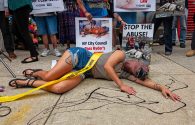
Directly across the street from the courthouse entrance, another racially mixed cadre of protesters held court, amplifying the Newsomes’ message with their own impassioned displays — placards with disturbing blown-up screenshots from videos capturing the moment Penny might have executed his deadly “bloodchoke,” or chokehold. Far from opposing the Newsomes, they served as an extension of the call for justice, engaging motorists and passersby in often contentious debates. When white motorists leaned out of their cars to shout, “Daniel Penny is a hero,” the protesters fired back with chants and pointed arguments, refusing to let such claims go unchallenged. “He killed Michael Jackson!” shot back a young white female activist at the forefront of the rally, her keffiyeh draped loosely around her neck and falling like funeral bunting over a handsome photo of Neely in a public sign of perpetual mourning.
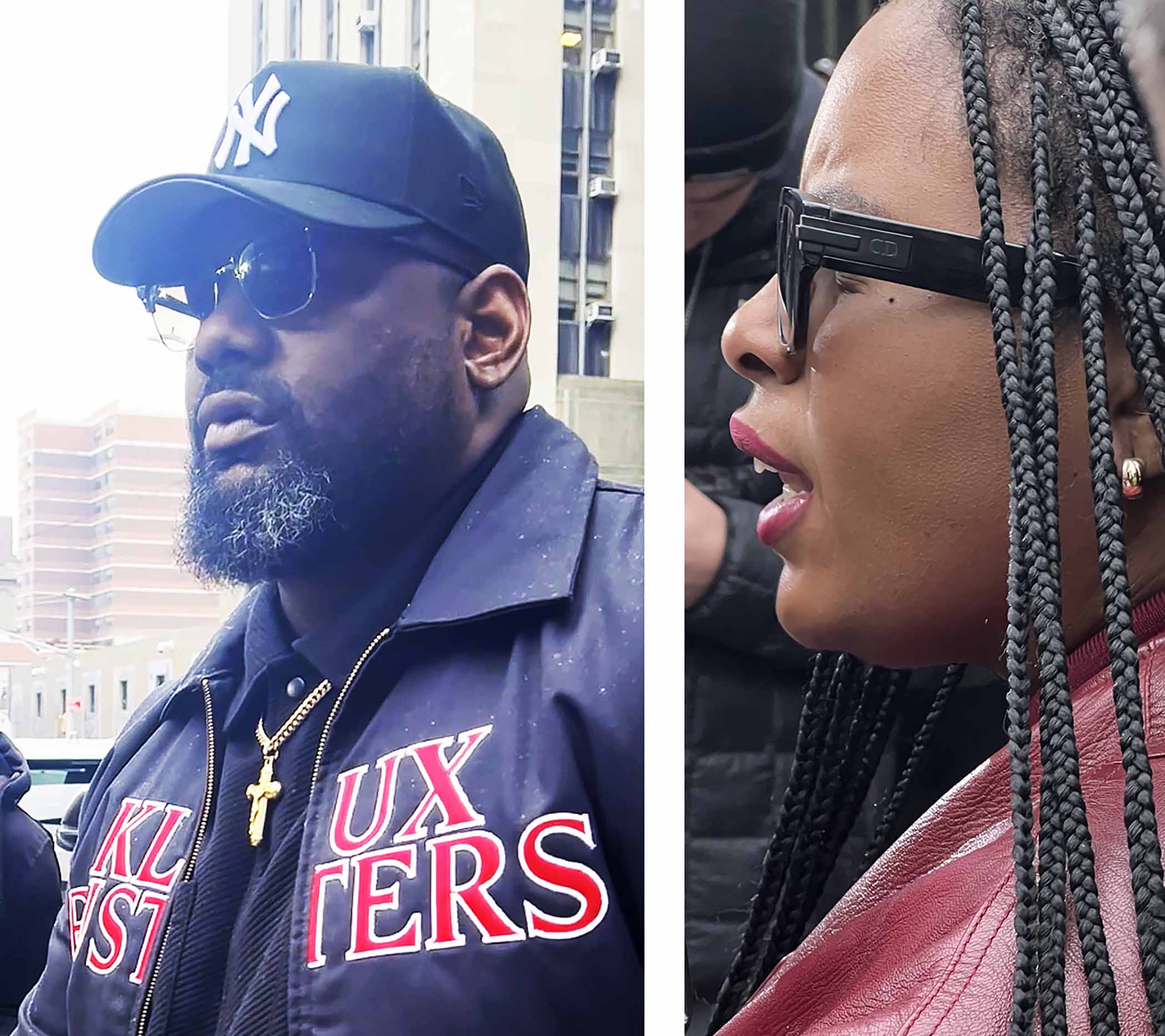
But it was the activists’ unyielding criticism of the judicial process surrounding the trial that eventually took center stage. It was alleged that a “white supremacist jury specialist” influenced the selection process, creating a panel that was biased from the outset. According to the New York Post, the activists were referring to “celebrity jury consultant Jo-Ellan Dimitrius, who has helped high-profile clients like Kyle Rittenhouse pick juries in recent years, and worked with O.J. Simpson on his murder trial.” Yoran, the prosecutor, criticized defense attorneys Raiser and Thomas Kenniff for using eight of their nine permitted challenges to exclude jurors who were people of color. Kenniff dismissed the accusation as “outrageous,” noting that one of the selected jurors was a Black man. Judge Wiley allowed the defense’s challenges to stand after requiring Kenniff to provide reasons for excluding the jurors in question. But Yoran raised the issue again later, stridently objecting when the defense used another challenge on a juror of color, arguing “race is playing a huge part of it.”
Outside, Hawk Newsome agitated before a bank of TV cameras. “When we said that they had a white supremacist jury specialist who specializes in getting white supremacists off with murder, the person who got Kyle Rittenhouse off of murder picked the jury upstairs,” Newsome pointed out, bringing up the case of the 17 year-old gunman who fatally shot two men and wounded another during Black Lives Matter protests in Kenosha, Wisconsin, in August 2020, following the police shooting of Jacob Blake, a Black man. Rittenhouse, who carried an AR-15-style rifle, claimed he acted in self-defense after being attacked. His trial, in 2021, garnered widespread media attention and polarized the nation, with some viewing him as a vigilante and others as a symbol of Second Amendment rights. He was acquitted of all charges, sparking debates about gun laws, self-defense, and racial justice in America.
“Y’all should know this,” added Newsome, who has a law degree and is self-trained in asymmetric lawfare. “But listen, this ain’t about them no more. It ain’t about begging and asking a monster with no heart to have heart, bro, white folks who fuck with us, we love you, but to the racists you can burn in hell, along with Daniel Penny…. [B]ut I want to take you back to jury selection.… In this defense team, a jury specialist knew that there was no way you could put nine white people in a room that would find Daniel Penny guilty. They picked a white supremacist jury specialist to target the racists in that jury. The prosecution pointed out the fact that the defense was eliminating people based on race.… Logically thinking, if you pick a white supremacist jury specialist and you pack the jury with white people — obviously you think race has a significant role in this case. And obviously you were looking for that one white supremacist holdout, that one holdout might have been more, but there was definitely one person in there who said, ‘I’m not gonna convict this white kid.’”
As Newsome rallied on, he shifted focus from the racial biases embedded in the jury selection process to the broader implications of systemic racism and its enduring stranglehold on the justice system. “The police found inconsistencies in his story and allowed Daniel Penny to walk free,” he fumed. “When does that happen for Black people? Am I not making my point clear enough? … Racism has its evil tentacles all over the case and all around the minds of white America. Are all white people bad? No, the prosecution did a phenomenal job. The judge is trying his hardest to bring justice to Jordan Neely’s name, but racism is still alive and kicking in America. There’s no other way to view this. Everyone has looked at the case, and those among you who say that Daniel Penny is innocent have racism and bias in your heart.”
Jury deliberations extended over a period of five days and were marked by tension, legal wrangling, and key rulings by Judge Wiley. By the end of deliberations, the jury’s struggle to reach unanimity on the charge of manslaughter in the second degree would lead to a polarizing decision by the prosecution and a cascade of questions about strategy and justice.
On December 6, the jury sent a note stating: “We, the jury, request instructions from Judge Wiley. At this time, we are unable to come to a unanimous vote on count one, Manslaughter in the Second Degree.” This note highlighted the jury’s challenge: navigating the legal and moral intricacies of Penny’s claim of self-defense versus the accusation of excessive force. Judge Wiley’s response included an “Allen charge,” urging jurors to continue deliberating and emphasizing their responsibility to seek consensus. His instructions walked a delicate line, balancing the need for compromise with respect for individual conscience. Judge Wiley told jurors, “There is no reason to think that any other jury at a future trial would be more intelligent or reasonable or hard-working than you are.”
In addressing jurors’ confusion over the term “reasonable person” — suggesting that jurors had been debating what a reasonable person in the situation Penny found himself would do — the court name-checked Bernhard Goetz. Judge Wiley drew on a landmark ruling in the prosecution of Goetz for shooting the four Black teenagers on the subway. This invocation of Goetz exposed the racial and social undercurrents of Penny’s trial: Like Goetz, Penny’s actions were scrutinized within the fraught context of public perceptions about race, crime, and vigilantism. Goetz’s trial centered on whether his belief in imminent danger was reasonable, which it was not, Kunstler told me at the time. This precedent, though distinct, became a touchstone for Penny’s trial. The defense and prosecution debated Goetz’s relevance. Prosecutor Yoran acknowledged its importance, noting, “Goetz created the two-part test for justification, which jurors must now consider.” However, defense attorney Kenniff countered that the analogy was flawed, arguing, “Goetz focuses heavily on subjective belief; this case demands an equally strong objective analysis.”
As jurors continued to deliberate without resolution, the prosecution made a controversial move: dropping the manslaughter charge. “This dismissal allows jurors to focus on count two and prevents a mistrial,” Yoran argued. However, the defense, initially, vehemently opposed this decision, calling it coercive and unprecedented. Kenniff stated, “This is a violation of the jury’s role and undermines the principle that verdicts must be unanimous on each count.” After a recess, the defense wanted the case thrown out completely. “Your Honor, so the defense’s position at this time is we are moving for a mistrial,” Kenniff said. “We note, for the purposes of the record, that the jury has been deliberating for roughly 20 hours over four days on what is, in many ways, a factually uncomplicated case as far as this is an event that transpired over minutes on video. I understand that there are complicated medical testimony and nuances, and so forth, but it’s not a — you know, multi-count RICO indictment or anything like that. We are concerned that the giving of an Allen charge under these circumstances would be coercive. We certainly feel, based on case law, that there is …that there is no basis for anything regarding a partial verdict because the jury has not indicated that they reached a partial verdict.”
While acknowledging the defense’s concerns, Judge Wiley denied the defense motion and granted the prosecution’s motion, reasoning, “This is a unique situation where the elements of justification blur the distinctions between the charges.” The decision sparked intense speculation about Yoran’s strategy, and District Attorney Alvin Bragg’s approval of it. Yoran, a veteran prosecutor with a track record in high-profile cases, had earned respect for her meticulous approach. However, she misjudged the jury’s dynamics, gambling on their ability to convict Penny on the lesser charge of criminally negligent homicide. Bragg’s support for Yoran hinted at a broader calculation: avoiding the spectacle of a hung jury in a politically charged case.
The deliberations took a surprising turn with reports of a juror allegedly leaking details to the media. While the juror’s identity was not confirmed, the account closely mirrored events in the courtroom. Defense counsel raised the issue, but Judge Wiley dismissed it, stating, “Unless there is direct evidence of misconduct, I see no reason to question the jury further.”

The dismissal of the manslaughter charge marked a dramatic shift in the trial. While some saw it as a pragmatic response to a deadlocked jury, I viewed it as a prosecutorial sellout that undermined the seriousness of the case. Now, the defense was all but certain to win. It was their creative ruthlessness, nuanced to a certain legal degree, that William Kunstler had warned me about, that led to the struggle between truth and deception — I felt the case was standing strong on its face — until Yoran sliced off its nose of self-contained credibility, and everything collapsed. From my vantage point, her mood had shifted to resignation: that let’s-just-get-it-over-with attitude symbolized the dramatic unraveling of the case. When Yoran couldn’t stop the hemorrhaging from the self-inflicted act, she threw in the towel, prompting audible gasps from some in the courtroom. Many scratched their heads at a decision so puzzling it might send even Pete Hegseth back to drinking. “You can’t be serious,” National Action Network observer Reverend Sandra Hynson Simpson whispered from her backseat perch. I remembered that a visibly irate Hawk Newsome had earlier passed me a note he’d hurriedly scribbled in ballpoint red on a brown paper bag. It dripped with sarcasm about the culprits he suspected were behind Yoran’s decision to dumb down the charges: “That ALL White Jury! They knew 10 white people wouldn’t find him guilty.”
(Asked for a racial breakdown to confirm or deny speculation that the jury was predominantly white, Douglas Cohen, of the Manhattan DA’s press office, emailed: “We don’t have one.”)
During a recess, Newsome cranked up the volume for those he felt hadn’t gotten the message: “If you look at the facts of this case, then you understand that Daniel Penny is guilty. But today, white supremacy got another victory. Today, the KKK, the Klansmen, the evil in America, got another victory. They got that top charge dismissed…. And Black people, don’t get your hopes up. I’m’a save you the shock. Even if convicted on the top charge he wasn’t getting more than four years…. They might throw some crumbs here and there, but we don’t get justice in these buildings. And I dare you to show me a study or some case law to disprove that.”
Did District Attorney Alvin Bragg’s office fail to properly vet its forensic expert’s testimony? The defense swiftly capitalized on this insinuation, pointing to the medical examiner’s preliminary ruling, in which she initially claimed to have immediately determined the cause of Neely’s death based on her experience and watching videos of the incident, only to later walk back some of her conclusions.
According to the defense, several of Dr. Harris’s misjudgments, untested by the rigor of medical certainty, amounted to outright incompetence — failures that might have paved the way for the defense’s claim that Daniel Penny was wrongfully prosecuted.
It’s difficult to accept the defense’s claim that Jordan Neely would have died anyway, that it was his own struggle against Penny’s “bloodchoke” — whatever the exact technique was — and alleged drug addiction that accelerated his death. In the courtroom, however, the defense shifted sharply from technicalities to humanizing Penny, with Raiser presenting the jury with a portrayal of his client’s “softer side”: “Because Danny is not just a former Marine, he’s an architectural student. He’s a surfer. He’s a musician. He is a caring friend, brother, and son. That is the softer side of Danny. And it is that softer side that informed him to apply something less than a textbook Marine bloodchoke, by choosing not to render Mr. Neely unconscious. Keep in mind, it’s a choice. He could have squeezed Mr. Neely to unconsciousness…. Instead he laid with him on the dirty subway floor, while the smell of uncleanliness, sweat and feces enveloped him.”
Of course, if it were up to him, Neely never would have chosen the filthy subway car floor as the site of his execution — a place where Penny allegedly decided not to, putting it bluntly, squeeze the shit out of the “crackhead” to render him unconscious. But somehow this grotesque assertion, as absurd and twisted as it sounds, became the cornerstone of Daniel Penny’s legal strategy — a strategy that, against all odds, proved effective. It’s a chilling echo to Kunstler’s argument: The power of legal rhetoric can reshape reality, no matter how nonsensical it might seem.
Saying so, I don’t argue there was any nefarious collusion between the defense, prosecutors, and jury — only that there was a clear link between the defense’s role and the prosecutors’ unintended complicity, tied directly to how they helped sell junk justice by authorizing the Bill of Sale for Penny to get away with manslaughter. Defense “quackery” or not, it had damaged the prosecution’s ability to present or rely on credible evidence. The defense Penny was entitled to — incredible and exaggerated as it was —maintained a legal tone while expertly obfuscating the truth for the jury. Kunstler’s wisdom foresaw not only the verdict of Bernhard Goetz’s trial — he was convicted only of one count of carrying an unlicensed firearm and acquitted of attempted murder, assault, and reckless endangerment charges — but the enduring pattern of injustice it heralded. And here we are, decades later, witnessing its continuum in the chokehold killings of Eric Garner, George Floyd, and Jordan Neely. The themes are hauntingly familiar: a system where legal strategies cloak societal biases, where the incredible becomes credible, and where the nonsensical twists itself into justification. Kunstler’s words remain a stark reminder of what we must confront — a call to resist accepting the unacceptable, no matter how convincingly it is argued in a courtroom. ❖
Peter Noel writes mostly about social, racial, and criminal justice, focusing on police violence, culture, poverty, and politics. He lectures as an A’Lelia Bundles Community Scholar at Columbia University. Noel is the author of Why Blacks Fear ‘America’s Mayor’: Reporting Race, Crime and Black Activist Politics Under Rudy Giuliani.

