



∼ ∼ ∼ This article is part of a series — At 250, Who Will America Be? — reporting on threats to American democracy as we approach the nation’s Semiquincentennial, on July 4, 2026. ∼ ∼ ∼
For generations, conservatives have pushed the racist myth that poverty is mainly a Black issue. The plutocrats, led by Ronald Reagan, campaigning for the presidency in 1976, reinforced this harmful trope with damaging stereotypes. One of the most infamous was the “welfare queen,” draped in Chinchilla furs and driving a souped-up Cadillac. Another was the image of the “strapping young buck” who Reagan claimed angered white shoppers when they saw him cueing up in line at a grocery store “with a fist full of food stamps and a stack of porterhouse steaks.” MAGA Republicans, drawing on these “Southern strategy” dog whistles (first employed by Richard Nixon in his two presidential victories, in 1968 and ’72, which then helped Reagan beat Jimmy Carter in 1980), pride themselves on “owning the libs.” That saying has become a pejorative zinger used to describe the act of defeating or humiliating liberals in the culture war debates. On the divisive issue of social welfare, conservatives believe they own the libs, that they’ve outsmarted the “bleeding hearts” by burdening them with an insurmountable public relations challenge. Liberals need to dispel the myth that compassionate policies — such as food programs, shelters, and sanctuary cities — amount to a cowardly surrender by the government to the procurers of “populist handouts.”
Cowed liberals do have the power to push back against this pervasive demagoguery, which demeans shared responsibility. Instead of getting dragged into futile “gotcha” debates, liberals can shift the narrative themselves through a rhetorical inversion — and, to coin a phrase, “own the cons.” This is exactly what the Reverend Dr. William J. Barber II might just have achieved. One of the resolute intellects behind the Poor People’s Campaign, Barber has craftily outmaneuvered conservatives in his lifelong mission to reveal the true face of poverty in America — and it’s not the Haitians of Springfield, Ohio, or their longsuffering Black American counterparts. How Barber pulled off this feat is featured front and center in his powerful new book, White Poverty: How Exposing Myths About Race and Class Can Reconstruct American Democracy.
“At the moment when we as a nation made our greatest push to expand efforts to include everyone, politicians who opposed those programs began to vilify the poor people who benefited from them. To do so, they leaned into the old myth. They effectively erased a huge swath of the white poor and created the stereotype of a Black ‘welfare queen.’”
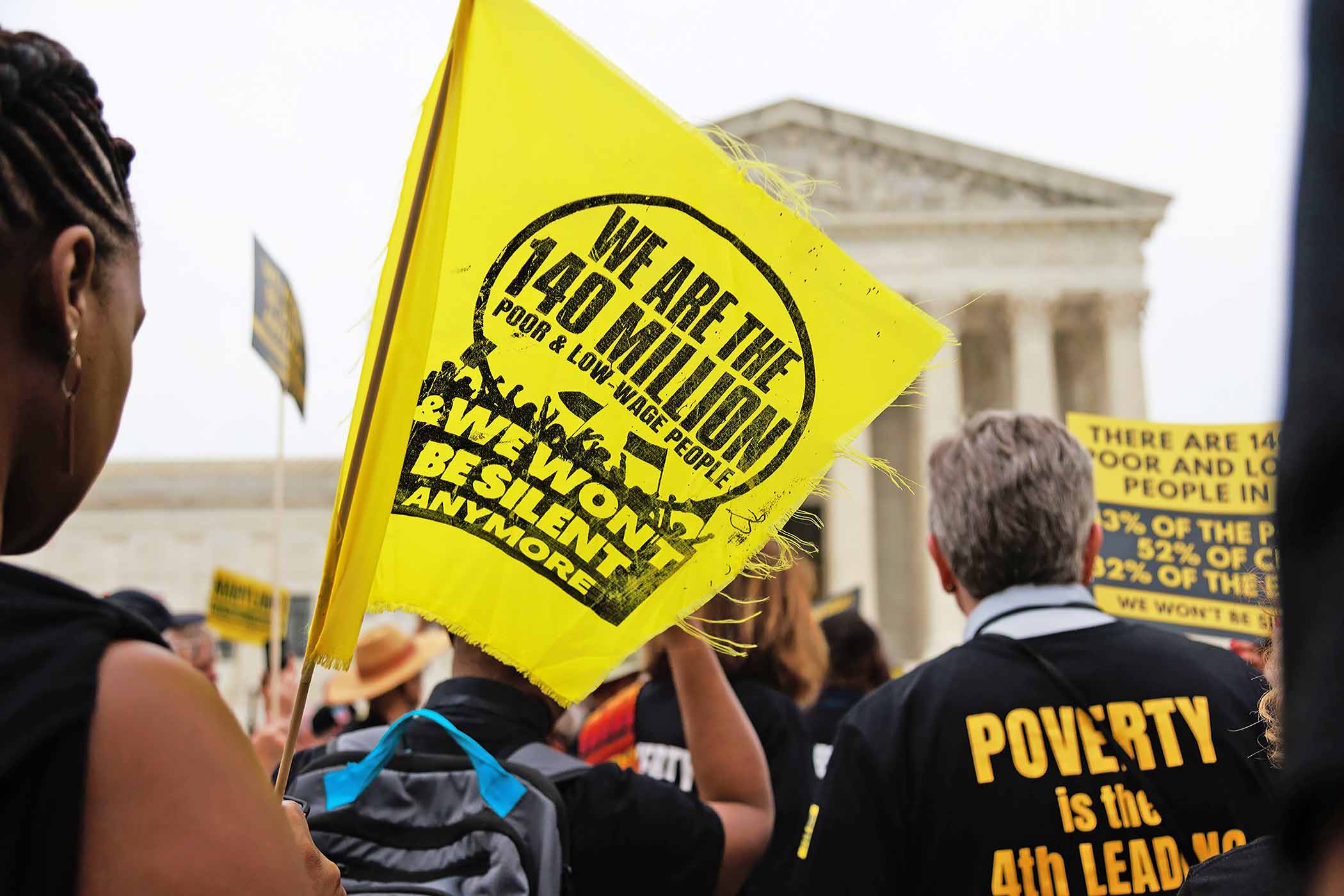
Conservatives don’t own this righteous loudmouth. In a disruptive, data-driven argument, Barber proves that conservatives have historically manipulated racial divisions to conceal the fact that the largest group affected by poverty is not Black or Brown, but white. By manipulating this evidence, conservatives have perverted the welfare state, diverting attention from the widespread economic struggles of poor white Americans. “When we look at poverty through this lens of practical necessity, 140 million Americans are poor or low-income — a full 43 percent of the country,” Barber writes. “This is the definition of poverty I’m working with.… These are the data that reflect what I’ve seen as a watchman in America. If you disaggregate the data on the 140 million Americans who are technically poor or low-income, 24 million of them are Black. That’s 60 percent of all Black people in America — an incredible burden that reflects the ongoing influence of racism in American life, and one that is shared by a similar percentage of the population in Native and Latino communities. But when you look at the raw numbers of poor and low-income people, there are 66 million white people — almost three times the number of Black Americans.”
The contention that most recipients of SNAP (the Supplemental Nutrition Assistance Program, which provides financial assistance to help low-income individuals and families purchase food) are white and working-class forces a rethink of who actually benefits from government aid. The Republican narrative, nevertheless, stubbornly clings to the stereotype of welfare as a handout from “deserving” taxpayers to “undeserving” others. Barber matches the rhetoric of racialized and politicized hunger, shying away from the Democrats’ stammering defense and delivering a mic-drop moment that can’t be easily challenged: “Here again was the same imagined Black beast, hungry not for white women, but for something white men cared about even more: their hard-earned money.”
“As we walked in silence toward the elevator to go up to the second floor, where the doors to the house and senate chambers are located, I heard a whisper echo off the vaulted ceiling of the lobby: ‘Where did they get all these white people?’”
Barber backs this up with a historical review of the real case of fraud that was twisted to birth the “welfare queen” myth, weaponized to dismantle social welfare programs and punish those in need. What distinguishes his account is the striking manner in which he calls out the unindicted co-conspirators, making them share in the shame of perpetuating this harmful fiction. “After the Civil Rights Act of 1964 and the Fair Housing Act of 1968, which ensured access to antipoverty programs for nonwhite Americans, the public face of poverty began to change dramatically,” Barber writes. “At the moment when we as a nation made our greatest push to expand efforts to include everyone, politicians who opposed those programs began to vilify the poor people who benefited from them. To do so, they leaned into the old myth. They effectively erased a huge swath of the white poor and created the stereotype of a Black ‘welfare queen.’ Beginning with his 1976 campaign for president, the former actor Ronald Reagan began citing the tale of a Black woman from Chicago who drove a Cadillac to the welfare office and defrauded honest taxpayers of their hard-earned money. While white Americans were doing their best to take care of their families and share with their neighbors out of the generosity of their hearts, they learned from Reagan that a Black woman was using the government to pick their pocket. If they elected him, he promised, the government would stop helping Black people steal from them. Reagan’s mythological Black boogeywoman was, in fact, based on an actual case of a con artist, who sometimes went under the name Linda Taylor. Reagan had learned about her not because the government was facilitating her crimes, but rather because the Chicago Tribune reported at the time about how the government was prosecuting Taylor. A different storyteller might just as easily have emphasized the ways Taylor’s fraud stole from the poor people who did qualify for the government programs she had scammed. Instead, Reagan used her as an anecdote to undermine programs that had helped many of the hardworking, everyday Americans whose votes he sought.”
Barber’s masterstroke was more than just a display of political savvy or a clever maneuver that outflanked conservative resistance — it came with a few tricks up his clerical collar. One signature approach, known as “moral fusion,” involves incorporating white activists as metaphorical battering rams within a Trojan horse strategy. When white activists stand side by side with people of color, proclaiming that poverty is not simply a “Black problem” but a widespread injustice, it forces conservative policymakers to respond, since dismissing the concerns of white constituents undermines the very base they claim to represent. Barber’s idea of reclaiming moral and political ground for building a diverse coalition for social justice can be seen as a rhetorical clapback — “owning the cons.” One of Barber’s most potent examples of this occurs in his recounting of the “Moral Monday” protests, during which a white woman suggested that they switch roles in discussing voter suppression. In that moment, Barber’s tactic of moral fusion became reality. The Trojan horse strategy of moral fusion broke through that day, in part due to a group of liberals penetrating hallowed institutions, advocating for their rights, and engaging with stiff-necked policymakers.
“The NAACP was established in 1911 by white and Black Americans who came together to raise the alarm about white supremacist terrorism that was being used to stamp out the promise of democracy in America.”
“In the committee room where the extremists in the North Carolina legislature passed their voter suppression bill that precipitated our Moral Monday protests in 2013, I signed up to testify against the legislation as president of the North Carolina NAACP,” Barber recalls in White Poverty. “While we waited in the gallery, facing the elevated desks where the legislators talked into their microphones, I sat beside a silver-haired white woman who’d come to testify against the bill on behalf of women voters. While we listened to the proceedings, she leaned over to me and said with a deep Southern drawl, ‘I grew up in Georgia. I know what they’re doing. Why don’t we switch this up on them? You talk about how this bill will hurt white women, and I’ll talk about how it will hurt Black people in North Carolina.’ ”
Though Barber had assembled “a representative mosaic of the people who make up the Old North State,” he charged the political battlefield with this white woman at his side. “To lead our delegation, I walked hand-in-hand with Barbara Zelter, a white social work professor wearing rectangle-framed glasses and a black business suit,” Barber recalls. “We walked slowly, with intention, past a phalanx of security officers and made our way into one of the lobbies of the building, where legislators, their staff, lobbyists, and members of the media often linger outside the legislative chambers during sessions. With television cameras and an anxious line of officers following us, we drew the attention of people who were used to business as usual in this space. As we walked in silence toward the elevator to go up to the second floor, where the doors to the house and senate chambers are located, I heard a whisper echo off the vaulted ceiling of the lobby: ‘Where did they get all these white people?’ It was an instructive question. I’d learned from nearly a decade of experience as president of North Carolina’s NAACP that most people in state government thought they knew how to handle Black people and civil rights issues. The newly elected Republican governor, Pat McCrory, had welcomed me into his office just after his inauguration and pledged to meet with me monthly to discuss the concerns of African Americans in our state if I would agree to not criticize him publicly. I told him in no uncertain terms that I hadn’t come for tea and crumpets. I represented a coalition that wanted justice for everybody.”
Barber highlighted how he outsmarted conservatives who had over-promised, underdelivered, and underestimated the power of coalition politics. “[F]ew people in state government expected the president of the NAACP to walk hand-in-hand with a white woman to lead a group of people as diverse as the state itself in an action to demand justice for all people,” he notes. “The question I heard echo through the atrium that day helped me see that the identity my daddy had fought to claim at my birth — the moral fusion he always talked about — was an interruption of the stories we often tell ourselves about who we are in this country. Those stories, it turns out, aren’t even historically accurate. They’re based on stereotypes about Black-led organizations and movements that obscure our actual past. The National Association for the Advancement of Colored People (NAACP), for example, was established in 1911 by white and Black Americans who came together to raise the alarm about white supremacist terrorism that was being used to stamp out the promise of democracy in America. Though it has become a Black-led legacy civil rights organization that’s best known for honoring Black achievement and hosting award shows, the NAACP’s founders more than a century ago were mostly white — many Jewish, in fact. Those white folks were shocked that guarantees of citizenship and equal protection under law that had been written into the U.S. Constitution after a bloody Civil War were being denied by extremists who used the language of ‘separate but equal’ to comply with the letter of the law but lynched anyone who demanded equality for Black people.”
Some may dismiss Barber’s moral fusion strategy as the wishful thinking of a “bleeding-heart” liberal — naively optimistic in his push for unity and compassion. Others might even label him a “hope dealer,” peddling a type of kumbaya weed to a nation unwilling to face its harsh history of economic inequality.
What tripped up the white lawmakers that day was not merely their misjudgment of the coalition’s diversity but their ability to consider the shared risks the legislation posed. “I’ll never forget the look on that committee chair’s face when my new friend walked to the public comment podium, looked him dead in the eye, and said, ‘I see what y’all are doing. I’m here to talk about how this bill targets Black people because I know it will hurt me, too.’ When it was my turn, I talked about how the proposed changes would make it more difficult for white women to vote. They still passed the bill out of committee, but I knew we’d made the first step toward higher ground.’”
Barber’s mission of moral fusion is as bold as it is clear. A spin-off of his achievement — too audacious to ignore — is helping to set the stage for a political revolution. In the run-up to November’s consequential elections, Barber and the Poor People’s Campaign have mobilized grassroots organizers across more than two dozen states, targeting “sleeping giant” communities with door-to-door canvassing efforts that evoke a sense of urgency and call to action. These are “high concentrations of poor and low-wage infrequent voters” — many of whom are white — and the very demographic Barber addresses in White Poverty.
Barber’s book arms both the campaign’s volunteers and the broader electorate with an uncompromising truth: Those poor and low-wage voters hold immense, untapped political power. As more traditional conservatives make the case that Donald Trump is a threat to democracy, Barber’s exposé on white poverty hiding in plain sight emboldens these communities to become political juggernauts — potentially reconstructing American democracy in the process.
“These voters … make up many times the margin of victory in each of the election’s so-called ‘battleground’ states,” both Barber and co-organizer Reverend Dr. Liz Theoharis assert in a widely circulated bulletin to progressives, touting the success of the second National Coordinated Weekend of Canvassing, which concluded on October 5. This means that those “15 million voters” the organizers targeted in swing states like Pennsylvania, Arizona, and North Carolina can sway elections and directly decide the outcome of the battle between Trump and Kamala Harris, in the nation’s closest presidential race in recent memory.
The outreach has borne reassuring results. “[That] weekend’s canvassing felt really good,” the Campaign quoted from a testimonial by Tammy Rosing, a member of its Pennsylvania coordinating team. “Looking out upon my community of Lancaster, seeing the different dynamics, the diversity and where everyone[’]s at … there was no intensity or hate around any conversations we had, even here in the Bible Belt of Pennsylvania. We took the time to have really in-depth conversations with the poor, hearing their thoughts and their struggles. We shared our PPC statistics — that there are 135 million in poverty. It wasn’t about Democrat or Republican, it was about meeting people where they were at.”
So do not, even for a split second, give credence to any conspiracy from those on the Left who might suggest that Barber is a pawn of the system, being used to flip the script on Black poverty and deceive Black communities with the moral equivalence of lamenting over poor whites. Some may dismiss his moral fusion strategy as the wishful thinking of a “bleeding-heart” liberal — naively optimistic in his push for unity and compassion. Others might even label him a “hope dealer,” peddling a type of kumbaya weed to a nation unwilling to face its harsh history of economic inequality.
“The men who came to burn a cross on my uncle Richard’s lawn in the late 1970s weren’t performing the backwoods ignorance of uninformed people; they were acting their part in a story told by some of the most powerful and influential people in American public life.”
“I realize that, in this moment, it may seem strange that a Black man who stands in the long tradition of Black-led freedom struggle would write a book about white poverty,” Barber acknowledges in the book. “Some of my friends worry that if a Black person lifts the lid that obscures white poverty, it somehow diminishes the urgency of addressing Black people’s pain. But I contend that it actually intensifies the urgency — and in a good way. I take on white poverty as a declaration that Black people may have problems, but we are not the problem. Other people face the same struggles we do. It doesn’t make any sense to try to fight this battle on our own. It’s past time that we come together and stop being played against one another. We need to link up with anyone who can see that we’re living in a society where it’s hard for most of us to get by, while an increasingly smaller number of people at the top enjoy an unimaginable amount of wealth. White folks, I fully realize, have their own reasons to be suspicious of someone who capitalizes ‘Black’ but writes ‘white’ in lowercase. Who is to say that a Black man writing about white poverty doesn’t just want to see the tables turned, with Black people up on top?”
Barber’s challenge to his followers is not to validate the simpleminded arguments of those who might seek to pigeonhole his mission, but to expose how, when it comes to the real face of poverty in America, race and class are deliberately entangled to divide and conquer.
“Civil rights workers in rural Black communities noted that the desegregation of lunch counters didn’t mean much to people who couldn’t afford to eat. And the poor and hungry, they noted, weren’t only Black. They were also white families in Appalachia and in the bayous of Louisiana. They were welfare rights advocates in urban centers and Chicano workers in the grape fields of California. They were members of the Apache and Navajo nations, still fighting for the right to exist on their ancestral lands. This patchwork of America’s poor was the emerging coalition that Dr. Martin Luther King Jr. was serving when he went to Memphis to stand with sanitation workers who were on strike to demand better working conditions. This is the movement that was building to demand that America see its poor when an assassin’s bullet ripped through Dr. King’s neck on the balcony of the Lorraine Motel in Memphis, Tennessee.”
After King’s assassination, the legacy of his struggle against racial injustice remained under siege, as evidenced by the chilling actions of those who sought to uphold white supremacy. “The men who came to burn a cross on my uncle Richard’s lawn in the late 1970s weren’t performing the backwoods ignorance of uninformed people; they were acting their part in a story told by some of the most powerful and influential people in American public life. The old myth echoed in the code words of the Southern Strategy and told them that an interracial marriage violated the basis of their identity and threatened the moral fabric of American society. But that myth also served to obscure the ways any relationship across racial lines represents the potential for common understanding that has fostered every stride toward a more perfect union in American history. Fear kept those men from seeing this hope — and because their fear plunged me into a situation of potential violence, it almost hardened me against the possibility of working together with white people. By grace, I grew up in a family and an extended community that prized moral fusion as both our inheritance and the promise of a better future. And in time, I had the opportunity to see for myself that there is a story more powerful than the myth that sustains white identity to prop up a system that hurts most of us.”
Will conservatives, who have long promoted a racialized narrative of poverty, be “shocked, shocked” to find that most poor Americans are white? Or that the very policies designed to harm Black people ultimately end up harming whites as well? Such a reaction would be a disingenuous display of surprise — performative outrage disguised as moral indignation at what Barber refers to in one tragically fatal case as unavoidable “policy murder.” In White Poverty, Barber illustrates the dire consequences of political decisions on healthcare access, particularly in North Carolina.
“When Congress passed the Affordable Care Act (ACA) in 2010, they planned for the essential federal funding that’s needed to keep critical access hospitals open to follow patients to their local facilities through the expansion of Medicaid,” he explains. “It was, as many conservatives had lobbied for it to be, a market-driven plan. But when Tea Party reactionaries branded the new law ‘Obamacare,’ the term itself a dog whistle, they pushed the entire Republican Party to resist implementation of the ACA at every stage. Many state legislatures controlled by Republicans, like ours in North Carolina, refused to accept the ACA funding to expand Medicaid. This meant that a half million uninsured North Carolinians who were technically eligible for Medicaid still couldn’t access health insurance. As I’d told the all-white crowd up in Mitchell County, the vast majority of those uninsured people — 350,000 of them — were white. But whatever the color of their skin, many of them lived in communities where their critical access hospitals were closing because they didn’t have the money the ACA had directed to fund them through Medicaid expansion.”
“Mayor Adam had come to the statehouse and told members of his own party that their decision to refuse Medicaid expansion was going to kill people. Gibbs’s death was, by any honest account, intentional. This was policy murder. The perpetrators, who make the laws, could not be tried for their crime in a court of law.”
Barber retells the story of his collaboration with Mayor Adam O’Neal, who, after falling victim to his party’s extremist right-wing ideology, faced a bitter struggle to prevent the closure of his town’s only hospital. “Pungo Hospital, a simple, one-story brick building, sat on the waterfront in Belhaven. In its day, it served three rural counties in northeastern North Carolina. Though the healthcare company that managed it had purchased the hospital from a local nonprofit with the promise that they would keep it open and improve services, the community was outraged because they’d learned that their hospital was slated to be closed. Mayor Adam had already reached out to the Republican legislators who represent his part of the state in Raleigh. ‘They wouldn’t even return my calls,’ he told me. He was beginning to feel what it’s like when people with power believe your suffering isn’t their problem. He was grateful for our support, but he said to me, ‘This is going to shock a lot of people — you’re a Democrat and I’m a Republican.’
“‘First of all,’ I told him, ‘I’m not a Democrat. I’ve been an Independent all my life, and I vote like I want to vote.’ ‘Well, yeah,’ he said, ‘but I’m sure I’ve supported a lot of people you’ve stood against.’ ‘Maybe so,’ I told him, ‘but that’s not the issue here. From what I understand, you’re about to lose this hospital. And if you do, it’s going to hurt everybody in this community.’ We shook hands and agreed we’d fight together in this battle. If Pungo Hospital closed its doors, the next closest emergency room was an hour’s drive for some residents of northeastern North Carolina. ‘People are going to die,’ Mayor Adam started saying. We worked with our lawyers at the NAACP and filed a Title VI complaint with the U.S. Department of Justice, asserting that the plan was discriminatory because it would deny Black people in eastern North Carolina access to critical care…. [We] knew what Mayor [O’Neal] understood: closing the hospital would also impact the white Republicans who had elected him. The mayor and I went to Raleigh together and held a press conference. Basic access to healthcare, we said, shouldn’t be a Republican or Democrat issue. It was a moral issue. ‘Now, Reverend Barber and I don’t agree on everything,’ Mayor O’Neal told the reporters. ‘Heck, we don’t agree on most things. But we agree on this. We can’t let people die.’ Nonetheless, after a short delay, the courts couldn’t save the hospital from politicians who would not act to save it.”

Alleged inaction led directly to the tragic and avoidable death of Portia Gibbs. At just 48 years old, Gibbs became the first victim of what Mayor O’Neal had long forewarned. Here was a white Republican mayor in a predominantly conservative “red county,” powerless to save the life of a white woman from the neighboring county because leaders from his own party refused to even acknowledge him.
“Portia Gibbs’s unnecessary death was nothing less than a crime,” Barber declares. “If it had happened because of the unintentional neglect of lawmakers who were distracted by other responsibilities, they would still be culpable. But this was far worse than that. Her life hadn’t somehow slipped through the cracks. We had petitioned legislators at Moral Monday events to expand Medicaid. Hundreds of us had gone to jail when they told us to be quiet. Mayor Adam had come to the statehouse and told members of his own party that their decision to refuse Medicaid expansion was going to kill people. Gibbs’s death was, by any honest account, intentional. This was policy murder. The perpetrators, who make the laws, could not be tried for their crime in a court of law. We knew we had to take this case to the court of public opinion. Just as Ida B. Wells insisted on telling the truth about lynching victims [in the 1890s], even as the dominant narrative blamed the victims for the violence committed against them and against democracy, we knew we had to tell the truth about the policy murders that were being committed to expose the myth that says poverty is only a Black issue.”
Liberals, taking a cue from Ronald Reagan’s iconic remark “The nine most terrifying words in the English language are ‘I’m from the government and I’m here to help,'” must ensure that Reverend Barber’s Trojan horse strategy of moral fusion — reinforced by my liberal assertion that Barber, indeed, does “own the cons” on the issue of white poverty — strikes at the heart of what former Republican president George W. Bush ironically described as “the soft bigotry of low expectations.” Conservative lawmakers, unprepared for the power of a unified marginalized movement — as demonstrated by the Moral Mondays protests in the South — now face advocates they never expected could so effectively challenge those policies that, as Barber puts it, “prevents us from seeing the pain of poor families who have been offered little more than ‘whiteness’ and angry tweets to sustain them.”
Barber’s broader argument speaks not only to the interconnectedness of economic oppression across race and class lines but appears to align with Kamala Harris’s vision of an “Opportunity Agenda for Black Men” and what she calls “bold, persistent experimentation” with an “Opportunity Economy” for all Americans. As voters flock to the polls, answering the Poor People’s Campaign’s “national call for moral revival,” White Poverty becomes essential reading for exposing platforms like Project 2025 — the right-wing policy manifesto akin to a modern-day Mein Kampf, which, under the guise of patriotism, ties problems such as crime, welfare, voting rights, and immigration to racial minorities.
In my final takeaway from the book, it became clear that Barber’s use of Langston Hughes’s poem Let America Be America Again goes beyond literary appreciation. It forms the backbone of Barber’s moral and political crusade against those who stoke fear and pit struggling communities against one another:
I am the poor white, fooled and pushed apart,
I am the Negro bearing slavery’s scars.
I am the red man driven from the land,
I am the immigrant clutching the hope I seek—
And finding only the same old stupid plan
Of dog eat dog, of mighty crush the weak.I am the young man, full of strength and hope,
Tangled in that ancient endless chain
Of profit, power, gain, of grab the land!
Of grab the gold! Of grab the ways of satisfying need!
Of work the men! Of take the pay!
Of owning everything for one’s own greed!
That excerpt from Hughes’s poem highlights how disturbing it is that the anti-racism verses he published in 1936 resonate ominously with present-day events. The title itself, Let America Be America Again, coincidentally echoes the sentiment behind Donald Trump’s slogan, Make America Great Again — yet it delivers a profoundly different message. Similarly, the lines “the poor white, fooled and pushed apart” (Trump’s base) and “the immigrant clutching the hope I seek, and finding only the same old stupid plan of dog eat dog” (the Haitians of Springfield, Ohio) form an unsettling coincidence in how they foreshadow the divisive rhetoric that fuels Trump’s rise.
In that context, Barber’s vision, though embodying Langston Hughes’s lament at the beginning of the poem, “America was never America to me,” emerges as a poignant counterpoint to Trump’s nativism. Where Trump’s rhetoric promises a return to a past greatness that excludes and alienates, Barber calls for a reimagining of an America that lives up to the ideals it has long denied to the poor, the immigrant, and the marginalized. His vision transforms Hughes’s despair into a hopeful pursuit of social justice. ❖
Peter Noel writes mostly about social, racial, and criminal justice, focusing on police violence, culture, poverty, and politics. He lectures as an A’Lelia Bundles Community Scholar at Columbia University. Noel is the author of Why Blacks Fear ‘America’s Mayor’: Reporting Race, Crime and Black Activist Politics Under Rudy Giuliani.