





Bill Morrison’s Incident arrives in New York this month, finally, having traveled a long and winding road to DOC NYC. Morrison’s short had its world premiere seven months ago, at Visions du Réel, in Nyon, Switzerland, the first of 10 European venues — including the new Unarchive Found Footage Festival, in Rome, where it won for Best Short — before tentatively entering the Americas by way of Cinemancia, in Medellín, Colombia, only landing in the United States in September, at Telluride.
That Morrison’s most overtly relevant work to contemporary U.S. society launched at rarefied festivals outside the United States is as comprehensible as it is anomalous. Incident is a rough-looking film about a rough topic. Composed of publicly accessed digital surveillance footage, the 30-minute video documents, virtually in real time, a white cop’s contentious killing of a Black man five years ago in Chicago.
It’s also a very personal film. Set on Chicago’s South Side, near where Morrison was born and raised, it premiered there in a screening and community conversation attended by the victim’s mother — notably, only 10 days before its New York premiere in the East Village, where the artist has lived and worked since he arrived here to study at Cooper Union almost 40 years ago.
Bringing Incident home, to New York as well as Chicago, seems to have been fraught. Yet it’s not only the forensic subject of the work — recently named to the International Documentary Association’s short list of best shorts of 2023 — but its digital sources and form that seem, at first look, to signal a significant departure from the artist’s noted oeuvre.
Morrison has been making new films from bits of old ones for the better part of three decades. His works are new not simply because they interpolate in the present footage produced in the past. They’re new because they expand the contemporary practice of documentary art, by projecting moving-image history not as nostalgic preservation but as dynamic conversation between movies made and viewed by bygone others and those Morrison makes from them today.
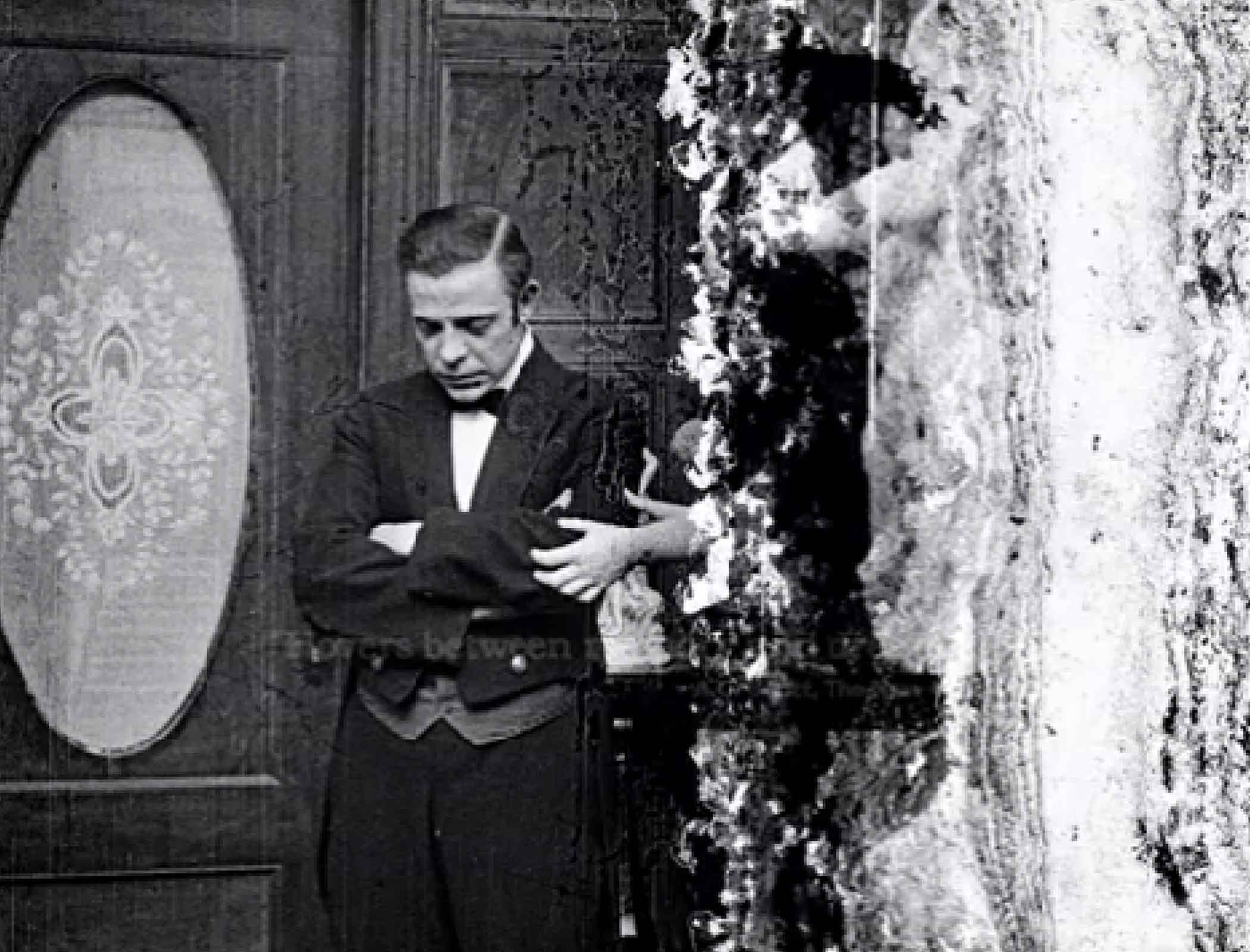
Morrison’s best-known films feature visually noisy silent-age footage that he mines in archives. Manically unstable nitrate stock generates the optic static that erupts as abstract phantasms gamboling into frames inhabited by unsuspecting co-stars from yesteryears. The title of Morrison’s singularly iconic work, Decasia (2002), adumbrates the chameleonic decay that brands his entire oeuvre. Named in 2013 to the National Film Registry of movies deemed intrinsic to the heritage of the United States, it is preserved in the Library of Congress, itself a repository of oodles of reels that have contributed to multiple Morrison projects, including Decasia.

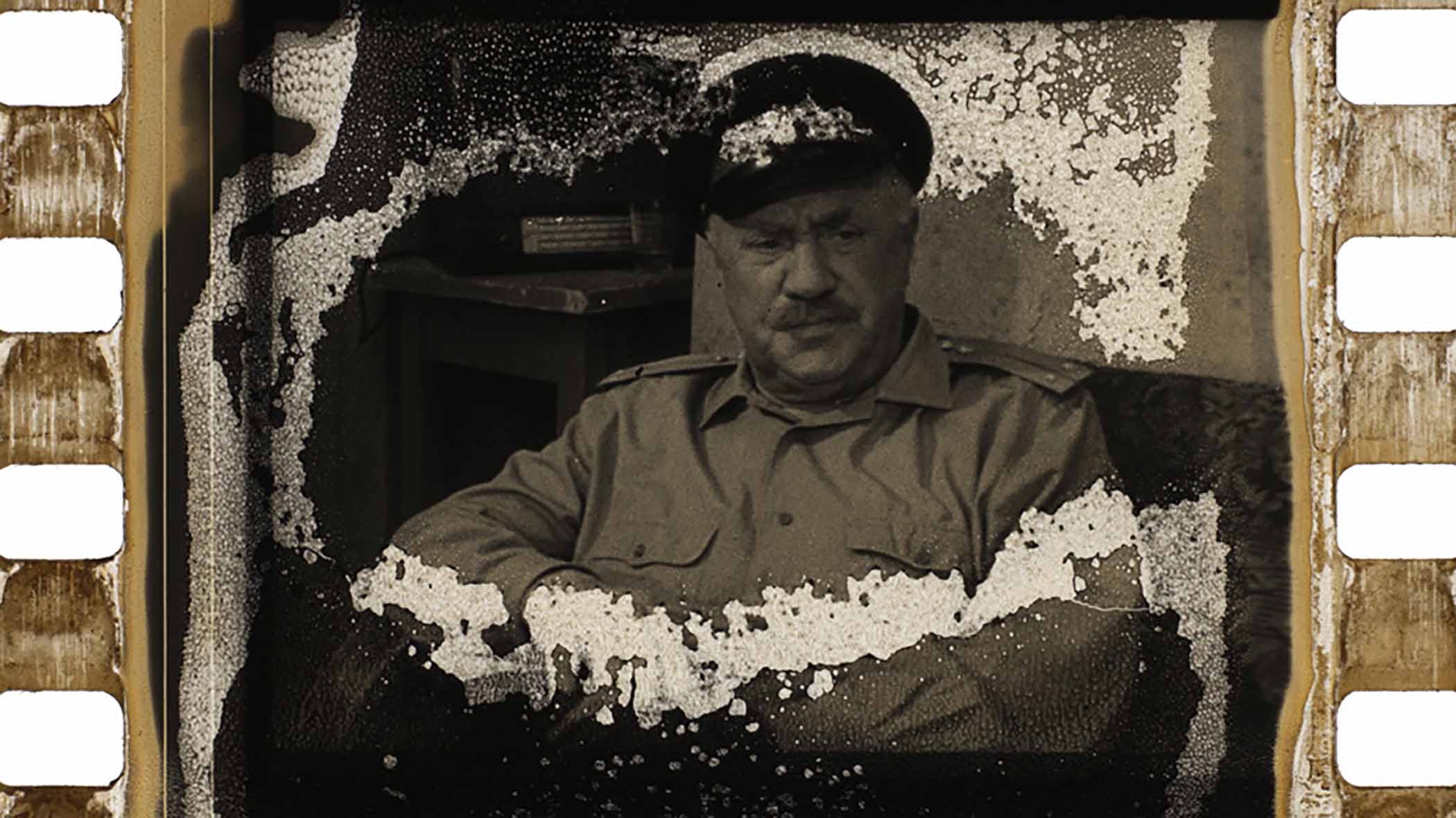
An audiovisual symphony that elides narrative exposition, Decasia nonetheless dives deeply into history, not to explain events but to evoke time across temporalities: the known time of the footage’s production, the unknown time of its material transformation, and, finally, the time of Morrison’s creation. Those historical poetics have remained in place even as his most recent long-form films — notably, Dawson City: Frozen Time (2016) and The Village Detective: A Song Cycle (2021) — have become increasingly expository by narratively addressing film history itself, as well as weaving stories about individuals on the screen and around it in ways that rehearse Incident’s dedication to relating its story.
I first learned of Incident when I joined Morrison across the street from Cooper Union, at McSorley’s Old Ale House, on a cold November evening a year ago. A couple of months earlier, I had published an essay about The Village Detective, a meditation about Morrison’s own archival practice expressed through its contemplation of the long career of Soviet movie star Mikhail Zharov. Triggered by an Icelandic lobster trawler’s incidental dredging of a partial print of the Russian actor’s most popular movie (Morrison’s titular source), a widely available 1969 sound film, and decayed by the ocean (not long-obsolete nitrate stock), The Village Detective now feels like an incidental transition to Incident’s abandonment of esoteric cinematic sources altogether. In any case, as Morrison and I discussed my take on his last feature, he mentioned his new short and subsequently provided me access to the work-in-progress.
I found Incident startling on its own, but also for how it magnified Morrison’s practice. As I viewed its evolving iterations, I recognized that its evident divergences from Morrison’s prior works — notably, its absence of both old cinema and new music as well as its direct focus on a recent real-life event — only distilled his constant commitment to social relevance, exploring the ambiguity of visual evidence, and visualizing time as contextual, not absolute. Even before I attended a screening of an almost-final cut last December, I knew that I wanted to discuss Incident with Morrison.
Incident’s narrative and visual form is its politics; there’s no mystery, no emotional redemption, no legal compensation, just lethal reality: a shot of straight hooch cut with a jigger of ambiguity.
In May, as Incident hopped around Europe, Morrison and I met again at McSorley’s, just around the corner from this paper’s former long-time headquarters on Cooper Square, where Morrison told me that, back in the day, he “would pick it up on Wednesday nights from the office and get a jump on stuff.” The same waiter who greeted Morrison with easy familiarity when we met last fall did so again this past spring. “Rich and I are about the same age and he was working here when I was coming here for burgers on my lunch break” (from Cooper Union, back in the late ’80s), Morrison told me. The filmmaker is a McSorley’s steady, the locution Joseph Mitchell recorded in his indelible New Yorker profile of the Old Ale House, in 1940, at what is now about the halfway point in its history.
i was sitting in mcsorley’s. outside it was New
York and beautifully snowing. — e.e. cummings (1925)
Morrison is part of a tradition. A pantheon’s worth of Gotham artists has been drawn to McSorley’s. Some, like Mitchell, markedly documented their connection. John Sloan painted the haunt realistically a dozen years before E.E. Cummings wrote about it cubistically. Berenice Abbott — who, like all women (before the National Organization for Women successfully sued the establishment for discrimination, in 1970), could not drink there — nevertheless lobbied successfully to document the joint’s interior, in 1947. Her photographs are visual evidence that what Mitchell reported a few years earlier, about the saloon’s first 86 years — that all of its owners “have been opposed to change” — remains relevant 83 years later.
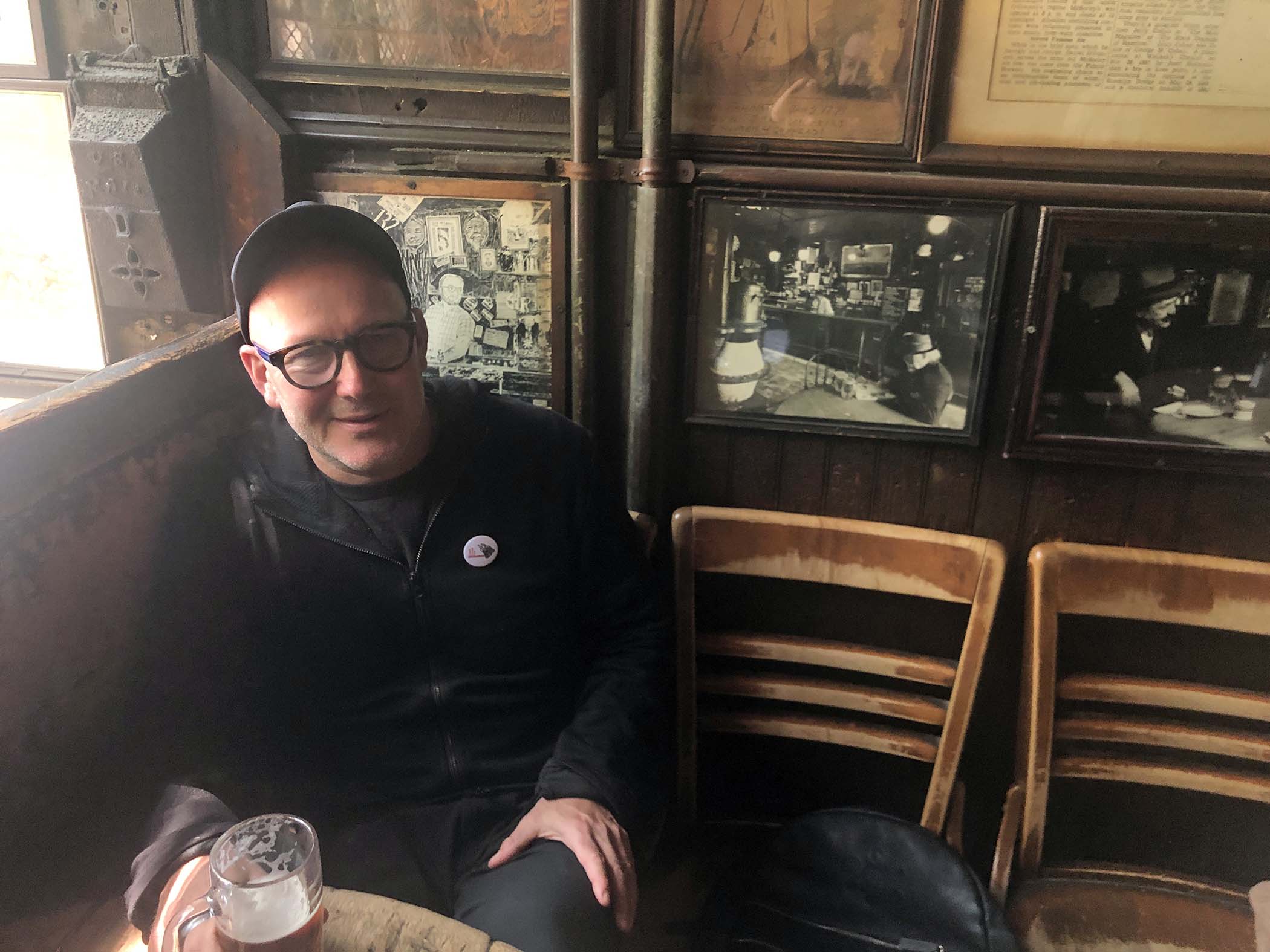
Indeed, the tavern’s artifact-plastered walls exhibit dedicated preservation. The bar is an inhabited archive. But material conservation can provoke artistic innovation. As Cummings’s line suggests, the dissonance between McSorley’s atavistic interior and the contemporary world through its windows could be supremely generative. Old things inspiring new creations is, after all, the essence of documentary art. Maybe that, as well as the burgers and ale, and his longtime connection with Rich, continues to draw Morrison there.
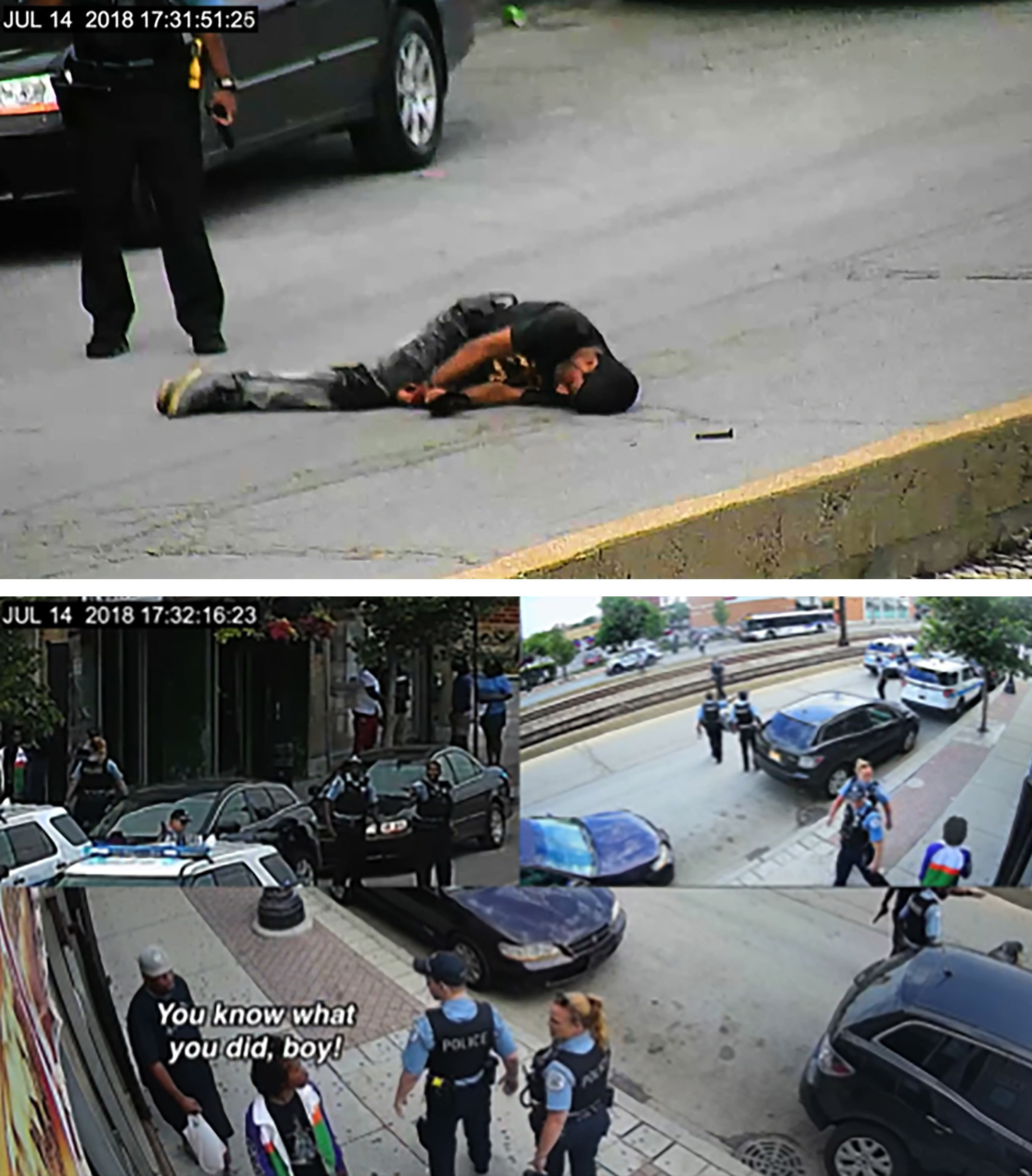
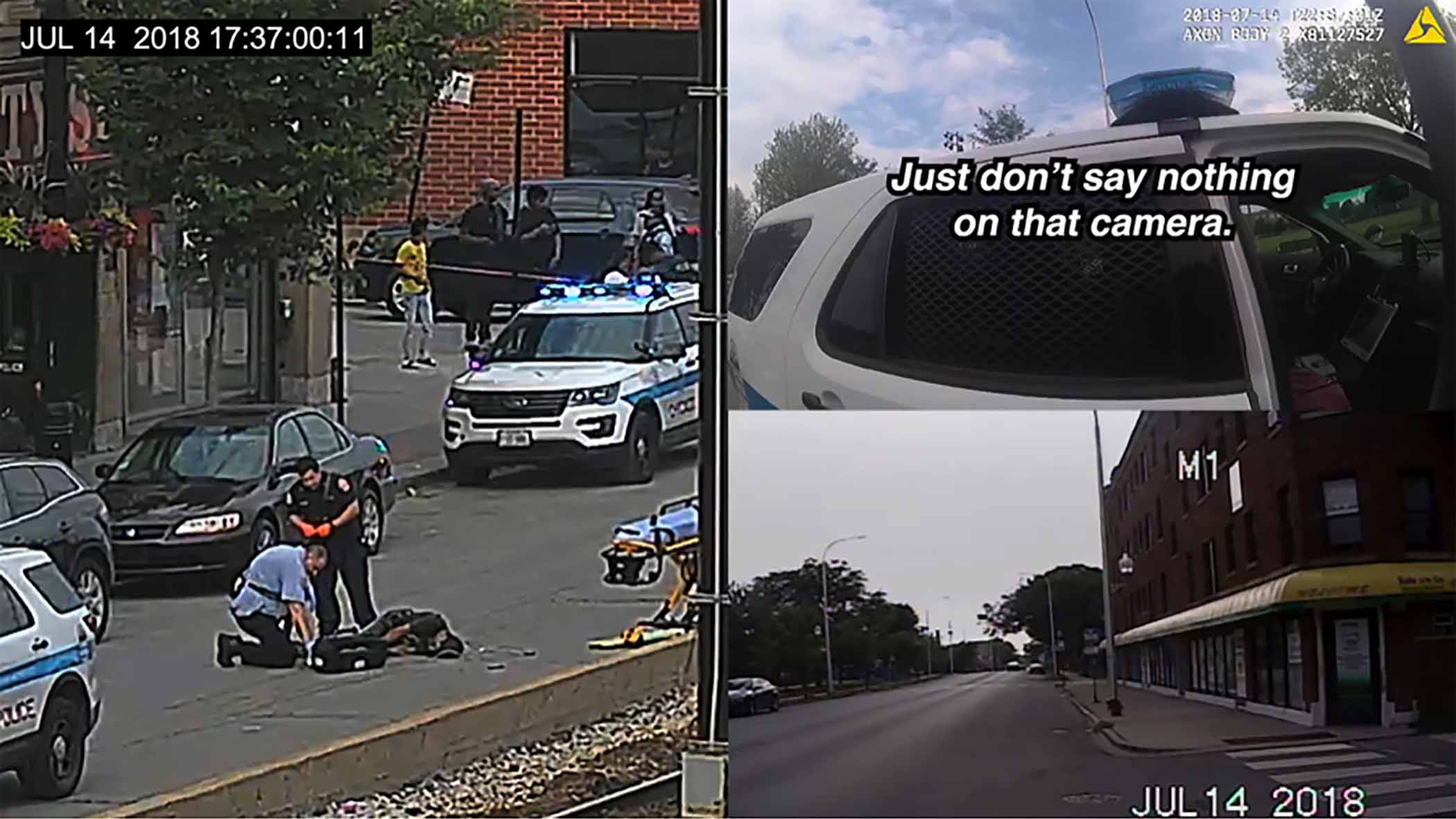
Much like his nitrate sources, Morrison’s practice has changed across time, movement that Incident punctuates. It jettisons the romance of the archive. The texture of its surveillance footage does not beguile. It’s not degraded; it’s simply low-grade. But Incident’s form as well as its content enthralls. Morrison’s split-screen editing divides time spatially, synchronically juxtaposing different views of the roughly half-hour that surrounds the killing of Harith “Snoop” Augustus, a 37-year-old father of a then-five-year-old daughter, who was walking near where he cut hair, at the Sideline Studio. The footage does not speak for itself. The artist is present and necessary — a lesson relevant for our fragmented media age, saturated with audiovisual evidence but starved for discerningly creative interpretation.
Producing history across media, in print or video, is an act of informed revision. Incident re-visions two iterations of the footage from which it draws: the truncated video that the Chicago police department claimed cleared Dillan Halley — the probationary police officer who killed Augustus on July 14, 2018 — by showing that the shooting was a reasonable “split-second” defensive decision, and Six Durations of a Split Second: The Death of Harith Augustus, the public video installation — produced in 2019 by Chicago’s Invisible Institute (a co-producer of Incident) and deploying analytic animations rendered by Forensic Architecture — which critically challenged not only the official judgment’s exculpatory conclusions but also the temporal terms of its analysis: the assertion that the cause of Augustus’s death could be reduced to a split second.
“Police shot! Shots fired at the police.” These most unquestionably untrue words, radioed by the cops reporting the “incident” (police parlance for a police shooting), reveal Incident’s most undeniable truths: official disregard for the truth and for the victim, as cops self-protectively, counterfactually, reflexively closed ranks at the scene (as well as in their postmortem investigation). Halley insisted immediately, “He pulled a gun on us!,” an invention that his partner, Megan Fleming, fervently confirmed. (Halley, the shooter, received only a two-day suspension for not turning on his body cam in a “timely manner,” one of the five violations also cited in Fleming’s 60-day suspension, which, Incident reports, included both “stopping a suspect” and “making physical contact without justification.”)

Augustus’s intentions after the police physically accost him may remain subject to individual and institutional interpretation, or, more likely, predisposition. But the cops’ intentions are evident after Halley kills Augustus. Accordingly, Incident could be meaningfully retitled, Incidental. This works not only because much of the video’s multicam footage was recorded incidentally but also because of how incidental, how bone-chillingly inconsequential, Augustus’s life appears to be to the police cavalierly conversing, indifferent to the victim’s body lying a few feet from their feet, as bystanders resolutely condemn the shooting of their neighbor as a mortal misdeed.
Although most Morrison works reassemble silent footage, they are anything but silent. Music is vital to his practice. He has closely collaborated with composers on his films — including Michael Gordon (Decasia, 2002), Jóhann Jóhannsson (The Miners’ Hymns, 2010), Bill Frisell (The Great Flood, 2012), Alex Somers (Dawson City: Frozen Time, 2016), David Lang (The Village Detective, 2021). He’s also produced numerous projections for such iconic iconoclasts as Steve Reich (Different Trains, 2016) and John Adams (The Death of Klinghoffer, 2003; Nixon in China, 2017; and Antony and Cleopatra, 2022/2023).
Morrison also follows the blues. And if ever there were a story that resonates with the blues, it’s Harith Augustus’s stunningly sudden demise on an early-summer late afternoon on Chicago’s South Side: senselessly shot by a panicky cop, stumbling into the gutter, gunned down, down the street from where he barbered. Yet, unlike most Morrison movies, Incident has no music but does have lots of found sound and silence. Body-cam-recorded audio and police-radio transmissions prevail, sonic evidence rigorously synced to action; when corresponding sound for closed-circuit footage is absent, the scene is deathly silent.
In our conversation, Morrison cited Akira Kurosawa’s Rashomon (1950), which dramatizes four divergent testimonies of one murder, as Incident’s inspiration, initially as a narrative work. Indeed, aspects of the actual documentary, especially the acting by the police, rival narrative cinema. Too, Incident achieves the realist effects that narrative films have attempted, most obviously Mike Figgis’s Timecode (2000), which simultaneously projects four 90-minute interlaced docufictions (each shot in one surveillance-like take) on a quadrated split-screen. But it is Incident’s sonic scheme — even more than its visual form — that indexes its approach to history as well as its place in film history.
The 30-second buffer, where you can see video from 30 seconds before but not [hear the] audio, is to protect the police from something stupid they might have said 30 seconds before that could have exacerbated or escalated things.
Incident’s sound design projects a sharply connective contrast with the monumentally significant, genre-defying, true-crime film of the past century, one also dedicated to forensic analysis of official injustice. Errol Morris’s The Thin Blue Line (1988) — which, like Decasia (a movie Morris has fulsomely praised), is on the National Film Registry — was the first of Morris’s three movies (so far) scored by Philip Glass, with whom Morrison has also collaborated. But Incident is an audiovisual counterpoint to The Thin Blue Line’s aestheticization of history, as it is to Morrison’s own prominently scored films. Where Morrison’s short starkly juxtaposes non-professionally shot archived footage that shockingly observes a cop’s specious curbside shooting of Augustus, sans composed sound, Morris’s feature stylishly stages minimalist mises-en-scène — as burnished as Glass’s minimalist harmonics — that create haunting cinematic evidence of a criminal’s roadside killing of a cop in a predigital, pre-dash-cam age.
The films’ formal differences exhibit, however, a shared commitment to self-reflexive re-creation of specific moving-image regimes, as well as (unjustly adjudicated) deadly shootings. The Thin Blue Line untangles as a serpentine Hollywood noir, a mystery climatically solved by a truth revealed. Along its way, Morris interviews a menagerie of B-filmish, real-life characters playing themselves in scenes that are as hauntingly staged as his film’s dream-like dramatizations. Contrastingly, Incident’s look resembles a multicam security monitor, anywhere today. Its narrative and visual form is its politics; there’s no mystery, no emotional redemption, no legal compensation, just lethal reality: a shot of straight hooch cut with a jigger of ambiguity.
Incident ends where it begins: Harith Augustus shot dead. Its story is less an arc than an ellipse, a deformed circle. There is no progress, only the antiheroic actuality of American Exceptionalism, writ small. It’s a craggy blues story, minus the melody. As Morrison told me at McSorley’s, “It’s a bummer of a film. And some of my films, as difficult and challenging as they can be, the people who like them are uplifted by them. And this, I think, nobody leaves this film happy.”
…
(The interview below has been edited for clarity and concision from a face-to-face conversation with Morrison in May 2023 and an email follow-up in October. SF)
SETH FEIN: How did Incident happen?
BILL MORRISON: There’s a journalist out of Chicago, Jamie Kalven [credited as Incident’s co-producer]. He runs something called the Invisible Institute. He originally filed the lawsuit Kalven v. City of Chicago to make all police recordings public record, and then broke the Laquan McDonald case by suing for the dashboard cam, which made all Chicago police records public access and required that they be released within 60 days, which is sort of the premise that this film sets up: That’s new for the cops and they’re all sort of performing now. They know that they’re on camera and that’s going to be reviewed.
[Chicago police officer Jason Van Dyke killed 17-year-old McDonald in October 2014. Van Dyke’s claim of self-defense unraveled with the release of dash-cam footage that showed he fired 16 times at McDonald, who was retreating. Van Dyke’s upcoming September trial hovered over Chicago, Incident explains, on the day Halley shot Augustus. Convicted of second-degree murder, Van Dyke had served only 39 of his 81-month prison sentence when released, in February 2022.]
Jamie wrote about the Augustus case extensively in The Intercept. … and he’s an old family friend. I’ve known him since I was a kid. And we’d meet on the street sometimes [in Chicago, where Kalven lives near Morrison’s mother], either he was walking his dog or he was running and we would talk. And one thing we were talking about, as he got more and more into surveillance, was this idea of a modern-day Rashomon written as a narrative, not a doc, in which each retelling of a crime would be from a different camera — an iPhone, a surveillance camera, a dashboard camera, closed-circuit TV, a body cam — they would all tell a different truth. And that was a really compelling idea. And I still think it’s a compelling idea. But as he continued to write about this piece and then did sort of an epilogue last summer [2022] kind of wrapping it up, about what happened, none of these cops served any time.
Jamie included, sort of as footnotes, the footage that had been released. He was referencing, like, 40-second clips. But as I went deeper into those and their sources, which were all up on a Vimeo channel administered by COPA (Chicago’s Civilian Office of Police Accountability), you could get the entire reel of what the police had shot. And then he had a mother lode of other body-worn camera footage, which he gave me. I showed him a bit of a rough treatment of what I planned to do with this and he got very excited and said, Here’s everything I got.
I went back to that footage and I saw that you could tell the story from many different angles continuously, synchronously. So I started applying rules. One of the rules was that you should always be able to see the victim alive or dead. I might have broken that a couple of times, but for the most part Augustus is on view from the moment the police encounter happens till he’s carried away in the ambulance. So I said to myself, let me see how far I can take that. And then you’re sort of aware of this guy everyone is ignoring. You know, the actual corpse and he’s also belied the main lies of the police [that Augustus had attacked them]. I thought there was a way to put it together where there was this bunch of different views. And, as I started playing with it, I realized it also heightened your anxiety to have the same thing happening from a different point of view [simultaneously visible], sharing the same audio, that all of a sudden you didn’t know where to look, where to read, and as a viewer you became sort of vulnerable.
How long did you work on it?
I would say I began it in September of 2022 and I wrapped it in March, so six months.
How did you finance it?
It’s all public-domain footage. It didn’t cost me anything. It just cost me time.
What did you do with the footage in postproduction?
There was one session with the audio, we had to decide whose mic [among the multicam footage appearing onscreen at once] was going to stand out the most, when we were going to go into surround sound, what rules to make for that.
Composed music has been central to your films. Did you ever consider music for Incident?
Once I came up with the idea that I wanted to start with that wide shot and then back into it, that of course is all silent because it’s on the POD (police observation device), I thought it might be confusing to people, projectionists for instance, to have the first minute and a half silent, and that there was an opportunity there for [a musical] artist.
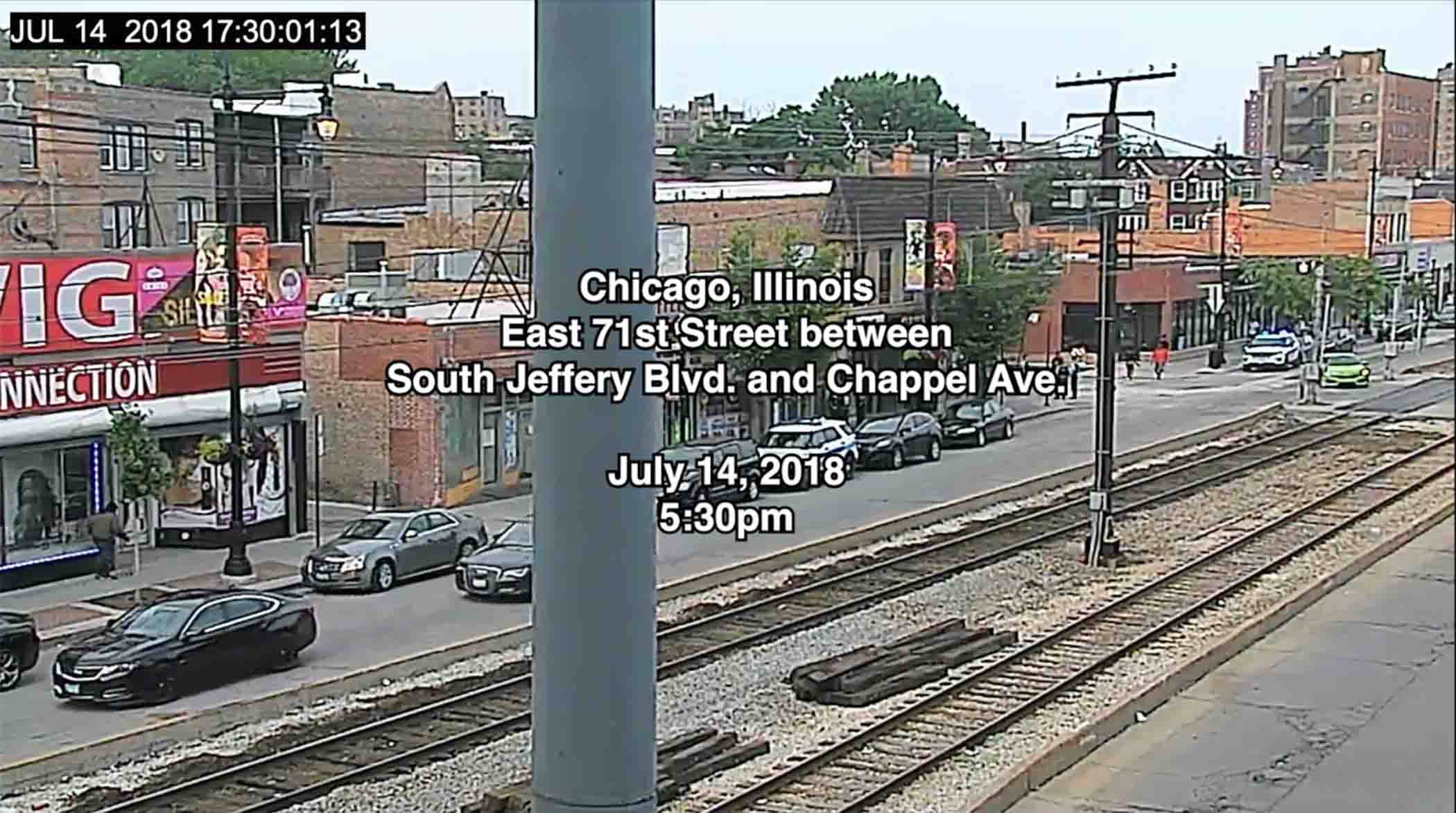
But by the time I finished it, I realized what an important role silence was playing. I realized you had to start with silence to realize how little you knew about what was going on from seeing these cyphers [small figures in the wide opening shot] on the street. And you don’t have the audio to tell you the story, and that at the end when all the police officers turn their body cams off … you go back to silence. You’re back out on that same street without a clue. Like it’s all been cleaned up and that spoke to the fact that we don’t control that media or who has access to it; without the cooperation of the police, we wouldn’t know what was happening. It speaks to who owns the media and how it gets out.…
Also, in defense of the police, they can’t be asked to turn cameras on and off when it gets hot, so I think those cameras should be on all the time. I think they should be uploading all the time. According to Jamie, who spoke to Axon [the body-cam manufacturer], the 30-second buffer, where you can see video from 30 seconds before but not [hear the] audio, is to protect the police from something stupid they might have said 30 seconds before that could have exacerbated or escalated things.
Given the Invisible Institute installation’s existence, why make Incident?
Well, I’m somewhat opportunistic with my projects. I like to find a project that’s supported by an archive. Dawson City was supported by an archive. The Village Detective was supported by [the reels dredged from the sea] and, by extrapolation, the larger Russian archive. So as a filmmaker who works by himself, who doesn’t shoot a lot of original material, I’m interested in trying to tell a story with, if not a single archive, an archive that’s implied by a group of archives. So, in this instance, I saw an incredibly rich and deep story that could be told with a single body of work.
I also thought that I’d said [in past works] a lot about the archive by referencing stuff that was old. And that the archive is becoming increasingly important as a harbinger of what actually happened; it’s becoming less and less clear what actually happened and that this was a prime example of it, even with all this material you can draw different conclusions about what actually happened, and that’s without deep fakes or AI or anything like that. So even an incredibly well-mediated moment when there are more cameras than there should be on a given instant, which is also a product of our racism and paranoia, there’s an archive that can tell this story in a rich but also ambiguous way. And it was almost immediately clear to me that the work that Jamie had done was incredibly helpful groundwork, but it had not gone into this type of cinema.…
I guess another big difference between what I did and what they did is that I included a lot of crowd commentary that becomes a chorus. One person says, What do y’all need this yellow tape for? You know what y’all did … And really there’s a way in which this entire story could be told from the perspective of that riot and what caused this riot [about three hours later, when the police attacked protesters], where you start there and you go backward. I didn’t want there to be time breaks [as there are in Six Durations]. So I became obsessed with this as a continuous story. There was something compelling about watching how this unfolds, how quickly it happened, how quickly it was all swept up. But also the endlessness of it. How this corpse was lying there endlessly and also how time can seem to stand still.
What was the political impact of Six Durations of a Split Second in Chicago?
I’d say that Harith Augustus is still not a well-known name. That South Shore community knows him, but he hasn’t gained the pantheon of Laquan McDonald, George Floyd, and Breonna Taylor. He’s not like a well-known name that a European would know. The Americans who were in the audience [in Europe] were like, we don’t know that name either. So, part of that is he was carrying a gun and may or may not have reached for it. The way the news put it, as you see in one of the Invisible Institute essays, the [police] talking heads were like He had a gun and it was over. The police released that footage of him touching his gun, which reframed him as a perpetrator … and the case was closed. He wasn’t martyred. I think that the work Invisible Institute did with Forensic Architecture actually shows that Halley had drawn the gun and was ready to go and so that if you’re in Augustus’s position, you’re between the two cars and turning around, you already see a guy pointing a gun at you, you’re already dead. So why not take a shot, I think it had reached that stage. We don’t have the camera to show that, but that’s what I think happened.
“It’s a bummer of a film. And some of my films as difficult and challenging as they can be, the people who like them are uplifted by them. And this, I think, nobody leaves this film happy.”
Do you see Incident as potentially having a different political impact than Six Durations?
I thought there was a way to tell this story that was also about the media and that was self-reflexive in that way, that was not only politically challenging but challenged the media and talked about what the media can do. So, I got very excited; I got excited by being able to play with something on a media level but that would also have political and cultural impact. And that would also recast what I do.
Do you find it more liberating or confining to produce art from an archive that others have mined for their own interpretation of the same event?
That would assume that everyone had seen Six Durations. So I told the story from the beginning. And I wanted the footage to tell the story. You do have my voice as text giving it context, but it was very important to me that for the most part the footage spoke for itself that it wasn’t manipulated, except for the epilogue, where I slowed it down.
Incident shows that Halley was ready to fire because he was scared. I’m wondering if Augustus was scared, too, because, although he was a licensed handgun owner, he wasn’t a licensed concealed carrier. I looked into what it takes to get an Illinois carrier’s permit. It’s not that hard: $150 and a government-issued ID, plus the Firearms Owners Identification card (gun owner’s permit), which Augustus had on him.
In a state that allows concealed carry, you’re not really allowed to stop someone and say Do you have a license for that unless they’re exhibiting some behavior like brandishing it or threatening someone, where it becomes an issue, so it’s sort of like, Who gets to carry a gun and who doesn’t.
It seems ironic that, as Incident explains, local business owners, who were presumably Black, wanted more cops on the street, and that it’s likely Augustus owned a gun for protection from crime.
There’s great irony. Augustus was in a cash business, sometimes working by himself. It’s a hot summer day. It’s the end of the day. They’re sort of bored. And you’re right, they’ve been ironically put there by the business owners, because, you can’t overemphasize the context of the Laquan McDonald trial, which was just about to happen, so there’s a lot of tension between the community and the cops, and the cops are aware that they’re not well loved in that community. And they’re not from there and they have been dropped in there destined to lose. They haven’t been supported by the system either.
New York, which has at times been a subject of your films, is very important to who you are and what you do. But Chicago is where you’re from and remains central to your identity; you still root for the Bulls and the White Sox. Were you drawn to Augustus’s story because of your connection to Chicago, especially its South Side, where you grew up?
My mom and my sister still live in Hyde Park which is two miles to the north of South Shore. It is a very different neighborhood, but 71st Street [where Incident happens] is a commercial strip. It’s a middle-class neighborhood; Michelle Obama grew up there. And as you can tell from the passersby on the street, there’s an incredible range of people going about their business. Augustus’s killing is kind of a freak occurrence for a place like that.… There was a blues club that I used to go to for years, right around the corner from there, called Lee’s Unleaded that’s probably been closed for five or six years (but there’s a rumor that it will start up again). My connection to that neighborhood is going to Lee’s, which still to this day is absolutely my favorite club ever.
So, in what ways is Incident about you?
If I make a movie about coal miners in the northeast of England [The Miners’ Hymn, 2010], if I make a movie about Dawson City, as an American telling a story about a Canadian city, I never get that question. When I made The Great Flood [2013], all of a sudden it’s about the African American experience moving into Chicago. I said, well, in a certain way that’s more about the neighborhood I grew up in than any of these other films.
Incident is more directly engaged with contemporary politics than anything you’ve done before. But I think all your films are political. That’s not new.
Thank you. Not everybody … I mean in Europe it was like, You finally made a political film and I was like, I’ve been making political films.
I think race is very present in all your films, even in ones that are not directly about race. For instance, Dawson City deals with the indigenous peoples of Yukon, and Decasia, by not being specifically about race, shows us, without narration, incidentally, and therefore powerfully, the prevalence of colonialism, visualized racially, in the West’s film culture.
Yeah. That’s a very interesting point. Buried News, you saw?
I don’t know it.
It’s the short I made in 2021 using race riots from the Dawson City collection. All of the newsreel footage is about lynch mobs.… It definitely ties in with Incident, and the two films will be shown together someday.
I want to discuss Incident’s form in relation to your prior works.
The big difference is what this material is; it’s low-grade video material so it leant itself to being smaller frames. These wipes and kind of cheesy video effects, I wouldn’t have tried using nitrate film.
What’s compelling to me about Dawson City [Morrison’s feature, which tells the story of, as well as stories around, long-buried and, in many cases, long-lost silent films unexpectedly unearthed in Canada’s Yukon territory] is that, as it itself documents, its footage had been dug up and archived a long time ago. That reveal explicates the heart of what you’ve been doing across your career: less discovering than re-interpreting, using film art to show us things we wouldn’t otherwise see. The same is true in The Village Detective, because its titular source turns out, as you, again, reveal, to be not a lost film but a lost print of a well-known film, which provides an opportunity for new storytelling. And going back to your short The Mesmerist (2003), it re-edited the elliptical remains of decrepit reels of The Bells (1926) — otherwise available as a well-preserved, more-complete feature — to tell a different story, around a specific character, than the one originally told.
Yeah.
So I’m wondering if Incident’s re-telling of Augustus’s story — where the archival footage has not only already been selectively presented by the Chicago police and then critically reanalyzed by the Invisible Institute — actually clarifies your practice, which has depended less on finding old things than in constructing new stories from them? In other words, despite its many obvious differences in source and form from your prior works, is Incident actually less a jump cut from than a continuation of your practice across your career?
Of course, I think of it as a continuity. I saw what Jamie had done, and I was excited by it, but I also saw an opportunity to further the earlier conversation, the Rashomon conversation that he and I had had, because the installation didn’t do that. It was very important that it got the facts and the context and the history out there. And for me, I saw something more akin to a narrative. And Jamie saw it as a continuation of the work that the Invisible Institute had done.
Way back, when you discussed Dawson City with my students at Brooklyn College’s Feirstein Graduate School of Cinema, one asked if you thought in the future you would work with decaying digital media. You answered very declaratively, No, elaborating that you didn’t find digital video visually compelling. After Incident, do you still feel that way?

I get that question a lot.… Students in particular often ask me: Can you see applying this to digital imagery? I don’t think what I obsessed about in Incident was the decay of digital, or even the materiality of the video archive. This is more content based and that’s why I felt more at ease about wiping in and quadrating the footage. I don’t think of this stuff as a physical object. It’s something that got uploaded; it’s a file. The thing is the digital breakdown has very little subtlety to it, it’s either 1 or 0 [computer binary code] and glitches out for a while. There are no happy accidents, or very few; there’s no gradation. There’s a world of romantic imagery within the decay of film you just don’t see in digital video.
From the beginning of your work becoming well known, with Decasia, critics have described it as both raising the dead and evoking mortality. In Incident you deal with an actual death and a video resurrection; you begin with Augustus’s end, with his killing, and then bring him back, observing how his end unfolded on earth in ways, not unlike found-footage characters in your other films, which he can neither witness nor could foresee.
Right, Right.
Does Incident, then, suggestively dramatize, via Augustus’s story, the essence of your own practice, usually with old films, by displacing it onto contemporary video?
You know, I don’t make films thinking about how it fits into my larger body of work. I think it’s interesting, with perspective, to say, Oh wow, that does continue that story. That’s the first time someone’s said that to me, and I wasn’t thinking of that. I think you’re right, though, that the curtain of mortality is always between the audience and what’s intriguing is that it becomes a mirror of our own mortality.
I hope that in some ways people can see themselves in Harith Augustus. I think there’s always going to be that question, Why did he run? You and I wouldn’t have run. It’s a different experience, I think, being a Black guy on the South Side of Chicago and having a bunch of cops come up on you. Your day is not going to end well. You’re not going to be able to walk away and say, Ok, next time I’m going to bring my license. Thanks for that. This is the way that I think it would have gone had [Quincy] Jones [the Black cop who was questioning Augustus before Halley and his partner, Megan Fleming, both white, intervened] continued his conversation. I think it was going to be a warning or a conversation, before it got escalated.
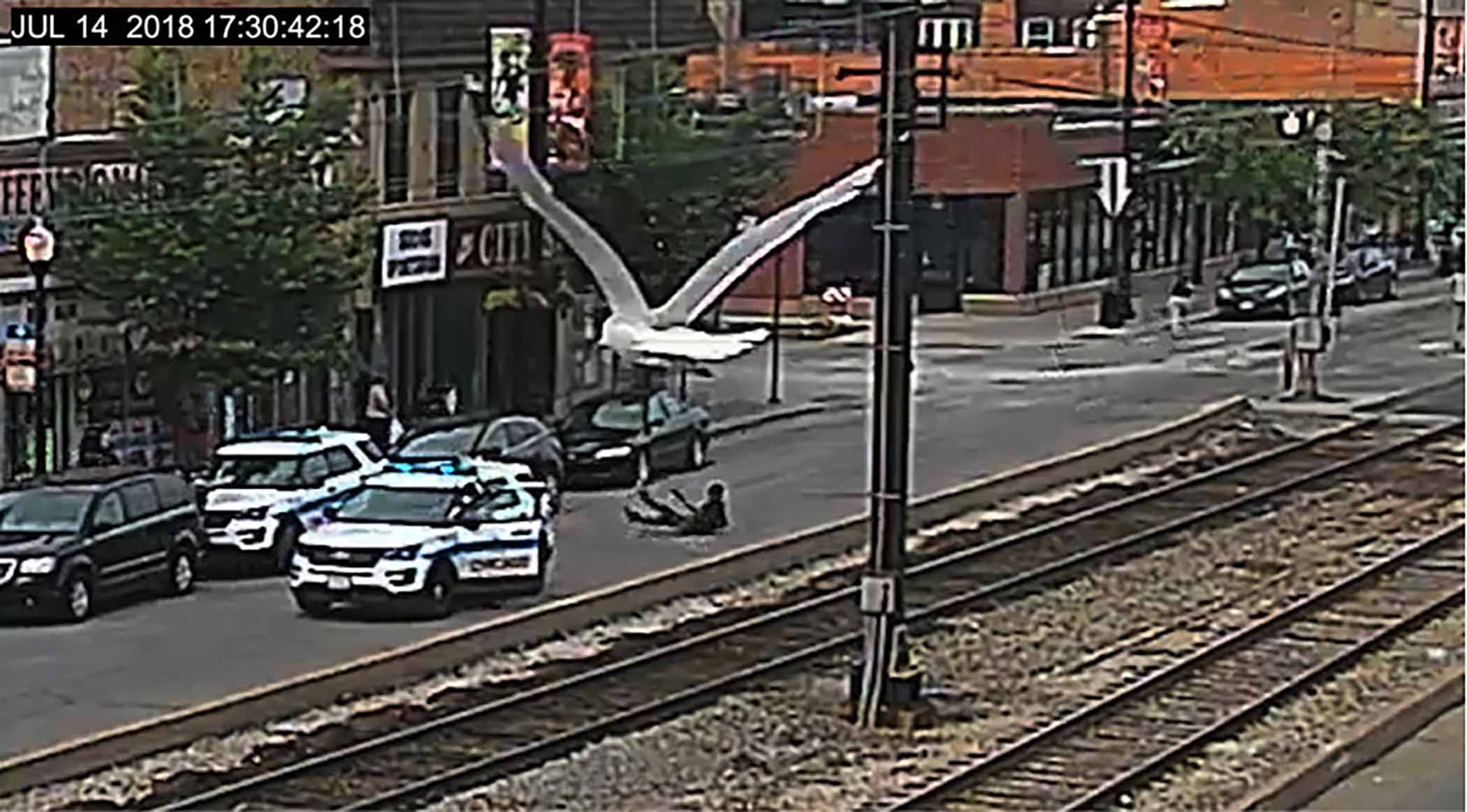
Do you consider Incident art? I do.
Yeah, I do. If you take the seagull [which flies into the footage that opens and closes Incident], that was a happy accident. It becomes the narrator.
The omen.
Yeah.
Your films have often made me think of Bruce Conner’s works. And Incident made me think particularly of Report (1967), about JFK’s assassination, because of the found footage and especially found sound from broadcast news.
That’s a great comparison. Yeah and also Perfect Movie (1986), by Ken Jacobs, that’s news footage in the wake of Malcolm X’s assassination. So, in a certain way Incident is found public footage that tells a story reassembled. I love the Conner comparison.
Do you think that art can keep this story alive? We’ve become so desensitized to police killings. By documenting this story in this form do you think Incident has, do you hope it has, the potential to re-sensitize people to this all-too-familiar tragedy, because we view it in an unexpected format rather than just clips on the news or social media.
Right. And also, it is a timely piece, an evergreen piece, but it’s not about something that happened yesterday. It happened five years ago. In a way it becomes iconic in that way. I think what makes it a compelling story is that it doesn’t come out and say that there’s a right or wrong here. I certainly think it could have ended differently and could have been avoided, but there is an ambiguity, which makes it a more interesting case. There were all these cameras on and we still don’t really know what Augustus’s intent was. We do know that he didn’t draw.
He never unholstered it; he was trying not to drop it.
Maybe he was trying to keep his pants up.
Has Incident changed you?
I don’t know how it’s going to change my work. It was a long time [spent via the archival footage] on that street corner in 2018, immersed in that kind of arcane examination and relistening, and the acute choreography of how a moment goes down.… So that placed me in a certain time and a place like I’ve never done before. That was different. I went back to Chicago in November [2022] and went right to that block and walked up and down it; the trees had grown a little higher but I saw where the railing around where the tree pit was and the cracks and I went to the sandwich shop and got a sandwich and everybody looked at me like I was a cop! [laughs].
How does it feel to see Incident finally out in the world?
Seeing it in Europe, I knew that in some ways I was in a safe zone, because I’m presenting our freaky country with our freaky gun laws. Everybody could say you guys are freaks and I could agree with them. We are. ❖
Seth Fein is a historian and documentarian. He operates Seven Local Film in Jackson Heights, Queens, where he lives.
Incident (2023) screens at DOC NYC on November 13th and 15th, at the Village East by Angelika. The downtown opening is also a national event; U.S. viewers can stream Incident for the first time via the festival, between November 8th and 26th.