






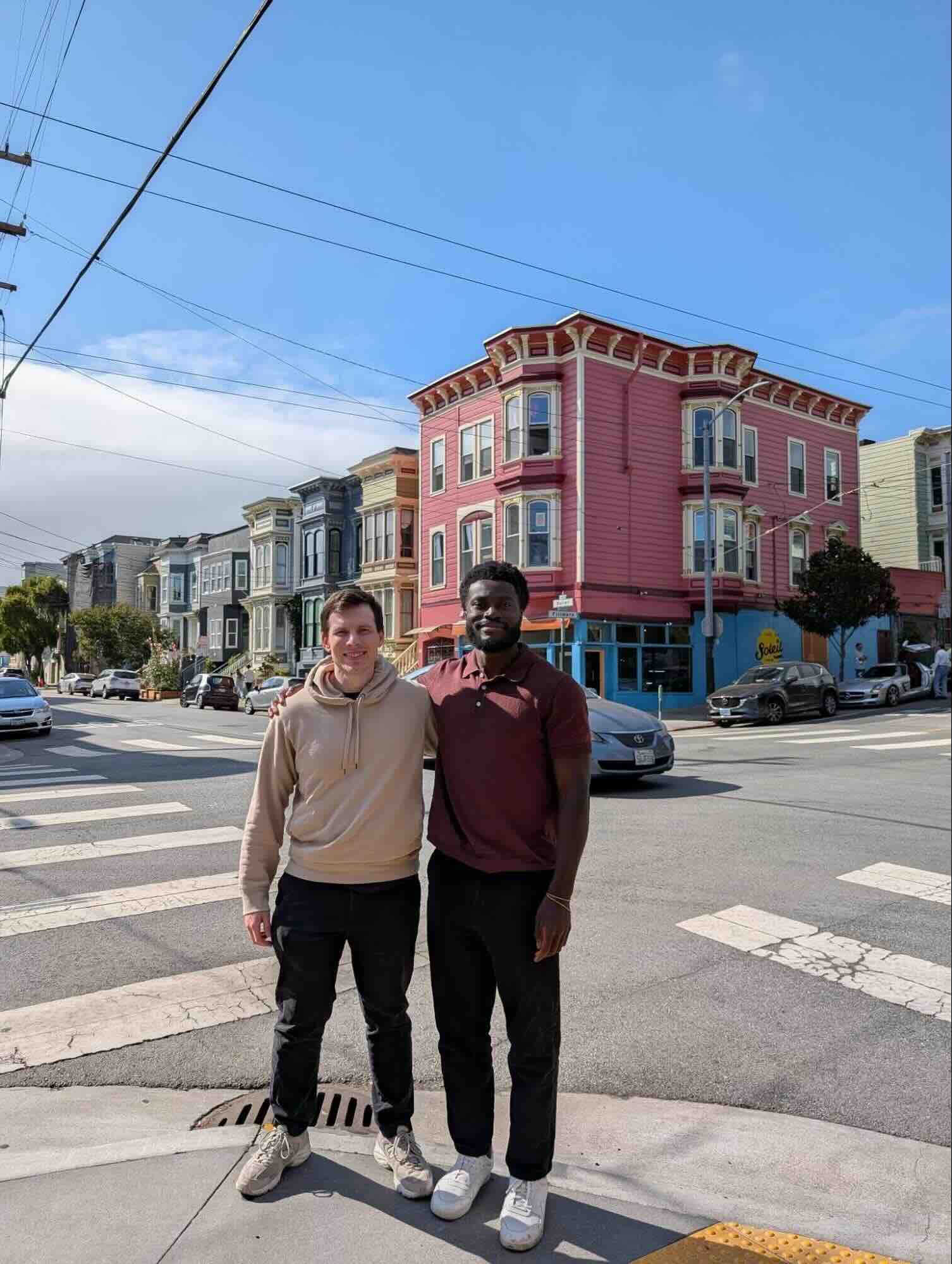
The former investment banker and Faire executive has built an AI system that can process an insurance submission in hours instead of days. Maple VC led the round.
Underflow Inc. has raised $2.75 million in seed funding to automate submission processing for commercial insurance underwriters, Ola Kolade, the company’s founder and chief executive officer, confirmed.
Founder Ola Kolade previously led strategic finance for the upmarket division at Faire, the online wholesale marketplacelast valued at $12.4 billion, and worked in investment banking at National Bank Financial.
The round was co-led by Maple VC, whose founding managing partner Andre Charoo was one of the first 25 employees at Uber.
Ola Kolade spent two years watching insurance submissions move through the commercial insurance system the same way they have for decades: slowly, manually, and one PDF at a time.
Now the 28-year-old former investment banker has raised $2.75 million to change that.
Underflow Inc., the San Francisco-based company Kolade co-founded in December 2025, has closed a seed round led by Maple VC to build and scale Aurora, an artificial intelligence system that functions as an autonomous underwriting assistant. The product reads incoming insurance submissions, extracts and structures the data, identifies what information is missing, and follows up with brokers to obtain it, all without human intervention.
“The U.S. commercial insurance market processes hundreds of billions in premiums every year, with the excess and surplus segment alone reaching nearly $100 billion in 2024,” Kolade said. “And the entry point for all of that business, the submission, is still handled almost entirely by hand. We built Aurora to change that.”
The problem Kolade is targeting is one of the most widely acknowledged pain points in the industry. When a broker sends a commercial insurance submission to a wholesaler or managing general agent, the package typically arrives as a collection of email attachments: ACORD forms, loss runs, schedules of values, and supplemental documents. An underwriter must manually open each file, read through it, extract the relevant data, enter it into internal systems, determine what is missing, and email the broker to request what was not included. The process often takes days per submission.
The numbers are well documented. According to Capgemini’s 2024 World Property and Casualty Insurance Report, 41 to 43 percent of commercial underwriters’ time is spent on administrative tasks like data entry and record keeping. Accenture’s research found that the average underwriter spends roughly 70 percent of their time on non-underwriting activities, and estimated the industry-wide cost of that inefficiency at $85 billion to $160 billion over five years.
“These are highly skilled, well-compensated professionals spending most of their day on work that does not require their expertise,” Kolade said. “Every hour an underwriter spends re-keying data from a PDF is an hour they are not spending on risk assessment, which is the thing they were actually hired to do.”
The submission bottleneck has attracted technology investment before. Over the past two decades, insurtech companies have built document management platforms, optical character recognition tools, and rules-based automation systems aimed at streamlining underwriting intake. Most have had limited impact.
Kolade argues this is because the problem was misdiagnosed. In a December 2025 article for Rough Notes, one of the oldest insurance trade publications in the United States, he wrote that previous solutions treated the submission process as a document management problem when it is actually a comprehension problem.
“OCR can read the words on a page,” Kolade said. “It cannot tell you that the loss run covers three years when the carrier requires five, or that the construction type on the application contradicts the schedule of values. That requires understanding the documents in context, not just extracting text from them.”
Aurora approaches the problem differently. The system connects to a firm’s existing email environment, typically Microsoft Outlook. When a submission arrives, Aurora reads the email and every attachment, extracts all relevant data, and structures it into a single record. It then performs a granular gap analysis, identifying not just that a file is incomplete but specifying exactly what is missing and why.
The system drafts follow-up communications to the broker requesting the missing information, either under its own name or through the firm’s email accounts. If the broker does not respond within a set period, Aurora follows up automatically. When the file is complete, it packages the submission and routes it to the assigned underwriter.
Aurora also performs functions beyond intake. It writes preliminary risk assessments, flags data inconsistencies across documents, identifies coverage opportunities the broker may not have requested, and enriches submissions with research from public data sources including property records and business registries.
“We did not build a tool that helps underwriters process submissions faster,” Kolade said. “We built a system that handles the processing entirely, so the underwriter receives a file that is ready for a decision rather than a pile of documents that need days of manual work before they can even begin.”
Andre Charoo, the Founding Managing Partner of Maple VC who led the round, said the investment was driven by both the scale of the problem and Kolade’s approach to solving it.
Charoo, who was one of the first 25 employees at Uber and launched the company’s Canadian operations before co-founding Maple VC in 2016, has deployed capital into dozens of early-stage companies including Clay, Neo Financial, and AutoLeap. He also serves as Venture Partner at Inovia Capital, a firm managing over $2 billion in assets, and as Executive Fellow at Harvard Business School.
“In nearly a decade of evaluating hundreds of early-stage ventures, it is rare to encounter a founder who has both identified a problem of this magnitude and built a technically differentiated solution capable of addressing it at scale,” Charoo said. “The commercial insurance submission workflow has not fundamentally changed in decades. Aurora represents the kind of infrastructure innovation that can reshape how an entire industry operates.”
Maple VC’s thesis focuses on Canadian-founded companies building in the United States. Kolade, a Canadian citizen who studied at McGill University and now operates out of San Francisco, fits squarely within that mandate.
Kolade’s path to insurance technology was unconventional. After studying economics at McGill, he spent two years as an investment banking analyst at National Bank Financial in Toronto, the sixth largest bank in Canada, working on more than ten transactions across the technology, media, and telecom sector including IPOs, mergers and acquisitions, and debt financings.
He then moved to San Francisco to join Faire, one of North America’s largest wholesale marketplaces, where he led strategic finance for the upmarket division, the business unit responsible for the platform’s largest retail customers. At Faire, Kolade designed and operationalized the first dedicated account management frameworks for the upmarket business. It was there that he first encountered the commercial insurance distribution chain and began studying its operational inefficiencies.
Kolade’s instinct for building goes back further. As an undergraduate at McGill, he was part of a team that created a first-of-its-kind device to prevent head trauma in football players by regulating helmet pressure. A former football player who experienced concussions as a teenager, Kolade understood the problem firsthand. The device was recognized by the NFL’s HeadHealthTECH network, and the team reached the finals of McGill’s entrepreneurship competition, finishing in the top 10 percent out of approximately 400 entrants.
The timing of Underflow’s launch coincides with a workforce challenge the insurance industry has been anticipating for years. Approximately one quarter of the current commercial insurance workforce is aged 55 or older and approaching retirement, taking with them decades of institutional knowledge about carrier appetites, risk patterns, and underwriting judgment that is difficult to transfer to new hires.
“The industry is losing its most experienced people faster than it can develop replacements,” Kolade said. “That is not a problem you solve by hiring more people. You solve it by building systems that capture the repeatable parts of that expertise and make them available at scale.”
Kolade plans to use the funding to expand Aurora’s capabilities and grow the company’s presence in the United States commercial insurance market. Underflow is currently in stealth and has not disclosed specifics about customer adoption.
The market the company is pursuing is large. The U.S. excess and surplus market grew at a 21 percent compound annual rate over the past five years to surpass $104 billion in premiums in 2023, and the broader U.S. commercial insurance market is many times that size. Every dollar of that premium begins with a submission.
“We are building the system that makes the first step of that process intelligent,” Kolade said. “If we get this right, the impact extends to every participant in the commercial insurance chain: brokers, wholesalers, managing general agents, and carriers. The submission is where all the business starts. Fixing it fixes everything downstream.”