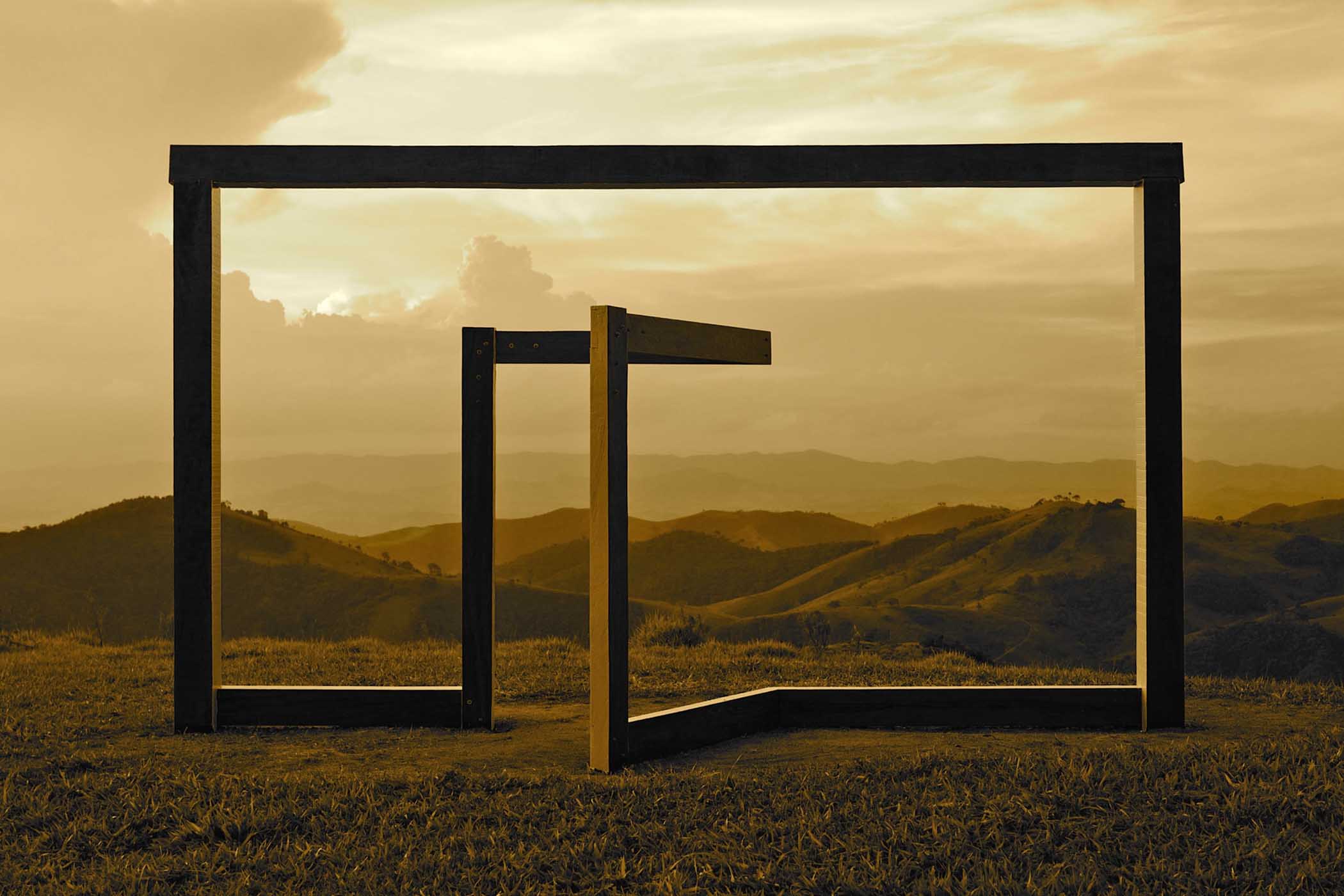






With concurrent exhibitions in Los Angeles and New York, polydextrous interdisciplinary artist and occasional architect Olafur Eliasson continues his multisensory, multiplatform advocacy on behalf of Earth’s natural magic. Eliasson — who New Yorkers will remember from the large-scale, site-specific 2008 Waterfall installations at four locations on the East River waterfront — is currently tearing the roof off Los Angeles. Literally. His massive, architectural-scale kaleidoscopes — one rises right through the roof of MOCA Geffen — capture and refract the real-time L.A. sky.
Possibly the most anticipated of all the big-ticket PST ART: Art & Science Collide offerings, Eliasson’s is not only among the most crowd-pleasing, beautiful, and unexpectedly emotional of the 70 Getty-sponsored exhibitions — it is also one of the most satisfying and salient embodiments of the initiative’s mandate to explore how science manifests in historical and contemporary art. And that’s because science — from ecology to color theory, optics and acoustics, thermodynamics, oceanic and celestial tides and orbits, meteorology, physics, mathematics, organic chemistry, geometry, and geology — has always been at the heart of Eliasson’s practice.
From the surprisingly variable qualities of the skies above L.A. captured in an enormous version of a child’s toy kaleidoscope to delicate drawings and illusionistic mirror-rooms, Eliasson leads viewers through a hushed industrial field of giant, spaceship-like pavilions, each containing a new iteration of the alchemy of natural light, ambient and terrestrial elements, and refractive effects. Indeed, not only your eyes but your mind open wide.
In New York it can be even more impractical to rip the roof off buildings, so Eliasson’s interventions in the spaces at Tanya Bonakdar Gallery, for the exhibition Your psychoacoustic light ensemble, respond to the architecture in other ways, such as projected light and sound waves; the audience feels the spark of unexpected senses being involved in the physical experience. As with many of Eliasson’s more confined indoor pieces, the aesthetic goes way past image and into the realm of quasi-psychedelic inquiries into the conventions of perception itself.
I believe that space and people co-produce each other — people have a responsibility in shaping their environments.
Yet in both exhibitions we see up close that despite all the spectacular Prospero-like invocations of natural, scientific, and mathematical phenomena that animate Eliasson’s works, he favors humble materials: ice, driftwood, sea glass, exposed scaffolding, rudimentary projectors, latticed lanterns, water, and the open sky. At the same time, Eliasson is increasingly working not only at architectural scale but in the making of actual architecture. So how does the artist keep all these expansive ideas present in his mind across works as vastly different in scale as a whole building or the hand-held? How does he keep a permanent structure feeling alive and even ephemeral? How does he imbue the cosmos into a small drawing for the wall, or a single-channel sensoria?
We asked him these and other questions in an interview (edited for length and clarity).
Village Voice: As we spoke about at MOCA, in Los Angeles, I’ve visited your parabolic pavilion in Vejle, Denmark, and of course there are other examples of different kinds of fully realized built architecture — like the Donum Estate, for example. My question is one of scale — how do you think about translating your core ideas across such a variety of scales, from the intimate to the edificial, with different degrees of ephemerality/permanence and kinetic/phenomenological elements also at play?
Olafur Eliason: Since the early 1990s, I have conducted spatial experiments that explore how spaces affect our perception of reality. I’ve long believed that a model — whether a physical object or a conceptual framework — is no less real, even though it has traditionally been seen as a stepping stone toward a more “perfect” reality. For me, a building too is a model, despite its greater scale and more permanent materiality. As a model, it proposes the possibility of something else, something in another space or time. I think this allows for a more flexible and productive relationship with reality. These ideas have come to life through a number of artworks, both small and large.

For example, the New York City Waterfalls brought my experience of hiking in Iceland to the city known for its towering buildings. The speed of the water falling reveals how close or far away you are from the waterfall, and how large or small the waterfall is. An awareness of nature and natural properties as a way to place yourself within a space or in relation to something is both grounding and expansive. It anchors you to your environment, while also bringing you back down to earth, so to speak. It asserts your scale in relation to nature.
For my exhibition OPEN, at MOCA, my team and I constructed a number of kaleidoscopes that responded to the scale of the Geffen. One of these, Observatory for seeing the atmosphere’s futures, actually goes through the gallery’s roof — inviting visitors to situate themselves in relation to the sky above. It’s not just about sparking a sense of wonder but an invitation for viewers to take part in the creation of the artwork, through embodied experiences. It’s this idea of how a work can heighten or reawaken perception and environmental awareness.
Was architecture always an interest of yours, or did that come into the equation later, and how?
I’ve always felt comfortable naming myself as an artist. For many years, I have worked with my friend and colleague Sebastian Behmann to see how larger scale projects can come into being. Together we founded Studio Other Spaces, which focuses on projects that emphasize the creation of environments that engage visitors with their surroundings rather than designing isolated structures. When the lines between design, art, and architecture are obscured, a sense of openness emerges, inviting consideration of what lies beyond the space itself. Achieving this requires careful attention to not only the materiality but the spaces in-between, and of course, the people who will be visiting them.
To me, the focus on people is a bridge I see between my work as an architect and artist. In [the book] Life Between Buildings, the Danish architect and urban designer Jan Gehl explores how public spaces contribute to social interaction and urban life, emphasizing the importance of public spaces in creating connection. My interest in how people participate in my works — whether artworks or architectural projects — is key to how I approach my practice in both realms. One way this is translated in architecture is the movement. The way a person moves through the space is key to many of the designs, with curved forms frequently used to emphasize the concept of continuous motion.

My first formal architectural project was Fjordenhus, in Vejle, Denmark. In this work, I wanted to bring the atmospheric qualities of the surrounding landscape — the light, air, and water — to the forefront. The structure encourages an embodied experience where these elements can both be felt and seen by those who visit.
With regard to your current exhibition in New York, and related to the previous question, how do you translate those big ideas into gallery-size work for a more commercial discourse? I’m trying to get a sense of how you hold those ideas across such a variety of manifestations.
These same ideas — of perception and co-production — are central to my current exhibition at Tanya Bonakdar Gallery. While these are large, overarching ideas, I believe they are just as applicable to large-scale installations or structures as they are to smaller artworks. For me, it’s not so much about scaling the ideas down, but allowing them to shift and take on new forms within a space.
Space is not static but instead linked to time and the behavior of people within that space. Western society and commercial interests sometimes promote the idea of fixed, unchangeable spaces — which can lead people to perceive space as a passive backdrop rather than something dynamic. But I believe that space and people co-produce each other — people have a responsibility in shaping their environments.
In this show, I express these ideas through various mediums. One light installation, for instance, translates audio waves into visual experiences. By using low-frequency vibrations, I create a spatial soundscape that can be felt, seen, and heard — much like how an architectural structure or painting can also engage multiple senses. The projections in this work make the tones explicit or physically felt. You can see sound and hear the light, or, in other words, you can see yourself hearing. This is an experience that transcends the space, and rather is an embodied experience between the viewer and the work. ❖
Shana Nys Dambrot is an art critic, author, and curator based in Los Angeles and is the arts editor at LA Weekly. In 2022, she was awarded a Rabkin Prize for Visual Arts Journalism.
Your psychoacoustic light ensemble
Tanya Bonakdar Gallery
521 West 21st Street
Through December 19
OPEN is on view at MOCA Geffen, Los Angeles, through July 6, 2025 moca.org