







A spiral, when you think about it, works like an inside-out labyrinth. The end is completely visible from the outside. If you can walk it, there’s hypnotic pleasure in following your feet to the center. That’s the experience promised by Spiral Jetty, the monumental earthwork that arcs through the blood-red waters at Rozel Point, in Utah’s Great Salt Lake. This is a massive sculpture — a 1,500-foot-long rock pathway conceived and built in 1970 by the enigmatic artist Robert Smithson. A tall, skinny, brooding, chain-smoking ersatz cowboy from Passaic, New Jersey, Smithson lived only three more years after finishing Spiral Jetty. He went up in a light plane for a long view of his newest project, Amarillo Ramp, still in its beginning stages, and crashed in the desert. He was 35.
A good artist bio is a treasure box, and Suzaan Boettger gives the reader more of Smithson than anyone has to date. Still, reading Inside the Spiral is like getting a Snickers bar and being forced to eat the wrapper, too. There’s so much analysis and detail wrapped around the story of Smithson’s paroxysmal psyche that it feels like actual labor to get to the kernel of truth. This biography is dense enough to sink any ordinary reader. But once it becomes clear that Smithson was haunted by a childhood loss as grim as a circle in Hell, the information feels necessary, like padding for something fragile. In Boettger’s telling, Smithson was tenacious, but not quite a survivor. Remarkable, then, that he managed to win so many allies on his short journey. He liked significant people — artists and dealers — who held court in bars as if they were royalty or judges. But death was always on his mind.
God isn’t in the details of Smithson’s life so much as in the foundation. The Smithsons were Roman Catholics, and Robert was “a crazy Christian”— a friend’s words — to the end. Sacred art was very much a thing in the 1950s in the U.S., and plenty of ambitious mid-century artists, from Milton Avery to Andy Warhol, were making it. The ecstatic Catholic vein running through every study of Western art would get a boost in 1961, when JFK became the first Catholic to ascend to the White House. Smithson was a passionate reader on the sacred, and an equally passionate (though not very good) poet. This was more than conditioning. Smithson’s central attraction to his religious upbringing was linked to an obsession with blood — oceans of it.

Robert Smithson was his parents’ second child, and his life revolved around the older brother he never met, Harold Smithson, who died of leukemia in 1936 at age 9, before Robert was born. Boettger reports that Harold would have suffered and bled incessantly with this disease, and that Robert was conceived approximately a week after the first anniversary of Harold’s death. The author makes much of the “replacement child phenomenon” to explain Robert’s morbid turn of mind. At least he started out with his own name, unlike Vincent van Gogh, who reportedly was born exactly one year after the stillbirth of the first Vincent, and more than once had to look at the tombstone with his name on it.
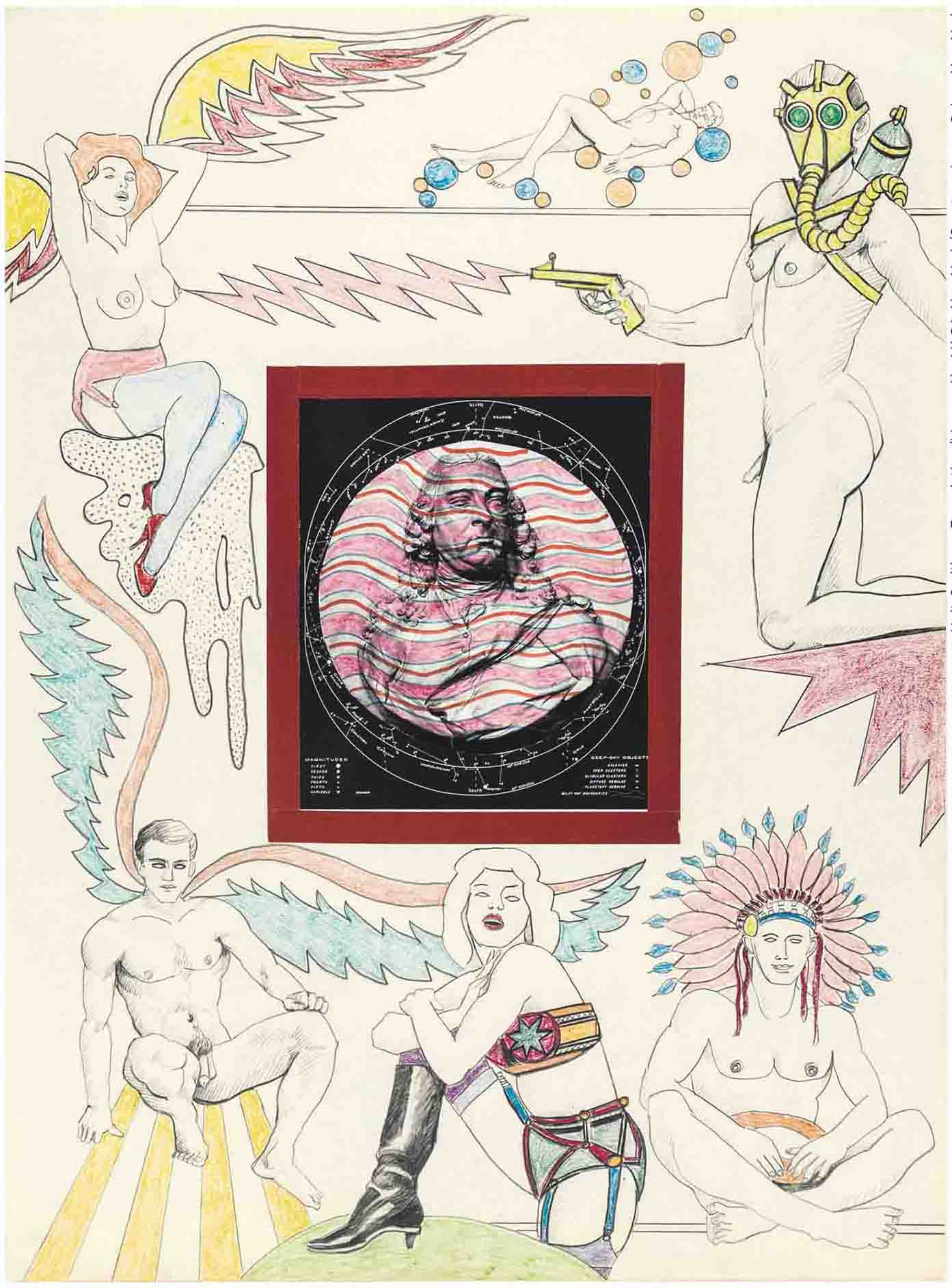
Smithson latched onto the trauma of Harold’s death and made it the center of his work, knitting it together with images of sacrifice, crucifixion, bloody doves, and flayed angels. Inside the Spiral’s reproductions of Smithson’s early drawings and paintings show him experimenting with black and red brushwork in a bold, stiff, Byzantine style, like an American Georges Rouault.
Marsh hired a plane, calling it the Texas version of a taxi. But he flagged the wrong cab.
In the narrative we witness the emergence of a fantastically uninhibited inhibited guy. Nancy Holt, who Smithson had known since middle school and would later marry, refused his invitation to his first New York opening because Smithson seemed so bizarre. (It’s not clear if this was intended to be a date.) In her words, Smithson was “one of the ten students to watch in high school, because he might commit suicide or go crazy or something like that.” This was in addition to his emerging interest in awkward and mechanical sex and his love of leather bars. Nevertheless, after converting to Roman Catholicism, Holt stuck with Smithson for the rest of his life.
Alice Neel’s 1962 portrait seems to further a sense of slightly creepy self-involvement. Smithson’s fingers are long and sensitive. He’s got that backward-curled magician’s thumb. His hair is floppy and probably dirty. His eyes focusing down his pointy nose, and his nose itself, give him the feral stare of a wild animal — a raccoon or an opossum (and I mean that as a compliment). Given Neel’s attraction to male vulnerability, it’s a fitting portrayal of a soul, at least from the outside. Smithson was said to dislike it because it showed his acne scars.
Smithson could run with the minimalists, writes Boettger, but he wasn’t one. His work could be construed as environmental, but he thought eco-activism was too pure. He liked to hang with his dealers, and he liked the cool-cat habitués of Max’s Kansas City — Mel Bochner, Tony Shafrazi (not really an artist, but guilty by association), Carl Andre, Richard Serra, Sol LeWitt, Donald Judd, Claes Oldenburg, Ron Bladen (a few creeps in there, for sure). Holt is a constant presence in Inside the Spiral, but doesn’t make much of an impression until she has a strange hunch that turns her away from Smithson at a crucial moment and saves her life. We don’t get much of a sense of color from anyone in Inside the Spiral, mostly straight reporting and not much opinionating; the book would have benefited from a few tasty asides. Art wasn’t supposed to be autobiography at this point in its history — not in New York, anyway — but this even-handed telling becomes a strain.
The eccentric Texas millionaire Stanley Marsh 3 then steps to the forefront of this story without having done much to earn it. He’d swapped the Roman numerals after his name for a number, thinking it less pretentious, and would have been just another art surfer but for his talent for bankrolling off-the-wall projects. (“Cadillac Ranch,” an installation consisting of vintage cars buried nose-first in the sand, is one.) Smithson and his gang stopped by Marsh’s ranch in the summer of 1973 to catch up with Tony Shafrazi, and started casing the property right away — this is where Smithson dreamed up Amarillo Ramp, a partial spiral in an artificial lake bed. The piece starts out at ground level and builds gradually into a circular promontory 15 feet high. It’s the mythical uroboros, the snake that swallows its tail. You can’t visit it; it’s on private property. (As for Spiral Jetty, the Utah tourist website reads, “if you are a lover of the iconic photos, you may be expecting something bigger and more dramatic.”)

Smithson planned Amarillo Ramp for Tecovas Lake, but wanted to see the site from above before beginning work on it. He and Holt staked out a location, and Marsh hired a plane, calling it the Texas version of a taxi. But he flagged the wrong cab. “Every time I pointed out the danger — that word isn’t strong enough — [Smithson] would make light of it, and assert that it was about that, it was about that feeling,” the terrified Tony Shafrazi said after their first trip aloft. Had they flown a high-wing plane, it would have been safer, but the Beechcraft had wings on the bottom — you couldn’t see the ground. Holt and Smithson revised the staked-out setting, but on the second trip Shafrazi stayed behind. Holt demurred too, having been ill and unsettled for days. The pilot apparently banked the plane for a better view and stalled it. All three people aboard — the pilot, the photographer, and Smithson — died.
Boettger eschews the emotional throughout the book, but that doesn’t mean readers can’t appropriate a grieving space of their own. “Red is the most joyful and dreadful thing in the physical universe,” Smithson wrote in his last essay, but the words weren’t his. He had borrowed Catholic philosopher G.K. Chesterton’s description of his favorite color: “It is the fiercest note, it is the highest light, it is the place where the walls of this world of ours wear the thinnest and something beyond it burns through.” It’s a bright antidote to Smithson’s lamentations, which proved to be prophetic. “Spare my dying puddle,” he wrote in a poem that’s better chanted than read. “Let the bloody dove go down.” ❖
Inside the Spiral is published by the University of Minnesota Press.
Sally Eckhoff is a painter, writer, and animator who lives in upstate New York. Her essays and reviews have appeared in The New York Times, Newsday, the Wall Street Journal, and Salon.com. She is also the author of F*ck Art (Let’s Dance), a memoir of 10 years of painting on the Lower East Side.