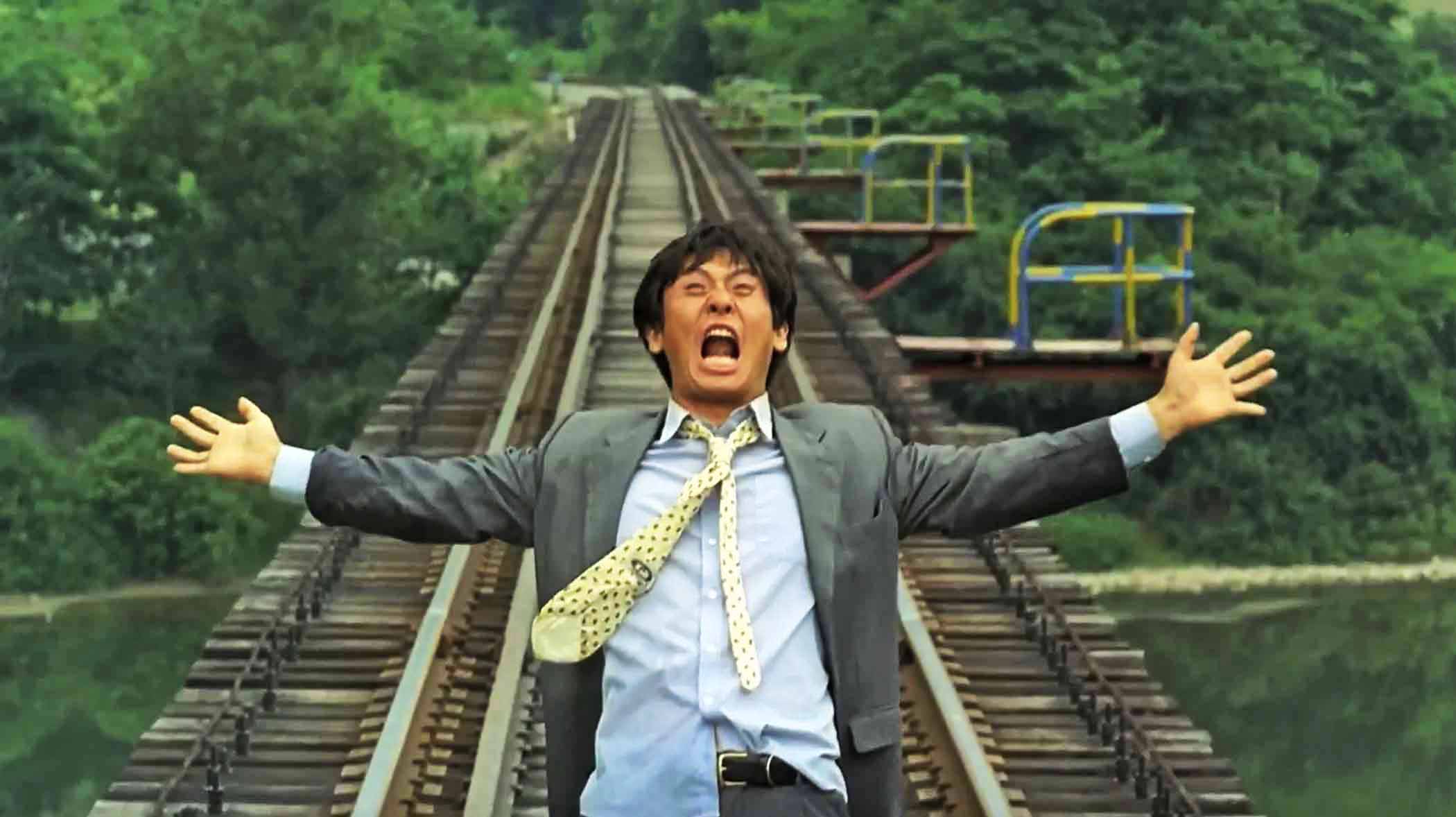




A veritable unicorn fossil unearthed from the Pleistocene bogland of 1974 and spit-shined for our retro-retro delectation, Isao Fujisawa’s late-New-Wave rule-breaker Bye Bye Love (Baibai rabu) may have finally found its proper day and age. Thought lost for most of the past half century, this neglected spritz of discontent — made when indie features in Japan were rare enough already — is newly famous for partying like it was 2024, in terms of who’s what. This is because in addition to its nostalgic pedigree and ancient-youth-culture bona fides, the thing is an avant outlaw-lovers-on-the-run road movie, in which the femme in question turns out to be ethereally trans, no one seems to care one way or the other about it, and no one frets very much about sex or love anyway, man.
In 2025, this romping fluidity feels startlingly wise, but back during the year of Richard Nixon’s resignation it must’ve triggered heart attacks. (We don’t really know if Fujisawa’s movie was ever publicly shown in Japan back then, or how extensively.) Certainly, pride of place would’ve been reserved for this crazy splat of cultural prophecy in Amos Vogel’s seminal book, Film as a Subversive Art, if in fact that historic volume hadn’t already gone to press that same year.
The up-in-the-air-ness of their relationship gives the movie a distinctive radical edge, as if even rebelling against middle-class society as a pair of lovers takes too much commitment.
The vibe is pure snot-nosed anti-establishment indie heaven, shot with golden amateur grain and the poise of a stoned weekend. Crude colors, crude action, fake reality out of the Godard handbook — up yours, old fart. Immediately we meet Utamaro (Ren Tamura), a disaffected delinquent in a tight polo shirt, who sees a cop chasing a beautiful babe (Miyabi Ichijô) and impulsively trips the flatfoot. Shrugging disrespect flows like rainwater from there, as Utamaro (clearly a fake name, taken from the famous 18th-century artist) shoots the cop with his own gun and links up with the mysterious and nameless fugitive, whom he dubs Giko, which in Japanese means both a mimic and the act of aiming a gun. “Really?” she shrugs. They bond sexlessly, lie about in her house (before whimsically trashing it), drink Coke and talk about Jim Morrison, shoot her American ambassador boyfriend (pointedly named Nixon), and drive off in an old-model Buick.

In there somewhere, Utamaro becomes aware, as we do, that Giko is no Bonnie Parker but is in fact an intergender-naut of some elegant variety, and he seems only mildly put off. “So, you’re artificial,” he grumbles, to which she replies, “The whole city is artificial.” Later, after a few more bodies and stolen cars, she muses, “It’s like a love triangle — you and the male and female parts of me….” Whatevs: In this abstracted generational rebel space, who gives a shit about roles and definitions and blah blah blah? The up-in-the-air-ness of their relationship gives the movie a distinctive radical edge, as if even rebelling against middle-class society as a pair of lovers takes too much commitment. (They’re not deciding to drop out, they’re not deciding anything.) Later, around the time that they hire a hooker and wrap all three in wires from a radio, to finally feel a charge, Utamaro even suggests maybe he’ll turn gay so he can consummate the pair’s counter-culture romance. But that never happens — they’re in a road-movie daydream, which is both patently unreal and doomed to end in a pointless hail of bullets.
In 1967, when asked at Cannes why his film Weekend had so much blood in it, Godard said, “That’s not blood, that’s red.” The redefinition is key not only to Godard but to the whole slippery blob-of-mercury zeitgeist that followed after him. Fujisawa’s film plants its flag in the middle of that stream, riffing on the Breathless story flowchart (itself a smirking self-conscious take on a film noir paradigm), pouring on the red paint, wallowing in wasteful downtime, and thumbing its nose at the squares. Which makes it a sprightly time capsule; every imitator of Godard made a film more or less like this, just not with this degree of nonchalant sexual ambiguity, and not in Japan. Fujisawa, always busy in the industry but otherwise notable only as an assistant to New Wave giant Hiroshi Teshigahara and prolific pulpster Yasuo Furuhata, never directed another feature. However much Bye Bye Love is an uppity work of its day and age, it’s as though Fujisawa made this one movie for the future, when gender vagaries would become both hardly scandalous in movies and a campaign air-raid siren for a fresh league of mercenary vote-grubbers in the real world. ❖
Bye Bye Love
Screenings begin January 17
Metrograph
Michael Atkinson has been writing for the Village Voice since 1994. His latest book is the new edition of his BFI tract on David Lynch’s Blue Velvet.