





We need a new history — and a historiography — of the Western. Look at that sine wave, morphing and undulating from merely Boys’ Own pulp to full-fledged national myth to right-wing propaganda hornbook to New Wave–era “anti” bloodbath to, today, a lonely prairieful of anti-myth woke-lesson-learning. It’s a roller-coaster stretching now 150 years or more, a million books, stories, films, comics, radio and TV shows, all derived from only about 60 years of history (roughly from the 1840s to just past the turn of the century). You can’t make a Western today without being “revisionist,” and since it’s a genre that in short order turned itself into the American origin story, it makes perfect sense to revise the crap out of it, and to cast a bloodshot eye back on even the more innocent white hat/black hat B-movie programmers of the ’30s. As we still live in a country at least partially deranged by the Western-cliche self-image, with our unnecessary cowboy hats and fake work pickup trucks and bigoted country-music radio, revisionism might be an imperative operation.
If only ennobling rectification of the historical record, away from whitewashing and toward white-settler culpability, was all you needed, movie-wise. The new Chilean film The Settlers is a revisionist’s revisionist Western, though obviously of a different colonial heritage; it might be that, generally, the Western paradigm isn’t as compromised by nationalist mythopoeia in South American countries as it has been in the U.S. Certainly, in Felipe Gálvez’s film, his first feature, the barbaric dynamic is so simple and clear-cut it makes the ramshackle subterfuge of the crimes in Killers of the Flower Moon look ambiguous.
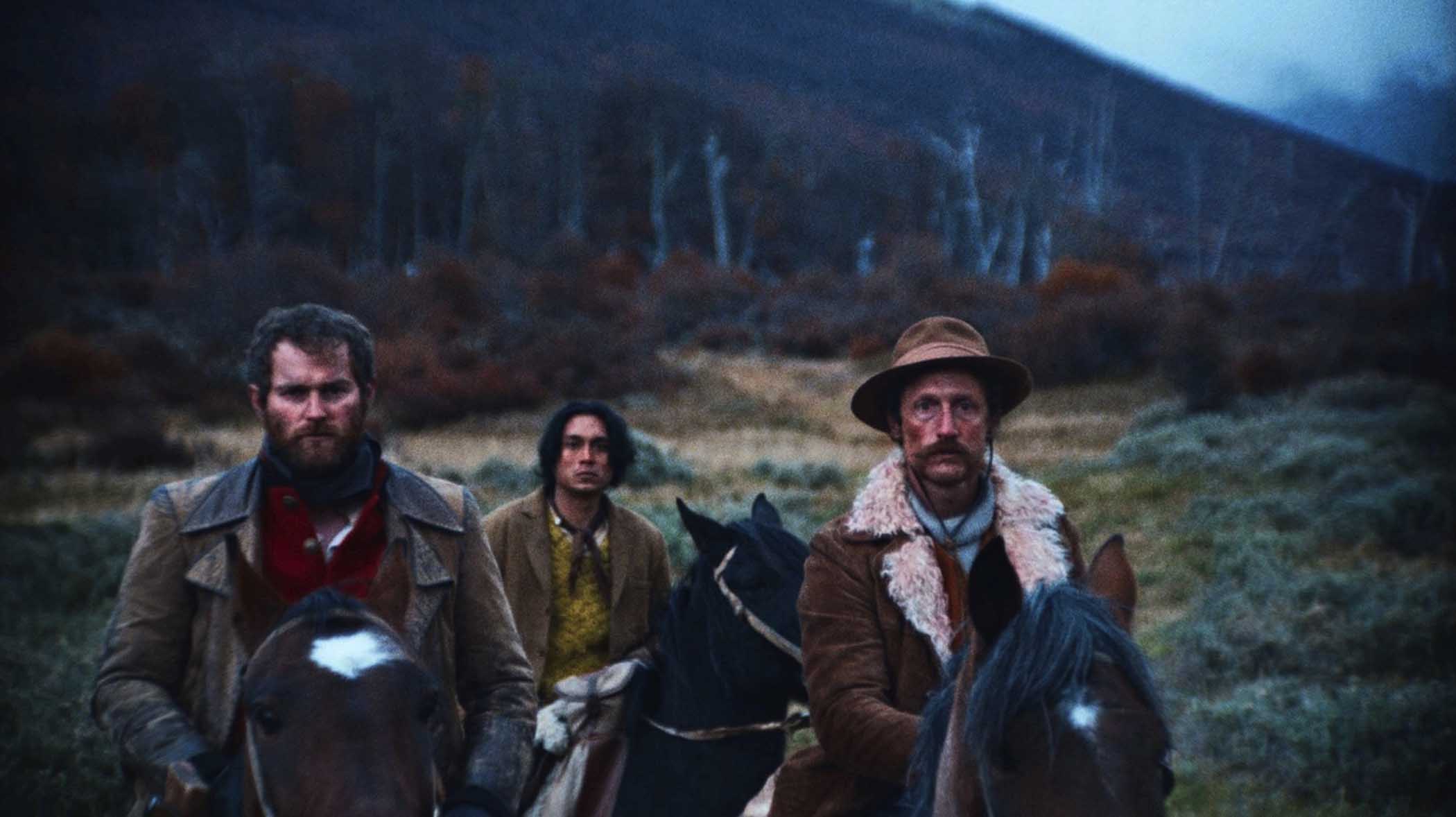
It is also perhaps the first film to depict the Selk’nam genocide, an orchestrated slaughter of the native peoples of Tierra del Fuego that began in the late 1800s, ordered by sheep-ranch magnates after the new government granted them millions of acres of otherwise Indigenously inhabited grazing land. Chilean character-star Alfredo Castro shows up as one such real owner, Jose Menendez, who, at the outset, in 1901, instructs his Boer War–hardened Brit foreman MacLennan (Mark Stanley), another authentic personage, to simply “clear the land” so the sheep will have an uninterrupted path to the Atlantic.
Instead of ceaseless slaughter à la Cormac McCarthy, the film has a spare picaresque shape to it.
MacLennan takes only two helpers with him: a mouthy Texan mercenary (Benjamin Westfall) and Segundo (Camilo Arancibia), an Indigenous mestizo sharpshooter who watches far more than he speaks. Segundo is our eyes and ears, as it dawns on him what the small troop’s vexing mission really is: simply to kill the local population and make the wilderness suitable for colonization. In that, the film treads the same ground as Cormac McCarthy’s Blood Meridian, Gálvez leaning into the Cormac-icity with the characters’ relentless coldbloodedness and sparsely poetic dialogue, and even folding in the lullaby “All the Pretty Horses,” twice.
But evoking McCarthy and his most violent book is a little misleading — most of what you might hear about The Settlers is about its brutality, but I found the movie almost strangely tasteful. The infrequent killings are rarely difficult to watch, and a central slaughter of a small village is shot obliquely, through thick fog. The corpses and ear-cutting that follow make the director’s point, surely, in an art-film’s-discreet-distance kind of way.
Which is fine, if not overwhelming. Gálvez is more interested in the stark ranginess of the landscape, and nailing down this time and place. At once both dogmatic and engagingly eccentric, The Settlers does smudge its evil-colonialist through line, leaving out huge swaths of incident (toward the end, Segundo recounts vast genocidal actions we never see), and toying with our urge to find a sympathetic character anywhere, including Segundo. (We take his quietude for the horror of witness, but it might not be.) Instead of ceaseless slaughter à la McCarthy, the film has a spare picaresque shape to it, crossing paths with a plummy surveyor escorted by Argentine soldiers (the competition between the two groups bubbles with swinging-dick anxiety) and with a drolly psychotic, and gay, British colonel (Sam Spruell, the best actor in sight) and his outcast squad, as if the southern tip of Chile was populated primarily with discontented foreigners acting out their “cravings” on the locals. Meanwhile, at one point, Segundo wakes in the night to a bizarrely body-painted native apparition, the cultural import of which might be clear only to the few Selk’nam left.
In its last third, the film toggles to a few years later, when the Chilean government initiated an inquiry into the genocide, and even locates Segundo in his seaside shack to record his grim testimony. But it’s a propaganda project for the 20th century, as we see clearly through the bitter gaze of Kiepja (Mishell Guaña), a native woman who attached herself to Segundo earlier and now, renamed and free, exudes her people’s silent rage. But she, too, it is hinted, abetted the violence we didn’t see — Gálvez’s film is dryly limning the colonialist project as an all-encompassing plague. Only the horses, who get many pensive, witnessing close-ups, are guiltless. ❖
Michael Atkinson has been writing for the Village Voice since 1994. His latest book is the new edition of his BFI tract on David Lynch’s Blue Velvet.