





“He was a son of a bitch,” Casablanca composer Max Steiner said of Richard Wagner (1813–1883). And yet, in 1967, Steiner also said, “If Wagner had lived in our times, he would have been our top film composer.” The multimedia alchemist of opera and author of antisemitic polemics laid the groundwork for film music with his use of leitmotifs: Wagner assigned short, recurring musical phrases to characters (Tristan), objects (sword), and psychological states, connecting and deepening the action onstage and providing an emotional throughline for the audience. Early film composers in Hollywood, many of whom were Jewish refugees from Europe, found the strategy irresistible, and the obsession continues to this day, in Star Wars, Indiana Jones, etc. In 1954, just short of a decade after Auschwitz, Erich Wolfgang Korngold (The Adventures of Robin Hood) spoke of his “admiration” for Wagner. That Steiner, Korngold, and many other Jewish composers could choose to both appreciate the music and curse the composer means that this irony of film music was also its triumph.
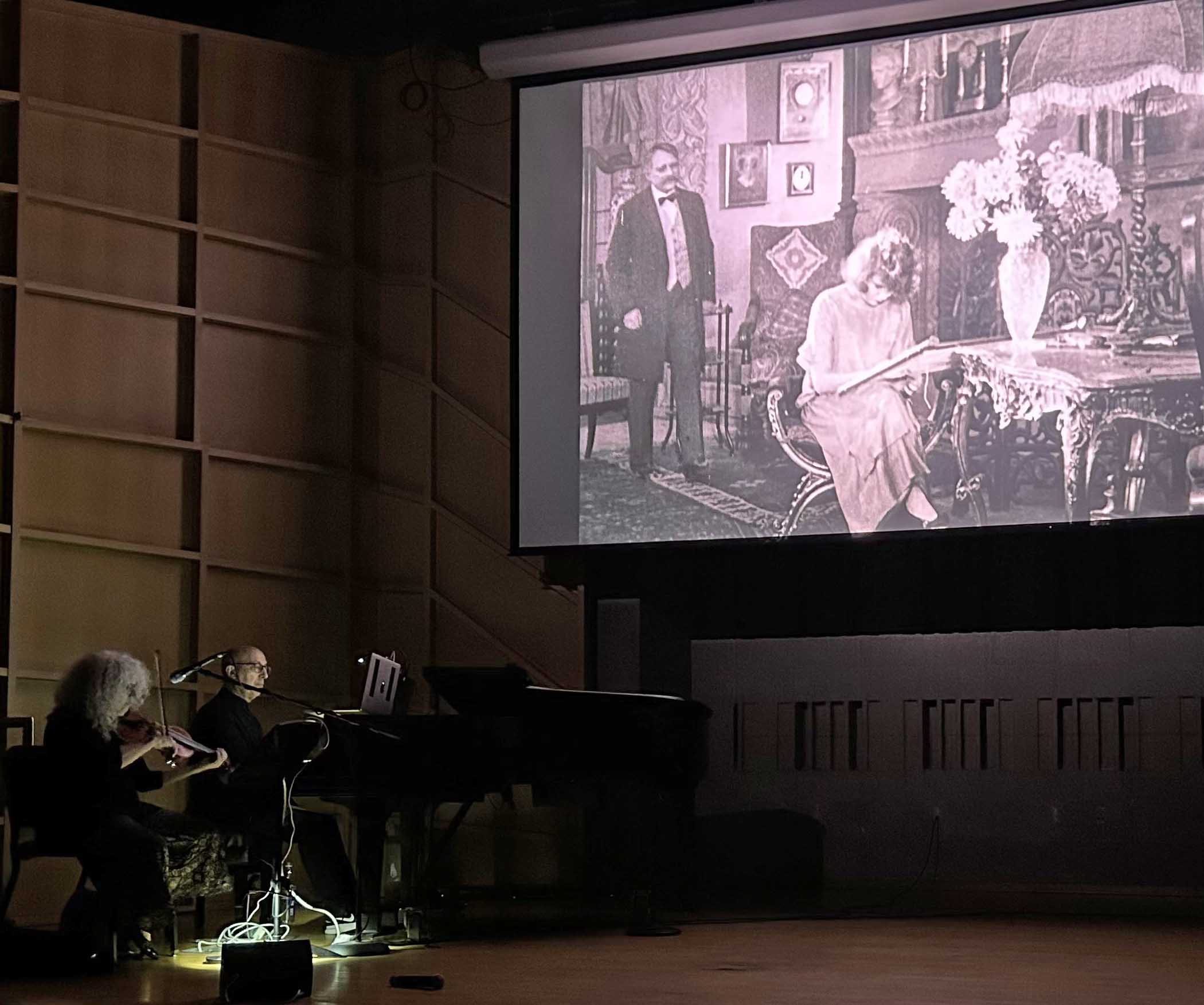
Irony and triumph were both on display earlier this month at the subterranean Engelman Recital Hall, at Baruch College’s Performing Arts Center, where klezmer fiddler Alicia Svigals and pianist/composer Donald Sosin played live musical accompaniment to a screening of the silent film The City Without Jews, which seems to have predicted the expulsion — but not the extermination — of Jewish Europeans. Playing live harks back to the original screenings almost a century ago, and it’s a treat to catch now, especially when the music is coordinated so well with the action and emotion onscreen — so much so that I sometimes forgot the musicians were even there.
Based on the eponymous 1922 novel by writer and journalist Hugo Bettauer, The City Without Jews was directed by H. K. Breslauer and premiered in Vienna, in 1924. The next year, Otto Rothstock, a former member of the Hakenkreuzler (Hitler’s first followers), entered Bettauer’s office and shot and killed him. But the film continued to screen until 1933, when it played in Amsterdam as a protest against Hitler. Then it disappeared entirely until 2015, when someone found a copy of it at a Paris flea market. Svigals calls the film “anti-anti-semitic.”
Svigals accompanied the opening shot with sarcastic, jittery folk tunes, which she called “fake-lore,” since she wrote them.
Ah, Vienna — the city where “people believed in ‘progress’ more than in the Bible,” according to the Austrian chronicler of the period, writer Stefan Zweig. The film is set in a sarcastic stand-in for Vienna, the “Republic of Utopia,” where unemployed workers are protesting the skyrocketing inflation. The vampiric Chancellor — who looks like a younger, taller Grandpa Munster — talks with his adviser to figure out a solution; seeming to read the Chancellor’s mind, the adviser warns him that committing atrocities is bad politics. But the Chancellor ultimately decides that the only solution is to expel the Jews, and the motion is heartily passed by the National Assembly. Chilling images of packed trains and pedestrian caravans haunt modern viewers, who know how real these images would become in two decades’ time.
Meanwhile, Lotte, the daughter of one of the antisemitic politicians who voted for expulsion, has fallen in love with Leo Strakosch, who is Jewish. Nevertheless, he is expelled too, and as the Jewish people head toward “Zion,” the economic and cultural life of the city begins to collapse. The Chancellor mindlessly scribbles the Star of David on a piece of paper as his advisers inform him that foreign buyers are boycotting the Viennese economy; one of their most loyal (gentile) American loan sharks has stopped giving them credit; and the only plays being put on are by talentless goys.

Eventually, the National Assembly resolves to pass a motion repealing the expulsion. The only problem? The anti-expulsionists need a two-thirds majority, and an antisemitic assemblyman named Bernart is the only one keeping them from achieving it. At that point, Leo, who has come back illegally to Austria with papers identifying him as a French painter, gets Bernart drunk in his bedroom. Then comes a remarkable series of dizzying expressionistic flourishes: The room rocks back and forth as Bernart stumbles to the front door and Leo points him toward a waiting cab, which Bernart sees in double vision. Absent for the vote, Bernart is driven to the countryside, where he awakens, stumbles into a mental hospital, frantically tries to telephone in his vote, is too late, and is subdued by the medical staff. They commit him to an angular room, where he climbs onto a Star of David–emblazoned chair, which looks like a prop from Picasso’s Cubist-inspired sets for the 1917 ballet Parade. “A very interesting case of delirium, dear colleague,” a doctor says. “This man imagines he is a Zionist!” Finally, Bernart awakens in a bar to find that it was all a dream. Vienna, for the moment, is still a city of progress.
For period audiences, even though the film was expressly made to warn against virulent anti-semitism, the horror depicted was evidently so unimaginable that it was laughable. For the modern viewer, the slapstick humor feels almost innocent in the way that the serious absurdity of, say, Eugène Ionesco’s 1959 play Rhinoceros does not. Ionesco’s play depicts the rise of anti-semitism allegorically, as humans turn into rhinoceroses while one teetotaling human man resolves to resist the animals. But Rhinoceros isn’t funny, even though its premise is comic — it’s sad, because we watch it with the hindsight of knowing that Bérenger, the protagonist, will fail. Today, remarkably, the slapstick humor of City Without Jews still manages to come through, with the right score.
Vienna — the city where “people believed in ‘progress’ more than in the Bible.”
The music of Svigals and Sosin reflected the grave import and the humor of the film, in a biting manner. Svigals accompanied the opening shot with sarcastic, jittery folk tunes, which she called “fake-lore,” since she wrote them. Then the duo made a seamless transition to more Straussian tones, as the rich Viennese danced at a ball. Sosin stated that he tried to compose in a period idiom from the 1920s, incorporating the styles of composers like Schoenberg. But to my mind, it was more a mixture of late Brahms and wartime Shostakovich (who didn’t make these sounds until 1937). I even heard some harmonies that could have come out of Philip Glass’s études (I told Sosin this, and he laughed). The Shostakovich sound continued as Sosin played heavy, dissonant chords on the lower end of the piano to accompany the labor march. At one point, the violin played a staggered, poking phrase, aligning with the hand gestures of an antisemitic assemblyman arguing in the bar. After the expulsion bill was passed, the duo, with sufficient irony, got jazzy. Then came another smooth transition into a sweeping, Brahmsian leitmotif, which runs throughout the film in different forms, signaling both hope and despair. As the film’s last title card proclaimed international brotherhood, Svigals and Sosin ended with their rendition of the famous “Ode to Joy” from Beethoven’s Ninth, which sounded like a Vienna Philharmonic record blasted into the middle of a hora.
Despite some lack of coordination between the musicians (at times one noticeably rushed or the other dragged), they played with a jaunty devotion that made the music infectious and enhanced the silent film. And although I was disappointed that the music didn’t necessarily deepen the characters (as good Wagnerian leitmotivic music does), it represented, in a captivating way, what was happening onscreen. After all, as Susan Sontag once asserted, “any work of art may be seen as an attempt to be indisputable with respect to the actions it represents.” The alignment of music and picture was beautiful and subtle. It is no wonder that this was enough to make one audience member approach Sosin after the concert to thank her, as he wept. ❖
Ben Gambuzza is a writer, pianist, book editor, and researcher living in Brooklyn. He is also the host of The Best Is Noise, a live classical music show on Radio Free Brooklyn. You can find his recital album, Baroque Jewels, Romantic Revivals, on Bandcamp and elsewhere.