



The year 1992 marked the end of the Cold War, the birth of the modern Christian Right, and the publication of a cranky broadside by critic Robert Hughes, titled The Culture of Complaint. Its argument, acerbic and scattershot, presented unimpeachably valid reasons for rescuing canonical books, pictures, and other cultural items from the torches and pitchforks of the era’s rising wave of “political correctness” — “You can learn from Picasso without being a phallocrat, from Rubens without becoming a Hapsburg courtier, from Kipling without turning into an imperialist” — along with a shoulder-launched jeremiad aimed at an army of Brylcreemed, rep-tie-wearing, “patriotically correct” Pete Hegseth progenitors. Beneath the ocean of partisan noise lurked great white nationalist sharks. Per Hughes: “The loss of reality by euphemism and lies” manufactured by presidents Ronald Reagan and George H. W. Bush “was 20 times worse and more influential” than that handstitched by “bien-pensant academics.”
At the height of the 1990s culture wars, Hughes described the country as characterized by enmity, polarization, and “a hollowness at the cultural core”— a nation “obsessed with therapies and filled with distrust of formal politics; skeptical of authority and prey to superstition; its language corroded by fake pity and euphemism.” At the 1992 Republican Convention, Pat Buchanan stood before the GOP faithful at the Houston Astrodome and channeled his best Father Coughlin: “There is a religious war going on in this country,” he bellowed. “It is a cultural war, as critical to the kind of nation we shall be as was the Cold War itself, for this war is for the soul of America.” Sound familiar?
Three decades later, a black hole the size of Elon Musk’s ego corrodes the nation’s heart. Half the country is distrustful of evidence-based findings or has been red-pilled by QAnon-like conspiracies; public language across legacy and social media is routinely stripped of common meaning, and, worse, common sense; and the nation’s “low-information” electorate voted to embrace an objectively fascist, coup-mongering, felon — a Biff-Tannen president-elect who promises to criminally target “enemies of the people” (read, journalists and others who oppose him) and abolish nonprofits he doesn’t like (such as the ACLU and The Bulletin of the Atomic Scientists, and public universities) by designating them “terrorist organizations.” (The Donald Trump-driven Stop Terror-Financing and Tax Penalties on American Hostages Act, or HR 9495, passed the House of Representatives on November 21; despite its similarity to Russia’s evolving “anti-extremism legislation,” it currently awaits ratification by the Senate.) If the nation’s bonfire of the vanities pulled five alarms after the murder of George Floyd — with Ibram X. Kendi’s How to Be an Anti-Racist shouldering out Jordan B. Peterson’s 12 Rules For Life on the nation’s bookshelves — the next four years promise Back to the Future, the 1490s Florentine version, starring Stephen Miller as Savonarola and Tucker Carlson as San Bernardino di Siena.
Circular firing squads roam social media like Putin’s FSB assassins.
In art, discussions around what constitutes the canon — once upon a time cathedral-solid but now as slippery as a recently retired Florida congressman — have resulted in two remarkable developments. The first is the opening up of once-exclusive art institutions to an unprecedented number of artists from beyond the racial, gender, geographic, and ideological pale. The second is the predictable ascent of reductive American-style identity politics (like other exhausted paradigms — say, the “domino principle,” for foreign policy hawks after the Cold War — it remains U.S. progressivism’s default drive), along with its corrosive carping, empty virtue signaling, and nonsensical bromides. Among the latter, consider identity-led demands to abolish the police, fund surgery for transgender inmates, promote land back claims that cover whole metro areas, as well as admonitions about which artists can safely address “triggering” material, like the murder of Emmett Till.
The results are as eye-gouging as Trump’s recent electoral college landslide foretold. One side, the putative Left, demands that museums and libraries betray their missions by simply swapping in newer artists for older ones — usually paler and deader male practitioners. Its opposite number, the far Right, mobilizes local, state, and national policy to censor, defund, and punish expression as a form of political payback (while banning discussions of, for example, slavery and climate change). As the wide-eyed naturalist said after watching the endangered Western gray squirrel gag on its own tail — the extremes meet.
So, who’s complaining now, you ask? The answer is: In private, everybody; in public, mum’s the safe word. Circular firing squads roam social media like Putin’s FSB assassins; corporate algorithms push trolls over experts for hate and profit (so much for technophiles insisting “information wants to be free”), and thoughtful artists, writers, musicians, and commentators alike appear, as the kids say, CAF (“confused as fuck”). To borrow a mathematician’s simile for instability, America is all poles and no zeroes. Same idea, different lingo: cancellation and clapback are features, not bugs, of our Internet age, and we’ve entered a new era of accelerationist anti-discourse. To cite Allan Bloom’s reactionary 1987 bestseller — we seethe in The Canceling of the American Mind.
If curmudgeonly oracles like Hughes no longer boast prominent tribunes — he spent more than three decades writing weekly art criticism for Time magazine — the public commons is awash with non-experts with YouTube-ready answers for legions of “This-explains-everything-addicts.” They include populist podcasters, wellness gurus, corporate “thought leaders” and outright flimflammers — crisis-borne confidence characters of the sort W.B. Yeats once pegged as “full of passionate intensity.” Enter, stage Right, a youngish, German-born, UK-raised art and fashion writer named Dean Kissick. A self-appointed slayer of woke mobs and defender of the icky 1970s Viennese Actionists (think, naked white guys on crucifixes smeared in animal guts), he arrives just in time to enact yet another Groundhog Day reprise in the pages of last month’s Harper’s: a bougie millennial parroting of novelist Tom Wolfe’s cavil from half a century ago.
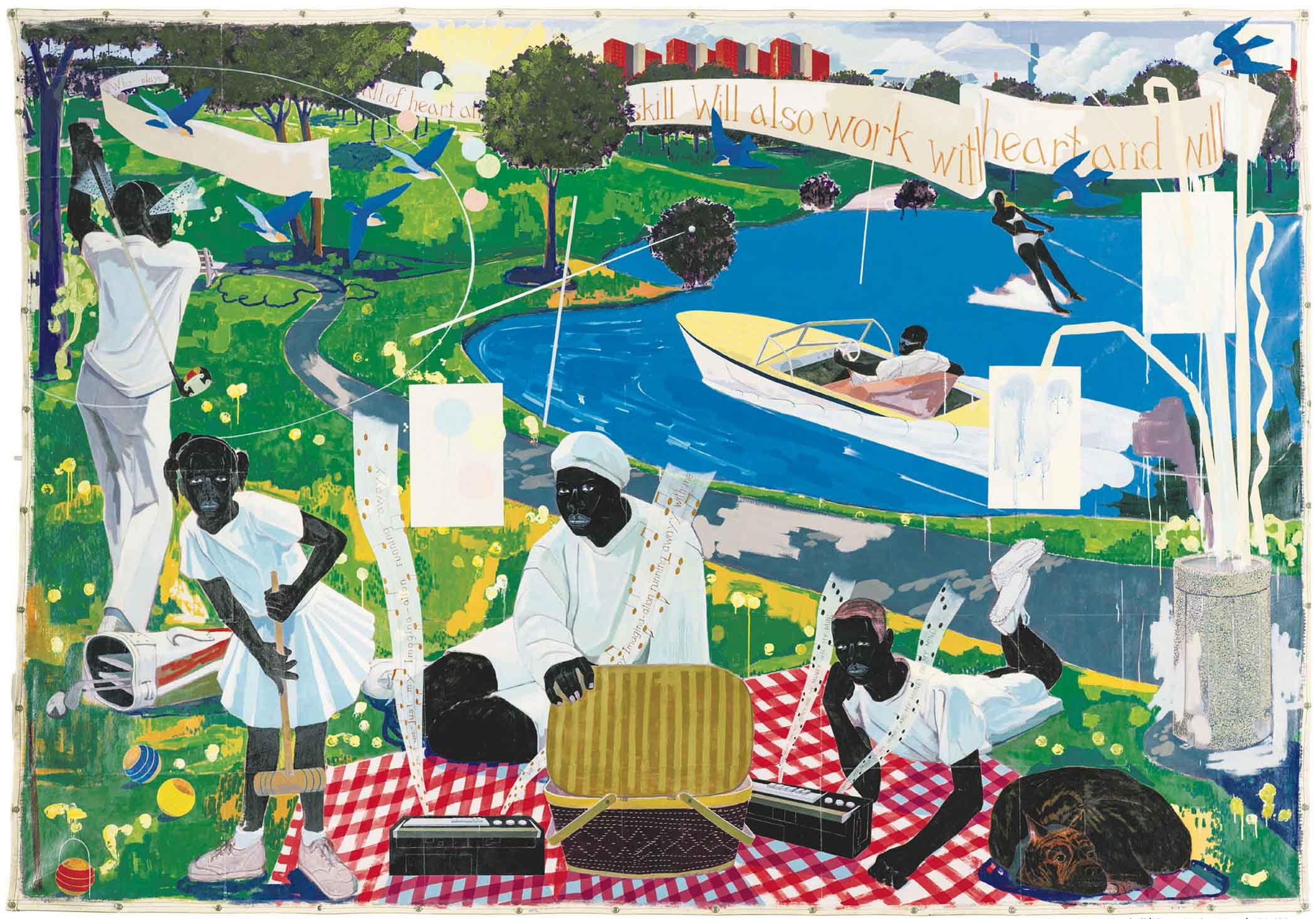
Titled “The Painted Protest: How Politics Destroyed Contemporary Art” — the tip of the retro fedora is to The Painted Word, Wolfe’s caricature of 1970s conceptual art, first excerpted in the pages of the same magazine in 1975 — Kissick’s much-commented-upon, scorched-earth denunciation of art circa 2024 managed an unlikely feat. It parodied contemporary art’s sanctimonious “social turn,” called out absurdities at marquee museum and biennial exhibitions, and dutifully red-Sharpied the “fantasies of resistance” attendant to the art world’s “liberal orthodoxy and feel-good ambient diversity.” What the essay did not do is equally crucial: It failed to acknowledge great works of political art from Goya to today — Kerry James Marshall anyone? Hans Haacke? Nan Goldin? — in order to paint the field of contemporary art as a dishonest comedy of manners à la Wolfe.
Toggling between nostalgic and ironic (two of art criticism’s principal default modes since the 1970s), Kissick begins his takedown of today’s identity-based political art on a truly bizarre note, by invoking an accident in which his real-life mother lost her actual legs — unforgivably, it appears, for the sake of this sorry opener: “My mother lost both of her legs on the way to the Barbican Art Gallery.” To indulge the writer’s setup for a minute, he informs his bedridden mum a few sentences later that the offending exhibition, “Unravel: The Power and Politics of Textiles in Art,” was not “worth losing her legs for,” after all. Holy Attila the Son! I’ve heard about children weaned on the Internet not being able to distinguish the actual from the virtual, but this takes the gamer birthday cake.
Brutal introduction done, Kissick gets busy swinging a piñata bat at every conceivable low-hanging museum wall label, with special attention paid to the identity art-lite and inscrutable Judith Butler-inspired texts animating two spectacularly milquetoast exhibitions: the 60th Venice Biennial, titled “Foreigners Everywhere,” and the 2024 Whitney Biennial, oddly christened “Even Better Than the Real Thing.” (Note to with-it curators: There’s nothing evolved about reprising three-decade-old U2 songs.) What follows in Harper’s is a predictably short list of boldface exhibitions (he namechecks the Barbican show, the aforementioned biennials, and the 2017 Documenta, in Kassel Germany, as typical of “a globalized circuit of biennials and fairs”), topped by textbook alarmism of the classic the sky-is-falling sort. Wherever Kissick looks, he sees “varieties of remixed neoindigeneity,” as well as heaps of “celebrations of identity” that he understands chiefly as pastiches — artworks “made in such deeply traditional styles [that they] are progressive in content but conservative in form.”
As anyone who has visited museums recently knows, leading arts institutions around the globe have struggled since the first Trump presidency. U.S. museums, in particular, have seen waves of executive and curatorial resignations, scandals have erupted, boards have been reshuffled, mission statements rewritten, and demands met to recast slow-moving repositories of culture as more “flexible” and, in some cases, more activist. As with all wild swings in culture, things are gained (greater artist representation in collections and on boards, for one and two) and others lost (the cancellation of the traveling National Gallery Philip Guston retrospective comes to mind). But parodying the excesses of these trends doesn’t just miss how art museums have successfully kept up with the times in spite of these struggles, it actively ignores business as usual at the world’s auction houses and commercial galleries — some $65 billion in sales of largely apolitical, non-woke, and agnostically decorative paintings and sculptures in 2024 alone. For anyone attending December’s Art Basel Miami Beach, or following news of Maurizio Cattelan’s $5.2 million banana, Kissick’s observations might as well describe art on Mars.
What candy-coated, head-in-sand, MTV Real World beach house does Kissick inhabit, anyway?
In 1998, a behavioral scientist named John R. Landry took note of the ascendancy of a classic kind of fearmongering. “Chicken Little syndrome,” he wrote, encouraged professional and amateur bloviators to infer “catastrophic conclusions possibly resulting in paralysis” and a collective “sense of despair or passivity which blocks the audience from actions.” Like Whataboutism in the first Trump era, tabloid-grade alarmism is chiefly designed, currently, as rhetorical grist for the cultural mill (think X and Truth Social). Similarly, fearmongering was Tom Wolfe’s stock in trade, delivered in book-length volumes that routinely exposed the Emperor’s New Clothes — for instance, the liberal-baiting Radical Chic & Mau-Mauing the Flak Catchers and the architecture-bashing From Bauhaus to Our House. With Kissick, that same bit gets the Kindle treatment. If the glibness or vacuity of his noodling seems familiar, that’s not just because he’s aping Wolfe; it’s because neither writer invented philistinism.
Meantime, rhyming polemics move on and metastasize, taking at once familiar and surprising shape. Who has the right to what subject matter? Do artworks have a duty to right representational wrongs? Can pictures, poems, novels, films, and songs be guilty of metaphorical violence? Will red and blue audiences become even more enraged and vulnerable after January 20? As the “Great Awokening” — the coinage is not mine but sociologist Musa al-Gharbi’s — winds down and the country braces for the coming Right-wing surge, one thing seems certain: For all the problems with wokeness, cultural consumers will likely miss it — not as a greater good, but as a symptom of a political climate that was far less evil than what came immediately after.
As the writer Becca Rothfeld wrote in response to Kissick’s hair-on-fire provocations: “The only thing that will make the second Trump presidency worse, culturally speaking, than the first one is if we spend four years calling it a brave act of truth-telling whenever anyone says Amanda Gorman is not a very good poet.” A second trenchant Rothfeld observation: Lots of writers have voiced gripes similar to Kissick’s (I called the 2024 Whitney Biennial “one very weak almond milk mushroom matcha”), but most avoid either-or propositions or black and white formulations. Another thing that’s clear to those without an anti-identitarian agenda: galleries and museums around the country are currently full of great political art, from James Rosenquist’s anti–Vietnam War F-111 (1964-65) at MoMA to Anastasia Samoylova’s recent photos of the effects of climate change on Florida at the Met (until May 11) to Narsiso Martinez’s portraits of migrant farmworkers done on supermarket produce boxes. The fact that these radiant symbols of political reality don’t register on Kissick’s selective radar is entirely on him.
Of course it’s possible to make art that is beautiful and celebrates identity (the Alvin Ailey–themed extravaganza currently at the Whitney is a case in point); that is both radically political and formally rich (the examples of the Mexican Muralists, Picasso’s Guernica, and Kara Walker’s silhouettes should suffice here); and to find options on the aesthetic menu that are — Whodathunkit? — both sweet and sour. Yet this is precisely where Kissick gets stuck in, to employ a Britishism. Among his shortcomings count the fallacy of composition: He consistently mistakes the part for the whole. (Finding “decolonial or queer theory” featured in certain biennial catalogs doesn’t mean the whole art world is “dominated by the language of decolonial or queer theory.”) To paraphrase Graham Greene: The art world is not black and white; it’s black and gray — and a pretty broad spectrum beyond.
A few concluding thoughts about The Painted Protest. Advice to readers: always persevere to the end of negative reviews — that’s when a writer finally tells you what they are actually for. Approximately 6,000 words in, Kissick does just that, delivering both critical intentions and a final kiss-off to the kind of contemporary artists Charles Baudelaire would have celebrated today as painters of modern life (even if they — like photographer LaToya Ruby Frazier and filmmaker Richard Mosse — are not all, strictly speaking, painters). “We are blessed to live in the now” — Kissick writes, with what reads like vintage white privilege, though his mother, per his Instagram account, is Asian — “in the West, in a strange world without common sense. As fact grows stranger than fiction, we should embrace the surreal and try harder to imagine more outlandish fictions. We might begin by accepting that we are being lied to all the time, that most of what we hear and see is an illusion, misrepresentation, or performance — and that’s fine.”

Where to begin with this ahistorical nonsense? Blessed to live in a brave new world of managed democracies? Where women in the U.S. travel hundreds of miles out of state for reproductive health care, and an incoming administration promises to crack down on internal enemies and launch mass deportations? What candy-coated, head-in-sand, MTV Real World beach house does Kissick inhabit anyway? The answer lies partly with his own critical record — he briefly chronicled and participated in a weirdly retro, lily-white, pandemic-era, Manhattan art scene called Dimes Square — but also with that of his dandyish, conservative mentor.
Kissick has written that he prefers the art world circa 2016. That was when, he claims, artists didn’t need curators, biennials, or museums, because the market validated their art and lifestyles, however momentarily. It was, hands down, a sexier, more stylish time, he writes, a period when artists “could do whatever they pleased”; when they were “famous, respected, and sexually desirable”; when they “could turn anything into art” and “made huge amounts of money for not doing very much.” A more accurate description of Kissick’s 21st century Decameron: status quo ante.
Tellingly, the word “status” in the Latin phrase is also what defined Wolfe — and I don’t just mean his sartorial choices. As Louis Menand wrote about the author of A Man in Full, Wolfe suffered acute “status anxiety,” which remained his principal theme during a lifetime of writing. “Wolfe was a satirist,” Menand points out. “Politically, satire is a conservative genre. Satire is premised on the belief that, no matter how much liberal enlightenment you introduce into human affairs, people will still sort themselves into some kind of pecking order, in which all the little birds are trying to get in with the big bird at the head of the line.”
In our time, as during previous crises, the Kissick style of alarmist writing amounts to criticism as conspiracy theory. It’s not new, and it’s hardly radical. No matter how much Kissick (or Wolfe’s ghost) spins the hateful crackle of America’s ambient static, the coming culture wars will need more and better political art, not less. Fixing white privilege like angry wasps in amber and dialing the clock back won’t take the politics out of culture — or make art or writing great again. ❖
Christian Viveros-Fauné has covered art and its intersections with politics for the Village Voice and other publications for more than 25 years.