




Editor’s note, May 1, 2026: Donald Trump may yearn to be king of all he surveys, but massive turnout at three No Kings rallies and the serial bankrupt’s declining poll numbers indicate his coronation will remain only the clammiest of his many fever dreams of dominance.
Still, through spurious claims of elections stolen from him and vindictive prosecutions of his political enemies, Trump continues to bludgeon the norms of American democracy.
Case in point: This past Tuesday, the Department of Justice filed a second indictment against former F.B.I. director James Comey, after the first, brought for allegedly making false statements to Congress and obstructing a congressional proceeding, was dismissed by a federal court. This sophomore attempt claims that Comey threatened Trump’s life by posting a photo of seashells on the beach spelling out “86 47.”
Despite often dining in high-end restaurants (when POTUS doesn’t drag them to McDonald’s), no one in Trump’s Epstein-class administration seems aware of waitstaff lingo. I first heard the term “86” when, as a teenager, I got a dishwashing job in a workaday family restaurant in a bedraggled suburb of Baltimore, where the cooks would tell the waitresses to “86” something (usually fried) off the menu, say, the fish and chips special, because there were no more cod fillets in the walk-in freezer.
So we weren’t killing anything, just crossing it off the menu, which, it is fairly safe to assume after his years in the public spotlight as a thoroughly buttoned-down lawyer, was also Comey’s intent: to cancel the 47th POTUS’s term by political and legal means.
The Trump team probably isn’t aware of another term we sometimes used for the rush we would get early Sunday afternoons: the “Jesus crowd,” diners who arrived after attending church and who were often poor tippers; they were also “campers,” meaning they would sit gabbing around the table long after they’d gotten the bill, even as other customers were waiting in line.
So, as Comey comes up for his second turn on the Trump grievance wheel, we as federal taxpayers have to foot the bill for the investigators, prosecutors, judges, courtroom guards, bailiffs, grand juries, and so on, just to hunt down and punish seashell extremists.
Not that we haven’t seen such abuses before. Back in 1971, the citizens of New York State got stuck with the tab for putting 13 members of the local chapter of the Black Panthers through an eight-month trial in which they were accused of conspiring to blow up everything from NYC police precincts to department stores to the Bronx Botanical Gardens. Most of the prosecution’s case was based on testimony from an informant, whom the defense described as an agent provocateur.
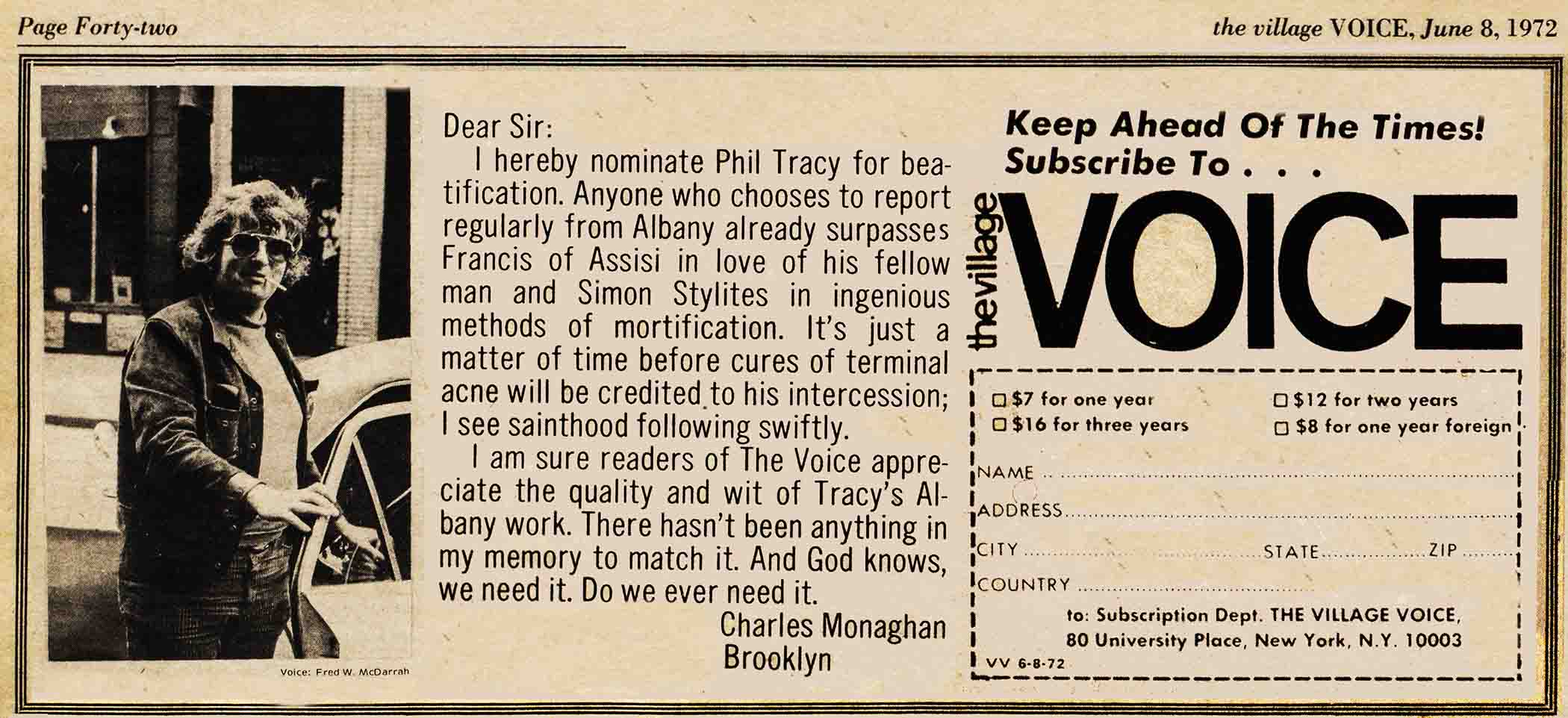
Edwin Kennebeck was a member of that jury, and wrote an essay for the Voice about his experience and that of his fellow jurors, a collection of everyman and everywoman citizenry, all of whom got through the proceedings “with the New York … sparkle.” In the article, the World War II vet gives a shoutout to his employer, Viking Press, for paying his wages during the eight months he was in the courtroom, something, he notes, that not enough do: “Many Great Companies that live in the system, by the system, on the system, won’t help an employee to participate in the system.” He also describes the reaction to the verdict of one defendant in particular, Afeni Shakur, who at the time was pregnant with future rapper Tupac Shakur.
The Voice headline would appear in a more elaborate form two years later, when Kennebeck published a book on his experience, Juror Number Four: The Trial of Thirteen Black Panthers As Seen From the Jury Box. —R.C. Baker
→ This article from the archives is part of a series celebrating the Platinum Anniversary — 70 years! — of the Voice. The first issue hit the stands on October 26, 1955. ←
Notes from the Panther jury box
By Edwin Kennebeck
May 20, 1971
We found them not guilty, 13 Black Panthers, on all 12 counts. The trial was the longest in New York State; it took us seven months to find nothing there.
We didn’t find any conspiracy to bomb department stores or subways or railroad yards, or to murder policemen, or to possess dangerous explosives and devices.
Twelve jurors, a very even dozen, a dozen of the most even citizens of the nation. (No. Sixteen, really — the four alternates were separated only at the end by the cruel good fortune that kept the dozen intact. Claudette! Joe! Obie! Murray!) Friends. During those months we talked about all kinds of things — but not the case. Each of us was burdened with a major mystery: what were the other jurors thinking about those lively people at the defense table?
Seven months. But the verdict didn’t take long: two and a half hours (not 90 minutes as the newspapers said). Our lunch had been ordered up — sandwiches; I’d have preferred moo-shi pork from one of the Chinese restaurants two blocks east. Judge Murtagh formally submitted the case to us, and before we “retired” to deliberate he suggested that we wait a while before beginning, that we relax and have our lunch first. We were not so inclined; we were bursting to say our say. We carefully got it said.
My good friends, my mystery friends, talked calmly, and as the quiet words came forth among the pastrami on rye and the roast beef on white and the chicken soup and coffee, the mystery cleared. From rainy skies an enormous amount of light seemed to pour through the windows.
I’ve never had or heard so much reasonable doubt.
* * *
Eight months ago, what was I? A believer in the New York Times. The newspaper described me as a white middle-aged bachelor. It was a shock to learn that I was that. I was a citizen to whom “jury duty” was an irksome but not unwelcome break from office routine. A newspaper reader who had a hard time distinguishing one conspiracy or bombing case from another, and didn’t make much effort to sort them out. An occasional writer of letters to the editor. A juror Acceptable to the People of New York State. What am I now? Am I still Acceptable?
* * *
It would take a book to tell the story; the court transcript takes 15,000 pages. At this moment, when I’m not yet down from last Thursday, some erratic echoes from 100 Centre Street are reverberating louder than others. (The acoustics in that place weren’t very good anyway, as the Judge remarked.)
* * *
The major charge was “conspiracy”; the word is derived from the Latin for “breathing together.” His Honor told us. Sure they were breathing together, to keep from suffocating.
* * *
How did such a jury get assembled? Why did the prosecution permit this special miscellany? Two teachers, a political science student, a Housing Authority maintenance man, a woman from the New York State Insurance Department, a retired longshoreman, an opera composer no less, two book editors, a tv-film editor, a welfare administrator, and a Post Office employee — stalwart gorgeous people all, with the New York … sparkle.
I pulled the sword out of its sheath, ran the edge along my wrist, pressed my hand against the tip. Blunt! It couldn’t have been used for shish-kebab.
Why? I can imagine the Prosecution explaining: “You are intelligent and sensitive people. This is a subtle case; conspiracy is a delicate crime. We chose you because you are imaginative. Use your imagination; we did.”
* * *
When we went back into the courtroom in late afternoon to deliver our verdict, the 13 guards seated behind the Panthers had turned into a wall of blue: twice as many men, standing up, screening the spectators from us. The court clerk, a sweet man, read the lists — 12 charges against each defendant. Ingram Fox, our foreman, intoned the dactyls in his alto voice: Not guilty. Not guilty. Not guilty. Not guilty. No need for him to read from the verdict sheets we had filled out.
Afeni Shakur gives us a joyful shriek; she sobs, she throws her head on Lumumba Shakur’s shoulder; his arm goes around her. Counselor Crain swings around in his chair to embrace Ali Bey Hassan across the table. Is Counselor Bloom crying, as I am?
Counselor Lefcourt puts his hands to his Afro-style hair and shakes his head. His eyes meet mine, as they often have before, and this time we can smile at each other too.
Not guilty. Not guilty. The two prosecutors, sitting at their table near us, are statues entitled Dismay. The Judge is impassive and no doubt tremendously … interested.
After the final Not guilty, the Judge thanks us; we have served the State of New York honorably; he discharges us.
Shouting and clapping — the tornado of joy follows us into the littered jury room. We pick up our suitcases, packed for a sojourn of several days. I hardly remember riding the elevator down. I remember my mouth was painfully dry.
* * *
“There’ll be 16 juror books about this trial,” someone said. I said, “Maybe 15 books and an opera?”
* * *
The company I work for paid my wages for those eight months. It didn’t have to. Many wouldn’t do it. Many Great Companies that live in the system, by the system, on the system, won’t help an employee to participate in the system. Way to go, Viking Press!
* * *
Does the system work? It never stops working: on the Berrigans, on Angela Davis…
* * *
Secret agent Gene Roberts moved among his Panther friends with a tiny microphone pasted to his chest, with a tiny wire leading to a tiny transmitter. He was a walking radio station. Two detectives in a car down the street kept the tape-recorder working.
Such old-fashioned ways! Surely by now they could spy on us with tiny televisions, the camera concealed in a tie pin, or maybe in a glass eye: a catheter wire strung through the hero’s head. “We are looking at you.”
* * *
We were saying to each other, “Where’s the mike in the jury room?” We were joking.
* * *
Before the Judge formally submitted the case to us, around noon on Thursday, he declared a brief recess and sent us out. But we waited in the jury room for a long time, an hour. At last the court officer asked us to step back in. Obie Tunstall said, “What do you suppose they’ve been doing in there?” Miss Yanes said, “Maybe they settled out of court.” Bless Miss Yanes, bringer of cookies, Jordan almonds, chocolate straws.
* * *
When a gang of detectives arrested Ali Bey Hassan at his apartment in the “early morning hours” of April 2, 1969, they “seized” several items of evidence. A pistol — so said one of the policemen — was there, with some bullets; a copy of the Black Panther newspaper with an article about bombs and grenades; a decorated sword cane. We were given these things to examine. I pulled the sword out of its sheath, ran the edge along my wrist, pressed my hand against the tip. Blunt! It couldn’t have been used for shish-kebab.
Near the end of the trial when the Prosecutor was summing up the evidence on “seizures,” he failed to show us the sword cane. I was sorry about that; it was a handsome article.
* * *
Nobody has to believe me, but I insist that one morning on the elevator at 100 Centre Street, when I was riding up to the 13th floor, a policeman was whistling “America the Beautiful.”
* * *
Near the back entrance of the courthouse is a plaque that tells us this site was once a station on the Underground Railroad.
* * *
The editorial in last Saturday’s Times sounded to me like an appalled reluctant grudging admission that the trial was “fair.” The writer decided that his opening paragraph should describe “the Panthers’ noisy and noisome oratory”! Dear New York Times, if you feel you have to say it to keep your advertisers, at least save it for a muttering footnote.
* * *
I don’t call a trial fair that piles up such mountains of non-evidence. Seven months to defuse it! That wasn’t even fair to the jury.
❖ ❖ ❖