







Like refugees from a dystopic short story by George Saunders, we contemporary humans seem too often to be wandering through an anti-funhouse, one lined not with warped mirrors but with screens purveying every reality but our own.
With the title of her new book, The Society of the Screen, Martha Schwendener references the OG of modern tech angst, Guy Debord, and his 1967 tome The Society of the Spectacle, the first thesis of which famously proclaims (with his emphasis):
The whole life of those societies in which modern conditions of production prevail presents itself as an immense accumulation of spectacles. All that once was directly lived has become mere representation.
But the maxim from Debord that hits even more square between the eyes in 2026 comes a little deeper down in the Situationist provocateur’s opening section, “Separation Perfected,” in No. 9:
In a world that really has been turned on its head, truth is a moment of falsehood.
Well, a–fucking–men to that. Echoing down through the decades you can practically here the unknown studio engineer’s voice droning “number nine number nine number nine number nine number nine …,” etc., on the tape loops, overdubs, back masking, vocal distortions, pans, fades, and whatevers on the Beatles’ 1968 “Revolution 9,” John Lennon’s — with help from some bandmates and Yoko Ono — abrasively collaged, self-indulgent paean to the political chaos and cultural dynamism of a decade that had seen multiple assassinations, broad social progress with orchestrated backlash to same, and concepts of personal freedom that challenged the authority of church and state across broad fronts.
But in those whipsawing Swinging Sixties, Lennon was only one of many ahead-of-their-time visionaries grappling with the seemingly speed-of-light changes roiling the globe’s cultural and political spheres. Here’s how Schwendener introduces the subject of her captivatingly written monograph:
Enter Vilém Flusser (1920–1991), as idiosyncratic and brilliant as any Silicon Valley technologist, hacker, or gonzo programmer.
Born in Prague, he fled his native city for Brazil after the Nazi invasion in 1939. His entire family perished in the Holocaust, and he never earned a college degree. Nonetheless, he became one of the most prescient philosophers of emerging media and technology, including the screens on which we perform everything from earning a living to finding a mate. Partly because of his nontraditional background, Flusser thrived in the art world, which was becoming a global platform in the twentieth century.
Schwendener backs up her assertions of Flusser’s “Radical Prescience” (as her book’s subtitle puts it) through copious images culled from myriad sources. (I teach in the same Master of Fine Arts in Studio Art program at New York University as Schwendener, and have long appreciated her ability to concisely traverse the visual-to-verbal gulf during student critiques.)
Throughout her book, Schwendener weaves together imagery, critique, and history, such as in this passage concerning the painter Samson Flexnor, an early abstract proselyte in Brazil:
In the 1960s Flexor painted a cubist-style portrait of Flusser, as well as a series of “monsters” that resemble Rorschach blots. The “monsters” were made in response to Flusser’s The History of the Devil (1965), a narrative of progress inspired by Goethe’s Faust, in which “the Devil is a criminal in order to be an artist, and is an artist in order to be a criminal.” … Like Jean Dubuffet’s figures or Francis Bacon’s painting, which crystallized philosophical existentialism for many viewers, Flexor’s monsters had a huge impact on Flusser. He wrote, “the results were colossal monuments to Nothingness; monsters at the same time anthropomorphic, zoomorphic, and geomorphic, with holes dug out of their entrails, floating in subtle colors above a white background and casting plastic shadows when light was shed upon them.
They remain terrifying and beautiful, like death and the human condition.”
Thus, a philosopher contemplates the beauty, complexity, and enigma of art through the veil of a family lost to the Nazi death camps.
In the early 1980s, Flusser wrote — indeed, presciently — “The basic structure of our thinking is about to experience a mutation,” adding, “What is involved here is not the classical problem of alienation, but an existential revolution for which we do not have any historical precedents.”
Schwendener uses such 40-plus-year-old pronouncements to stake out precedents for today’s digital onslaught, emphasizing Flusser’s constant interactions with visual artists, which in turn deeply influenced his thinking on how various forms of media function as communication. As she points out in her introduction, “You’ll notice immediately, this book explores philosophy through images. Technology is not neutral, and neither are photographs or artworks. Art can hold both fiction and truth, and it is a form of thought, not merely a reflection of it.”
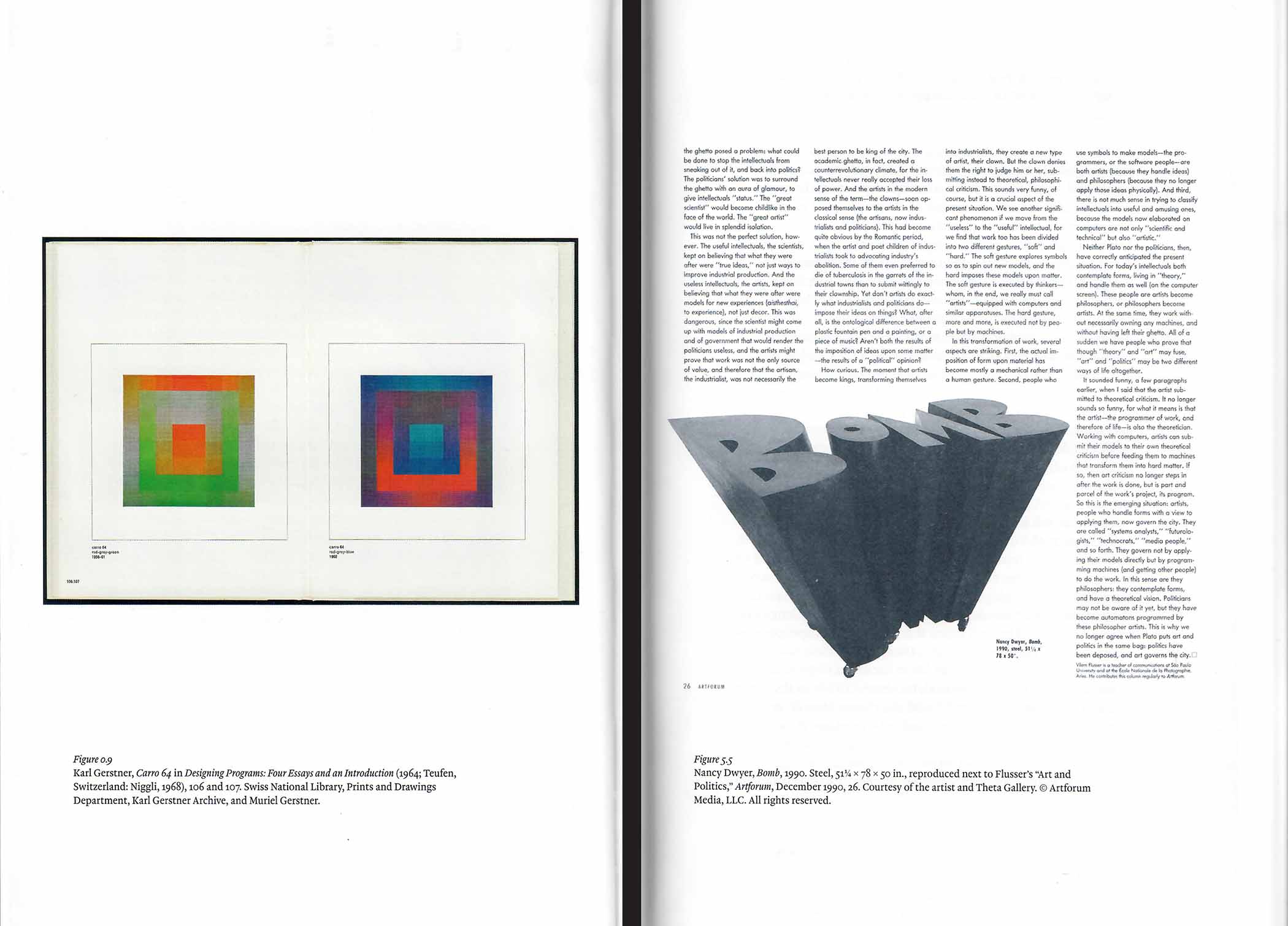
The book is divided into “Screens” rather than chapters, with such titles as “Land of the Future” and “Design and Deception.” In the latter, “Screen 5,” Schwendener notes that one of Flusser’s columns in Artforum around the period of the first Gulf War (1990–91) traversed “a continuum from art to industrial objects and military weaponry, with Cubism considered alongside Trident missiles.” On the facing page, a reproduction of the original magazine essay includes a photograph of Nancy Dwyer’s 1990 sculpture “Bomb,” consisting of roughly four-foot-high 3-D capital letters spelling out the title in vertical steel columns atop heavy-duty casters, emphasizing both the thrust and portability of modern munitions.
Society of the Screen is chockablock with many such fascinating images, all by artists who are rarely the usual suspects. Thus, Dwyer’s work might reference Robert Indiana’s Cor-Ten steel “LOVE” sculpture from two decades earlier, but “Bomb” wittily engages its predecessor while leavening a Dr. Strangelovian absurdity into that most basic word for mechanized violence, all while coming at us like the 20th Century Fox logo of yore. On another page, the dark-blue rectangle flanked by fading green flanges against a Stygian umber background in Karl Gerstner’s ca. 1970 mixed-media piece “Color Sound” might have you flashing on Ad Reinhardt’s earlier series of black paintings. Similarly, a series by Gerstner from the early 1960s uses a concentric square format recalling Josef Albers’s famous color studies, begun in 1949. In both cases, however, Gerstner’s exquisite gradations and graceful intermingling of hues and tones seem to presage the ever-higher levels of resolution and increased color spectrums of our own screen age. Schwendener reminds us, through both Flusser’s writings and those by artists and writers whom he influenced and sometimes collaborated with, just how long we’ve been living under digital technology’s ever-lengthening shadows. She notes that the Oregon-based artist George Gessert wrote to compliment Flusser about his prescience on biotechnology, and then, almost 20 years after Flusser’s death, frequently cited the philosopher in his own book, Green Light: Toward an Art of Evolution. Wrote Gessert, “Flusser envisioned photosynthetic horses, color-coordinated ecosystems, and new modes of thought. Military planners have long harbored dreams of race-specific biological weapons.” While that passage turns a very sharp corner from one sentence to the next, it is to Flusser’s credit that his expansive theories about color could embrace both a humanistic exploration of aesthetic boundary-pushing and racial realpolitik at its most savage.
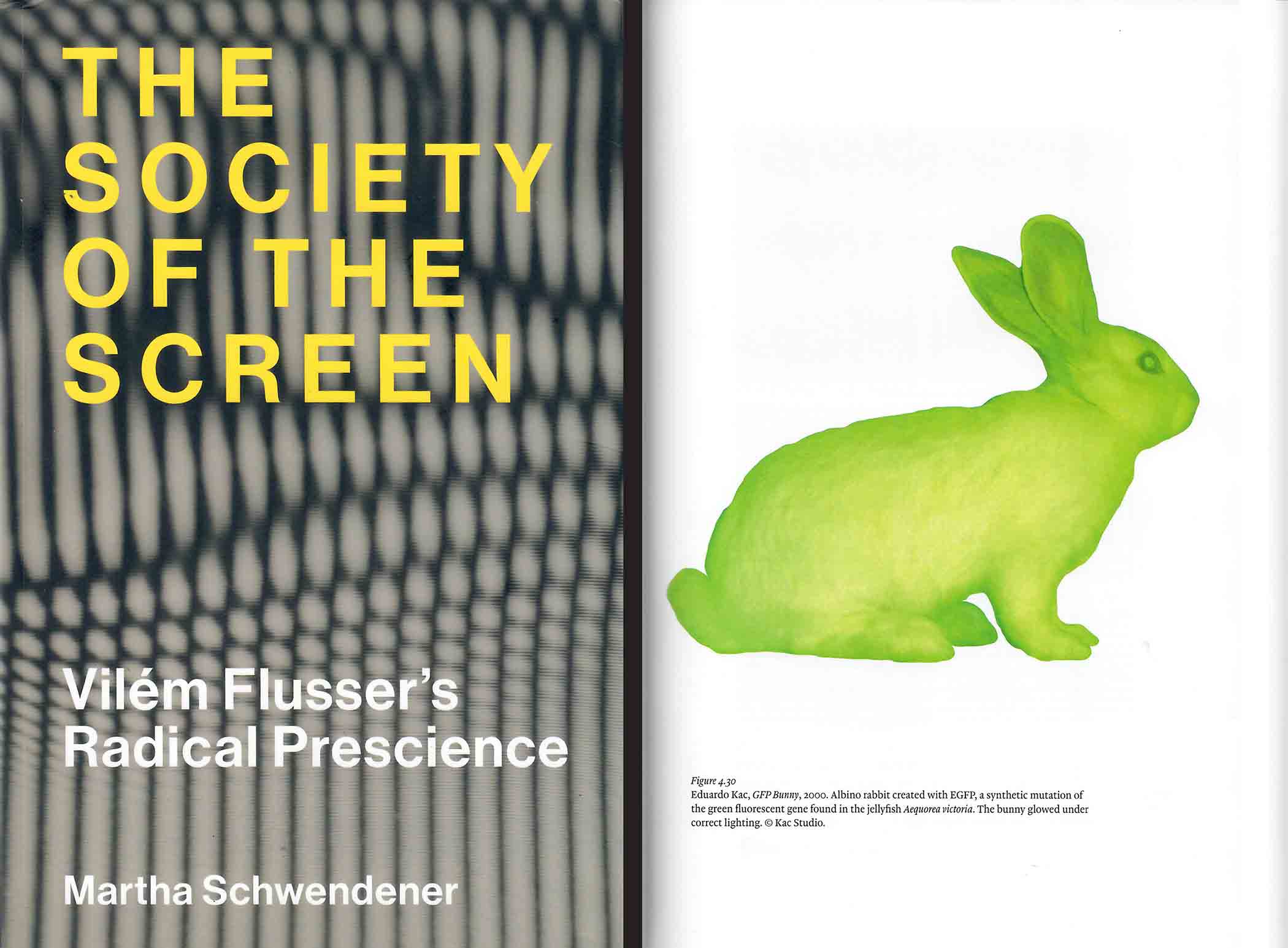
Schwendener amply demonstrates how pervasive Flusser’s insights have become, despite the fact that he died a year before the U.S. Congress passed the Scientific and Advanced-Technology Act, which allowed computer networks formerly limited to government, military, research, and educational purposes to more fully connect with the earliest Internet providers. Hit the Fast Forward button to the year 2000, when artist Eduardo Kac unleashed “GFP Bunny” on the world, an albino rabbit created with a synthetic mutation of the green fluorescent gene found in certain jellyfish, which would glow acid-green under certain lighting. Consider for a moment this hybrid creature of the sea and land, a species that scientists of, perhaps, the year 2525 might look back upon as an initial step toward an uncanny-valley evolution that 20th-century biotech and 21st-century AI loosed upon humanity. But as Schwendener’s book makes clear again and again, Flusser was already on the case in his Artforum columns, which ran from 1986 to 1992 (a year after his death) under various headings, including “Curies’ children” — certainly an apt allusion to all things that glow — and, more generally, “On Science.” In “Screen 4: Blue Dogs and Bio-Machines,” Schwendener states:
The opening paragraph [of one Artforum essay] reads like a template for GFP Bunny: “Why is it that dogs aren’t yet blue with red spots, and that horses don’t yet radiate phosphorescent colors over the nocturnal meadows of the land?,” Flusser wrote. “Why hasn’t the breeding of animals, still principally an economic concern, moved into the field of aesthetics?” He went on to argue that North American and European agriculture produced more food than can be consumed, but “we can now make artificial living beings, living artworks. If we chose, these developments could be brought together, and farming could be transferred from peasants, a class almost defunct anyway, to artists, who breed like rabbits, and don’t get enough to eat.”
Although Fluser came of age in an analog world, he — through his interactions with artists, who are always reconnoitering at the frontiers of being — divined that the cultural, tech, and political fractures of the mid-20th-century would send us heedlessly barreling into the everything digital everywhere all at once 21st. He died before he could see how right he’d been about our ever-more-pixelated ride, but on his way out, he punched the ticket for the rest of us. ❖
Readings and Events:
4/30 @ Emmelines (gallery in the subway across from MoMA)
5/6 @ Brooklyn Rail (live in Brooklyn with Lucas Blalock)
Podcast: The Art Angle with Ben Davis, Artnet


