



Editor’s note, April 16, 2026: Back in 2001, America was mired in a war in Afghanistan, the country that was harboring the Al-Qaeda leader Osama bin Laden and others who had planned the 9/11 attacks. As that war waged, on February 5, 2003, President George W. Bush sent his secretary of state, Colin Powell, before the United Nations Security Council to assert that Iraq was hiding WMDs, or weapons of mass destruction — even though both Germany and Britain’s spy services had disputed what was already weak evidence.
Nonetheless, Bush had, through speeches to the American public and diplomacy abroad, gathered a “coalition of the willing,” a multinational group of nations that included, among others, the United Kingdom, Australia, Poland, and Nicaragua, and Operation Iraqi Freedom commenced on March 19, 2003. On May 1, after more than a month of furious fighting, Bush appeared on the flight deck of the USS Abraham Lincoln to declare, “In the battle of Iraq, the United States and our allies have prevailed. [Applause] And now our coalition is engaged in securing and reconstructing that country.”
Actually, despite what came to be known as the “Mission Accomplished” speech — after a telegenic banner hanging behind Bush during his address — the war ground on. Approximately 4,000 American service members and hundreds of thousands of Iraqis were killed during the eight years between when that speech was given and when the war was officially ended, on December 18, 2011.
Another event that occurred during that interval was a special Pentagon screening of a film about unconventional warfare and the dangers that an invading nation — even an immensely powerful one — always faces on enemy territory. —R.C. Baker
∼ ∼ ∼ This article is part of a series — History Bites — which explores U.S. and world history, politics, pop culture, and the arts to illustrate how the past illuminates the present. ∼ ∼ ∼
Rocket the Casbah
By Michael Atkinson
Originally published on December 30, 2003
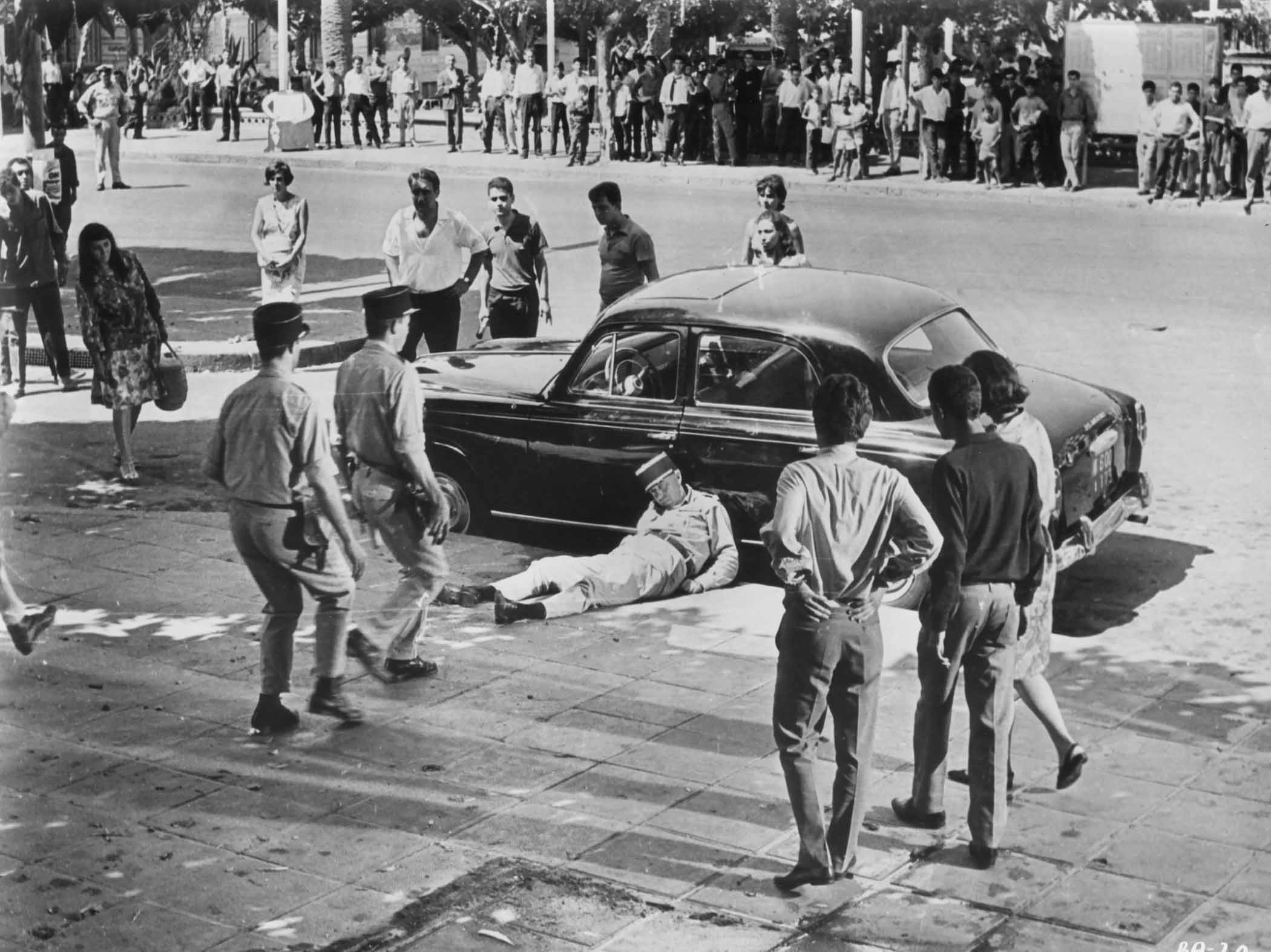
This past August, as both Iraqi and “coalition” cadavers piled up in post-“victory” insurgency fighting, the Pentagon’s Special Operations and Low-Intensity Conflict office sent out an e-mail advertising a private screening of Gillo Pontecorvo’s 1966 The Battle of Algiers. “How to win a battle against terrorism and lose the war of ideas,” the flyer opined: “Children shoot soldiers at point blank range. Women plant bombs in cafés. Soon the entire Arab population builds to a mad fervor. Sound familiar? The French have a plan. It succeeds tactically, but fails strategically. To understand why, come to a rare showing of this film.”
We don’t know who attended, or what impact upon Pentagon-think this legendary handmade-bomb of a movie might’ve had. Former national security adviser Zbigniew Brzezinski, for one, remembered it without being reacquainted — at an October 28 D.C. conference called “New American Strategies for Security and Peace,” he told the crowd of feds, politicos, and op-ed people that “[i]f you want to understand what is happening right now in Iraq, I suggest a movie that was quite well-known to a number of people some years ago. . . . It’s called The Battle of Algiers. It is a movie that deals with . . . [a] resistance which used urban violence, bombs, assassinations, and turned Algiers into a continuing battle that eventually wore down the French.” Obviously, this fierce piece of agitprop has seen its moment arrive for a second time. Is it tragic irony, or merely the evolutionary nature of realpolitik, that such a passionate, righteous revolutionary document is now most famous as an ostensible training film for neocon strategists?
Who cares; the movie arrives bristling with its own indefatigable legitimacy. Empathize with your enemy, as Robert McNamara says in The Fog of War, but the harsh reality of Pontecorvo’s film only serves to strip down imperialist rationales to their Napoleonic birthday suits. Did the Pentagonians even notice that the film, an Algerian project produced by one of the nation’s liberation leaders, sides squarely with the oppressed, bomb-planting Arabs? Has any movie ever made a more concise and reasonable argument for the “low-intensity,” low-resource warfare referred to by powerful nations as terrorism? Famously, a reporter in the film asks an Algerian rebel how moral it is to use women’s shopping baskets to hide bombs, to which the apprehended man answers, basically, we do not have planes with which to rain munitions on civilians’ homes (which is implicitly, then and now, the far more moral action). If you’ll give us your planes, he says, we’ll hand over our baskets.
Sound familiar? If any movie squeezes you into the shoes of grassroots combatants fighting a monstrous colonialist power for the right to their own neighborhoods, this is it. There are no subplots or comedy relief. A prototype of news-footage realism, the film makes shrewd use of handheld sloppiness, misjudged focus, overexposure, and you-are-there camera upset; the payoff is the scent of authentic panic.
We follow both sides of the combat — the uprising Casbah natives and the merciless if disconcerted French army — from 1954’s initiation of the rebellion to the official French victory, in 1957, over the National Liberation Front. It was a Pyrrhic victory, as the harrowing, riot-mad coda makes clear — the terrorist organization may have been rooted out, but the Algerian people still resisted occupation. Hard-edged he may be, but Pontecorvo cannot be called unromantic: Starting with the grifter-turned-assassin-turned-movement-leader Ali La Pointe (Brahim Haggiag), the actors playing the Arab seditionists were all chosen for their soulful beauty. (Not, it’s safe to say, for their chops; nearly all of their dialogue is post-dubbed, another factor in the movie’s on-the-fly affect.) Lizard-eyed ramrod Colonel Mathieu (Jean Martin, the only pro actor in the cast) is sympathetic insofar as he affects admiration for his antagonists (including co-producer Saadi Yacef, who essentially plays his FLN-leader self after writing the book on which the film was based) as civilian neighborhoods are obliterated into rubble, and a barbed-wire wall with armed checkpoints (!) is erected between Algiers’s Muslim and French quarters. French government officials complained that the film’s politics were anything but “fair and balanced,” and they weren’t wrong—it’s a revolt anthem, mature enough to document violative extremes on the Algerian side but never surrendering its moral rectitude.
But Neo-Colonialism for Dummies? The Pentagon boys should, at least, be daunted by the apparent inevitability of failure in the face of independence, just as they should perhaps take a similar look at Peter Watkins’s Punishment Park (1971), showing just once more in the Walter Reade’s sci-fi fest. That film’s astonishingly prophetic portrait of Ashcroftian civil control — a dynamic of ideological persecution, closed tribunal judgments, rationalized torture, and ersatz executions disguised as training exercises — forms, with Pontecorvo’s suddenly newsworthy yowl, an incinerative, two-front interrogation of Bush II, right down to the political spin-doctoring and just in time for the election year. ❖
Michael Atkinson has been writing for the Village Voice since 1994. His latest book is the new edition of his BFI tract on David Lynch’s Blue Velvet.