






It is unclear at first what we are seeing in the black-and-white photo of textured planes shot through by three rough diagonals joined by staggered, irregular verticals. Then this bold composition resolves into a scene any urbanite is familiar with: the zig-zag scar of a demolished stairwell. André Kertész (1894–1985) gave this offbeat vision a documentary gloss through the title, “Landing Pigeon, NY, March 2” (1960); once we discern the fluttering bird, the image becomes even more grounded in the real world.
But just when we, along with the bird, get our metaphorical feet on terra firma, further on in the gallery we encounter a small wood engraving print from 1945, “Three Spheres I,” by M.C. Escher (1898–1972), in which a fully rounded orb with regimented striations presses down an a second globe, flattening it by half even as it deforms a third into a tire-shaped disc. The rich shadows and depthless black background transmute what might be a geometry class teaching aid into something more like stepping stones to the cosmos.

Both artists — Escher with such tools as knives, chisels, gouges, and litho crayons, Kertész with lenses and film emulsion — journeyed through the mundane to arrive at the extraordinary.
Had Escher seen the mirrored ball and contorted hands and figures in Kertész’s “Fortune Teller”?
“Between Order and Chaos: André Kertész and M.C. Escher,” at Bruce Silverstein Gallery, finds the pair starting out with prosaic elements that help the brain navigate the abstractions that necessarily underpin all artistic representation — be it printmaking, photography, drawing, painting — which, after all, squashes our lived-in 3-D existence down to two dimensions, a realm in which layout and tone and color and texture and/or illusion and whatever have you must provide the dynamism that makes up for the missing volume.

Each artist saw our physical reality as a launchpad to the metaphysical. Toward the bottom of Escher’s 20″ x 8″ lithograph “Up and Down” (1947), a young man sits on a step of an open staircase, looking up at a woman gazing down from a window. As our eyes travel upward, vaulted ceilings converge on a patio that serves as the floor for the scene to repeat, only now we have a bird’s-eye view of the couple, as if we were an alley cat shape-shifted into a mourning dove. Kertész equally warps our perceptions in a series of nudes in which the figures are pulled as thin as taffy (“Distortion #154,” 1933) or bulge like water balloons (“Distortion #76A”).
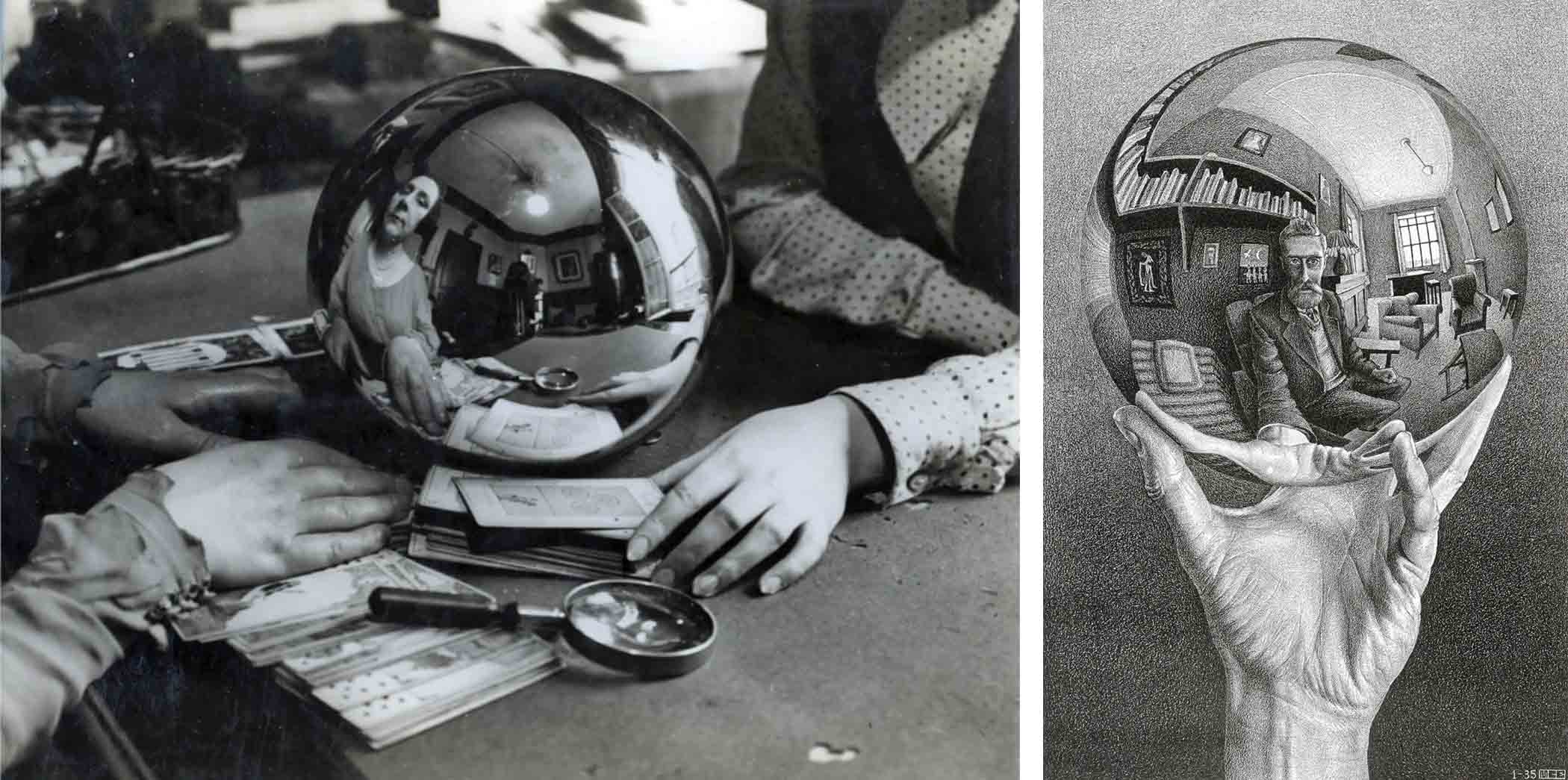
All this interplay — and flat-out playfulness — amid the physics and atmosphere and light and surface of our perceivable world can veil the stone seriousness of these artists’ achievements. Both were well aware of art history, evident in Kertész’s tableau of a plastic draftsman’s triangle, a postcard, and a Times news clipping — the soft focus as velvety as a charcoal drawing — nailed to a wall (“Going for a Walk, New York,” 1958), which recalls such 17th-century “deceptions” as “A Trompe l’oeil of Newspapers, Letters and Writing Implements on a Wooden Board,” by Edwaert Collier (c.1640–c.1707). Similarly, Escher’s famous self-portrait in 1935’s “Hand with Reflecting Sphere” reaches across the centuries to the reflection of the couple and their attendants (one of whom is possibly the artist) seen in the convex mirror in Jan van Eyck’s equally famous 1434 oil on oak panel painting “Portrait of Giovanni Arnolfini and his Wife.” Much closer to home, might Escher have seen the mirrored ball and contorted hands and figures in Kertész’s “Fortune Teller,” from 1930, which thrums with mirrored geometries of rectangular tarot cards, circular magnifying glass, and radiant light bulb?
Using exhilarating juxtapositions, this suavely curated exhibition reveals both Escher and Kertész achieving a near frictionless surreality, offering not an alternative universe but a way of seeing everyday existence freshly every day. ❖
Between Order and Chaos: André Kertész and M.C. Escher
Bruce Silverstein
529 West 20th Street, 4th Floor
Through March 21