





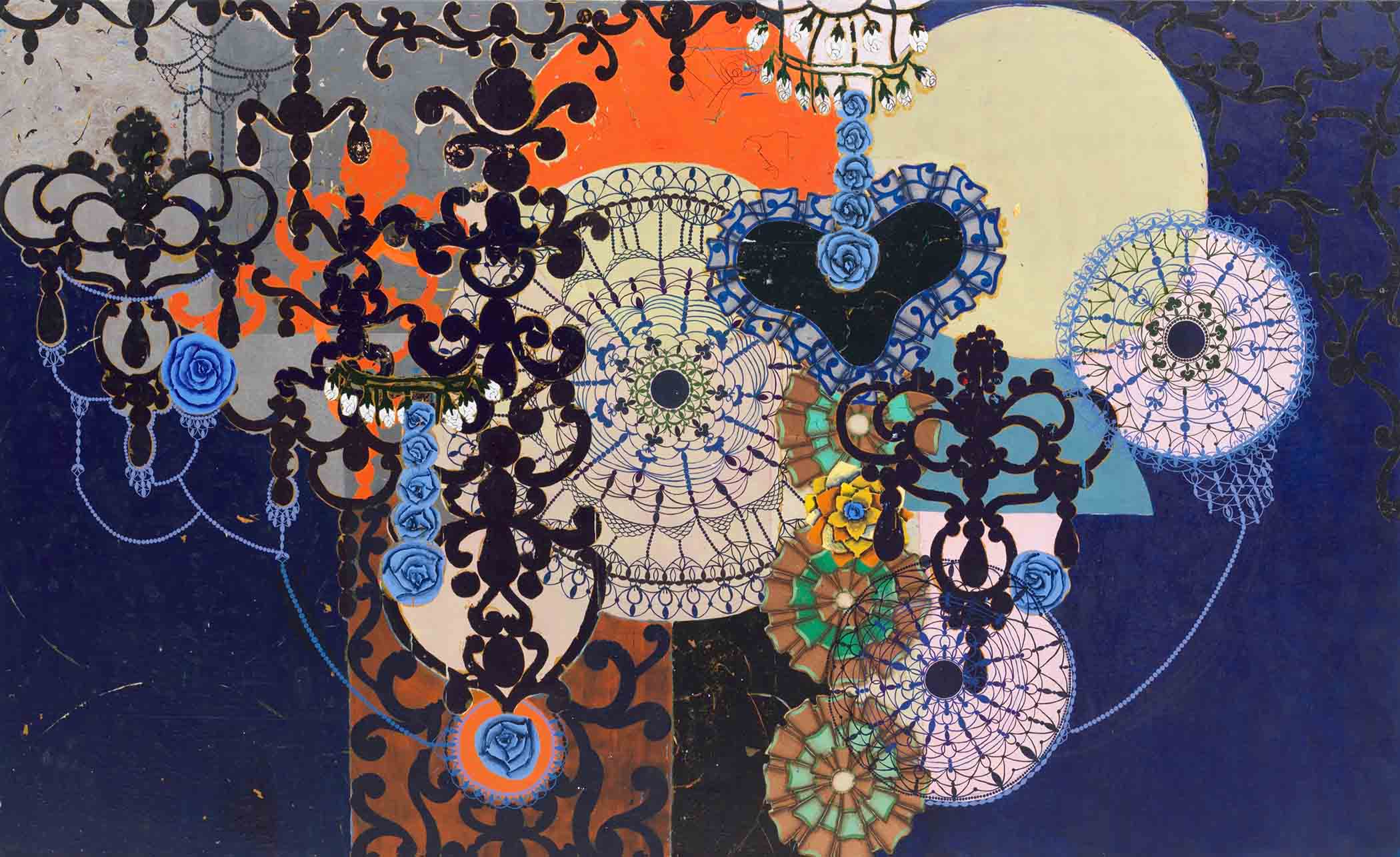
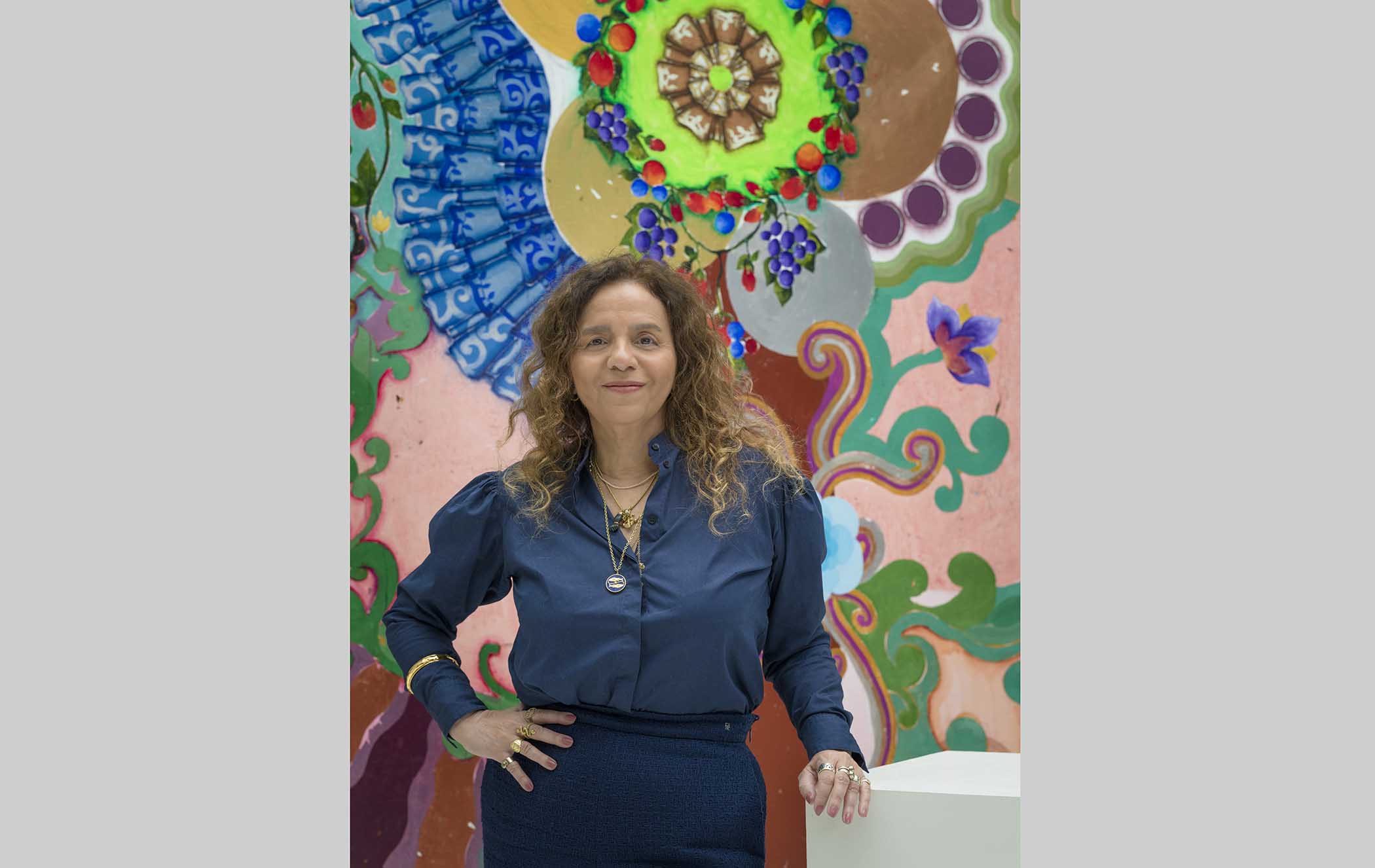
Tucked away in an eccentric polygonal gallery high up the Guggenheim’s ramp is an exhibition that leaps into view like a secret, wild garden. The most prevalent themes in Beatriz Milhazes’s exuberant large-scale paintings are botanical, floral, hyperstylized, and frequently lacy; in the mixed media collages, appropriated imagery in the form of both digital printed matter and motif-lifting from the natural world sometimes acts as the ground underlying a panoply of stripes, screens, textile typologies, patterns, perfect arcs, and other elements of interruption. Layer upon layer presses down and builds texture, so the natural elements remain flat even as their hyperchromatic life forces pulse through the shallow pictorial spaces. You fall in love with this color or that sequence, and use your body to approach for detail and recede to take in the larger sweep. Then you begin to see that it’s all falling apart.
Curated by Geaninne Gutiérrez-Guimarães and centering around the artist’s work in the museum’s permanent collection (augmented with a few important loans), Rigor and Beauty is the first museum show in New York dedicated to the artist, who was born in Rio de Janeiro in 1960. Across 15 paintings and works on paper, spanning 1995 to 2023, we see classic expressions of the way Milhazes’s inspiration derives from both Brazilian and European sources — decorative traditions, the structured legacy of modernist abstraction, the saturated palette of tropical modernism, and the layered semiotics of Brazilian culture. Yet the work avoids nostalgia or mere pastiche, and is far too maximalist and visceral to occupy a decorative assignation. In foregrounding not only the results but the intensely somatic nature of her compositional processes, Milhazes makes explicit reference to the undervalued skill sets of manual labor — both inside artistic traditions and, saliently, in the wider world of labor. In this way she proposes an alternative methodology, in which ornament and logic, excess and control, beauty and entropy, labor and love are expressed as interdependent and necessary cultural forces.
Milhazes’s muscular studio process creates movement in the layers she generates, a sort of physical concrete poetry wherein the way she paints mimics the wildness of fertile nature, as she deploys an action-intensive, collage-based process in which painted elements are first created on plastic sheets and then transferred onto canvas. This technique introduces a subtle sense of displacement and layering, emphasizing the constructed nature of the images as it embodies an organic irregularity during the translation. Her use of symmetry and radial composition recalls both mandalas and rosettes, yet avoids any totalizing or centered logic. Instead, elements appear suspended, overlapping, and juxtaposed in ways that frustrate hierarchical reading. Anchored in a geometric rectitude that recalls fabricated pattern repetition, the work is nevertheless enveloped in an expressionistic visual dialect of baroque architecture, haute and vernacular textile design, and the mountains of accumulated evidence of the artist’s hand in the creation process.
Milhazes has got absolutely everything going on.
In major paintings, like the 2000 work Paisagem carioca (Carioca Landscape), floral motifs and ornamental scrolls are rendered with such clarity of edge and consistency of surface that they resemble printed or industrial materials. But this is counterbalanced by the traces of manual application — the imperfections of transfer, the seams of collage — that assert the artist’s hand. The paintings oscillate between the decorative and the diagrammatic, suggesting not simply beauty but a taxonomy of visual culture, filtered through a hybridized explosion of the color wheel into shards, arcs, and lattices of sky, ice, teal, turquoise, forest, emerald, chartreuse, olive, mint, crimson, cherry, coral, rose, fuchsia, mauve, peach, rust, ochre, lemon, gold, violet, lavender, burgundy, cream, slate, silver, and, of course, black.
The work invites and rewards closer inspection, revealing an exponential array of moments alive with precision and interruption, repetition and rupture. The mixed media collages of the past decade lean into a facture of precision but gleefully threaten to overwhelm with the sheer volume of detail the artist assembles like a psychotropic puzzle. Milhazes’s practice is not about decoration as embellishment but about ornament as a form of cultural memory, spatial organization, and aesthetic intelligence. It’s dark at times, and quite comfortable with that. In one of the earliest pieces in the show — the nearly gothic In albis, from 1995–96 — the black patterning is the poetic protagonist of the whole picture, and sets the stage for the evolution of her vision as one of creation, decay, reconfiguration, and renewal, referencing abandoned architecture and the aging body alike.
In other works from that period, like the sprawling and recognizably oceanic 1995 acrylic on canvas painting Santa Cruz, the cryptozoic sinews of marine life suggest an underwater garden that hints at both proliferating marine biology and the shadows of a wicked undertow. In more recent works, the impulse to destabilize pictorial and terrestrial picture planes is taken up by an increasingly vast array of mark-making techniques and types of figuration, chromatic wizardry that does a number on the optic nerve and the nervous system. Adding a fractal sense of flow and a new deference to the laws of gravity, more recent works continue to evolve along the natural/artificial boundary, in a timely way that flirts with erasing it entirely.
Both the particular history of Brazilian maximalism and magic realism are also relevant to the conversation. The interdisciplinary colorbenders of the Brazilian collective Assume Vivid Astro Focus share her love of color and pattern, but their work across mediums was looser, more chaotic, and conceptually tied to identity politics and ephemeral media, whereas Milhazes is formally disciplined and firmly grounded in painting’s material legacy. The Ukrainian-born Brazilian writer Clarice Lispector was very keen on fragmentation and dissolution of the self; her protagonists often undergo identity slippage, moments of the mystical merging with nature or animal consciousness, echoing Surrealist ideas of psychic liberation in an intimate, somatic register. But that kind of metaphysical surrealism explores existence, being, and nothingness — whereas Milhazes has got absolutely everything going on, right out in the open, and her slippages are quite theatrical. This work is beautiful, but not contemplative. It’s disruptive, optically; it’s restless and it makes you feel restless. But it also gives you a million different places to go. ❖
Shana Nys Dambrot is an art critic, author, and curator based in Los Angeles. In 2022, she was awarded a Rabkin Prize for Visual Arts Journalism.
Beatriz Milhazes: Rigor and Beauty
Guggenheim Museum
1071 Fifth Avenue
Through September 7