




→ This article from the archives is part of a series celebrating the Voice‘s Platinum Anniversary — 70 years! — on October 26, 2025. ←
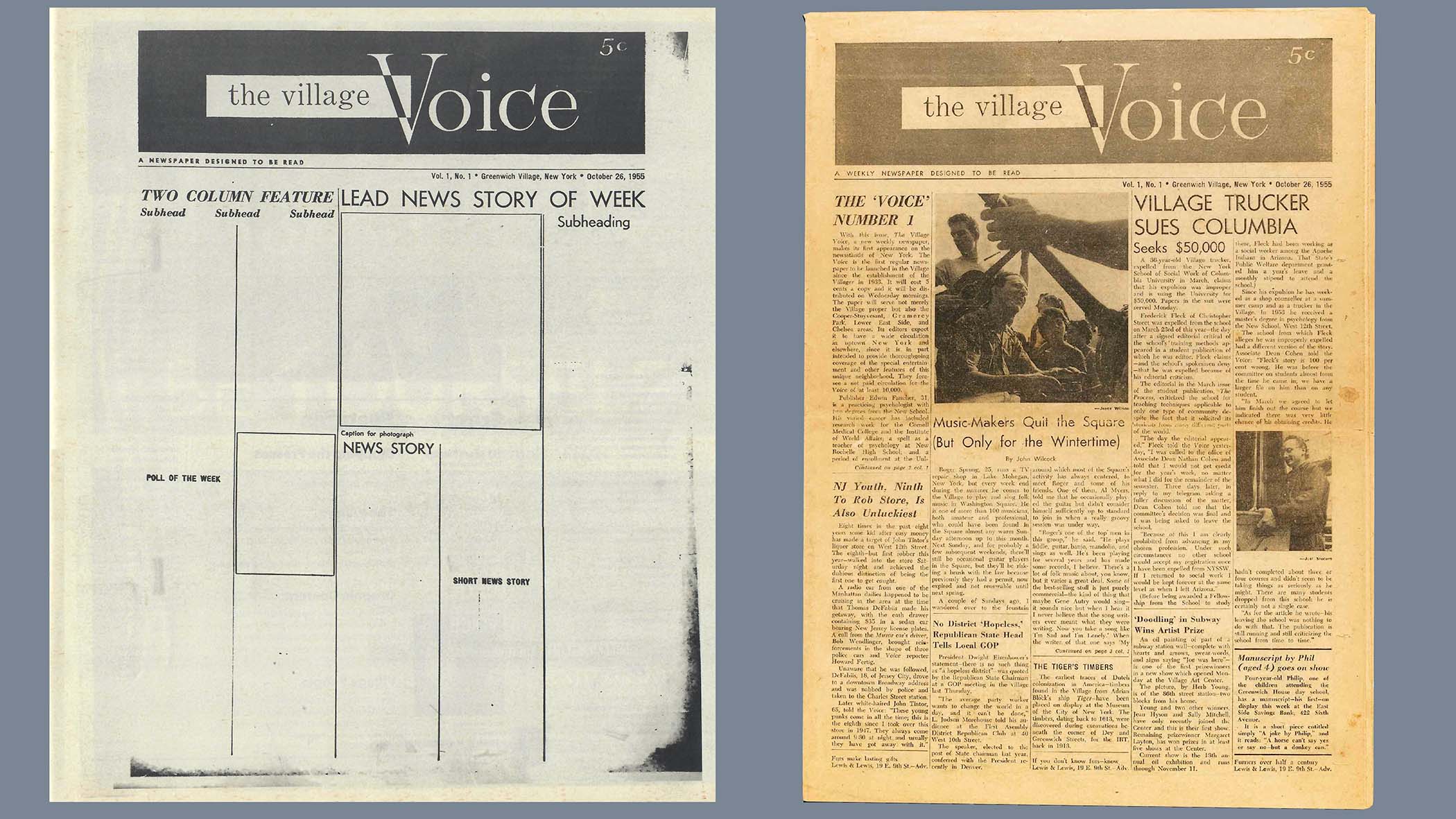
Elvis Costello once put it in a song, “Yesterday’s news is tomorrow’s fish and chip paper.” But some history is always fresh, and the inaugural issue of the Village Voice, cover-dated October 26, 1955, would forever change Greenwich Village and, eventually, all of New York City, the U.S., and chunks of the whole wide world. Only 12 pages long, that first edition featured an elegant logo designed by Nell Blaine, who, the editors noted, was “a young woman with an established reputation both as creative artist and book-and-poster designer,” adding that Blaine (1922 –1996) “is almost singly to be credited with the visual aspect of this and succeeding issues of the Voice.”
The publisher and editors also proclaimed that they:
… intended to provide thoroughgoing coverage of the special entertainment and other features of this unique neighborhood. They foresee a net paid circulation for the Voice of at least 10,000.
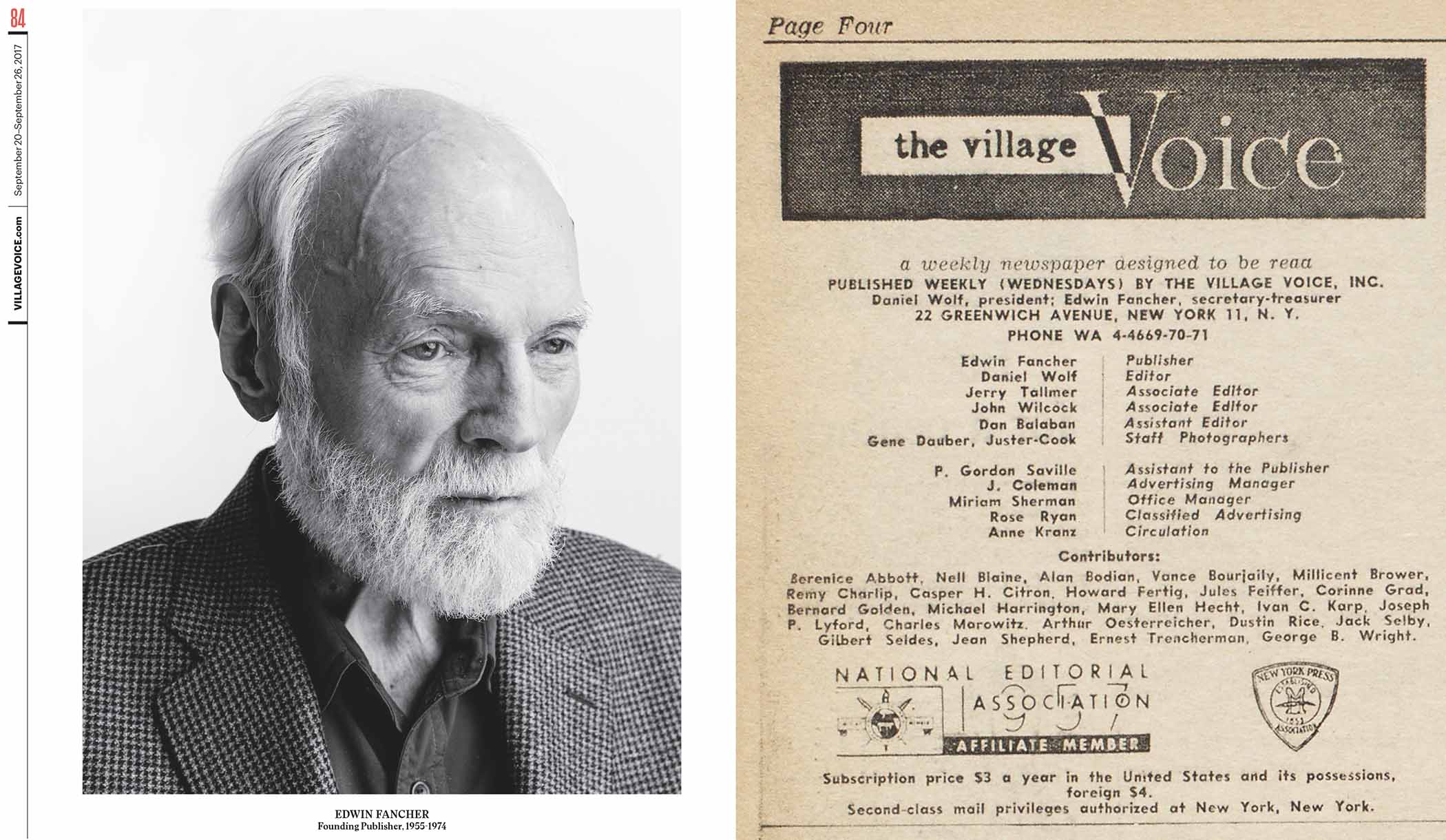
Publisher Edwin Fancher, 31, is a practicing psychologist with two degrees from the New School. His varied career has included research work for the Cornell Medical College and the Institute of World Affairs…
Editor Daniel Wolf, 33, former newswriter for the Turkish Information Office, has the unusual distinction of having written the Greek, Roman, Arabic philosophy, and Psychology sections of the Columbia Encyclopedia. Wolf was born in New York City.
The newspaper’s “back of the book” section — movies, theatre, books, music, painting, and the like — will be under the direction of Jerry Tallmer, 34, associate editor. Tallmer has for some years been a free-lance editor-writer and a regular contributor of articles and reviews to such magazines as Architectural Forum and the Saturday Review, and he has lately written a long pamphlet for the Board of Education on the city’s new school-building program. He too is a Greenwich Villager of ten years’ standing, and like Mr. Wolf he is a native-born New Yorker.
News editor for the The Village Voice is John Wilcock, 28. Starting as a cub reporter in his native England at the age of 16, Wilcock has already had a twelve-year career in working journalism. In England he served on the staffs of first the London Daily Mail and then the London Daily Mirror, largest selling daily newspaper in the world.
The initial front page featured an article on folk musicians in Washington Square (which included an editorial error that would take 62 years to fix — more on that in a future SEVEN DECADES installment), and, among other stories, reports on Village political goings-on, a truck driver’s lawsuit against Columbia University, and a prize-winning painting that featured part of the 86th Street subway station wall — “complete with hearts and arrows, swear-words, and signs saying ‘Joe was here…'”
This was the buttoned-down Eisenhower years — a review of Sloan Wilson’s book The Man in the Grey Flannel Suit ran on page 4 — but New York at that time had been home for more than a decade to the “New York School” of abstract expressionists, and pop and conceptual art as well as cutting-edge theater, dynamic dance, avant-garde music, and home-brew films were all percolating up from the Beat and beatnik undergrounds.
This was the loam of the counterculture, and the Voice was one of the most fecund seeds ever planted. The first issue covered theater, art, music — “Most of my friends hate Gilbert and Sullivan. Who can blame them?” wrote opera reviewer William Murray, who disagreed — and also fashion, with columnist Betty Bodian recommending Turkish suede slippers in an “exotic design” available for $6.95. And while that translates to 84 bucks in 2025 dollars, a genuine bargain could be found in the classified section — which would grow over the decades into not so much the paper’s cash cow but more of a cash great blue whale — in an ad for a “PLEASANT 4-room Village apartment; no heat, $27.”
Indeed, it was a different time, when all that was needed to become a serious bohemian was a wool beret, a couple of cable-knit turtlenecks, and roughly $326 (in today’s inflation-adjusted numbers) per month for rent.

But if time has changed some aspects of NYC life, other quarters remain dishearteningly the same. As we’ll see in future installments, the Voice would be there early and often to cover the malfeasances and degredations of New York’s political and business classes, including a nepo-baby real estate developer from Queens.
Stay tuned.
❖ ❖ ❖