



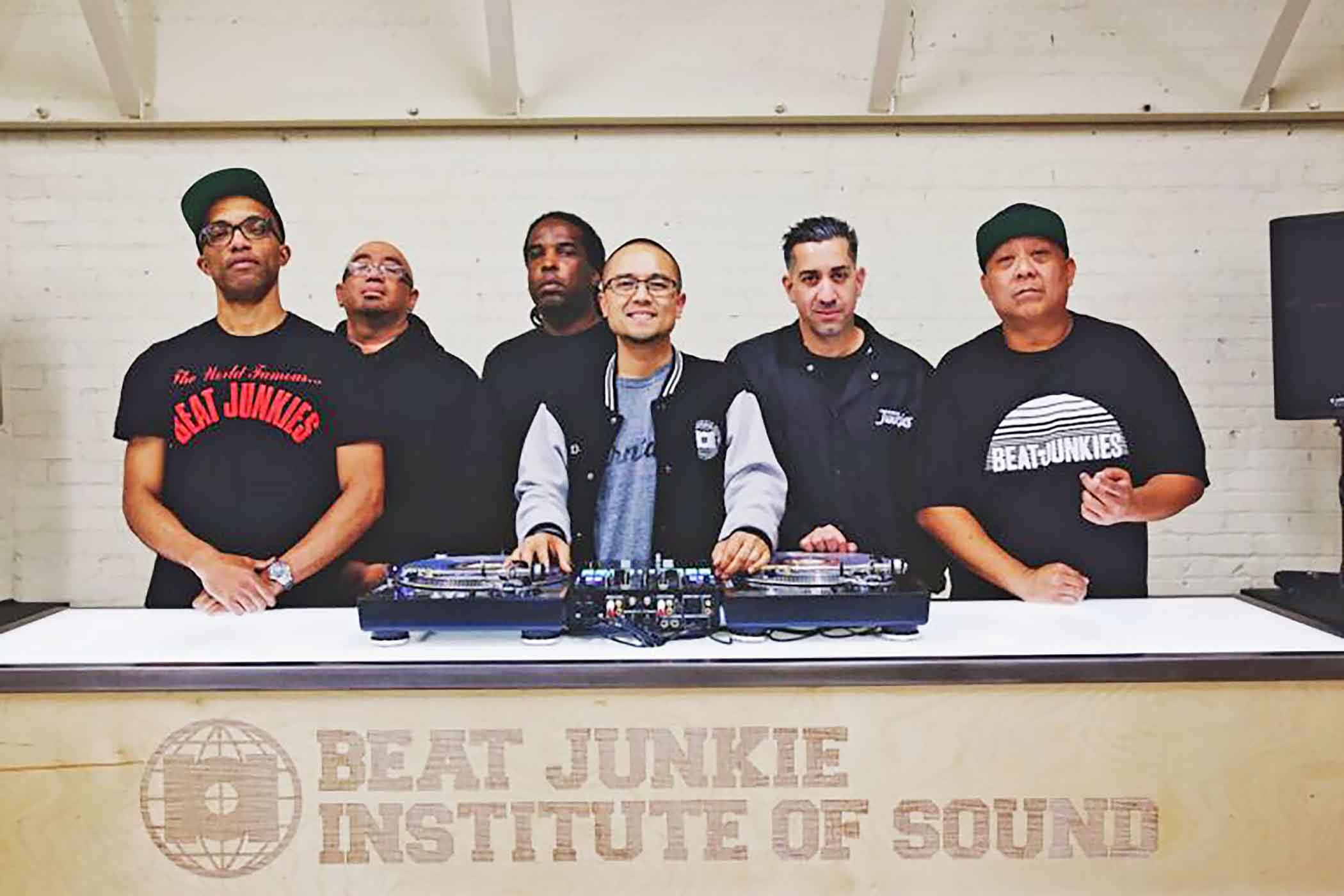
A diamond of turntable precision is tucked into a Glendale, California, brick-and-mortar DJ school, the Beat Junkie Institute of Sound, co-founded and co-operated by Los Angeles’s next-level-talented DJ Babu. The institute, teaching 12 students at a time with personal DJ booths, is led by an internationally known crew of teachers, The Beat Junkies, who have been lighting up the Southland since assembling from different backgrounds in the 1990s. BJIOS, founded in 2017, was the official introduction to teaching for the baby-faced assassin DJ Babu, who years before had invented the neologism “turntablism.”
The popular Beat Junkie, Babu — fans yell “BABOOO” at his performances — is off to college this year to teach at the Peabody Institute, North America’s oldest music conservatory at Maryland’s Johns Hopkins University.
Babu was hired last fall as an adjunct music professor with a specialty in turntable performance as part of Peabody Institute’s nascent Hip Hop department. Only one or two turntable-specific students will study under Babu, 51, later this year, he anticipates, as dictated by the institute’s rigorous admissions process, with an eye on “exponential” growth for fall 2027 and 2028.
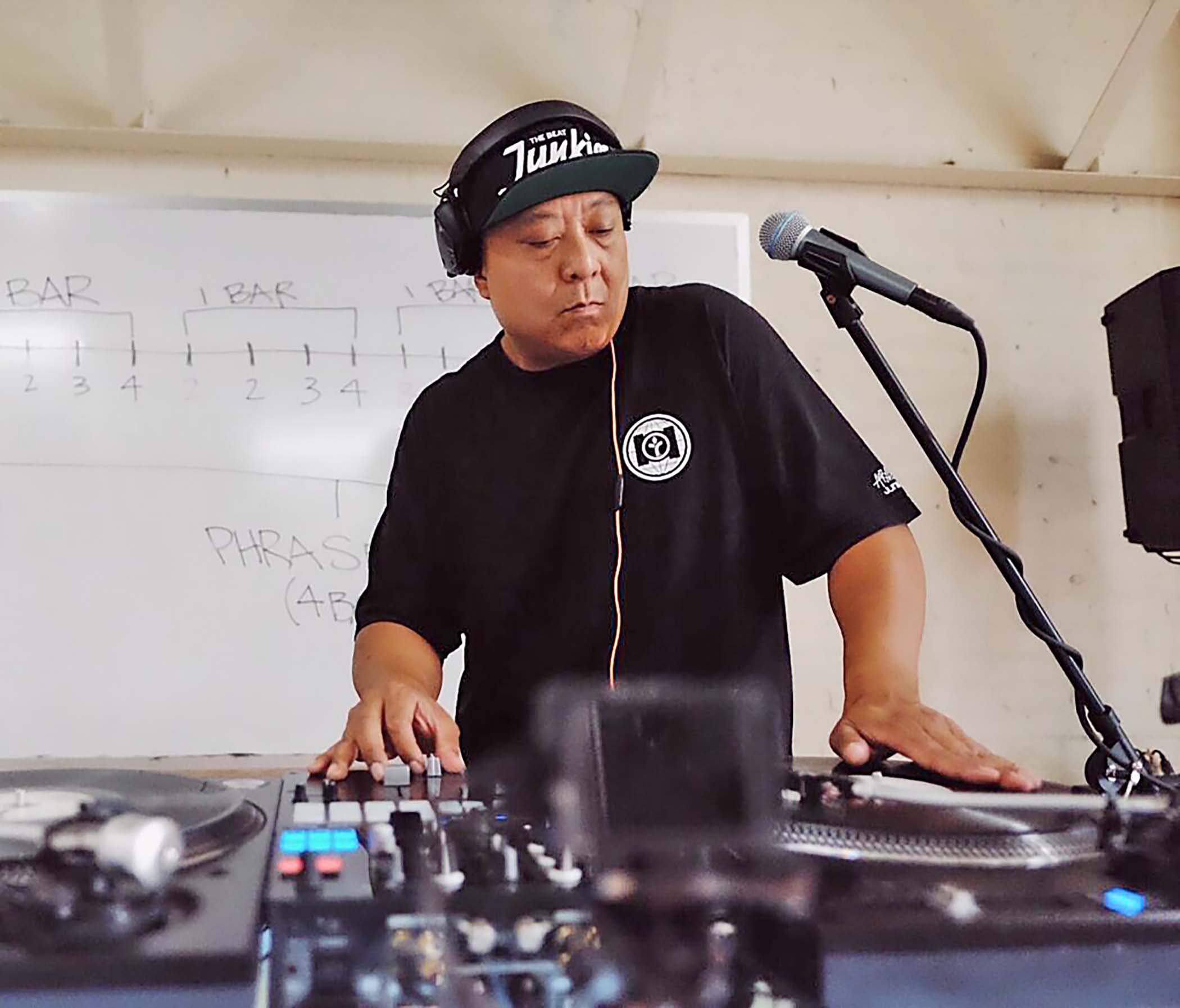
“Just beautiful exciting possibility here,” DJ Babu, real name Christopher Oroc, told me. “I’m very much in the early stages, barely in the admission stage, just learning my way around campus. Meeting other staff. I’ve been back to visit a few times now, maybe three or four times. It’s very surreal. It was this last trip in November [2025] where I got all my access cards and identification and all that kind of stuff.
“It’s amazing being on campus, meeting the existing hip hop ensemble students. This is new for all of us, so we’re figuring it out as we go. … [It] fuels my battery to keep going down this path.”
Babu appeared at Johns Hopkins several times last year, meeting with school upper administration and putting on a DJ masterclass that was open to students and the public. Conversations were had about bringing Babu back to campus this summer to work with Peabody Preparatory for a first-time, weeklong hip hop program for kids who could be talented potential Peabody Institute students, Babu said.
“It’s up to me to decide what that student needs and where they need to be pushed and spend more or less time,” Babu said. “I’m very intimidated coming in here. There is a part of me that is intimidated by a student who could run circles around me all day. At the same time, I remind myself I’m in this position because of the experience I’ve had onstage behind the decks, in competitions, in the studio — every kind of situation, I’ve been there. There is a reason I’m here.”

Johns Hopkins University ranked #7 of the best American universities on U.S. News and World Report’s influential list in 2026. The acceptance rate to the Peabody Institute for undergraduates was about 26% in 2025, with $66,670 annual tuition, according to the school’s website.
“No student [here] is just, ‘Let me try this violin thing and give it a shot,’ like a fraternity or sorority,” Babu says. “Every student there has been in their discipline since they were very young. Everyone is a genius. They have to apply to get into the school. I’m approaching it very much in that way. I’m looking for the highest caliber of DJs and turntablists to apply to this program. I would love to work with them closely and bring whatever I can bring to them — take turntablism and DJing to a higher level, so you can sit next to another instrument and earn that same kind of respect.”
Babu’s recruitment to Peabody Institute was the brainchild of Wendel Patrick, the Director of Hip Hop Studies at Johns Hopkins and Associate Professor of Music Engineering and Technology. Patrick is a classically trained pianist, composer, and hip hop producer who recruited Grammy winner Lupe Fiasco and vocal percussionist Max Bent for his teaching faculty. In 2025, Peabody presented Rakim with its George Peabody Medal and an honorary degree for his contributions to hip hop as an MC.
“[Babu] was on a very short list of people who I wanted for that position, and then I brought him out to Peabody as a guest last year,” Patrick said. “From a fundamental perspective, he’s so knowledgeable, not just when it comes to tricks and techniques, in terms of scratching, but also beat juggling. He’s been so connected to the culture and art form for so long that his relationships [are significant], as well. He commands a certain level of respect and admiration for how he approaches the art form for so long.”
Patrick said of the school’s plans for Babu, “We want him to be able to grow as a faculty member in ways that he wants. It’s an opportunity for him to potentially design classes as well.”
The BJIOS program humbly created by the Beat Junkies nearly a decade ago, though it might not have been planned this way, helped Babu crystallize a place for himself in higher education, as it created plenty of visual examples of how the Junkies — and Babu specifically — put turntablism into performance practice for students with originality, discipline, and crispness, an attractive combination for top-tier music schools looking to incorporate new instruments into their curricula.
“The Beat Junkie Institute has an extensive online presence, online courses and clinical, technical videos, where [Beat Junkies] Babu, D-Styles, and Melo-D are breaking down techniques, really explaining them in great detail,” Patrick said. “Babu and I had long talks about that — about music, how it is shared, and how that changes over time. There are traditions that change and shift, even just in the DJ world, in terms of technology.”
Cofounded and taught by fellow Junkies including “The Funky President” and group founder J.Rocc, Mr. Choc, D-Styles, DJ Rhettmatic, DJ Melo-D, and Babu, BJIOS is thriving in 2026 as a cultural hub of music-meets-education, popping up annually at the National Association of Music Merchants (NAMM) convention in LA with a live stream, or with the Junkies DJing parties of all sizes around town, recognized warmly by many LA locals. Their hundreds of BJIOS students have fanned out over LA and to other cities as emissaries for the group.
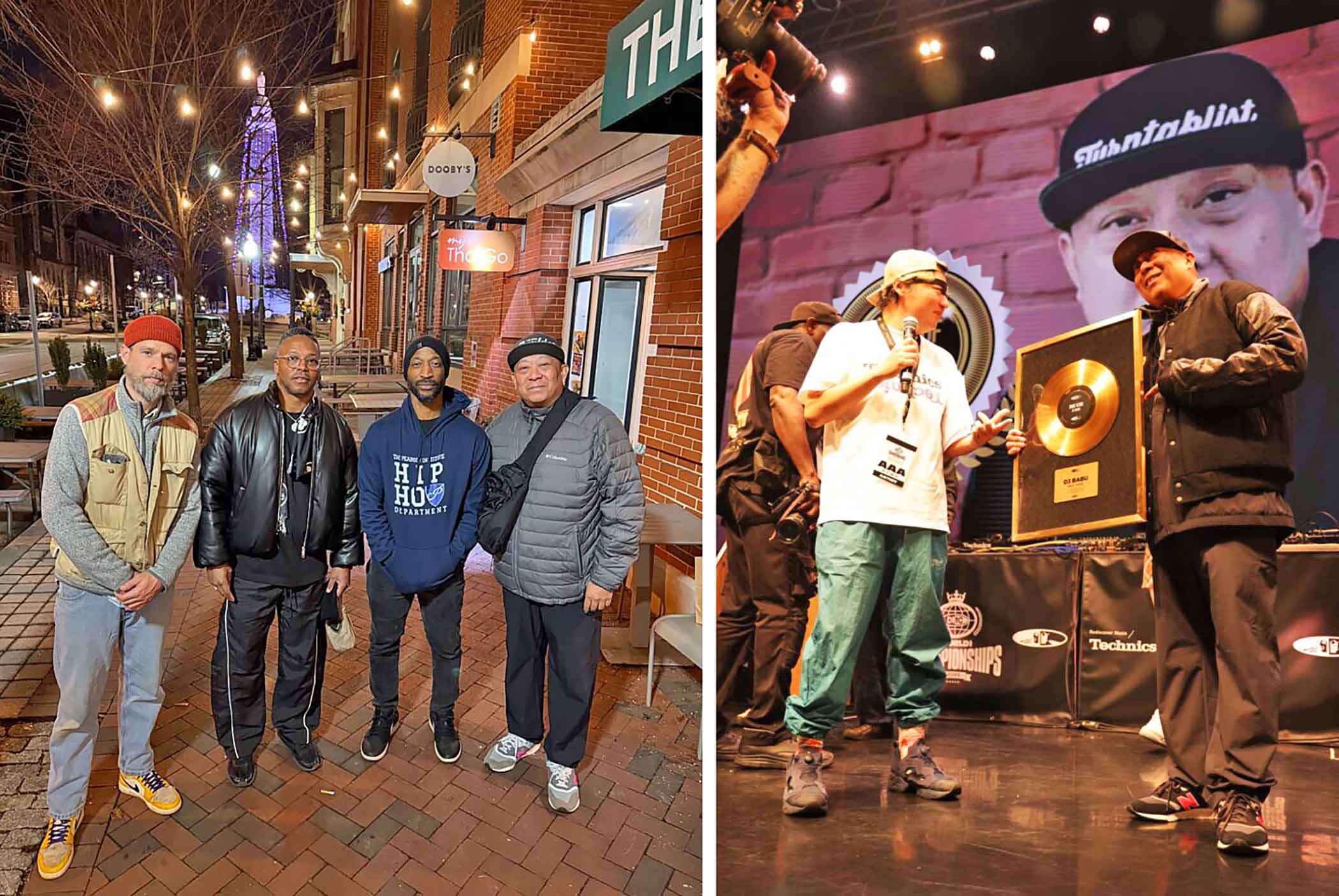
BJIOS Dean of Students Mr. Choc taught Babu how to teach, Babu said, a door-opening contribution to his personal progression. Mr. Choc, who dominated car stereos and house parties in the late 1990s and early 2000s on Power 106 mix shows like “Friday Night Flavas,” is a 10-plus-year veteran instructor from Jam Master Jay’s Scratch DJ Academy, with almost 40 years as a DJ.
“Mr. Choc’s experience and knowledge gave us the confidence to open BJIOS in 2017,” Babu, who is the BJIOS chancellor and program director, said.
In addition to the Junkies, DJ Babu — fresh off receiving the Icon Award at 2025’s DMC World DJ Championships (the turntable competition equivalent of the Super Bowl) and cohosting for the past three years — is best known as one-third of the LA hip hop group Dilated Peoples, which hit the national spotlight in the late 1990s with their single “Work the Angles” and first album The Platform, released under Capitol Records.
Along with his fellow Dilated Peoples, Rakaa Iriscience and Evidence, DJ Babu was a driving and visible force of the blistering LA hip hop scene of the era. Rakaa and Babu also have their own group, Expansion Team Soundsystem, and have traveled the world doing shows together.
Rakaa, whose voice is synonymous with the Dilated Peoples’ sound, helped recruit Babu when the group was starting, Rakaa told me, emphasizing the importance of having a skilled DJ at the group’s core. The DJ’s booth and turntable setup had become a visual prop for live acts, Rakaa notes, sometimes with unplugged decks or flashy laserdiscs on the plates instead of actual records. Babu’s Dilated Peoples presence was a statement about the DJ’s importance in hip hop.
“Babu is one of the most dangerous DJs ever,” Rakaa says. “For him to have coined the term turntablism and to have brought this spectrum of ideas together into a phrase like turntablism that captures the essence of what a lot of DJs before them were pushing forward — that shows his vision and his skills have been battle-tested around the world. He’s already proved he’s one of the best on turntables. But he’s also a visionary with a clear, committed view. He isn’t afraid to step forward and express that point of view. That makes him very unique in the space. Also, his ability to play from a lead, almost like a jazz musician.”
Rakaa, who is working on new music with Babu, says of his Dilated groupmate taking over as a Peabody instructor, “To be able to sit down, focus his energy, pull from his vast knowledge and put that it in an institute of higher learning, I thought was exciting. He’s a very kind person, personable. He’s funny. Not every DJ is a good speaker. A lot of times, they’re shy behind those decks. Babu is just naturally a charismatic person, very knowledgeable and humble. I think it was a great fit.”
Rakaa adds, “Being a humble student made him into being a teacher, when he transitioned, with the understanding of what it means to be a student. He genuinely wants to elevate the whole sphere. Everything that he loves, he wants to see that elevated.”
Flash back to 2017, when Babu was beginning his transition into the second act of his career — teaching — sinking his teeth into the creation of BJIOS as the turntablist collective was celebrating its 25th anniversary together. Dilated Peoples’ fifth LP Directors of Photography , was released in 2014, and Babu was picking up old-fashioned small business hustle, meeting people and winning over customers one at a time.
Like any entrepreneur, Babu looked at the competition for BJIOS. The group had the big advantage of brand-name DJs who could teach classes and promote the school through their social media. Babu focused on businesses, he says, such as martial arts, dance programs, and sports, which offered similar intensive, practice-meets-perform programs that could be scaled in difficulty and tied to educational expertise.
“All of a sudden, I’m here in my students’ faces, ‘Here’s my email, hit me up if you have problems,’” Babu said of changing from backstage-secluded artist to Beat Junkie of the People. “I have no regrets. It was a real beautiful change for me in my life. It’s not only made me a better instructor and a better DJ, it’s been good for my soul too.”
While the price for BJIOS is not inexpensive (tuition for the eight-week introductory course is $825), it’s not the highest price in this crowded field of DJ education. Scratch DJ Academy costs $1,050 for a 12-class introductory course, with an option for a $4,999 yearlong program. The pointblank Music School, whose alumni include Claude VonStroke and Goldie, charges $2,545 for its 10-class DJ skills level 1 class.
BJIOS students have described the school as an inclusive, safe, and creatively bold learning community, with an alumni roster that includes Joyce Wrice’s DJ, Midi Riperton. According to the BJIOS website, topics covered in the introductory class include DJ equipment and terminology, mixing, beatmatching, scratching, music structure and timing, practice habits, and vinyl fundamentals.
“[Babu] was hands-on and worked you through an exercise routine you might not be getting immediately,” Nicholas King, a beatmaker for the hip hop duo Windmills, said of taking the introductory BJIOS class in 2019. “If you nailed something, he was quick to give you praise and encouragement. He was super-approachable after class. It felt like a community because they were always having events and potlucks. Students were invited and encouraged to come.”
Now that both Babu and turntablism have reached a top American university, Babu’s mission of elevating turntable education could be shifting from what he describes as a recurrent theme as a DJ teacher at BJIOS.

Many top DJs then and now are proudly self-taught, particularly when YouTube videos spelling out a specific DJ technique can be found instantaneously. Turntablism is not an art form steeped in centuries of structure and training. As a matter of credibility, DJ training can, for some people, tiptoe on a boundary of legitimacy. Overnight DJs who dance around with pre-programmed sets are in no shortage and can lessen the perceived value of a hard-earned DJ education.
“I want my students to be proud of their experience,” Babu says. “I don’t think it’s corny that you went to DJ school — not if the DJ school isn’t corny. I think it’s such a new concept, even right now. When I tell people what I do, outside of the culture or industry, they say, ‘What do you do?’ ‘I own a DJ school.’ It’s still a very new concept or un-legitimate concept for people in their minds, until they walk in and see a classroom of 12 students executing.
“The concept of being taught formally is still in its baby stages. I’d like to hear other schools be able to boast this guy who is competing — ‘He learned under so-and-so at this DJ school.’”
Babu adds, “I think when people leave our school, they’re proud to say they graduated from the Beat Junkie Institute of Sound.” ❖