







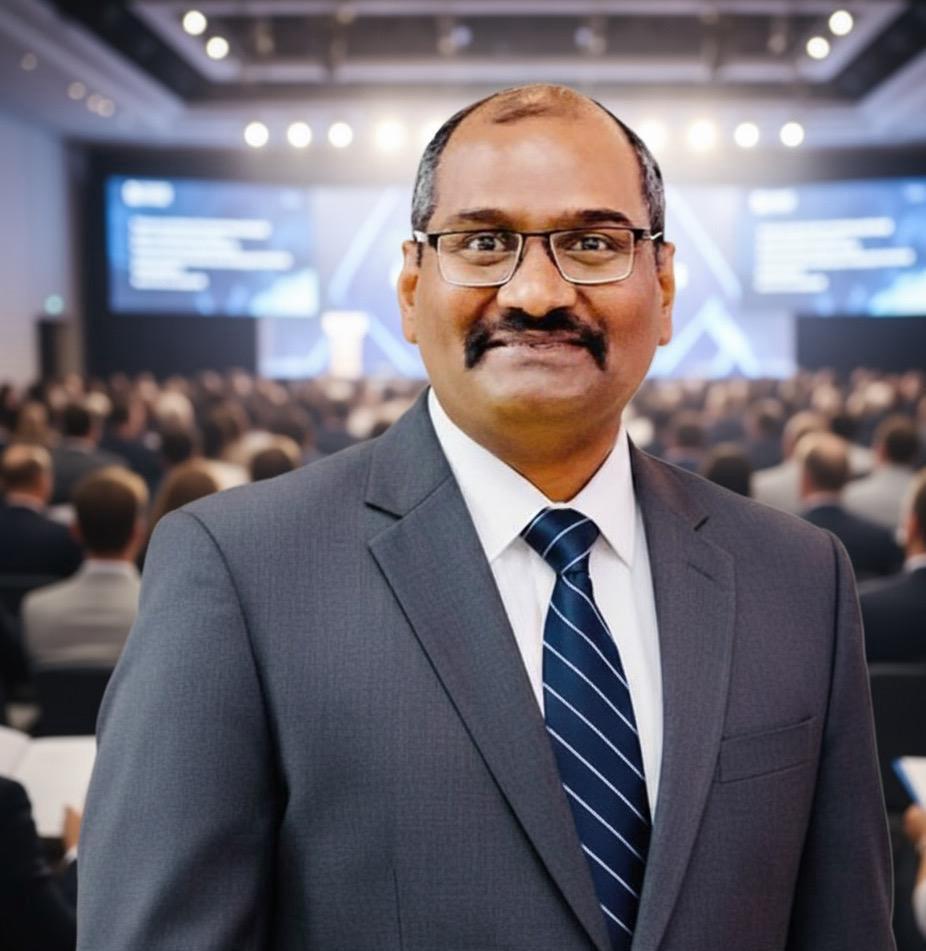
In today’s era of digital modernization, organizations across industries are racing to transform legacy systems, eliminate operational complexity, and adopt intelligent automation. At the forefront of this transformation is Ravi Kiran Kanneganti, Senior Manager at Capgemini America, Inc., whose two-decade journey has shaped some of the most influential enterprise automation initiatives in financial services, telecom, and public-sector ecosystems.
In this exclusive interview, Ravi shares insights on modernization, intelligent workflows, the challenges of transforming legacy environments, and the future of AI-powered automation.
- Ravi Kiran, you have spent over 20 years in enterprise content management and automation. How has this journey shaped your approach to digital transformation today?
Ravi Kiran: My journey has been defined by solving complex enterprise problems across financial, telecom, and public-sector organizations. Early in my career, I worked extensively with J2EE and IBM FileNet systems, which taught me the importance of resilient architecture, compliance, and long-term scalability. Over the years, I learned that true digital transformation is not about replacing old systems. It is about rethinking how information flows, how people work, and how technology can automate decisions intelligently.
Today, I approach every transformation with a blend of engineering discipline and business insight, ensuring that modernization creates measurable impact rather than superficial change.
- As Senior Manager at Capgemini, what is the core of your role and how do you ensure a solution meets both business and technical needs?
Ravi Kiran: My role involves leading enterprise solutions from concept to deployment. I translate a client’s vision into secure, scalable, and compliant architectures while ensuring the user experience remains intuitive.
Whether I am architecting workflow automation, modernizing FileNet systems, or designing microservices, I focus on creating frameworks that produce sustained value. The key is aligning business priorities with engineering best practices so the solution not only works today but continues to evolve with future needs.
- You have led major modernization programs for large enterprises. What achievements stand out the most in your career?
Ravi Kiran: I am proud to have delivered enterprise automations that generated more than 12 million dollars in annualized savings for large financial clients. Some key achievements include:
- Preventing 2.1 million dollars in annual losses through billing dispute automation.
- Delivering 8.4 million dollars in annual benefit by modernizing dispute management.
- Building chargeback automation saving 610,000 dollars per year.
- Implementing proactive dispute notifications that reduced call center volume and saved 750,000 dollars annually.
- Developing critical automation fixes that prevented potential losses of 1.2 million dollars per month.
Beyond these, I have served as a judge, reviewer, and session chair at international conferences and published research papers that advance the field. I am also holding memberships in reputed institutions and working as Advisory Board member. These contributions reflect my commitment to innovation and industry leadership.
- Enterprise modernization often faces technical and operational barriers. What are the most significant challenges you have encountered?
Ravi Kiran: One of the biggest challenges is transforming legacy, monolithic ECM systems into agile, intelligent platforms without disrupting business operations. Integrating IBM FileNet environments with cloud and API-driven ecosystems requires careful consideration because traditional systems were never designed for real-time interoperability.
Another challenge is performing large-scale migrations with zero downtime. To address this, I implemented blue-green deployment strategies using containerized FileNet environments and CI/CD pipelines, allowing seamless upgrades without impacting users.
High-volume financial environments also present latency and reconciliation challenges. Here, intelligent workflow automation and predictive exception handling helped reduce manual intervention by more than 40 percent, strengthening compliance and audit capabilities.
- You have engineered innovative solutions to overcome these challenges. Can you explain some of the frameworks or approaches you introduced?
Ravi Kiran: I implemented a modernization blueprint based on modular design, service-oriented architecture, and DevOps automation. This included:
- J2EE microservices for improved maintainability
- CE and PE APIs for flexible integration
- Saga-based orchestration to decouple rigid processes
- Containerized deployments for scalability
- Predictive exception handling for real-time efficiency
- Intelligent workflow automation for consistent performance
These design principles not only modernize legacy systems but also future-proof them by making innovation faster and more cost-effective.
- The industry is evolving rapidly with AI, automation, and orchestration. What trends do you see defining the next decade?
Ravi Kiran: We are moving toward a world where enterprise work is increasingly autonomous. With generative AI, agentic AI, and virtual enterprise assistants, systems will take on more complex tasks with minimal human intervention.
Enterprises today operate more than 1,000 applications on average, creating silos that slow innovation. Automation and orchestration will serve as the backbone, connecting, modernizing, and optimizing these distributed ecosystems.
From infrastructure as code to identity governance, automation will enhance security, compliance, and agility. According to Gartner, by 2028:
- 33 percent of enterprise software will include agentic AI
- Standalone automation will grow at a 12.7 percent CAGR
These trends highlight that automation is no longer optional. It is foundational for competitive advantage.
- With AI taking over more intelligent tasks, what is the right balance between AI-driven automation and deterministic systems?
Ravi Kiran: AI provides bursts of insight and efficiency, but deterministic automation provides reliability and control, especially for long-running, mission-critical processes. The future requires a hybrid balance.
Organizations should use AI for decision support, predictive analysis, and intelligent recommendations, while deterministic workflows handle compliance, governance, and execution.
AI-driven enterprise agents with human-in-the-loop verification will ensure that automation remains transparent, safe, and explainable, particularly in regulated industries.
- As a leader in automation, what skills do you believe future engineers must develop to succeed in this new landscape?
Ravi Kiran: Engineers must build strong fundamentals in architecture, APIs, and automation frameworks while also learning AI, machine learning, and orchestration tools.
Key skills include:
- Microservices architecture and cloud deployment
- Workflow automation and process design
- AI and ML for predictive automation
- DevOps and CI/CD engineering
- API-driven integrations
- Governance, security, and compliance-first design
Most importantly, engineers should combine technical depth with business understanding. The future of automation requires professionals who can solve problems end to end.
- How do you ensure that automation projects deliver measurable impact for organizations?
Ravi Kiran: Automation must be tied to business outcomes, not just technical upgrades. I measure value through operational savings, reduction in manual effort, system availability, and improved customer experience.
Every framework I design focuses on scalability, reusability, and long-term efficiency. When automation reduces risk, improves compliance, and accelerates workflows, the ROI naturally follows.
- Finally, what is your vision for the future of enterprise automation?
Ravi Kiran: I envision a future where enterprise systems function like intelligent teammates. These are agents that understand context, make decisions, and collaborate with humans.
The next era will be defined by AI-powered enterprise agents interconnected through automation, orchestration, and APIs. These systems will not replace people. They will augment them, enabling organizations to innovate faster, maintain stronger governance, and operate with unprecedented agility.
The goal is to build a foundation where automation is not just a tool but a strategic driver of enterprise excellence. That is the future I am committed to building.
Conclusion
Ravi Kiran Kanneganti’s work exemplifies the direction in which enterprise modernization is heading. With a strong foundation in engineering, a deep understanding of business processes, and a forward-looking vision shaped by AI and automation, he continues to redefine how enterprises transition from legacy systems to intelligent, future-ready architectures.
His leadership demonstrates that innovation is not only about adopting new technologies but also about building systems that are resilient, scalable, secure, and deeply aligned with organizational goals.
As enterprises enter a new decade of digital transformation, voices like Ravi Kiran’s will play a crucial role in guiding the industry toward smarter, more integrated, and more autonomous ecosystems.