


We know that the solstice is less than two weeks away, but does winter feel even darker than usual this year? Is it the pall of our national politics? The grim glowerings from screens that impinge on our eyeballs at every turn?
Well then, check out the sharp group show at the venerable Hudson Guild Gallery, which will be up beyond Groundhog Day and also features an Artists’ Talk, happening this coming Friday, December 12. Light Producing Objects provides a warming glow edged with plenty of formal wit and conceptual verve. Consider Tom Fitzgibbon’s wall of small canvases, each with a black Chinese symbol in the upper-right corner, gradated color patches on the front surface, and bright swirls of light shining through from the back, like outlines of some bioluminescent school of fish. The piece, “Transliteration — 26 Panels of Changjie Western Keyboard,” also features a tangle of wiring rising from the floor, lit by a stray “key,” as if the struggle to compress thousands of Chinese language symbols into a standard keyboard has beautifully blown the array’s circuits.
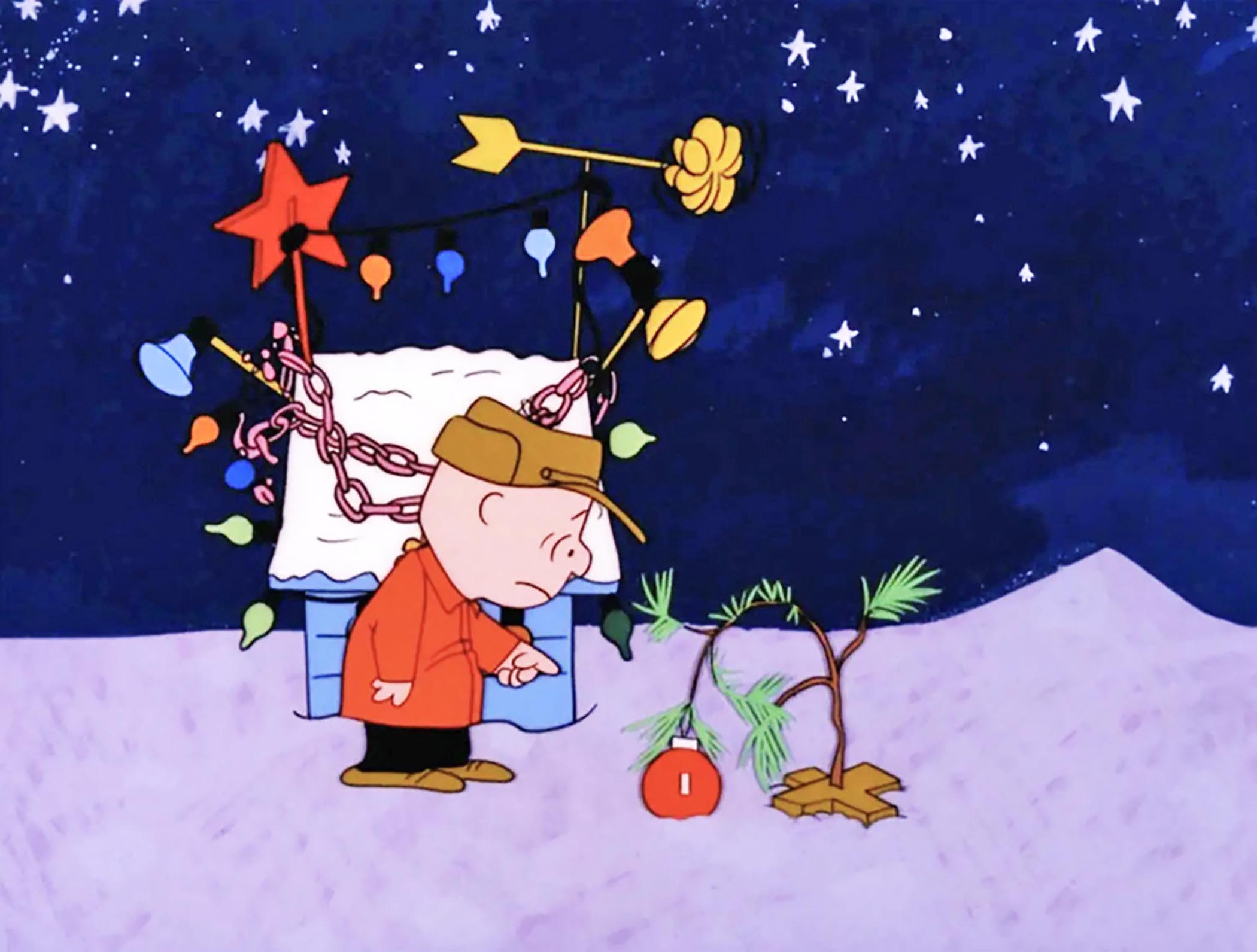
Carol Salmanson’s wall sculpture, “Arcangle 1,” beckons like a happy talisman, its raceway of luminous colored dots segueing through backlit planes evoking a smiling, otherworldly visitor. On the other hand, Ben LaRocco’s “Christmas Tree,” with its naked green and red light bulbs, exposed wires, and heavy nails jutting from bare, gnarled branches, conveys the abject charm of Charlie Brown’s seasonal offering, a TV special still going strong 60 years after network execs lamented to Charles Schulz and his animation team, “Nice try. We’ll put it on once, and that’ll be it.”
It’s always a good sign for a work of art when your iPhone has trouble focusing on the action.
Beams of light shoot mysteriously from behind two lumpy half-cylinders jutting from the wall in Kazue Taguchi’s “Minimal Luxury,” at times as keen as searchlights at a Hollywood opening, at others blurring like the miasma of the cosmos. And with its coating of writhing enamel paint and wriggle of blue electroluminescent wire hugging along the folded and twisted contours of its sheet-metal support, James O. Clark’s “Orestes” channels not only the mayhem and tragedy represented by the titular mythical hero but also the compositional drama of one of John Chamberlain’s crushed auto-body sculptures. In a different vein, the roughly foot-high, smoothly rounded lozenge of wood — inset with pink quartz and other minerals, as if they were medals — in Esther Ruiz’s “Beacon IV” seems a guardian, one ready to wield the neon strip curving around its bottom at the first sign of something gone amiss.

Katherine Jackson’s “Observatory” positively scintillates through an underpinning of LEDs that contrast green-glowing, hard-edged abstract designs against gleaming blue fogs, a mysterious realm further mediated by a glass disc hanging in front of the piece’s main glass panels. Similarly, Graciela Cassel’s “Portal 3” and “Portal 5” feature bulbous glass circles, about the diameter of a Frisbee, mounted before small video screens that pulse with imagery distorted by the warped glass, such as shots of clouds that divide and multiply like God’s own kaleidoscope.
Despite its somewhat elegiac title, “A Prayer For the Coral Reefs of the World,” Denise Corley’s pulsating sculpture is hopeful in the way of disaster movies that end with the promise of a more upbeat, if direly hard-won, future. Presenting as a chunky tower of homely gray packing nodules, the viewer has only to gaze into the many pressed-paper fissures to watch luminous waves flow through the interior space like multicolored lava. (I think it’s always a good sign for a work of art when your iPhone has trouble focusing on the action.) Corley’s piece is aesthetically complex while also being flat-out entertaining, perhaps reminding some viewers of that original-series Star Trek episode in which the Hortas, silicon-based beings despised by human mine operators, are ultimately revealed as misunderstood parents eager to help.
Certainly a bright note to end a dark year upon. ❖
Light Producing Objects
Hudson Guild Gallery
441 West 26th Street
Artists’ Talk, Friday, December 12, 5-6 p.m.
Through February 4