





Pride month has once again come to Ukraine, marking the third celebration since Russia invaded. While Ukraine has experienced immense losses and constant bombardments since the start of the conflict, the queer community has found a silver lining in the war — a more tolerant society, where homophobia has lessened as the country aligns with more progressive principles.
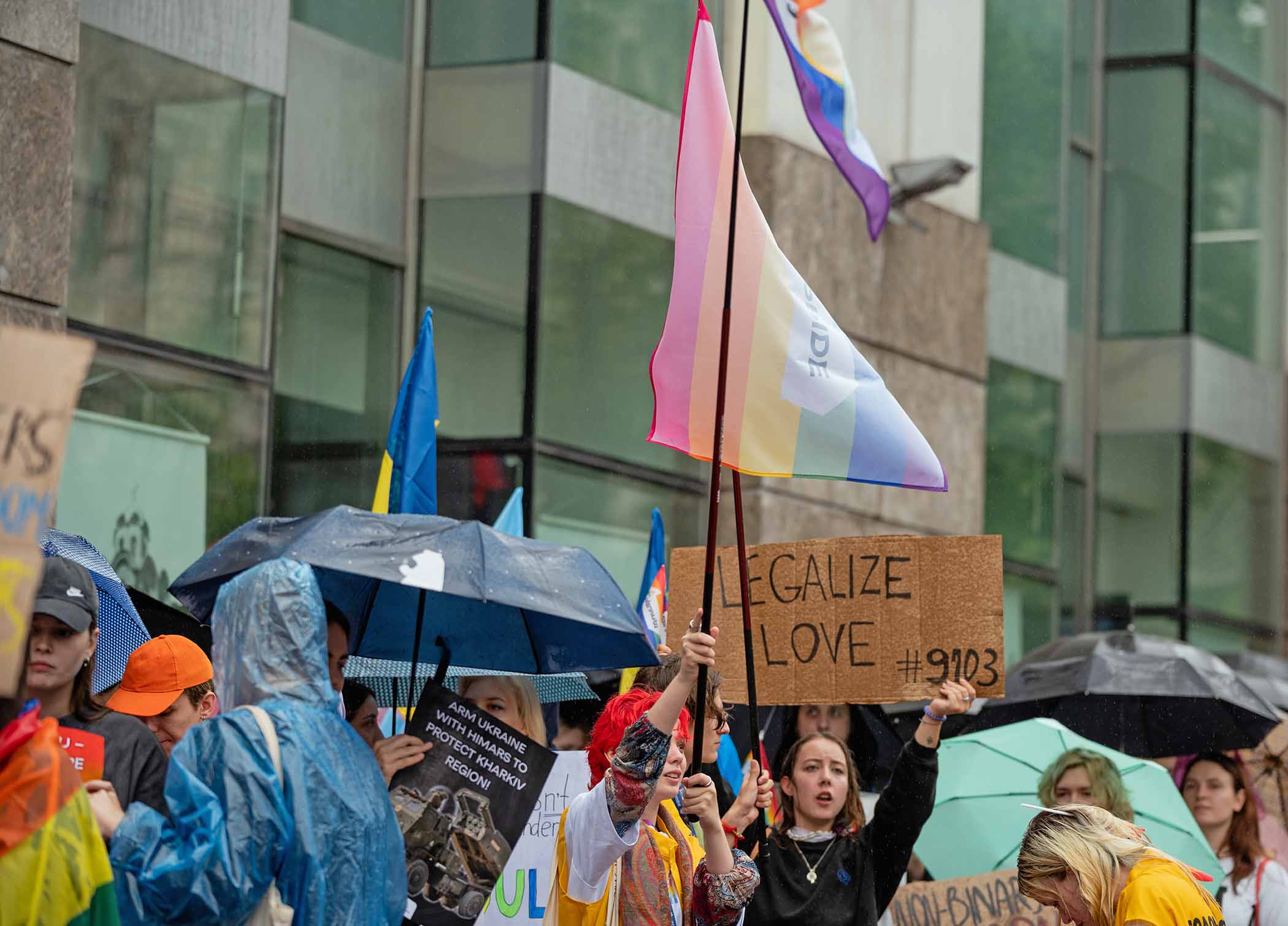
As the war nears its two-and-a-half-year mark, Ukraine’s queer community has been holding events ranging from a nightclub party in Kyiv meant to draw awareness to the struggles of same-sex couples in the country to events raising money for the military. On June 16, Ukrainians took to the streets of Kyiv in the first Pride march the country has seen during the war. Falling rain did not sway attendees from their demonstration, which aimed to remind people throughout the world that even during war, Ukraine’s queer community is fighting for equal rights, and that they will not be silenced in a country that still does not completely accept them.
Ukraine’s queer folks have faced constant oppression and homophobia throughout the country’s history. During the Soviet era, homosexuality was banned and treated as a mental disorder, and only after the Soviet Union’s collapse, in 1991, did Ukraine and Russia make same-sex relationships legal — but gay marriage is still prohibited in both countries. Queer activists in Ukraine have long campaigned for equal rights, but even now, when queer soldiers are on the frontlines, LGBTQ+ military personnel do not have the same rights as their heterosexual counterparts — including the right to make medical decisions for a partner and the right to be notified if a partner is killed or injured.
Sphere, a Ukrainian nongovernmental organization made up of LGBTQ+ people, has been at the forefront of the fight for gay rights in Ukraine. At Sphere’s Kharkiv office, Kateryna Kormilets, 22, a social media marketer for the NGO, says that before the war began, the LGBTQ+ community in Ukraine was seen as “Something wrong. Something demonic.” But as Russia ravaged Kharkiv, Ukraine’s second-largest city, people began to accept more progressive values, including gay rights. In 2016, the majority of Ukrainians did not support LBGTQ+ rights, according to a poll by NASH SVIT Center, a Ukrainian grassroots organization. With the advent of war, however, the attitude toward the queer community in Ukraine has improved. For example, in 2022, Ukrainian president Volodymyr Zelensky, in a written statement online, said that the constitution’s definition of marriage could not be changed during the war, but did note that “each citizen is an indivisible part of civil society, for whom all rights and freedoms fixed in the Constitution of Ukraine extend,” adding that his government had “worked out options for a solution regarding the legalization in Ukraine of registered civil partnerships….” Later that year, a bill was introduced in Ukraine’s parliament to legalize same-sex civil unions. (Ukraine currently does not recognize same-sex marriage or civil unions.)

When the NASH SVIT poll asked the question “In your opinion, should LGBT people in Ukraine have the same rights as other citizens of our country?” in 2016, only 33% felt that these citizens should be treated as equal. In 2022, that number had jumped 30 points, to an almost two-thirds approval rating. However, the same poll found that only 37% supported gay marriage. But Kormilets says she believes the actual number to be higher, adding, “I hear a lot of people are accepted in their communities. I think it’s getting better because we as a community are trying to explain to people that LGBT people are just normal people, like all of them.” She believes that Ukrainians have become more tolerant of all of their fellow citizens at a time when the country is fighting for its life. The Kharkiv region was among the first to feel the effects of Russia’s February 24, 2022, invasion. As Russian troops swiftly crossed the border into Kharkiv, the region became one of the epicenters of the war. In the city, fighting between Russian and Ukrainian soldiers raged on for months, and missile attacks constantly hit the city.
While Ukraine continues to make progress around LGBTQ+ rights, in Russia, the Kremlin has continuously taken measures to suppress queer people’s freedom.
One Sphere volunteer, a 20-year-old woman, was killed in missile shelling in the early days of the war, and there was a feeling in the organization that members could be killed at any moment. Still, despite the terror Kharkiv faced, Kormilets recalls that many of the NGO members remained in the city; some collected food for civilians, others raised funds for the military. Sphere has raised money for multiple military troops throughout the war, including LGBT Military which is described as a “union of the LGBT military, veterans and volunteers” and was established in 2018 by an openly gay veteran, Viktor Pylypenko. According to LGBT Military’s website, the union consists of “openly gay and closeted” members of Ukraine’s military and works to campaign for equality and to support its community, which is helping to defend Ukraine.
A soldier who is part of LGBT Military, Nick, 31, spoke to the Voice about his experiences being a queer soldier in Ukraine during the war. Nick is from Donetsk, a city in eastern Ukraine that has been occupied by Russia since 2014. H has lived most of his life in Bakhmut, which was a major hotspot of the war for months, before Russia seized it in May 2023.
Nick identifies as bisexual, and says that his family does not know about his sexual orientation. “My family has traditional views, and my father is, unfortunately, a [Russian] collaborator whom I no longer have contact with. In my unit … they do not know about this [sexual orientation],” he explains. He does note that some service people have shown support for the LGBTQ+ community in Ukraine, but others are vocal about their disdain for gay rights. “Whenever possible, I take part in various activities to promote the protection of the rights and freedoms of people like me,” he explains, adding, “In particular, I am in favor of legislation on [combating] discrimination.”
While Ukraine continues to make progress around LBGTQ+ rights, in Russia, the Kremlin has continuously taken measures to suppress queer people’s freedom. In November 2023, the Russian Supreme Court banned “The International LBGT movement,” according to the Moscow Times, and on March 22, it added the movement to its list of extremist and terrorist organizations. On March 30, the owner of a popular gay bar in Orenburg, a city in southwestern Russia, was arrested at an airport in Moscow. Earlier that month, police had raided his bar, Pose, during a drag show, arresting its administrator and artistic director in the first criminal case of its kind.
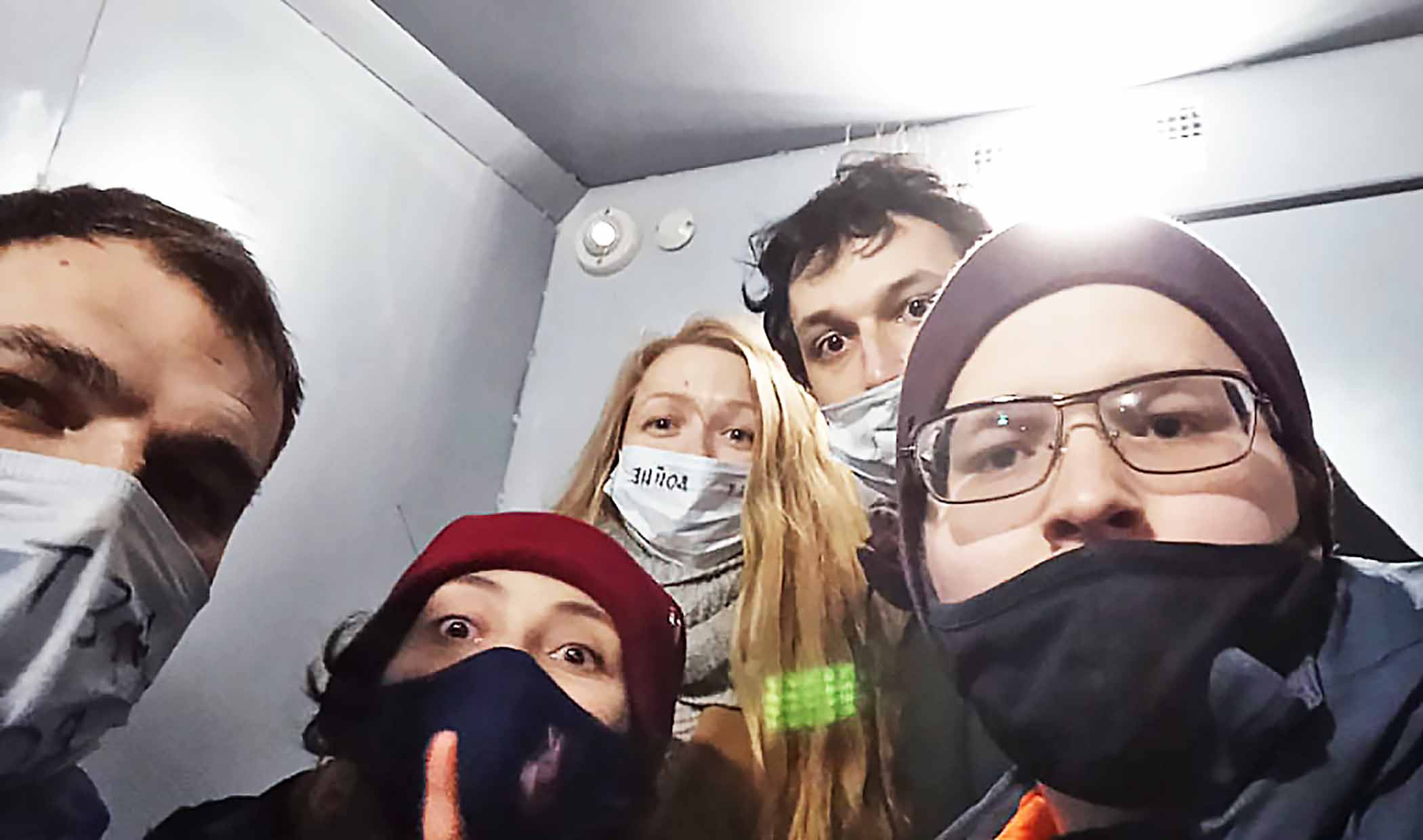
Fear of persecution remains high in Russia, where LGBTQ+ people face violence simply for their sexual orientation. Queer people in Russia who manage to escape the country are seeking political refuge in European countries such as Germany, which accepts Russian activists and journalists, amongst others, on humanitarian visas. Germany also accepts queer Russians who face discrimination at home, including Viktor, a 32-year-old gay man from Karelia, a small village in northwest Russia that he describes over Zoom as “Very bleak, in the sense that it’s not safe to be [queer] there and it’s impossible, especially in a small town.”
Viktor first realized he was gay when he was 13, but initially, “There was an inner homophobia in me developing. I didn’t accept it. I didn’t accept myself.” At 20 years old, Viktor says, he finally accepted himself and started to live with his sexual orientation. But in his small town, “I always had to be on my guard, on the lookout and keep my eyes open. They found out about me. Everybody knew.” Viktor says that he often had gay slurs shouted at him as he walked down the street, and that he was attacked multiple times in his village.
Ridicule aimed at Viktor’s sexual orientation continued for nearly a decade after he came out as gay, and in 2020 he reached a breaking point. He got into a physical altercation with a police officer who had accosted him with homophobic slurs at an emergency room in Karelia, where he had been taken for a medical examination following an arrest for drunkenness. Viktor was put on probation for “violence against an employee of the authorities.” His probation ended in 2021, and the following year, Russia launched its invasion. After attending an anti-war rally in St. Petersburg, in early March 2022, Viktor left Russia and moved to Armenia. He lived in a shelter for Russian activists in Yerevan, Armenia’s capital, where he met his boyfriend, Sasha, 24. In January 2023 the pair received humanitarian visas from Germany, and they have lived in Munich since then, where they feel that they can finally be an openly queer couple.
“I do not even know how things are with LGBTQ+ people in Ukraine,” Viktor says. “I did not particularly, say, go into the study of this issue. But as for Russia, I can say for sure that there is no acceptance of LGBTQ+ culture of any kind.” Then he adds, “It seems to me that LGBTQ people, it’s some kind of periphery, they are in a constant danger zone. And they don’t know what to do next. There is a lot of suicide among teenagers, as it were. Well, that’s understandable.” ❖
Anna Conkling is a freelance journalist based in New York City who, since the beginning of the Russian invasion, has been corresponding with and on the ground interviewing Ukrainian soldiers, students, and civilians, and writing about them for the Voice and other publications.