







It started with a text from Voice editor R.C. Baker, the steady hand, reluctant eulogist, and weary keeper of the newsroom’s flame: “I just found out that Tom Robbins is in hospice. So I’m going to have to start looking for something to honor him sooner rather than later, I’m afraid.” There was a heaviness behind it; not just the news itself, but the burden of ritual grief, the exhaustion of being the one called on to either assign to others — or summon from within himself — final words of comfort, again and again. The news about Tom Robbins was another toll amid some long years of farewells. Another name. Another legend slipping away.
I froze as I hesitantly acknowledged the quiet devastation behind Baker’s tone. You mean our freakin’ Tom?
That Tom Robbins — one of the Voice’s fiercest muckrakers, a native New Yorker truth junkie with a bullshit detector so sharp it should’ve come with a warning label? A precision-guided missile aimed at power and hypocrisy, whose pen never missed? Who could slice through corruption like a master chef deboning a fishy tale — so calmly, methodically, and relentlessly? That blazing moral compass, equal parts scalpel and sledgehammer, wrapped in a Mets cap and a working man’s conscience?
Former Voice hard-hitter Michael Tomasky confirmed in a social media post that Tom passed away on Tuesday from prostate cancer while in hospice care at home.
I used to call him “Major Tom,” a nod to David Bowie’s Space Oddity. “This is Ground Control to Major Tom … you’ve really made the grade,” I’d often greet him — that opening salute before the astronaut loses contact and drifts into the void. That was Robbins, in his own way. He’d made the grade, elevated not by self-promotion but by relentless truth-telling. Yet the higher he soared, the more alone he sometimes seemed, filing dispatches from a moral high ground that more than a few journalists were too scared or compromised to scale. He floated above the fray, untethered from the pack, exposing political rot and institutional decay with a kind of cosmic calm. Like Bowie’s Major Tom, Robbins knew the loneliness that comes from seeing too much and pretending too little. I think of Tom now as a secular saint in denim, lighting votive candles to honor justice in the church of investigative journalism.
Reflecting on Robbins’s enduring presence, I think of Alden Whitman, the legendary New York Times obituarist who revolutionized the form by interviewing his subjects while they were still alive. Whitman understood that waiting for the end missed the point. You had to catch the light in a person while it still flickered. It was about capturing the essence of your subject in their own words, ensuring that their story was told with authenticity and depth. In that spirit, perhaps it’s fitting to celebrate Robbins now, to acknowledge his contributions and the indelible mark he left on journalism. Maybe this isn’t a eulogy. Maybe it’s a love letter in real time. To Tom Robbins. To every ink-stained freak who once made New York quake. As public health visionary William Foege once said, “Every day we edit our obituaries.” Robbins is still editing his — with a red pen, a middle finger, and a spine made of NYC steel.
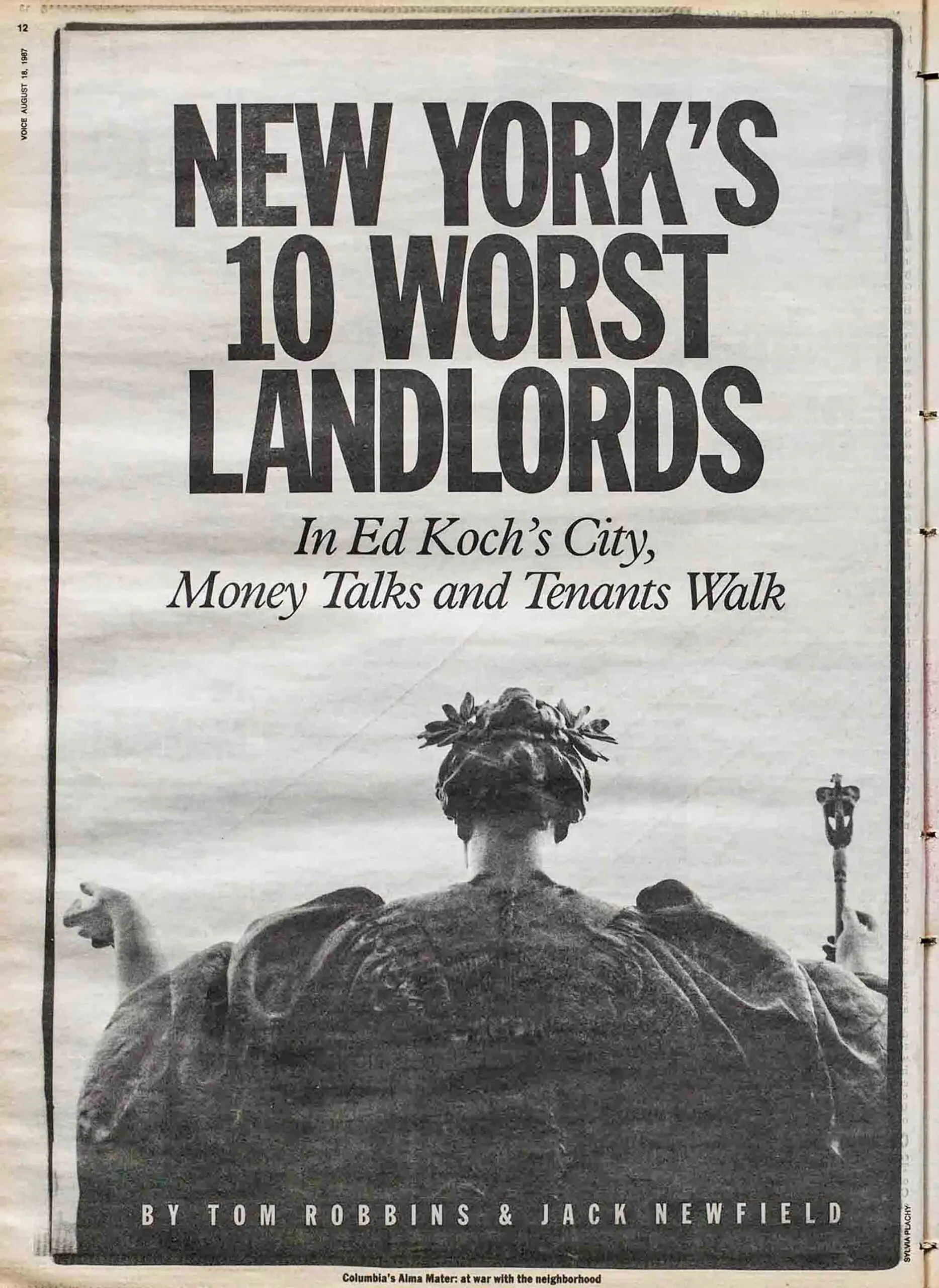
Robbins’s investigative legacy is etched into the very fabric of New York journalism. In 1987, alongside another take-no-prisoners newspaperman, Jack Newfield, he co-authored “New York’s Ten Worst Landlords of 1987,” a searing Voice exposé that spotlighted the city’s most negligent property owners, bringing attention to tenant abuses and housing injustices. That same year, collaborating with Wayne Barrett and Newfield again, Robbins delved into the murky waters of political accountability with “What Did Koch Know, and When Did He Know It?,” scrutinizing Mayor Ed Koch’s administration and its entanglements. Fast forward to 2008, when Robbins dissected the intricate web of political scandals in “A Month of Albany Scandals Is New York’s March Badness,” shedding light on the pervasive corruption in the state’s capital. And in “Hoffa & Obama: The Labor-Latte Alliance,” he explored the evolving dynamics between labor unions and political figures, offering insights into the shifting allegiances and strategies within the American labor movement.
I freaked out. I read Baker’s text over and over.
The timing was obscene. Susan Brownmiller had died just a week earlier. Karen Durbin before that. James Ledbetter gone. David Schneiderman. Barry Michael Cooper, too. These weren’t just names; they were fonts of power, voice, and resistance. Brownmiller, who charged into the male fortress of journalism with her feminist sword drawn. Durbin, whose sharp eye and sharper edits helped shape the Voice’s cultural soul. Ledbetter, witty and brilliant, a rare blend of financial intellect and old-school newsroom instincts. Schneiderman, the behind-the-scenes gladiator who fought corporate dragons to keep the Voice alive, often against impossible odds. Cooper, the cinematic chronicler of Harlem’s crack-era underworld, who turned journalism into prophecy and hip hop into scripture.
And now Tom?
For crying out loud, death isn’t new to us freaks. We danced with it in the copy department, toasted to it in bars, threw it into opening paragraphs, and buried it in punchlines. After Greg Tate and bell hooks died — back to back, in December 2021 — I remember asking aloud: What’s killing us? Tate, the thunderous jazz-slang prophet of Black cool, and hooks, the revolutionary feminist theorist with a poet’s soul and razor wit. Two cultural titans gone within days of each other. I posed the question not really expecting an answer. It just hung in the air like an unfinished hymn.
I thought of Tricia Romano’s book — The Freaks Came Out to Write: The Definitive History of the Village Voice, the Radical Paper That Changed American Culture. A stunning oral history, but now, increasingly, a roll call of the fallen. Since its publication, and even in the lead-up to it, death raked its fingers across its pages. Nat Hentoff, the jazz-soaked libertarian whose columns swung like sax solos. Jonas Mekas, the poetic chronicler of downtown dreams. Andrew Sarris, the auteurist who taught us how to see movies. Mary Perot Nichols, the fierce editor who made sure we didn’t flinch when punching power. Jack Newfield, the streetwise crusader who turned truth into a weapon. And then there was Wayne Barrett. His death hit like a poleax. Wayne was more than the Voice’s watchdog. He was its warrior monk. A tireless investigator with the appetite of a thousand interns and the fury of a betrayed patriot. He was the first to see the menace in Donald Trump. The first to name it. The first to say, “This man is dangerous.” Barrett died on January 19, 2017 — the day before Trump took office. Let that sink in. That weekend, time collapsed in on itself. The truth died and a lie was sworn in.
A few weeks ago, I found myself at the KGB Bar, in the East Village, attending the KGB Journalist Reading Series. A dimly lit, bohemian time capsule of a place. For 33 years, one-time Voice writer Mark Jacobson — part streetwise philosopher, part literary outlaw — has been hosting the series, gathering a rogue’s gallery of reporters, editors, and beautiful degenerates to read, rant, and remember what it meant to write like your life depended on it.
That night, I spotted another former Voicer, Joe Conason. Still sharp, still blessed with the gravity-defying grace of a man who has spent decades calling out corruption without ever sounding hysterical. Joe writes with the kind of clarity that makes presidents squirm and readers lean in.
They’re all part of Romano’s tale. She first got the idea for her book after a huge gathering of Voice alumni from far and wide, in 2017. The New York Times ran a piece about it, headlined “A Village Voice Reunion, and Nobody Got Punched.” That line has never left me. It was more than clever — a group of Black, Brown-skinned, and Blue-eyed warriors sitting in a room, not trading blows but memories. And, in some cases, strategies for the future. Robbins, for one, with his bulging Rolodex filled with crooks, pols, cops — and all combinations thereof — went on to contribute to the Marshall Project, a site specializing in coverage of America’s always ailing, never-blind-enough justice system.
But at that 2017 event, one could see among a good slice of the gathered writers, editors, IT and advertising folks, photographers, illustrators, and art directors the slow drip of age, of bodies betrayed. There was plenty of talk of disillusionment, of New York’s bane of gentrification. And what about planned obsolescence? The death of the underground? The corporate erasure of our wildest selves?
Or maybe it’s the fact that we’re still writing. Still remembering. And maybe that remembering is its own form of slow death. Because the ones who write the obits don’t walk away unscathed. We carry the echoes. We shoulder the weight. And we begin to vanish with every name we type. Tom Robbins understood that. Not in some grand manifesto, but in the gritty, unrelenting practice of showing up — week after week, story after story — to expose what power tried to bury. Tom never needed to mythologize the work. He lived it. And that’s its own kind of grace: Plugging away with the whole city watching, simply daring to tell the truth. ❖
Peter Noel was the Black Beat Reporter at the Voice from 1990 to 2001. He began writing for the Voice again in 2021.
Editor’s note: If you go into the Voice’s online publishing system and search for Tom Robbins — whose world-class BS-detector rooted out self-dealing politicians, avaricious landlords, and other Big Apple miscreants with zeal and the occasional bit of wry humor — you will note that his byline is credited with “999 items.”
That was so Tom — keep it humble and let other, flashier scribes, cross that 1,000 mark. (Though truth to tell, if there are 999 entries online, you can bet Tom easily bested that grand mark, though sorting through which of his 1980s tales on ink and paper have been uploaded into the digital miasma of today is a task for some righteous AI scanning program of the future.)
Tom passed away on Tuesday, but in our current age of shattered attention spans, his smoothly written, in-depth features covering how power actually works, whether at the national, state, or city level, remain talismans of truth, justice, and the best of the American way. In 2017, Tom was photographed by the estimable Celeste Sloman, along with scores of other Voice colleagues, during that alumni reunion, which had been planned as a celebration but became more of a wake due to an announcement that the print edition of the paper would cease publication that coming fall. Sloman’s insightful portraits appeared in what was, at that time, the “last” print edition of the paper, which hit the streets on September 20, 2017. (Since then, there have been 11 more issues of the paper printed.) In “Village People” (as that 2017 portfolio of Voicers past and — in a few instances — present, was headlined), Tom stands there, hands in pockets, sport coat but no tie, with a slight lean to his left, looking directly at you. I wouldn’t have been surprised if he’d turned around and there was one of those long, narrow reporter’s notebooks in a hip pocket.
Because Tom was always on the lookout for his next Gotham tale. Here’s how he opened a 2009 Thanksgiving feature:
This is a story about the other New York. Week in and week out, the city is dominated by spectacles of celebrity and scandal, of politicians and moguls squandering vast fortunes on self-promotion. The other New York — the one inhabited by ordinary citizens who plug away day after day doing small good deeds, by those who fight the good fight regardless of the odds — forever gets short shrift. Even if the spotlight found these unheralded heroes, they wouldn’t stand a chance in a cyber-media world where the language of snark and smirk has become the prevailing idiom.
Yep, that was the Tom I knew, and a few minutes after hearing he was in hospice at home, I sent this text to his family:
“I am so sorry to hear this news. In the dictionary, under the definition of ‘mensch,’ there’s a picture of Tom. Although my beat at the Voice was mostly art and pop culture, Tom was one of the writers at the paper (along with Julie Lobbia and Peter Noel) with whom I would discuss the news that really mattered — in general, which corrupt/racist/barking-mad president/senator/governor/mayor was being paid off by which corporate mogul/mobbed-up labor leader to put the screws to the rest of us — and over the decades, I’ve since written nearly as much about politics as art. That is in no small part due to Tom’s generous spirit and editorial example, which always emphasized comforting the afflicted and afflicting the comfortable. Tom’s standards of truth and fairness in his reporting, and respect and kindness in his relations with co-workers and colleagues, have always stood out to me. I’ve known a number of stand-up guys and gals in my time, and Tom has stood as tall as any of them.”
— R.C. Baker
Tom Robbins, April 10, 1949 – May 27, 2025
.