


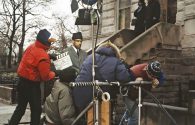




“Don’t Mourn, Organize” greeted viewers to American Job: 1940–2011, a recently closed exhibition of historical 20th-century labor photos at the International Center of Photography. This wall text, a quote from activist and posthumous folk hero Joe Hill, set the stage for a meticulous exhibition, curated by Makeda Best, of photographs documenting labor and activist struggles from the 1940s through the 2000s. The slogan is unattributed in the text, but it’s a known labor cry, adapted from Hill’s final words before he was executed for the murder of a police officer, despite the dubious evidence presented at his trial. It speaks to both the spirit of the exhibition and to the allure for many of the photographers themselves of documenting labor struggles and acts of righteous disobedience.
Artists in the exhibition range from the renowned, such as Robert Frank, to lesser-knowns like Bill Wood. Some names have been lost altogether, simply listed as “unknown photographer.” What emerges while viewing these works is that, as in all things, struggle too has form, beauty, and versions of truth. Thus highlighting the job of the photographer. Thus highlighting the job of the curator, too, in combing through archives, seeking chemistry, organizing.
Organize: To cohere, unify, to integrate or create order.
We do this to make sense of the world while in various ways attempting to align it to our values. To shape the world, we organize the exterior world from without. It can also be said that one organizes from within, to shape the self.
After seeing American Job, I left ICP wondering, What does it mean to organize? In society, and in art. As luck would have it, three additional exhibitions allowed me to pursue this question, in which personal and societal friction get processed in tandem. In these exhibitions, the shaping of the self gets interwoven with shapes of the world, and, in so doing, asks an implicit question: How can the world be reimagined? Reshaped?
Organizing Freedom. Or a Version Thereof.
In American Job, what was frequently depicted was the “job” of organizing — citizens pursuing human dignity and trying to improve their sense of freedom. The photographs serve as a timely reflection of an era when labor made gains, expanding the middle class while overlapping with civil rights and women’s struggles. Although veiled by the documentary aesthetics of black and white photography, these depictions of workers mobilizing throughout the 20th century need not feel dusty or distant. With labor reforming after decades of regression, these images might serve as vessels of trans-era solidarity, where, fast-forwarding to now, radical challenges to capitalist excesses are having a renaissance, even if they are sure to encounter fierce resistance and are perhaps likely to eventually become tamer and more diluted.

The outcomes of America’s labor struggle have too often been modest, where just enough freedom suffices. This attitude is embodied in what the International Labor Organization (ILO) calls “decent work,” things like fair pay and workplace safety. We further see this in the demands for a “living” wage versus a “thriving” wage. When employers deny human dignity, workers often adopt the modes and aesthetics of revolution (organizing and protest) to ultimately achieve modest gains. The irony is that if this hard-fought battle for modest gains is successful, it actually benefits capitalism long-term, not only by creating a stronger economy but also by preventing a revolution from ever occurring. Despite FDR having become America’s socialist bogeyman for the political right and the corporatist class in this country, Roosevelt’s New Deal can accurately be viewed as his successful attempt to preserve capitalism and to prevent a socialist revolution in America in the wake of the Great Depression.
It’s accurate to say that the inflamed culture-war backlash America is experiencing today has always been inextricably linked to multiculturalism’s rise, backlash being built into all social progress.
This pattern of workers achieving modest gains while never achieving novel freedom (relational as well as personal) is either just how the world goes, or it is something to be endlessly pursued. Hannah Arendt examined the framework of human thriving by way of organizing individual efforts culminating in the efficacy of communal politics. Arendt offers us a hierarchy of sorts for how to view the interwoven relationship between labor, work, and action, where “action,” being at the top of the hierarchy, leads to the fundamental organizing of our world through human interaction and politics (i.e., our ability to shape society). Action further leads to the unexpected, the new, and is the way we achieve durable change. For Arendt, this ability to act, to achieve action, defines our access to freedom.

In her 1958 book, The Human Condition, Hannah Arendt offered her hierarchy of human endeavor: labor, which she characterizes as being directed at basic biological necessities of maintaining one’s existence and reproducing the species, therefore providing the least freedom; work, or the completion of some lasting project that provides some freedom; and, at the highest point, action, through which an individual’s ability to conduct autonomous, consequential activities produces the most freedom. These efforts conflict with the goals of the employer/capitalist, who seeks to convince employees that they do good work while preventing them from ever achieving real action.
Jesse Krimes’s Corrections, at the Metropolitan Museum of Art (closed July 13), featured work the artist made while in prison on a drug charge. Krimes’s work embodies all three of Arendt’s descriptions of human activity, making a material argument for how the artist did — and how the viewer might — contemplate freedom. One body of work, Purgatory (2009), consists of prison-issue bar soaps carved into smaller substrates displaying ghostly portraits. These portraits are mugshots that Krimes found in newspapers, which he transferred onto the soaps. Krimes also applied the images of public figures, such as Colin Powell, Gene Simmons, and Hugh Grant, similarly lifted from print publications, onto the soaps, allowing viewers to draw their own conclusions as to the pairings. As a tidy conceptualist, Krimes provides initial mystery and opacity before a rather direct explanation of the work’s intent and process is revealed, via the wall text. It’s no surprise, then, that material always has some poignant meaning: soap as “purifying surface,” in Krimes’s own words, when describing Purgatory. In his large-scale mixed-media collage Apokaluptein:16389067, which uses prison bedsheets to depict a panoramic landscape of images transferred from The New York Times overlaid with hand-drawn elements such as small nude female figures in dance-like poses, the landscape is a sprawling depiction of heaven, earth, and hell. Krimes’s use of New York Times articles (from 2010 to 2013) and accompanying images from those articles, as well as ads, creates a collage within a collage (worth inspecting up close). The use of the Times as a kaleidoscopic tapestry for how our culture is organized is rather apt. Here, the Times functions as an irrefutable but suspect authority for how the world is to be perceived and organized, where facts, lies, damned lies, beauty, horror, capitalism, and good taste collide.

The works in this exhibition harbor delicate, corrupted surfaces that remind us of our tenuous and muted ability to fully know human incarceration and its costs. If the “system” is corrupted, then perhaps so are we. To make this human cost even more pronounced, Krimes and Met curator Lisa Sutcliffe juxtapose the “works” of Alphonse Bertillon alongside Krimes’s Purgatory. Bertillon was a French police officer and criminologist who innovated documentary and photographic techniques to catalogue criminals in the 19th century. He is credited with codifying the modern mugshot, along with other techniques that helped law enforcement organize suspects and offenders into the state’s registry.
Bertillon’s use of photography embodies the devil’s bargain of modern technology: dehumanized efficiency. His service to a larger project invokes 20th-century writer/philosopher Lewis Mumford’s coining of “megamachines” — exploitative, human-sustained complexes of power and technology. Mumford applied his concept to ancient Egyptian pyramid building, as well as to modern world-shaping bureaucracies like the Pentagon. Bertillon’s obsession with reducing recidivism through criminal-management innovations would eventually assist the carceral state in becoming its own megamachine, none more perfected than America’s prison-industrial complex.
The modern carceral machine’s inevitable dehumanization and frequent injustice is foretold in Bertillon’s Mugshots of Suspected Anarchists, from French Police Files (1891–95), a display case of dozens of small photographs of “artists, journalists, printers … whom the French government had accused of antagonism against the state. Some were arrested for protesting for regular work hours or improved conditions for the oppressed.…” We can easily view these social disruptors in the same sympathetic, monochromed light of the labor and activist figures seen in ICP’s American Job, endangering their bodies or livelihoods for freedom-seeking, collectivist causes, and organizing for radical — or simply reasonable — change.
Bertillon’s indexed mugshots of alleged criminals exhibited side by side with Krimes’s artful, incarcerated “mugshots” is a powerful move, juxtaposing two impassioned organizers from opposite ends of the megamachine. This pairing was already on point 15 years ago, when Krimes’s work was first made, but the specter of those leftist, socialist agitators populating many of Bertillon’s mugshots looms even larger in our current Trump 2.0 moment, when even centrist, corporate Democrats are referred to as “radical left lunatics,” threatened with incarceration, and even arrested for mild protest, while democratic cities are being targeted for severe punishment. God help the real radicals.
If Bertillon was organizing images and details of human beings into a system of punishment and supervision, Krimes’s Purgatory organizes his time in punishment not into supervision but, like any good art, a kind of “super seeing.” Conceptions of the personal and collective past, present, future, and all connecting absurdities therein are reconciled through cognitive and physical acts of enthralled assembling and defiant creation. If we are to experience this exhibition through the lens of process, contemplating the conditions (imprisonment) in which most of the work was created, we might be reminded of Bruce Nauman’s series of video performances in the studio, which have the artist “trapped” in a Beckettian time loop, compulsively organizing time and human productivity into a captivating but perhaps horrific simulation of freedom. The longer that notion existentially sticks, the more it helps the work. But, with further shades of Nauman, there is of course a path to freedom, through that oh-so-lonely simulation — because, quite simply, Krimes too has received a relatively large audience, the ability to be seen and heard. The ability to get some real action.
Organizing To See (and Be Seen).
One’s efforts to organize lead to questions of visibility, when asking, What shall be seen? What does the self wish to see … or obscure? This includes visibility of the self. Is there a desire to be seen by others? And which others? Others like me, and/or … other others? In Magazine Fever: Gen X Asian American Periodicals, curator Herb Tam makes visible a chapter of lesser-known American media history that takes on this question of the who, what, and how of “representation,” as it relates to Asian American visibility. The exhibition, at the Museum of Chinese in America (MOCA), surveys magazine publications revolving around Asian American perspectives, primarily from the 1980s through the 2000s. While this is the core of the exhibition, historical precursors from the ’60s and ’70s are also on display (along with a room showcasing three contemporary Asian-led magazines). The earliest periodicals include publications such as Gidra, a UCLA student newspaper (1969–74), and Getting Together, a Marxist newspaper established in New York’s Chinatown (1970). Both had community and activism in their lifeblood. Magazine Fever is an insightfully researched, linear jaunt through a narrow but fascinating lane of American media history, documenting a community’s sustained effort to organize itself, making itself seen through periodicals and printed media.
After the fire does its terrible thing, and when the work of progress continues, we can still look at pictures from the past to remind us of a history and a legacy that has led to sane American social structuring (through “resistance”).
The exhibition smartly and accurately frames these Gen X periodicals as symbiotically tied to the ascendant multiculturalism of the ’90s. Upon viewing, two beats are felt: The first, how a community with just enough gumption and freedom finds its voice through media; the second, the future-forward, wishcasted idea that multiculturalism had perhaps finally found a permanent and safe place in America.

The show highlights multiculturalism as an era-defining social theory, while also noting its backlash, where multiculturalism becomes a “battleground for the decade’s culture wars.…” It’s accurate to say that the inflamed culture-war backlash America is experiencing today has always been inextricably linked to multiculturalism’s rise, backlash being built into all social progress. But what’s poignant about seeing this past era through a glossy, multicolored lens is that, despite any backlash, the dominant culture uplifting this project was in fact “winning.” To that end, the more radical periodicals that are included from the ’60s and ’70s — where popular representation wasn’t a given — pave the way for the later, perhaps less radical periodicals of the ’80s through the 2000s to function as something entertaining and culturally safe or vetted, just like any shiny mag on a public newsstand. Here, venturesome, irreverent, but still largely optimistic Gen X attitudes could be harnessed. The first issue of Yolk magazine, in 1994, had cover lines, next to a Shiva-like Margaret Cho, that read “Buzz Off!! An Asian American Woman’s Response To ‘Rice Lovers’” and “Asian American men & their meat — Need We Say More?”
Presumably, these periodicals found an audience and helped undermine stereotypes while creating greater visibility of Asian Americans. How much visibility and in what manner is a question the exhibition encourages us to ask. It’s also impossible not to view these periodicals celebrating otherness, while appealing to the norms of the majority (glossy-magazine style), as time capsules of what is now a severely wounded project. In 2025, MAGA’s war on DEI and anything “woke” is also a war on multiculturalism — a battle many Gen Xers considered decisively won. At the time of this writing, “multicultural” is now one of the banned words within federal agencies.
The irony of Gen X’s oft-cited relationship to cynicism and irony is that it was earnestly invested in new forms and world-building beyond pastiche, even if the era was prone to conceding pastiche as something unavoidable — fine, even. Its cultural instincts, which blended post-civil-rights progress with countercultural cool, were what generated its power. So it’s no surprise that these magazines, as emblems of their time, promoted some ironic Edenic posturing while earnestly hoping for the best. Whatever the spirit of that particular age is called, and whatever its missteps or goofs may have been, when we see it grouped together (like magazine covers on a wall) against the vexing backdrop of our current age, it’s not a bad look at all.
Organizing Rhythm (and Rhuthmos).
Personally, I’m not a fan of sheet music. Its ability to code sound onto a flat plane (like paper) is an amazing human invention, and yet it is inherently stultifying. Admittedly, this reaction is entirely a “me” problem, likely due to being a self-taught melody maker who can’t read or write this language. The horizontal lines of sheet music, the staff, unnerve like an electric fence, dividing me from a pasture I can never reach. Sad.
I contemplated staff lines and “me” problems while viewing Christine Sun Kim: All Day All Night, at the Whitney Museum, curated by Jennie Goldstein. Kim’s large-scale mural of meandering staff lines with dislodged notes greets viewers to the sixth-floor gallery, prompting further inspection of “me” problems within the context of Kim’s art-filled interrogations of the world as a deaf person. This decade-plus survey of Kim’s multidisciplinary practice (video, sculpture, drawings, installation) mixes styles and modes of conceptual art with the wit of a comedian, the wonder-filled angst of an indie graphic novelist, and the scrawlings of a daydreaming employee doing hell-work in a data center.

The exhibition exudes a rhythm that becomes evident in the flow and musicality of its groupings and pacing: a rhythm of thought and inquiry, and of execution. A room of sparsely scrawled black and white drawings here, the undulating staff lines with dislodged notes over there, will soon lead one to the “Trauma Room,” where the artist uses infographics to organize her experiences, gripes, and rage (e.g., “Degrees of Deaf Rage”) into pointed and humorous pie charts. The graphics report the totality of Kim’s experience on a topic where experiences are organized into occurrences and frequency, and/or proportional impact for Kim. Drawings scrawled with the titles “SHIT HEARING PEOPLE SAY TO ME” and “WHEN I PLAY THE DEAF CARD” allow “hearing people” to analyze, consider, and imagine, if not strain to comprehend, what the world must be like for her, for deaf people — legibly conveyed (smudges and all) through drawings on paper.
Sound itself isn’t just evoked as a kind of ontology of absence but rather as a dynamic, fluid substance. Art substance, philosophical substance, life substance — that which Kim’s analytical, emotional, and artistic selves clearly invested much into understanding. While Kim uses audible sound in pieces such as One Week of Lullabies for Roux (2018) or A String of Echo Traps (2022), it’s the persistent idea of sound as a multimodal substance that helps craft a musicality of inquiry and rhythm throughout the exhibition. The murals depicting staff lines point to this idea, as does her play on “echoes” in crafting works that embody her experience with the way language travels, through various forms and persons, through translation and American Sign Language (ASL), along with metaphorical ideas about echoes in society.
It’s an interesting vision, one that bridges concepts of the process of communication present in both A String of Echo Traps (depicting an animated echo trapped in a suspended cube) and the third-floor gallery installation of “Echo” drawings and wall murals, where the echo takes on a visually rhythmic notion inspired by how an echo bounces off objects (evoking the ASL sign of sound bouncing off a surface) with repetitive peaking waveforms. While the visualization of rhythm as repeating waves is clear and rather familiar, there’s also an alternative way to view this sense of rhythm.
We initially register this work and this idea through the post-Socratic definition of “rhythm,” which describes things with orderly structures and repeated intervals, like music and dance. Or waves to a shore. However, we should also consider the pre-Socratic meaning of “rhythm,” whose Greek origins, “rhuthmos,” isn’t just an alternative definition but embodies a different way of understanding experience itself. Rhuthmos, as linguist Emile Benveniste discovered in the 20th century, instead describes the fleeting phenomenon of dynamic things in a world where our perception of those things translates them into a “shape” rather than a fixed “form.” This shape, best described as a representative pattern of a moment, rather than a totality, captures the dynamic thing or occurrence (like moving water) as an essence and phenomenon that is by nature and by definition (in rhuthmos terms) fleeting, temporary, impermanent. And this sensitivity to time, the thing’s impermanence or fungibility, is core to our understanding of that thing’s character and resonance.

Kim’s echoes capture the aesthetics of the more familiar post-Socratic intervalled rhythm, like a repeating waveform. But this, like the exhibition itself, also inhabits the spirit of rhuthmos, which seeks to give shape to impermanent phenomena that, yes, recur, but are never fixed and always changing. Like language itself, rhuthmos is consistently open to interpretation, and even reinvention. To a non-ASL speaker like me, watching ASL communication is almost like watching language being physically reinvented before my eyes, with all of its fluidity and expression. And in rhuthmos terms, I wonder how I might choose or depict the “shape” of ASL, or, more pointedly, the shape of what I’m experiencing when I watch ASL.
In All Day All Night, Kim’s wondering about how to make sense of sound, music, and language is its own symphony of wonderance (occurring “all day all night” for the artist), in which experience — her personal experience and also invoking one shared by the ASL community — is organized into rhuthmos-ic patterns of expression. There’s an implied, necessary hustle with the wrangling of this pattern, which both Kim’s work and the public persona of the artist embody. In all of it, there’s an influx energy, but the patterns are clear. Consider again Kim’s large-scale murals adorning the walls of institutions like the Whitney, which impose both physical dominance and impermanence, encapsulating big, big shapes of a moving world punctuated by violence, noise, separation, and silence, all happening in recurring but unfixed motions.
Organizing Resistance (and Reimagination).
In addition to concepts of “organizing,” these four shows share another curatorial thread: notions of societal justice, promoting human solidarity, and de-othering. These things bear the stamp of good educational, liberal values. I don’t always want or need this in my art, but I root for it when it’s done well and with purpose, as it is in these exhibitions. Despite the trials of so-called “identity politics” or “social justice” being championed within the arts, lowercase “L” liberal institutions have often supported what were safely viewed as modern humanist principles, or have at least paid lip service to such principles. This modern project has validated our shared sense of being good cosmopolitan pluralists of the post-war, post-civil-rights era — less corrupted, we once believed, by the ignorance of the past. This, after all, was adjacent to “the left” “winning” the culture wars.
Which then feeds into the rise of the anti-woke backlash.
In our post-woke era, when the pendulum is swinging wildly, we will need to rely on our institutions more than ever to hold the line on these values, which includes, at a minimum, that aforementioned lip service. Here’s my bland, edgy plea: that even the vapid versions of upholding humanist “institutional values,” the aesthetics of pluralism — deservedly panned for its sometimes cynical, opportunistic hypocrisy — will still play a role. In other words, the Obama-era version of social justice and equity, filled with mixed results and cringe-inducing “woke capitalism,” is now the boring-as-hell bare minimum. Yes, I want my Target stores selling me rainbow-flag boxer shorts like it’s not a problem. Yes, I want Amy Sherald, an artist whose work I’m not personally invested in, to someday have her now canceled exhibition at the Smithsonian intact and triumphantly displaying her painting Trans Forming Liberty (2024). Thus, humanizing perceived “others” will still be a value to assert — a line that should be held — even if the shape of such assertions must rightly evolve; even if my own politics rejects identity politics when it’s (too often) at the expense of class consciousness and solidarity.
To allow this messy but necessary untangling to occur, we must first demand that our cultural institutions not become hostile to, or bullied into abandoning, these pluralistic values — that is, liberal humanist values writ large — as fascist-induced fear spreads like wildfire. This applies to institutions such as universities, media organizations, and art museums.
But after the fire does its terrible thing, and when the work of progress continues, we can still look at pictures from the past, like the ones in American Job, or images of student protests in the ’60s, or what comes out of the 2020s, to remind us of a history and a legacy that has led to sane American social structuring (through “resistance”), something akin to Hannah Arendt’s “action” and freedom-seeking, where class solidarity and anti-war convictions are just as identity-forming and reality-shaping as our current culture-war-inflected in-group/out-group obsessions. And may it then surpass the Gen X-cum-Obama era of symbolic but often naive progress suffocated by layers of class and power-blind neoliberal orthodoxy, or whatever’s even worse than that. Fascism is one thing, but if these corrupt and discredited world-shaping orthodoxies remain in place, while still determining how our institutions function, it will severely compromise an art institution’s, media organization’s, or university’s ability to tell complicated — and even simple — truths. And in that new era, the ability to tell those truths must be nonnegotiable.
In this not-so-distant future, when, aspirationally, we are recovering from Trump 2.0 and crimes of genocide, let’s hope that our institutions can indeed sort themselves out (and let’s help them do so) when it comes to matters of history, conflict, and “social justice” — where “justice,” in a post-Obama-Biden-Trump world means that we, and our institutions, can solemnly organize weighty things to provocatively educate/entertain when examining aesthetics, class, wealth, atrocity, and power. Let them be free to tackle all of it, and not just some of it. After all, these things, some inconvenient, some still forbidden, will have rhuthmos — phenomena waiting to be made imperfectly visible — by skillfully organizing them into brand new shapes. Shapes that I can only imagine we won’t soon forget. ❖
Magazine Fever: Gen X Asian American Periodicals
The Museum of Chinese in America
215 Centre Street
Through August 31
Christine Sun Kim: All Day All Night
Whitney Museum of American Art
Through September 21
Jason Tomme is an NYC-based artist and co-founder of Black Ball Projects, and has written about things like lawn mowing in his self-published book, Groundskeeper, and about Robert Irwin for the Chinati Foundation newsletter.
