



In 1998, a London-to-Broadway revival of Cabaret — with Alan Cumming as the slithering Emcee and Natasha Richardson as the decadently vulnerable chanteuse Sally Bowles — made things seedier and sexier than the ’66 Broadway original, with lots more ripped stockings and bisexuality than before. That earlier show, with a score by John Kander and Fred Ebb and book by Joe Masteroff, was based on the 1951 play I Am A Camera, by John Van Druten which in turn was based on the 1945 collection The Berlin Stories, by Christopher Isherwood. The tale is well-known, particularly from the Oscar-winning 1972 Bob Fosse–directed movie version, which whittled down the older characters and made Weimar Germany dazzlingly hollow and darkly seductive. The ’98 retread kept the mature characters but amped up the crotch-bumping all around them, and proved to be perfect for the new Times Square, where the porn was being squeezed out by then-mayor Rudy Giuliani but for big money, you could get your rocks off via a leering Broadway show.
So how does the newest London-to-Broadway revival — called Cabaret at the Kit Kat Club — make things fresh and relevant all over again? For one thing, the August Wilson Theatre has been reconfigured so it’s a theater in the round, with a circular, at times spinning stage showcasing the action both at the Kit Kat Club and at offstage locales. What’s more, they’ve added a bustling pre-show that starts 75 minutes before curtain time. Have you ever fantasized about going nightclubbing in Weimar Germany as the Nazis were rising up? Well, lucky you! Pre-showtime, ticket holders are free to roam up and down three levels of the theater and witness dancers and musicians performing to music by British-based composter Angus MacRae. Everywhere you turn, you spot them playing a violin, accordion, bass, and a klezmer clarinet, as dancers with white-pancaked faces adopt suggestive poses and German expressionist attitudes.
In the press materials, director Rebecca Frecknall explains, “We wanted to subvert an audience’s idea of what it is to go to a Broadway musical, and create a club space that’s surprising, arresting, and alive from the moment you enter.” Choreographer Julia Cheng adds, “The Prologue comes from a place of empowerment and celebrating differences: artistic expression, gender, body shape, race, and ethnicity. It is ‘anti-status quo.’”
Also worth noting is the official statement in the same materials: “Patrons can upgrade their experience at the Kit Kat Club with exclusive dining or drinks packages that allow them to soak up the pre-show atmosphere.” As one of the Emcee’s big songs goes, “A mark, a yen, a buck or a pound … Is all that makes the world go around.” Lol.
I wasn’t quite sure what to make of Rankin’s performance, but I realized that deeply disliking her at first, then coming to feel for her, is probably exactly how one should react to Sally.
And then comes the show itself, which hasn’t upped the sexuality quotient, though it has definitely underlined what’s over the top. Everything that was extreme in previous productions is now even more so. As the Emcee of the Kit Kat Club, Oscar and Tony winner Eddie Redmayne has to separate himself from two legends (Joel Grey and Alan Cumming); he does so with exaggerated hand gestures and head bobbing and with vocal tics that sometimes resemble those of Jerry Lewis. Redmayne sings the show’s signature tune, “Willkommen,” in brown leather culottes, long black gloves, and a bright-blue party hat (costumes by Tom Scutt, who also did the sets), and seems to have veered outside the normal human range, going instead for a Cirque du Soleil meets demented puppet effect that’s often weird for weird’s sake. Each time Redmayne appears, the costumes grow more outlandish, though vocally his best moment is when his Emcee is dressed conservatively as a Master Race type, standing still and smoothly singing the Nazi anthem “Tomorrow Belongs to Me” to creepy effect. A succession of miniature wooden Redmayne dolls in the same garb (puppets of the puppet, as it were) appear on the edges of the rotating stage as he sings, foreshadowing the moment later in the show when the entire cast storms the stage, suited and looking like fascists.
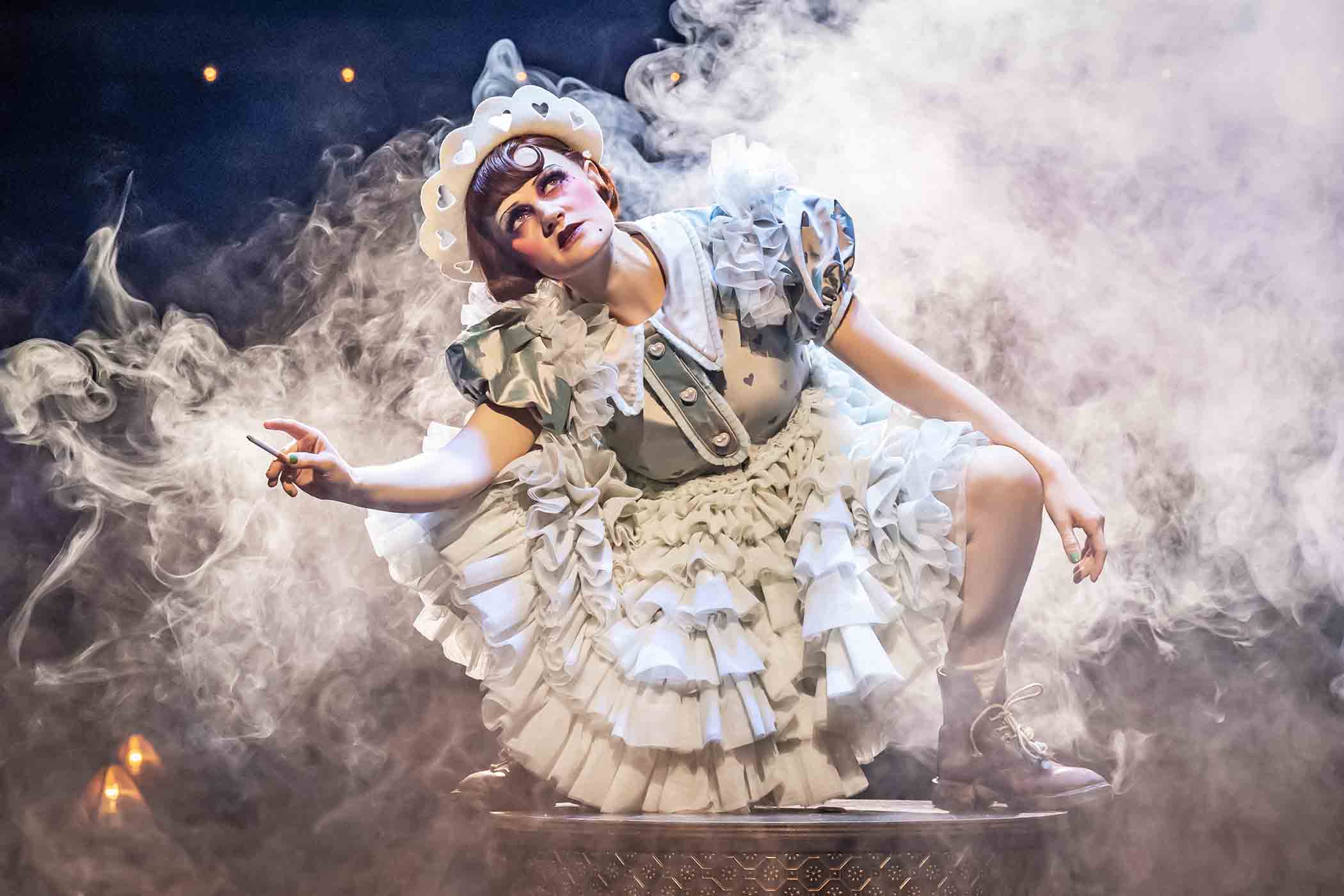
Similarly, the house singer, Sally Bowles (Gayle Rankin, who played smaller parts in the 2014 revival), shrieks her way through dialogue and her first few songs, though by the time she’s singing “Maybe This Time” — “Well, all the odds are in my favor / Something’s bound to begin” — she’s calmed down and become extremely affecting; maybe she’s just exhausted. I wasn’t quite sure what to make of Rankin’s performance, but I realized that deeply disliking her at first, then coming to feel for her, is probably exactly how one should react to Sally. As Rankin plays her, she’s a brash, unapologetic, damaged, and self-sabotaging diva who’s always demanding attention, then not knowing what to do with it. Another reason her “Maybe This Time” works is that director Frecknall has Rankin sing it directly to her paramour — the Isherwood character, writer Cliff Bradshaw (Ato Blankson-Wood) — not to the Kit Kat audience, as it’s always been done. But by the time the title song climatically comes around, near the very end of the show, Rankin is screaming again, though it’s more artfully done and better earned, considering the way this Sally seems determined to wreck her life and live (or die) in denial. At this point, it seems that messy Sally, who’s just been brought back as the club’s entertainment, is determined to get fired again.
Meanwhile, the older couple — realistic boarding-house landlady Fraulein Schneider (Bebe Neuwirth) and her Jewish suitor, fruit vendor Herr Schultz (Steven Skybell) — always feel like they’re in another universe than the nightclub characters, grounded as they are in decency and common sense. Schultz gives her a pineapple as a gift and proposes marriage. Schneider — who’s always managed to take care of herself and survive — ultimately begs off, because the idea of marriage to a Jew is becoming increasingly problematic. Neuwirth and Skybell are wonderful as the doomed duo — a parallel to Cliff and Sally, who can’t click for different reasons. (Sally simply knows that she won’t be able to stay committed, even though Cliff is the first person she’s truly loved. And she’s already betrayed his trust in a devastating way.)
The Kit Kat dancers are a vividly diverse bunch (“Each and every one a virgin,” swears the Emcee), and they even work the crowd during the Entr’acte, where I caught them dancing the Bunny Hop onstage and encouraging audience members to do “the wave”! Would we next be passing around a beach ball?
In any case, this Cabaret doesn’t always trust the material, but there are also times when it breathes life into the show, becoming powerful as its “go for broke” approach increasingly hits the jackpot. Please buy drinks! ❖
Cabaret at the Kit Kat Club
August Wilson Theatre
245 W 52nd Street
Michael Musto has written for the Voice since 1984, best known for his outspoken column “La Dolce Musto.” He has penned four books and is streaming in docs on Netflix, Hulu, Vice, and Showtime.