





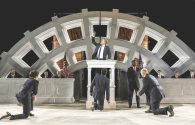

A Republican demagogue wrecking lives via fearmongering and distortion is certainly a topical theme, as proven by Good Night, and Good Luck, a new play by George Clooney and Grant Heslov based on the 2005 Clooney-directed film by the same duo. That it also deals with a power figure who effectively fights back against the tyrant and gets him dethroned is perhaps what makes it seem novel in the dire political landscape of 2025, Cory Booker and various judges and DAs notwithstanding.
In the award-winning black and white film, David Strathairn played Edward R. Murrow, the fearless broadcast journalist whose TV news show, See It Now, made waves by critiquing “commie”-baiting Wisconsin senator Joseph McCarthy in the 1950s. Murrow dared to opine that it was McCarthy and his hyped-up “Red scare” that was proving a way worse threat to democracy than the left-wingers he was so rabidly targeting. He believed that McCarthy had crossed the line from investigation to flat-out persecution, and had wrongly confused dissent with disloyalty. The senator also seemed to have become a little too fond of presuming guilt any time he heard murmurs.
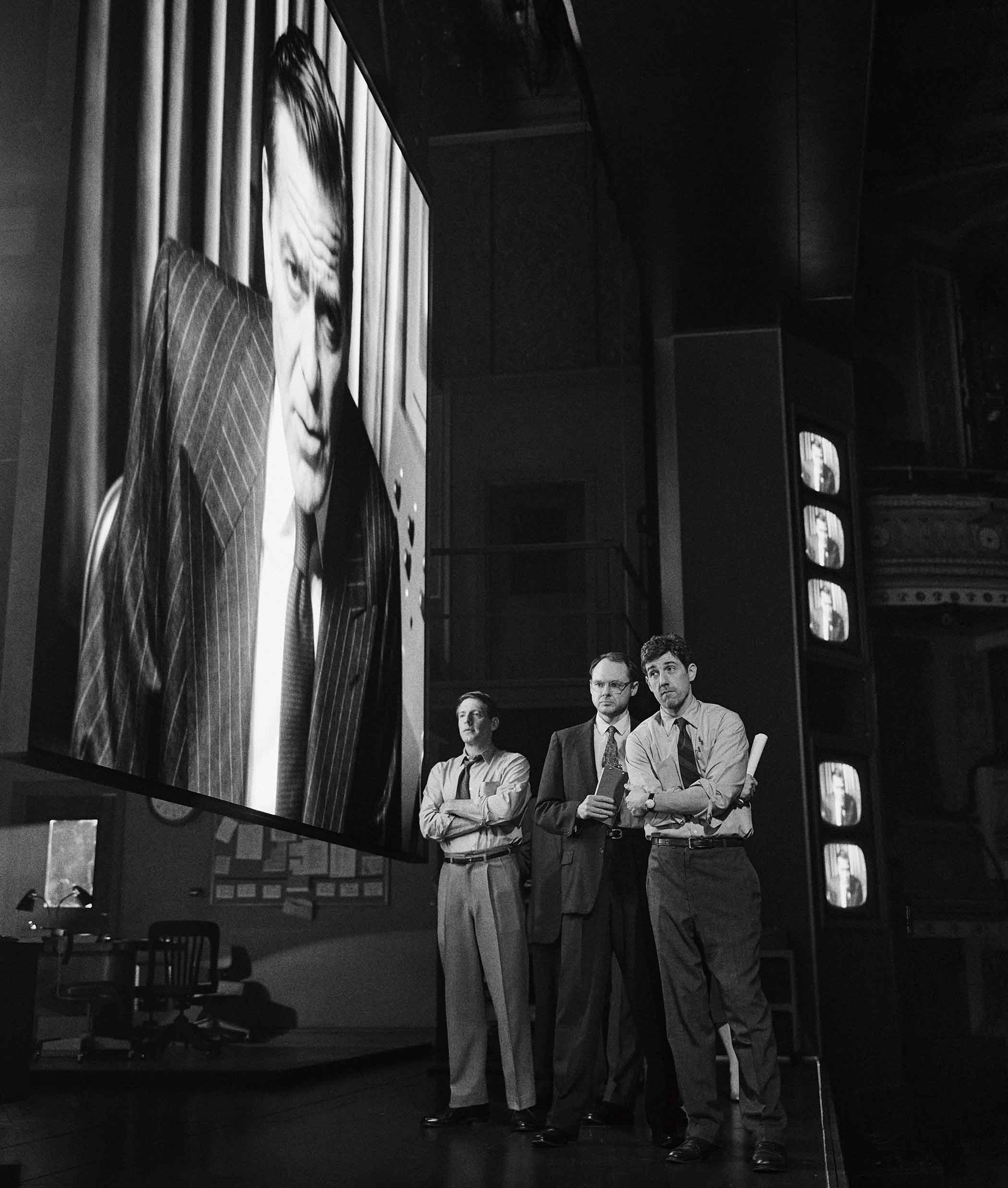
In the movie, Clooney — who portrayed Murrow’s co-producer, Fred W. Friendly — used actual footage of McCarthy, in all of his snarling faux patriotism, rather than cast someone in the role. It was a potent choice. No actor could have approximated the cringe level inherent in the unflappable senator, especially as he responded to Murrow’s attacks by claiming that Murrow himself was a Communist. (Murrow wasn’t surprised that McCarthy went that low, and vehemently denied the charge.)
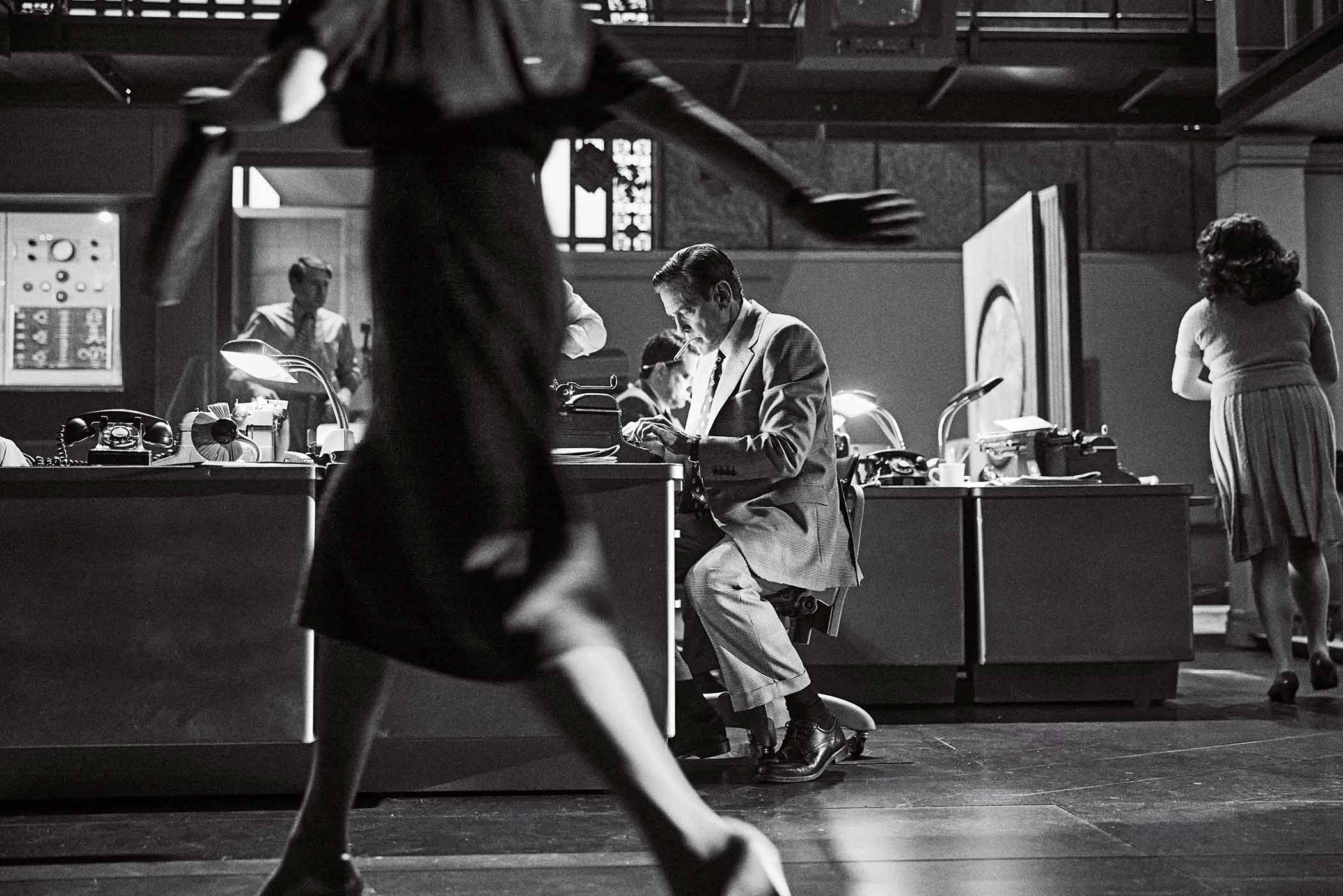
The play also represents McCarthy only in creepy newsreel footage. And Clooney, making his Broadway debut, now tackles the central part — Murrow — leaving the directing chores to theater favorite David Cromer (The Band’s Visit, Dead Outlaw). The newsroom ambience onstage is truly from another era — cigarette-smoking journalists whose main concern is to honestly report news, and whose constant bantering is an appealing means of getting through the difficult work at hand. The most trusted man in America at the time was “Uncle Miltie” — outrageous comic Milton Berle (which is interesting, since his most common shtick was wearing a dress and acting girly!). Meanwhile, the shirt-and-tie-sporting Murrow was gaining mass trust by speaking with a righteous intelligence, drawing upon moral character and even quoting Shakespeare when need be. (From Julius Caesar: “The fault, dear Brutus, is not in our stars, but in ourselves.”)
The main star of the show, it turns out, is the set, by Tony-winner Scott Pask, a period-flavored marvel.
Murrow’s sense of realness is underlined by a funny sequence in which he interviews glitzy, closeted pianist Liberace, and the jewel-encrusted musician natters on about his love for “young ladies.” When the interview is over, Clooney’s Murrow looks amusingly on the verge of rolling his eyes like pinballs.
Murrow ultimately loses a sponsor (hard-hitting news was giving way to quiz shows), and as a result CBS reduced him to only five remaining newscasts, on Sunday afternoons. CBS President Wiliam F. Paley had an aversion to Murrow’s penchant for playing with fire. But Murrow had already kicked McCarthyism in the crotch, and was an integral figure for basically saying “Good night, and good luck” — his parting on-air phrase — to the tyrant’s campaign of hate.
The play ends with a video montage dotted with right-wing extremist acts that have happened since that era, encompassing conspiracy theories, a neo-Nazi salute, and other MAGA madness … heavy-handed parallels that bring us to today’s arena, though the gasping audience seems to appreciate the reminder that McCarthyism never really went away. And yet we could have drawn the connections without such help. It’s quite evident that McCarthy ruined lives without due process — simply with smears and innuendo — and similarly, Trump has been accused of having immigrants deported and even jailed without any semblance of following established rules of law. In another very “now” moment, Don Hollenbeck, a CBS newsman in the play, comments at the time on the witch-hunting burnout that had crippled everyday discourse. “I wake up in the morning and I don’t recognize anything,” he admits wearily. “I feel like I went to sleep three years ago … as if all the reasonable people took a plane to Europe and left us behind.” The audience laughs with a chilly recognition. Hollenbeck — called a “pinko” by McCarthy-supporting columnist Jack O’Brian — ends up taking his own life, as he did in reality, in 1954.
And Clooney? If Murrow was a screamer, Bryan Cranston would no doubt have gotten the part, and been riveting. Instead, the newsman was someone who boiled under his skin but never went over the top. He was earnest, droning, and rather dry, succeeding based on his clipped speech and lack of hyperbole. Clooney is fine in the role, though it’s hard to dazzlingly play someone who’s so right so much of the time. Murrow was so self-effacing (and fair), he even offered McCarthy a See It Now episode where he could rebut the newsman’s attacks. The senator accepted the challenge but failed to save his ass; censure by the Senate followed in December 1954.
The main star of the show, it turns out, is the set, by Tony-winner Scott Pask, a period-flavored marvel. At center is the sprawling newsroom; on the right side is a conference room, topped with a recording studio, where a singer named Ella (Georgia Heers, sounding like Sarah Vaughan) is recording lilting melodies such as “When I Fall in Love” and “I’ve Got My Eye On You.” (The lilt dramatically contrasts with the traumatizing news events that consumers saw reported on the small screen day and night. The 1950s were a schizo time to be a consumer, fraught with the Korean War, the Cold War, Elvis’s pelvis, and elevator jazz.) Rows of old-style TV screens pop up, one row on either side of the stage, with Murrow and/or McCarthy dominating each screen. Contributing to the detail-perfect representation, Pask, Heather Gilbert (lighting), David Bengali (video/projections), Daniel Kluger (sound), and Brenda Abbandandolo (costumes) all turn in stellar work.
But if we want to be dramatically brought to the present by more than just parallels to the past, I’m not being facetious when I say that I’d love to see a play about Clooney himself. It would specifically be about the actor/director/activist having been so instrumental in getting Joe Biden to step down as a candidate last year, because he had allegedly become doddering. The resentment, excitement, and horror that followed would make for a priceless American thriller. ❖
Good Night, and Good Luck
Winter Garden Theatre
1634 Broadway
Michael Musto has written for the Voice since 1984, best known for his outspoken column “La Dolce Musto.” He has penned four books and is streaming in docs on Netflix, Hulu, Vice, and Showtime.
