






Eva Perón meets Rosemary Woodhouse somewhere in Iowa? That’s campy shorthand for saying that triple-Tony-winner Patti LuPone (Evita, Gypsy, Company) costars with cinema luminary Mia Farrow (from Rosemary’s Baby and — dare I say it? — 13 Woody Allen films) in The Roommate, an intermission-less, 100-minute comedy about mature-chick bonding. It’s basically a one-act play about second acts.
At a time when we may be on the verge of electing the first female president, female empowerment is already prevalent on Broadway, as in Suffs (the all-woman musical about the suffrage movement) and Hell’s Kitchen (about an NYC’s girl coming of age, thanks to female mentors).
But in Jen Silverman’s The Roommate, the bonding has a dark edge, dabbling in the dangerous lure of bad behavior. (“There’s a great liberty in being bad!” the main character tells us right before the curtain comes down. As if I didn’t know.)
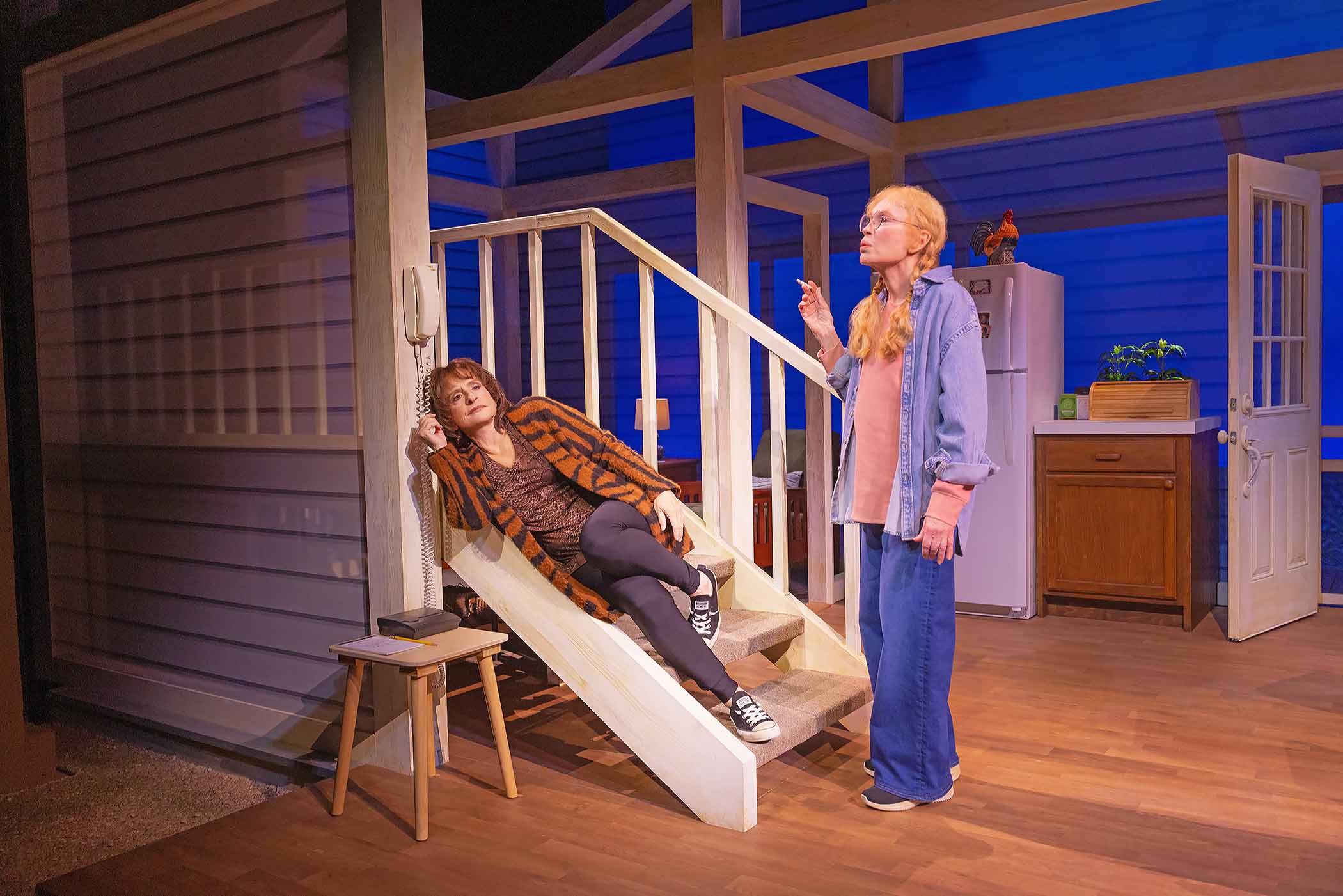
Fortunately, the two-character play — while no classic — is not bad. Bob Crowley’s set consists of the furnished frame of an Iowa house, which allows you to see a sweeping blue sky between the wood beams; the expanse visible from the house makes it clear that there’s a world of opportunity out there. The house belongs to Sharon (Mia Farrow), a perky innocent in a flannel shirt, granny glasses, and blond pigtails, who has “retired” from her marriage, though hubby actually retired first. She admits that she’s not a very good mother to her son — a straight decorator, though his friends are gay, including his girlfriend. A recurring theme concerns sexuality labels and how they aren’t always adequate. “Are you … a bisexual?” wide-eyed Sharon asks her new roommate, Robyn — played by LuPone. “No,” says Robyn, matter-of-factly. “I’m just saying people find specific words for themselves because it’s easier than not having words…. But it doesn’t mean those words are all accurate all the time.”)
Mia Farrow has become better known, to those under 60, as a tabloid regular than as an actor, but the fact is she’s always been magnetically translucent.
The sardonic Robyn uses labels herself, though. She’s a Bronx lesbian and vegan, all no-nonsense in a bomber jacket and shades. Robyn has been a slam poet, a potter, and a tambourine player, but she seems more interested in cultivating and taking medicinal herbs. (“Herbs only become drugs when a capitalist economy gets involved,” she declares to Sharon.) She also seems fixated on evading her past, which turns out to involve some unsavory dealings in bilking innocent people of cash. You know how shady those Bronx lesbian vegans can be!

Sharon is so taken with Robyn’s edginess that she follows her lead into the world of crime, and seems to have fallen for her in the process. (Again, any labels that might have previously applied to Sharon no longer seem to apply. They don’t work with Robyn, either; she readily reveals that she’d been married to a man.) Sharon has been awakened into a nouveau Bonnie Parker, and it’s at this point that the play goes from glorified sitcom — complete with lame jokes about Iowa and a pot-smoking scene that could easily have starred Lucy Ricardo and Ethel Mertz — to a devilish dramedy with some meat to it (despite all the vegetables). No wonder some wags are calling it “The Odd Couple meets Thelma and Louise.”
LuPone, known for her commanding performances in musicals, has been underrated as a “straight” actor, having scored even in such underpowered works as David Mamet’s The Anarchist (2012), where she and Debra Winger were alone onstage, sparring as a terrorist and her parole officer. Here, she is priceless as a tough but shadowy fish out of water, who, in the process of hiding out, manages to help her new housemate garner some confidence. (“You are actually younger than most U.S. presidents!” is one of her biggest laugh lines.)
Farrow has become better known, to those under 60, as a tabloid regular than as an actor, but the fact is she’s always been magnetically translucent, including in stage work. (Her last Broadway outing was another pas de deux, 2014’s Love Letters.) She has the juicier role here, and gamely portrays Sharon’s transition from a Holly Hobbie–type into a free-spirited wacko. It helps that she drolly foreshadows that evolution by telling Robyn about walking past the “hot yoga” place in town and noting, “They all look so healthy and happy, you sort of want to injure them.” Her grifting phone call to a friend, done in a thick French accent (“I wonder if you are interested in saving the lives of starving children, orphans, oui, orphans in Senegal … In many places, but specifically, Senegal”) is hilarious. And her eventual desperate isolation — when the label “roommate” no longer applies either — is also deftly played. An extra treat is that Sharon’s son — heard, but not seen — is voiced by Farrow’s real-life son, Pulitzer-winning investigative journalist Ronan Farrow, who’s uncredited. Briefly checking up on his unraveling mom and informing her of Robyn’s whereabouts, the guy remains a sketchy figure (so this can stay a two-character play).
Jack O’Brien (Hairspray, Shucked) directs with a sure hand, and David Yazbek (The Band’s Visit) provides the woodwind-heavy incidental music. There’s no show without the stars — their staccato interplay is expert — and while Silverman’s play often feels like it might evaporate through those beams, it’s nice to spend time with these two old friends. If you can label them that! ❖
The Roommate
Booth Theatre
222 W 45th Street
Michael Musto has written for the Voice since 1984, best known for his outspoken column “La Dolce Musto.” He has penned four books and is streaming in docs on Netflix, Hulu, Vice, and Showtime.