



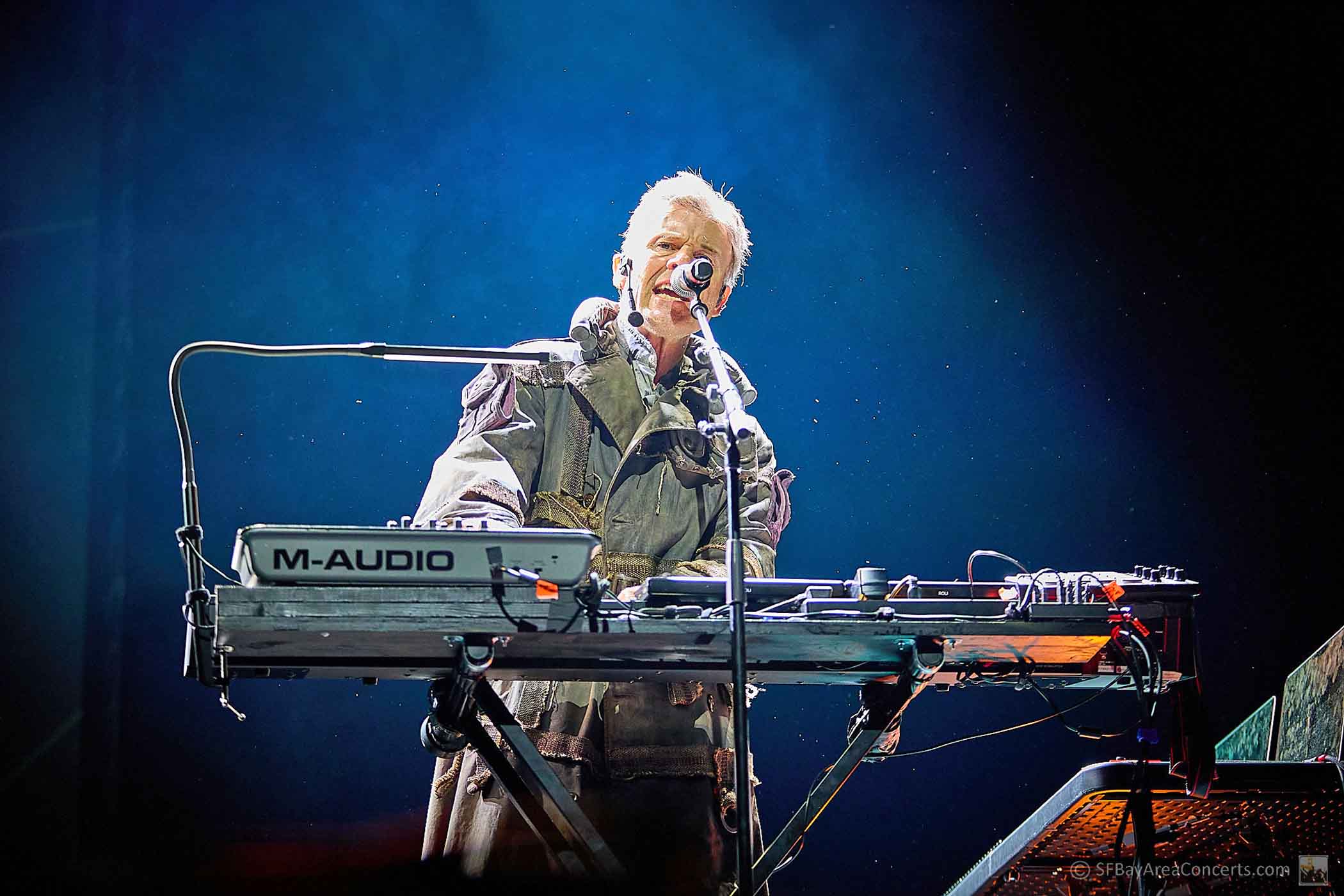
Tom Bailey can’t recollect the name of the place where the Thompson Twins performed back when they first arrived in New York City during the group’s early days, circa 1981. But he certainly remembers what happened during showtime at the club. “My bag was stolen from backstage,” he recalls. “It contained a notebook of song ideas. A friend put out a message on local radio asking for it to be returned, and eventually it arrived at my hotel, minus a camera, but with the notebook.”
Hopefully, such ill-fated happenstance won’t occur again to Bailey, lead vocalist of the Thompson Twins, when he returns to the Metro area on Thursday night as one of the headlining acts for the Totally Tubular Festival, a 22-city North American tour featuring some of most popular acts from the early MTV era, which drops anchor at Pier 17.
Bailey will be joined by fellow ’80s hitmakers Bow Wow Wow, Modern English, Men Without Hats, the Plimsouls, Thomas Dolby, Wang Chung, and Tommy Tutone on the rooftop that night. Together they will be recreating the late, great WPLJ’s afternoon drive rotation, by performing tight sets of all the hits that made them key players in the sounds that helped define New York pop radio in the Ed Koch era.
None of the acts are strangers to these city streets. The Voice spoke with some of them about their first experiences playing Manhattan, 40 to 45 years ago, back when the Mudd Club, on White Street in TriBeCa, was the place to be and a destination for the English New Wave groups to haunt while they were in town.
“We went on at three in the morning. Everybody went on after two o’clock in New York City at that time, and this was in the middle of the week. The people were just wild.”
“We went to the Mudd Club back in those days,” says Bow Wow Wow singer Annabella Lwin. “It was a really lovely little place. We used to go in and have a little dance and a chill out. I used to love having a bop after a show, unbelievably after doing what we did on stage. But I was in my teens back then. It was a very different New York City.”
“I first came to New York City when I was 19, with Bruce Wooley and the Camera Club, and we did a show, I think it was at the Beacon Theatre,” recalls Thomas Dolby, referencing the band he was in prior to going solo. “It was a showcase for a bunch of bands on the label at the time [CBS Records]. And we had a couple of nights in New York and one of the nights I went to the Mudd Club and met David Bowie for the first time, which was interesting. In the club, it had this weird industrial elevator in the back and there was some sort of fashion show going on. So there was this back bar near the elevator, and I just happened to be riding with Bowie in this elevator at the time. And as we walked into this crowded bar, the crowd started to part like the Red Sea as he walked across the place. It must’ve been strange being David Bowie.”
The Peppermint Lounge, at 128 West 45th Street, was revived in 1980 by Rudolf Pieper and Jim Fouratt, serving as a post-punk destination until it shut its doors forever, in 1985. Eddie Muñoz, of the Plimsouls, recalls a night there in 1981. “It was a wild show,” he professes. “It was packed to the rafters. We went on at three in the morning. Everybody went on after two o’clock in New York City at that time, and this was in the middle of the week. The people were just wild. We had a great time. There were celebrities up in the VIP balcony, and we had the crowd in the palm of our hands. It was incredible.”
Another venue that came up when speaking with artists in the Festival was the Ritz, which began in the historic Webster Hall building, on East 11th Street, before it relocated in 1989. The club hosted everyone from Eric Clapton to the Cro-Mags back when Lwin and Tommy Tutone both played its stage.
“We had the Zulu Nation supporting us at the Ritz,” Lwin tells the Voice. “It was their first show, and it was like all these kids. It looked like a school playground on the stage. It was awesome to see. And I met Afrika Bambaataa that night, and obviously all the guys spinning and the girls twirling. It was all very, very new.”
“We were definitely on the warmer side of cool.”
Tommy Heath, frontman for Tommy Tutone, remembers playing there back in 1984. And he has the tape to prove it, thanks to the sadly gone radio network Westwood One, which would broadcast rock concerts on select stations including New York City’s own, legendary AOR station WNEW, from 1976 until 2011.
“It was one of our last shows before me and my original partner, Jim Keller, broke up,” Heath explains. “There’s a really good recording of our show at the Ritz. There was a great crowd, and Westwood One was really popular at the time. Len Fico, he was the director and wound up inheriting all the tapes, including ours. And this Ritz show really captures how the band really rocked in those days.”
But when Heath brings up Tommy Tutone’s first show in the city, it’s the night the band opened for Tom Petty and the Heartbreakers, at the Palladium in 1980.
“It was our very first big tour,” Heath recalls. “It was two years before our hit song ‘867-5309/Jenny’ made the charts, and we had just put out our debut album. We had a bootleg song that was played all over the country, called ‘Cheap Date,’ and we had an official single called ‘Angels Say No.’ And Petty just hired us out of a bar in Mendocino, California, and we found ourselves playing Red Rocks the next day, and soon after, the Palladium.”

Heath particularly remembers admiring the structure of the Palladium, which during its heyday was located at the old New York Academy of Music, on East 14th Street, not to mention the venue’s apparent loose policy on stage enhancements. “It was such a beautiful theater,” he says. “What I loved most about playing there, however, was there were these side monitors on their stage. And to get a big feel of the band, I wanted to aim them at the people right in front. I just needed those folks to really hear what I’m saying, so I turned the monitors and aimed them right at where the mosh pit would be at a punk show. And that’s who I was addressing when I was making small talk and little jokes from the stage. The rest of the audience I treated like one big lion, and I was out there to tame it. But it was a pleasure to play the Palladium, because they actually gave us a soundcheck even though we were a new band.”
Modern English bassist Mick Conroy, meanwhile, talks about how the group’s first gig in New York was at CBGB, shortly after the band’s seminal 1981 debut, Mesh & Lace, hit the import section at Record World, in the Mid-Island Plaza on Long Island.
“The garbage strike was in full swing, thousands of people moved out of Manhattan, leaving it to the artists, musicians, street people, and muggers. It was beautiful.”
“As far as we were concerned, it was the home of New York City punk rock — the Ramones, Television, Talking Heads. We were pretty excited to play there,” says Conroy. “It was quite scary as well — the Bowery was a different place in those days. We were on an East Coast tour in support of our first album. There was this woman, Ruth Polsky, who brought over Modern English, the Fall, the Birthday Party, Bauhaus, and others to the States. She was friends with the people over at 4AD Records and Factory Records and Rough Trade, and was one of the main people in America who was into the really alternative post-punk stuff as it was happening. The audience that night was really only people who were into obscure English bands, so it wasn’t packed.”
Jack Hues, of Wang Chung, admits that his group’s first Metro area gig wasn’t in Manhattan at all, but rather across the Hudson River, in East Rutherford, New Jersey, 40 years ago. “I think our first gig in NYC was at Meadowlands, supporting the Cars on the Heartbeat City tour in 1984,” recalls Hues. “Six months before, we were playing London pubs and the Marquee Club in London to a couple hundred people. We did a few festival dates in the U.K. — we did Wembley Stadium with Elton John, which was big, but nothing like the size and enthusiasm of Meadowlands. The Cars headlined, but because ‘Dance Hall Days’ was a proper hit, the stadiums were pretty full when we went out. We were green and very enthusiastic — the crowd loved it and we often got feedback that we blew the Cars away, because they had a policy of turning their backs on the audience after each number rather than responding to the crowd. You could feel the crowd response diminish with the lack of interaction. I guess they were trying to be cool. We were definitely on the warmer side of cool. And I remember playing the Ritz in 1987 — recorded for MTV — that was pretty good, us at our most rock ’n’ roll both on and off the stage.”
For the artists involved in the Totally Tubular Festival, coming back to New York City will no doubt be a different experience, considering how much the Big Apple has changed even over the last decade alone.
“Everyone wants to hear ‘I Melt With You.’”
“I’m interested to see it. People say it’s gone downhill and everywhere smells of pot!” says Hues, laughing. “It’s been a while since I’ve been in NYC — maybe 2018 was the last occasion. I loved it, as I always have — lots of good memories. I went to Village Vanguard to hear a local piano trio — it was like a classical concert, no talking, no smoking, no salt peanuts. Playing in the city is always a blast and I think this latest incarnation of Wang Chung will appeal to New Yorkers.”
“I miss the funky New York City of the ’70s,” confesses Muñoz. “The garbage strike was in full swing, thousands of people moved out of Manhattan, leaving it to the artists, musicians, street people, and muggers. It was beautiful. All the great clubs, Mudd Club, CBGB, Trax, etc. It’s a culture that will never be repeated.”
“I love New York, it’s the most amazing city in the world,” Conroy states. “Post-Covid, it’s definitely changed. I live in Chelsea, and it seems like every other day a new smoke shop opens up on the block. Then a few days later it gets shut down and then another one opens up. But the fact that this city is so malleable is incredible to me. My nephew came to visit me from London about a month ago and it absolutely blew his mind. I related, because it reminded me of the first time I came to New York and seeing the steam coming out of the street from the subways. I was thinking, ‘Wow, it’s like the opening credits for Kojak.’ It’s not some kind of special effect, it was real.”
“In the ’80s it was like going to Rome if you lived in the Ancient World — the greatest city in the world and the heart of the culture at that time,” Hues adds. “The vibe changed from block to block as you walked from, say, Union Square up to the park — sophisticated and expensive on one block, hookers and street crime on the next. Times Square was definitely dangerous and seedy at night. The last time I went it felt safe and like a theme park for trust fund kids. I imagine that’s all changed now.…”
“Our first single was a song called ‘Swans On Glass,’ and we were hearing that it was being played in some clubs in New York,” notes Conroy. “When we first came up, it was with bands like Medium Medium and the Thompson Twins, back when they had 10 people in the band and were also being played in the clubs. New York City was amazing back then, with clubs like AM/PM, the Berlin Club, and the Pyramid. These were places that went on all night.”
Yet while the artists on the Festival tour are packaged together to market neon-lined memories of the Reagan era, the majority of them are still making new music in 2024. And if you look at the trajectory of modern pop over these past 10 or 15 years, you can handily hear elements of all eight of these acts in today’s Top 40, in both distinct and subtle ways.
“A package tour like this has its advantages and disadvantages,” admits Dolby. “On a certain level, I got only 35 minutes to play, so I’m not going to play the deep cuts. I’m going to play the songs that everyone knows. You can’t really play to your own fans because they’re likely a small proportion of the audience overall. But the benefit I see is that Pier 17 holds 3,500 people. There could be a thousand who’ll go, ‘Whoa, I forgot about this guy. He’s great!’ They might not be hardcore fans, but the next time I come through to play my own show, then they might be buying a ticket. I see it as a good springboard.”

“Modern English are still a vibrant force,” Conroy retorts. “The thing that keeps us interested and excited is always what’s next for us. Our new album, 1 2 3 4, has gotten pretty good reviews. And even on college radio, we’re listed on their charts, which is staggering for us. So we are treating this tour as a great way to promote our new album as well. Even though we’re doing short sets, we squeeze in a minimum of two [new] songs so people are aware of the fact that we have new music out. We also have very old music we play, because everyone wants to hear ‘I Melt With You.’”
“Nostalgia can be put to good use sometimes,” Bailey surmises. “I like to refer to a time when we collectively felt music brought people together to make the world a better place. Also, my band is made of brilliant young musicians, so they don’t dwell on the ’80s … some weren’t even born then! That brings an immediacy back to the music and we can play in the present, not the past.”
“Wang Chung is a great live band,” asserts Hues. “We stretch out on some songs and I play a lot more guitar than I used to. We have a new live album coming out soon — recorded at the El Mocambo, in Toronto, last month. That shows the band as it is now. I get that our fans want to hear the hits, so we have to give them that. Hopefully they go and explore my solo albums and jazz stuff on digital platforms. I’m okay with nostalgia, but it misses the point that hearing us play ‘Everybody Have Fun Tonight’ or ‘To Live and Die in L.A.’ now is a totally contemporary experience. The music gets reborn every time you play it. It’s much more than just reminiscing about the past.”
“I have a fantastic new band,” proclaims Muñoz. “I’m gigging with people I’ve known for a long time and people that I really didn’t know from back then, and we are having a great time sharing a mutual sense of community and purpose.”
“The risk is if you do all these retro shows, you get pigeonholed as an also-ran,” says Dolby, “versus the bands who’ve transcended the decades like Depeche Mode, the Cure, Duran Duran, and New Order, who really don’t need to do package shows because they’re still making valid records. It’s a delicate line to tread, but I think it definitely has its upside, especially if you’re making new music.”
“I don’t think New Wave and the ’80s are synonymous,” explains Heath, who reveals that Tommy Tutone is recording new music. “If I could personally remove the whole ’80s thing to it, I would. I live in Portland, Oregon, and there’s a bunch of young New Wave bands here. So I’m for promoting New Wave as a genre. I actually have a whole new genre of my own I like to call New Wave Americana. And I’m playing on this tour with all these English keyboard dance bands, and we’re just twangy guitars. But they like it, so it’s fun. I always thought we were two different genres, but we all fit in together pretty well.”
“It’s completely ever-changing, New York City, but that’s what I like about it,” enthuses Conroy. “It’s a bit like the weather in the U.K. — if you don’t like it, just stick around for 10 minutes, because it’s gonna change.” ❖
Ron Hart is the editor in chief of Rock and Roll Globe. As a freelancer, he has contributed to numerous publications, including Billboard, Spin, Rolling Stone, Pitchfork, Vice, and Relix, among others. Find him on X at @mistertribune.