







Every winter, a familiar migration takes place across South Florida. Retirees from the Northeast settle into their seasonal routines, and among the first things some of them do is find a chorus. Not a church choir, not a casual singalong, but a Broadway-repertoire ensemble where they can perform the music that shaped their lives. These are songs they grew up with, songs they know by heart. Most of them barely glance at the score.
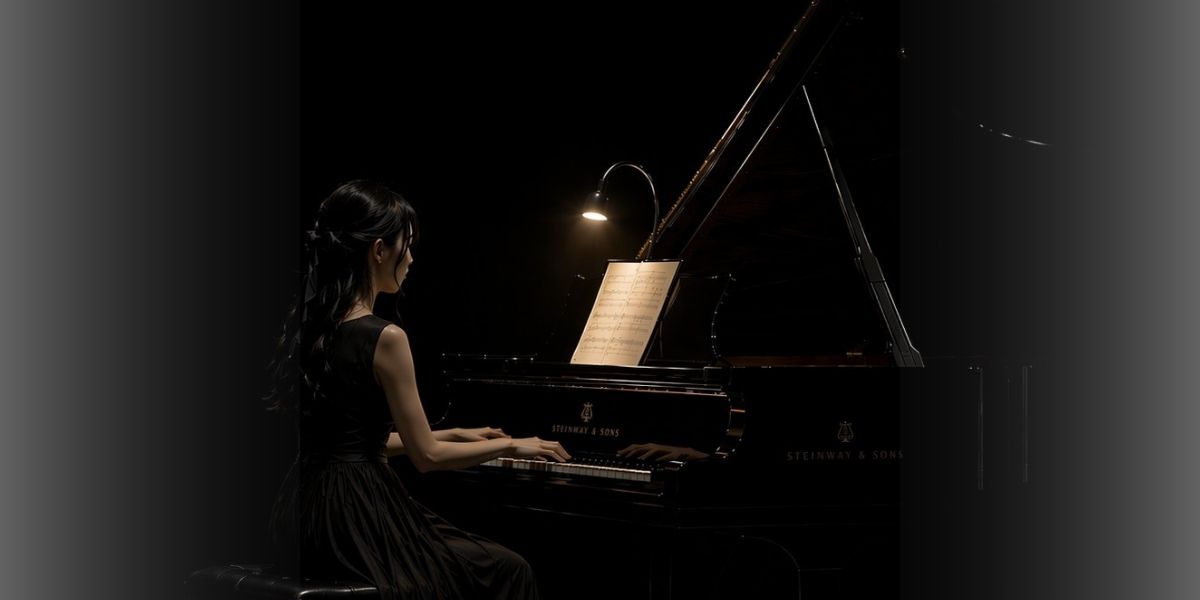
This past season, when one such chorus in Boca Raton needed a pianist, its music director did not look locally. Based in New York for most of the year, she reached out through her professional network and kept hearing the same name: Yu-Hsuan Feng.
“I had heard Yu-Hsuan’s name through a New York colleague before meeting her personally,” the director recalls. “Once we worked together, I understood why she had been recommended. She brought sensitivity, reliability, and real collaborative awareness to the keyboard.”
For Feng, the engagement was a window into something she found musically striking. “These singers carry Broadway in their bones,” she says. “The songs are not something they learned for this concert. This music has been part of their lives for decades. As a pianist, you feel that immediately. You are not leading them through unfamiliar territory. You are stepping into something they already own, and your job is to support that ownership.”
Feng knows something about stepping into other people’s rooms. She has served as staff collaborative pianist at Interlochen Arts Camp in northern Michigan, one of the most recognized pre-professional arts training programs in the country, working across multiple faculty studios and preparing instrumental students for competitions, recitals, and master classes.
A chorus like this could rehearse with a pre-recorded soundtrack. Many do. It is cheaper and simpler. But a recording cannot do what Feng did. A soundtrack is fixed. It does not listen. It cannot pause when a singer needs a moment, or stretch a phrase when the emotion in the room calls for it. If a singer loses their place, a recording keeps going. A live pianist follows, catches them, and brings them back in without the audience ever knowing something went wrong.
This is, in miniature, the entire argument for what Feng does for a living.
The same principle holds wherever the artistic standard is high enough to demand it. Many recreational studios run their classes to recorded music, but at professional companies, live piano remains the standard. As one veteran ballet master teacher at American Ballet Theatre’s school has put it, the difference between recorded and live music in the studio is like the difference between dried flowers and a fresh rose. Both are beautiful, but only one is alive.
At Boca Ballet Theatre, a professional dance company in South Florida, that aliveness is what Feng provides. She serves as pianist for classes and productions, reading each dancer’s body in real time and adjusting tempo and phrasing to match movement that changes with every person in the room.
“The art is in how each performer shapes time and space,” Feng says. “The space between notes means something different every time, depending on who is creating it and how. My job is to feel how they are shaping that space and respond to it, not impose my own.”
Then there is the work that has no precedent at all. Through the New Light Foundation, Feng was invited to serve as collaborative pianist for the world premiere of an opera aria, a piece that had never been heard by any audience, interpreted by any singer, or shaped by any pianist’s hands. In a premiere, there is no tradition to lean on, no recording to reference. The pianist must build an interpretation from the raw material of the score, negotiate every musical decision in real time with the singer, and commit to choices that will define how the piece is understood from that point forward.
Mezzo-soprano Madison Marie McIntosh, who has performed as a soloist at Carnegie Hall and is a recipient of the American Prize, collaborated with Feng on the project. “Working with Yu-Hsuan on a world premiere required a level of preparation and musical imagination that goes far beyond ordinary accompaniment,” McIntosh says. “Because there was no performance tradition to rely on, every interpretive choice had to be built from the score and shaped in collaboration. She came to the project with sensitivity, precision, and the kind of instinct that makes a singer feel both supported and artistically challenged.”
After the performance, Feng sat down with the composer to discuss interpretive details of the score. They talked through phrasing, voicing, and choices that would carry into future performances of the work.
As summer approaches, the snowbirds are heading back north, and the Boca chorus has wrapped its season. Feng, too, is packing up. There are rooms waiting for her in other countries, other time zones, other languages. The repertoire will be different, and the people she is listening to will be different. The work will be the same.