




When the “final” print edition of the Village Voice rolled off the presses, in September 2017 — those quote marks denote the fact that 11 more issues were printed in 2021–22, confirming that one just never knows — it was a victim of, among other nails in newsprint’s coffin, the migration of too much advertising to the likes of Craig’s List, too much circulation to blogs and other online freebies, and the cost of paper, press time, and distribution to a street box near you.
Indeed, the ways in which the “printed” word is delivered to your eyes and brain have been wrung through several revolutions over the past few centuries, culminating — until some tech behemoth begins beaming it directly into your cerebellum — in the digital text you’re reading right now.
The Grolier Club’s current exhibition, The Second Printing Revolution: The Invention of Mass Media, slides down some fascinating meta-chutes to illustrate — literally — how the invention of steam-powered rotary presses, mechanized bindery machines, and other Industrial Revolution innovations outstripped verbal pronouncements from the pulpits and podiums of the elites by delivering daily broadsheets of news, opinion, debate, gossip, and scandal directly into the roughened hands of newly mass-literate workers in Europe and America.

This fascinating survey begins with a section entitled “Powering Up,” and includes prints illustrating the ever-ratcheting industrial upheaval in England in the 1600s and 1700s. “An Iron Foundry, with Two Men Working the Metal with Long Poles,” a hand-colored mezzotint from 1799, is both matter-of-fact documentation and, with its roiled flow of molten orange metal, a vision of Hell in the workplace. Such rapid changes had given rise a decade earlier to a proclamation, also on view, in which the King of England offered the then huge bounty of 50 pounds for the apprehension of coal miners who destroyed steam engines that could pump water out of previously unworkable mines, which, as a label informs us, “did not improve the workers’ atrocious working conditions or address miners’ low pay. Instead, labor-saving mechanization disrupted the traditional socio-economic order, and workers enduring periodic economic downturns and excessive exploitation turned to such Luddite tactics as machine-breaking.” The Luddites were named for “Ned Ludd,” a pseudonym used on letters threatening business owners and government authorities as laborers fought for better wages and conditions at the time. An 1817 pamphlet in the exhibition features an illustration of the severed head of presumed Luddite “Jeremiah Brandreth, alias John Coke, alias the Nottingham Captain,” who was executed for High Treason for trying to overthrow the government. The report is in black and white, but the gory etching is enlivened with some yellow in the hair and a bit of blue on the face, with red dripping from the neck and beard of the rebel.
Revolutions come and go, but today’s workers might feel a kinship with those Luddite “machine breakers” of yore.
That labor struggles and the print revolution were intimately entwined becomes clear in such publications on display as Les Femmes Compositrices d’Imprimerie, an 1862 pamphlet concerning wages in France and England. Text in the vitrine displaying the yellowed original pages notes, “Printers in both countries were motivated to train and hire women typesetters because they could pay women half to one-third of what they paid men. Many women, especially unmarried women … sought the work. Male typesetters, who were typically responsible for supporting families, objected to women’s lower wages, which they believed depressed their own incomes.”

In addition to pitting the sexes against each other economically, budding media barons looked for ways to systematize their empires. A well-thumbed handbook on display, The Paper-Maker’s Ready Reckoner (1805), enumerated cost savings and product optimization through tables calculating, as the exhibition’s curators put it, “an exhaustive number of expenses, from the prime cost of rags [for making paper] per ream, to rent, taxes, utensils, wages, supplies, and other associated fees.”
As the industry grew more sophisticated, color illustrations became ever more plentiful, enlivening the most sensational stories. Just as steam was driving weaving looms and the new printing presses, it was also powering an expanding network of railroads across Britain. This new form of travel was supplanting the horse and buggy whip, but, early on, was prone to such excursion interruptions as exploding boilers and derailments. Caricaturist Henry Heath took aim at these outrages in his hand-colored engraving “The Pleasures of the Rail-Road – Showing the Inconvenience of a Blow Up” (printed in London, 1831), which details severed limbs and sundered torsos sent heavenward by an engine explosion. Heath is part of that long and venerable (and continuing in our digital age) line of polemical satirists who attack those who put profits over the safety of workers and customers. Heath stepped on some powerful toes with his trenchant spoofs, and perhaps that caused him to make himself scarce in London; various sources note that Heath’s “later work is still not properly investigated. He is reported to have emigrated to Australia in 1842 after which he is lost to sight.”
Even while the occasional locomotive might crash and burn, railcars provided a new way to transport the large, heavy sheets and newsprint rolls that printers needed, and in turn distribute newly manufactured newspapers, serialized magazine chapters by Charles Dickens (and his many imitators), fully bound books, and all manner of printed matter from London to the smallest of villages. Railroad stations filled up with more and more travelers who would purchase not only the latest penny-dreadful tales of love, murder, ravishment, and avarice but also buy railroad guides and schedule charts. A bit of ink smudging your fingers from these mass-produced periodicals seemed a small price to pay — along with a ha’penny or two — for escapist tales catering to every taste, as well as volumes of practical information.
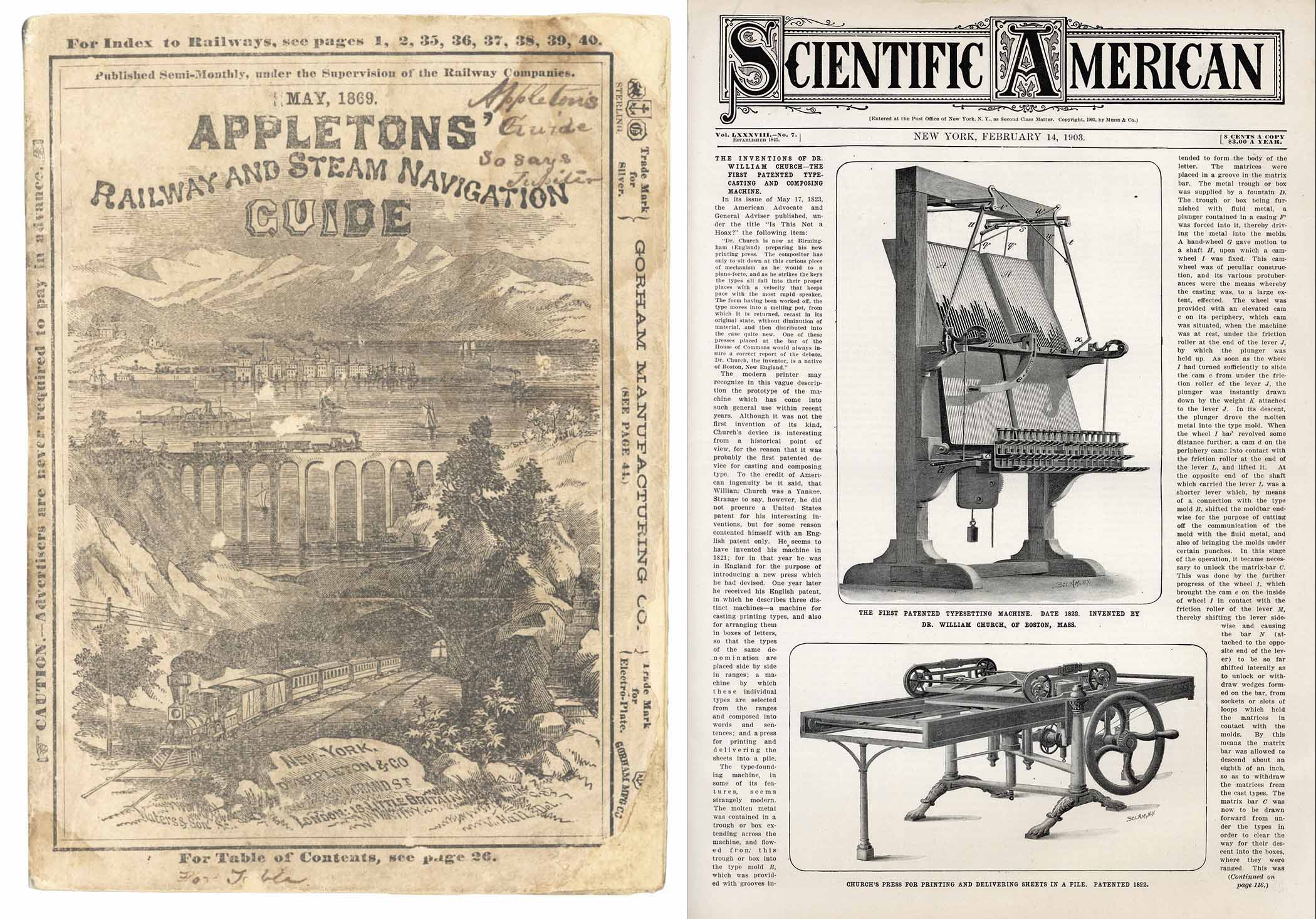
Throughout the exhibition are illustrations of the tools and machinery that created the images on view, such as a 1903 issue of Scientific American that reported on the previous century’s typography machinery through finely detailed etchings. An 1822 contraption allowed small, individual lead letter slugs to fall into place for composing a page of type: “The compositor has only to sit down at this curious piece of mechanism as he would to a piano-forte, and as he strikes the keys the types all fall into their proper places with a velocity that keeps pace with the most rapid speaker. The form having been worked off, the type moves into a melting pot, from which it is returned, recast in its original state, without diminution of material, and then distributed into the case quite new.” Although that 1903 issue was reporting on a typesetting method that was already 80 years old, “hot type” was still used well into the 1970s, even as “cold” photochemical processes took hold in the 1950s, a system that reigned until computer layout programs became ubiquitous in the 1990s and aughts, all transitions that resulted in smaller staffs. Plus ça change.
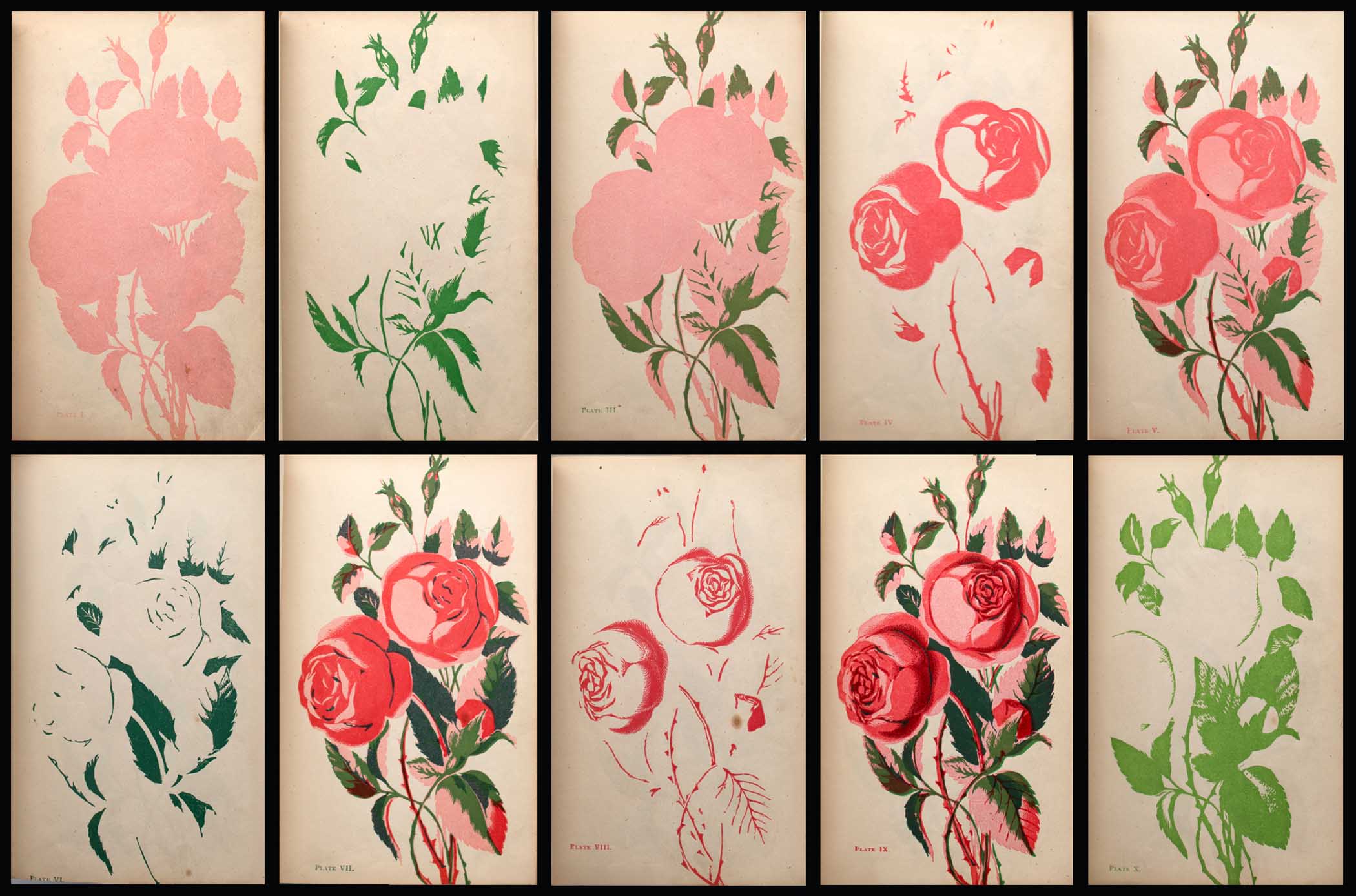

The finished product: Plate XI from Gaskill’s handbook.The Grolier Club’s show also tracks how color printing steadily improved through the centuries. The Printing-Machine Manager’s Complete Practical Handbook, printed in London in 1877, seems styled, in retrospect, to warm the mercantile heart of such product-minded artists as Andy Warhol. The 10 examples on display reveal how a full-color image is created by layers of separate printing plates, and also the serendipitous beauty of each plate, a formal insight that Andy, a world-class graphic designer, manipulated for aesthetic impact throughout his career. In his studio, appropriately nicknamed “The Factory,” Warhol (along with a small army of assistants) would splash out broad swathes and blobs of color, which were then overprinted with black screenprints depicting everything from car crashes to flower petals to celebrities’ faces — an industrial graphic design process that would revolutionize “high” art in the 1960s even as such techniques would be familiar to the artisans surveyed in this exhibition.
Revolutions come and go, but today’s workers, watching as AI rears its rapacious digital brain — trained and collated by stealing all of the intellectual labor and cultural capital we ourselves posted online over the past few decades — might feel a kinship with those Luddite “machine breakers” of yore. Good luck, though, taking a sledgehammer to a data center in the middle of nowhere — the easy targets of bolted-down steam-driven looms or papermaking presses or coal mine pumps are things of the past. The adage “Information wants to be free” now must take into account the concept that misinformation desires only conquest.
Today, we muck our way through digital realms targeted by evil actors who “flood the zone with shit.” An age in which anyone can type/illustrate/layout/distribute pretty much anything by flinging it into the digital ether to see if it catches hold and creates a movement for a minute — or for a Thousand Years, because who knows what Joseph Goebbels could’ve wrought with TikTok — should give us all pause.
But who has the time? With the 2026 midterm elections barreling toward us, and a presidential election, hopefully, two years after that, The Second Printing Revolution is a great reminder that we might have been better off when, in order to actually read something — to obtain and consider information and run it through our own personal bullshit detectors — we still had to get our hands a little dirty. ❖
The Second Printing Revolution: Invention of Mass Media
The Grolier Club
47 East 60th Street
Through April 11