






Two hundred years ago, anyone who wanted a Christmas tree in New York City would have had to go out of town, fell their own fir, and tow it back via horse and wagon. In fact, 200 years ago Christmas was not even a national holiday (it was declared one in 1870), nor were Christmas trees commonplace, except in the homes of immigrants from Germany, where the custom began.
However, according to an 1878 article in the New York Tribune, in 1851 a “jolly woodman named Mark Carr, who was whistling away a happy life on the flanks of the Catskills, conceived the idea that New York needed some Christmas trees.” Supposedly, Carr felled a number of trees, lugged them into the city, purchased a $1 permit to sell them near what is now the World Trade Center, and sold out almost immediately. Thus the custom of Christmas tree vendors dotting street corners citywide began. Though the tradition has continued for more than a century, today’s rising tree prices, along with fierce competition from big-box stores, are taking a toll on the old-fashioned trade.
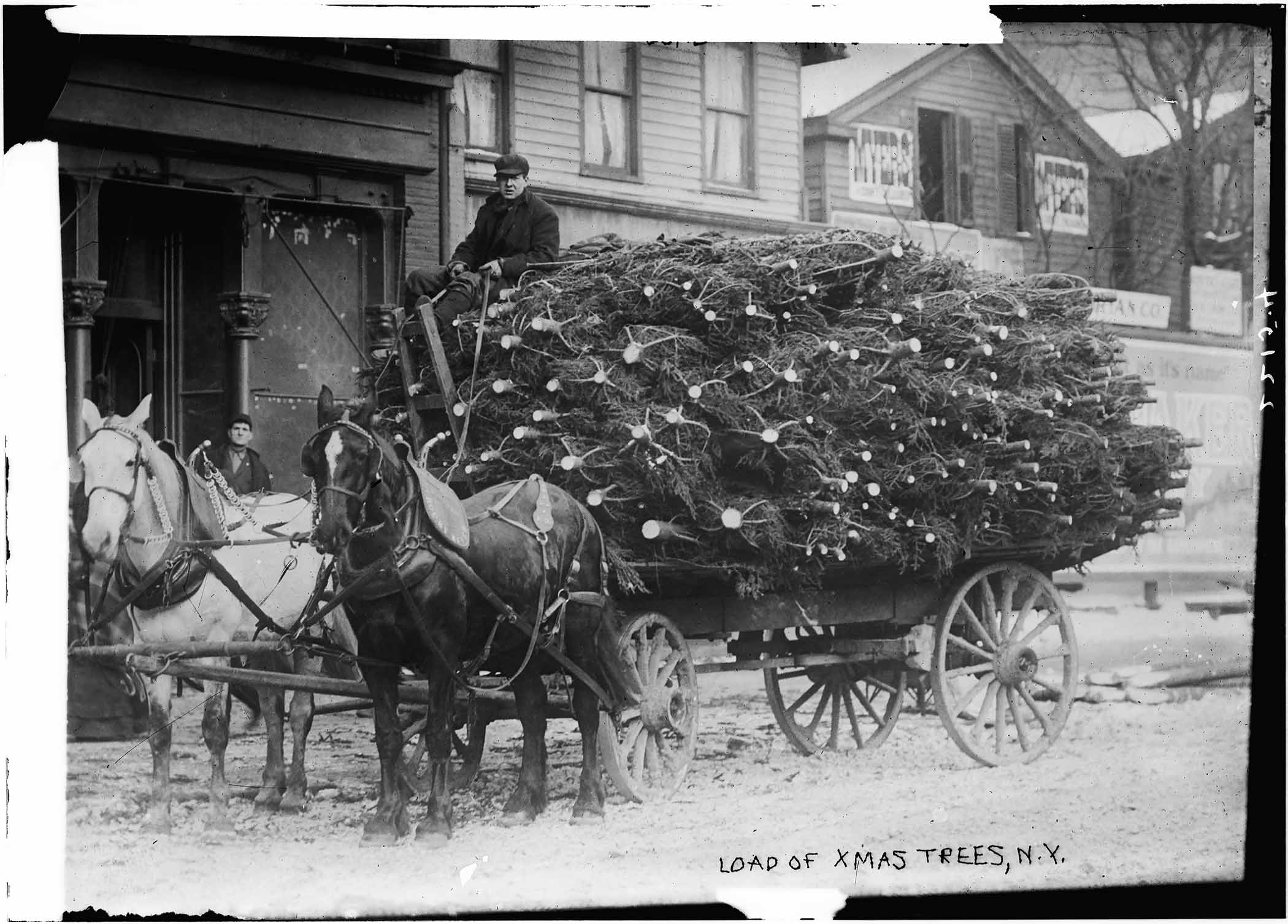
In the 1930s, then-mayor Fiorello La Guardia cracked down on street peddling. In addition to going after summer ice cream peddlers, he tried to clean the city’s streets of Christmas tree vendors by instituting a strict licensing requirement. But in a city where Christmas trees had become a beloved symbol of unity (the first Rockefeller Christmas tree was erected in 1931), this was a step too far. As the story goes, the city council clapped back, adopting an ordinance known as the “Coniferous Tree Exception.” The New York City Administrative Code states, “Storekeepers and peddlers may sell and display coniferous trees during the month of December” without a permit, so long as they obtain permission from building owners and leave a passage open for pedestrians.
Today’s Christmas tree business is highly territorial. Certain locations, such as city parks and high-traffic subway stops, do require permits, which are auctioned off to big-shot vendors every few years. Otherwise, the location of a given Christmas tree stand is dependent on the strength of the relationship with the building it fronts.
“I came into the city for the first time for Occupy Wall Street. But I needed some money, so I answered a Craigslist ad to sell trees and I’ve been doing it ever since.”
“Everyone here is super nice,” says Colby Grant, a long-time vendor for Uptown Xmas Trees, on the Upper West Side. “I’ve gotten to know a bunch of multi-generation families that live in this building. It’s just a great tight-knit community.” Most tree stands across the city function as franchises: individual vendors work under the aegis of a company or individual who maintains territorial relationships and manages the distribution of trees to each stand. In Manhattan, downtown is divided between a number of companies and individuals. But uptown is primarily divided between two former partners: Uptown Xmas Trees (founded by George Nash and Jane Watermen and now managed by their daughter Ciree), and an enigmatic figure named Kevin Hammer. According to Grant, the competition between the two uptown companies has been cutthroat for decades.
“My parents were sellers before me, so I kind of know all the stories — like old robberies and stuff. But I think they kind of recently worked out a deal,” Grant tells the Voice. “Hammer has locations up and down Broadway, but he doesn’t have too many in Harlem. Jane and George and Ciree got Harlem, but we’re slowly moving down.” Another Upper West Side tree salesman, who goes by the name of Goyo, has worked for Hammer since 2018. “I think maybe I met him once,” he says. “But I’m not actually sure. I have no idea how he does his business, but I like getting to run my own scene.”
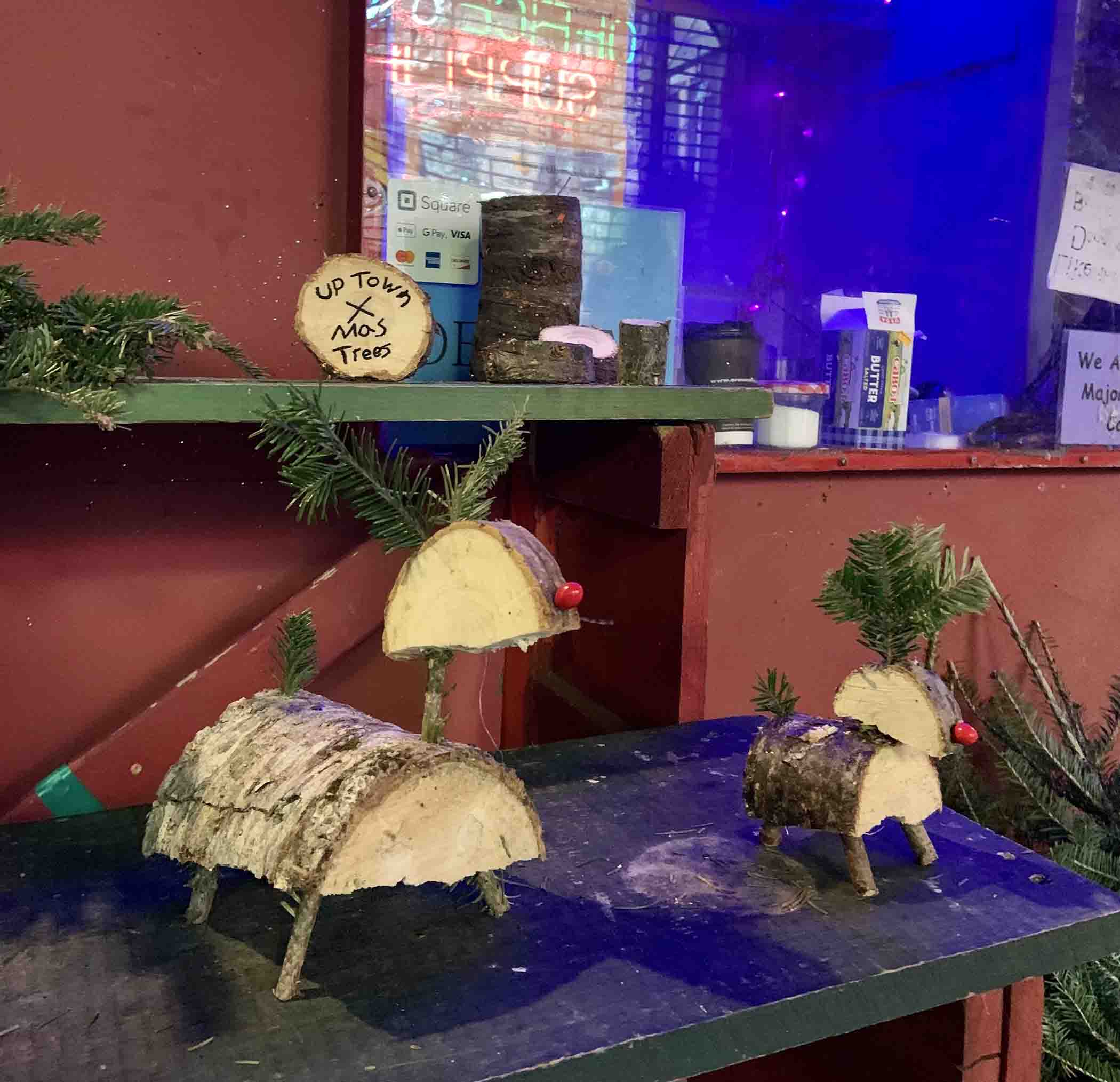
Uptown Xmas Trees often pays a small stipend to the buildings its stands front, in order to maintain locations from year to year. The company also rents apartments for their vendors to stay in when they’re off duty, though Goyo sleeps in a camper van parked next to his stand on Broadway. But no matter their sleeping situation, life is grueling for the tree sellers, most of whom stay in the city only for the month of December. “Down here every day is basically Groundhog Day,” says Grant, who hails from northern Vermont. “I work sometimes 14- or even 16-hour days, and then wake up and do it all again.” Goyo, a self-described French lumberjack who currently resides in Oregon, says, “It’s cold, it’s lonely. You’ve gotta be tough — you can’t be scared, you can’t let people mess with you. Last year I saw someone get stabbed where I was selling, up on 145.”
But Mike Drury Wilson, who is in his ninth year working with Uptown Xmas Trees at one of the company’s original locations, in Morningside Heights, replies with a shrug when asked about the long hours. The musician and northern Vermont native will often pass his slow days practicing guitar. This year, customers or passersby might even find him playing his lap steel.
Ellis Roberts, the founder of a worker-owned Christmas tree co-op in Brooklyn, New York State of Pine, has been in the tree business since 2011. “I came into the city for the first time for Occupy Wall Street. But I needed some money, so I answered a Craigslist ad to sell trees and I’ve been doing it ever since.” Since Roberts started the co-op, in 2019, business has thrived. “Because we don’t have a boss to pay, we’re able to be way more competitive on prices. I’ve also cut out all the middlemen and work directly with the farmers and wholesalers. The brokers aren’t happy, but it keeps prices down.”
“I think people have kind of forgotten that they can haggle.”
Drury Wilson tells the Voice that although prices have risen in recent years, due to inflation and greater demand, he hasn’t seen an increase this year. But a salesman from Quebec, called Quill, who works for Mr. Christmas Tree (and didn’t want to say anything more about the company), has had to continue upping costs because of Christmas tree shortages in Canada. It can take 10 to 15 years to grow a six-foot tree, so the 2008 recession is still having reverberations across the business. “I know a lot of people, at least in Quebec, had to sell their farms. Or they got bought out by one of the big-box stores. Home Depot or Whole Foods are now selling some of the inventory that used to come to us — and they can afford to lose money on good trees. It’s just another tool to get people in the door,” he explains.
Quill adds that his primary supplier experienced both abnormal flooding and a drought around 10 years ago. “It killed all the babies that should’ve been big by now. I’m no scientist or anything — like those kinds of things do happen aside from climate change — but I do know that the river I used to ice skate on as a kid hasn’t frozen over once in the past 12 years.” Warming temperatures have also allowed previously non-arable land in Quebec to begin being farmed with standard cash crops, including corn, soy, and oats. “We lost two farms recently that switched over to standard agriculture,” he notes.
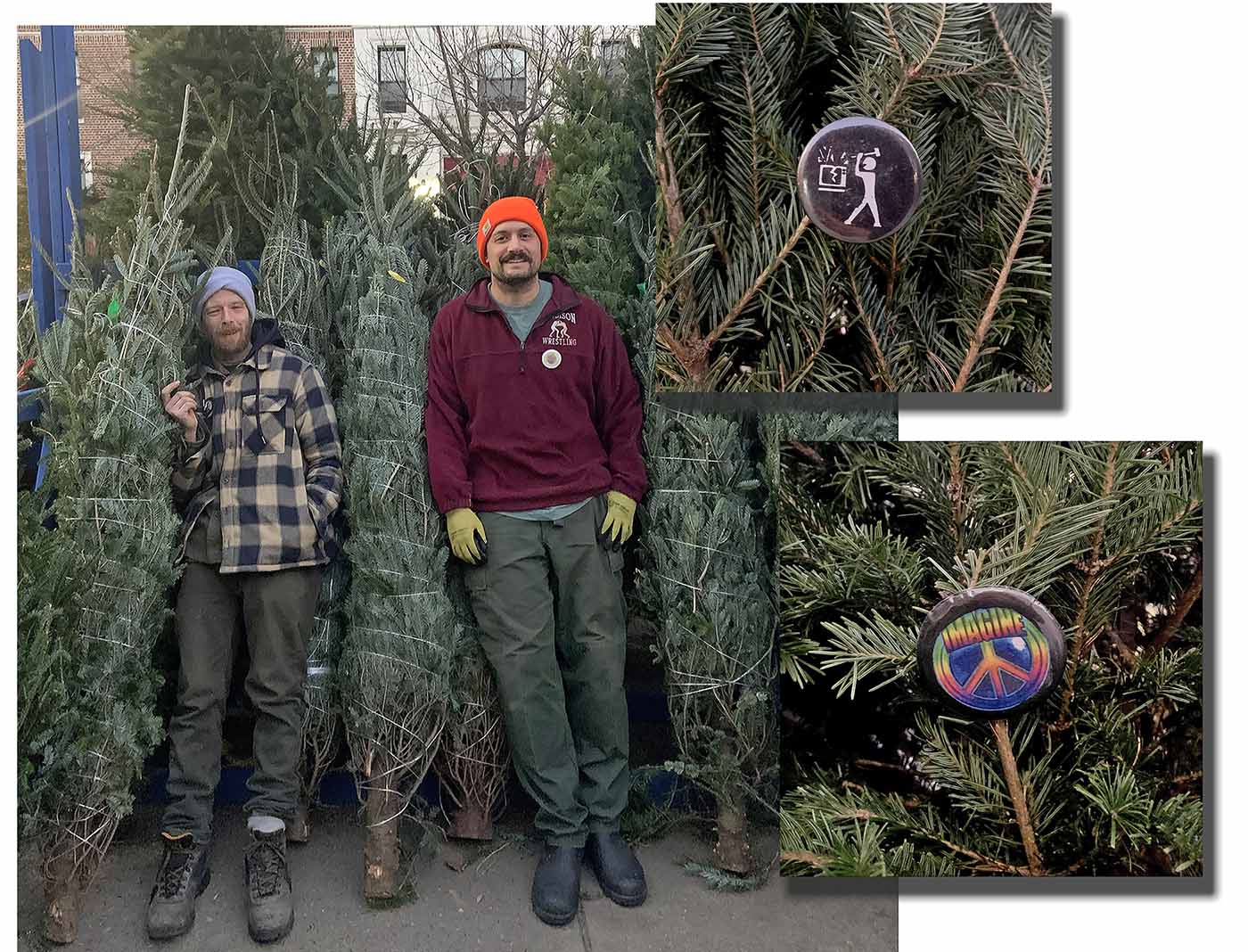
The convenience of an artificial Christmas tree is yet another force working against the tree vendors. Diana Jelinek, an annual customer at Colby Grant’s UWS stand, tells the Voice that many of her friends have pivoted to buying plastic trees from Amazon in recent years. Still, she says, “I don’t like sweeping up fallen needles, but for me, it’s that real tree smell — it’s part of the holiday.”
Co-op founder Roberts wants his customers to know that buying a live Christmas tree is a far more sustainable option than the plastic alternative. “They’re grown specifically for this purpose, they help to decarbonize the atmosphere, they provide important cover for animals,” he says. “And the city chips them up at the end of each season to use as compost.”
Live trees aren’t cheap — depending on location, a six-foot tree can run anywhere from $60 to over $200. But Drury Wilson emphasizes that the old tradition of street vending offers the benefit of wiggle room. “I think people have kind of forgotten that they can haggle,” he says. “But really they should haggle.”
“And if you don’t like it,” he adds, “then you might as well hail a cab to the nearest Christmas tree farm and cut it yourself.” ❖
Ruthie Kornblatt-Stier hails from the woods of western Massachusetts and works in New York City, covering topics ranging from women’s issues to the climate crisis to entrepreneurs. Her work has appeared in Worth magazine, Techonomy, and Propagule.