



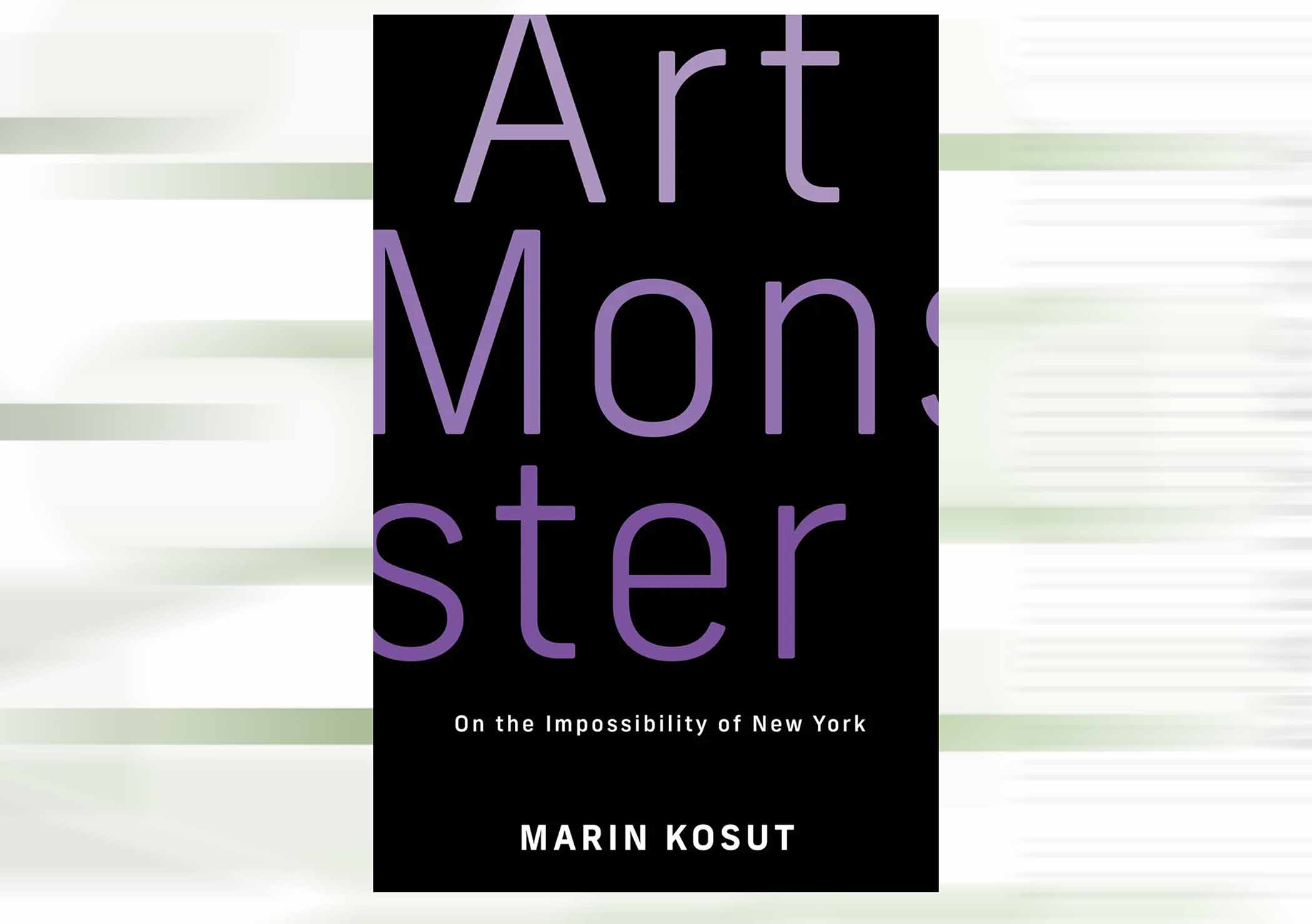
It’s hard to hurl criticism at Art Monster: On the Impossibility of New York, Marin Kosut’s new book, that the author hasn’t already anticipated, levied at herself, and responded to in the text.
What do her editors at Columbia University Press think of the book? Oh, probably something about how Art Monster “isn’t the book I proposed to write,” as she admits in the acknowledgments. So what? “If my perspective seems shifty, it’s because I’ve changed.” What do her academic peers think? Well, in response to one nostalgic section about how nice it used to be for artists to squat in paint factories and pay cheap rent, one scholar told her that it’s “‘all very good,’ but wonders if I could also engage with a bit about how nostalgia is dangerous, too.” Kosut seems to have preferred the grime and crime she used to see in the city to the “massive construction cranes” that now “lurk in the skyline, dangling like wasp legs.” What about the haters who accuse her of being unoriginal? “I’m not trying to be novel. I’m trying to be honest, and I am fucking furious.” And for good measure, let’s ask the pragmatists who picked up this book looking for answers while hoping that, after they bought it, walked to a nearby cafe, purchased a $7 matcha latte, and sat alone at a sidewalk table reading it, itching to be seen by someone who would ask, “Are you an artist?,” they would be able to use it as a training manual for how to do art in New York while wanting to kill yourself at a 9 to 5. But they would not find a sentence advising them to refrain from buying a $7 matcha latte. “Countless books proffer advice on how to endure the realities of living an artist’s life,” Kosut writes. “This isn’t one of them.” Anyone else wanna talk shit?
Kosut states at the outset that she wanted to write a “traditional ethnographic monograph” about how hard it is to survive as an artist in New York. But she came out with “a mess.” “I got historical,” she writes, “and then I got personal (hysterical?).” She confesses that as an artist (and sociologist) herself, “I’m bleeding all over this page.” That blood takes the form of ADHD digressions, self-conscious asides, and barrages of impassioned indictments against modern society’s preference for production over creation. She thinks “divergent art history” is a good term for the book’s mix of memoir and history. Schizophrenic manifesto with stories and citations might be more accurate.
She is not interested in “the congratulated, the fellows, the geniuses, the living artists who are the ones to watch, the dead ones who are priceless.”
Kosut’s voice, even though it’s often distracting (which she knows), makes for an engaging, sometimes funny read. And there are a lot of quotable lines to copy out, print up, and tack on your wall. One of my favorites is “I’ve been told that if I left New York for some place more affordable, I could ‘live good.’ I wouldn’t be as alive, so I stay and pay the price.” She reminds us of that price: Between 2000 and 2014, rent increased by 50.3% on the Lower East Side; across the East River, 78.7% in Williamsburg and 44% in Bushwick. In more recent news, between 2011 and 2021, all of Brooklyn experienced a 37.5% increase, according to a 2022 report by NYU Furman Center. Kosut still lives in the City of Churches.
The book is also character-driven, and the “deviant” (her word) artists Kosut chooses to spotlight are all colorful. We meet Ray, an artist she interviewed who legally changed his name to Xenophanes, the pre-Socratic philosopher, as an art project. We also meet Viva, the Warhol superstar who knocked down walls in her Chelsea Hotel room because, why not? But the main character is always Kosut, whether she is ranting, interviewing (“I sense that my question is annoying,” she parenthesizes in the middle of relating her dialogue with a sculptor), or promoting her own now defunct art experiment, Pay Fauxn, a gallery she made out of an abandoned payphone in Bed-Stuy in 2016. “If I say it’s a gallery, then it is,” she writes, staring down the doubtful reader. Her thoughts are so overpresent that if Roland Barthes were alive, he might write an essay about how a metatextual text such as this alienates the reader from the subject matter and forces us to confront the author, and ultimately, ourselves. That essay would perhaps be called “Just Shut Up and Tell the Story!”
All of the artists Kosut writes about, including herself, she considers “real” artists. That is, the ones who “don’t think about 401(k)s, have spent summers doing acid and working in restaurants, and would rather spend an afternoon alone in their studio — in their own head — than go to a birthday party on a beach and play volleyball.” She is not interested in “the congratulated, the fellows, the geniuses, the living artists who are the ones to watch, the dead ones who are priceless.” Nor is she interested in “content creators” or “creatives”: “I made a video. I took a photo. I’m an artist!” She thinks “we are in a new frontier in which claiming to be an artist is a sign of individuality. Artistness is a way to express yourself.” The word “artist” is just a dumpster, she writes: “You can throw anything in it.” Everyone used to be a critic. Now everyone is an artist.
“New York City will become alive again,” she writes, “when the people begin to speak to each other again not with information but with real emotion.”
The thing is, in many cases, the “real” artists are the ones who got us into this gentrification mess in the first place. It’s not their fault; they had to do what they had to do. It’s just that there would be no waterfront highrises in Williamsburg (the place is starting to look like Miami Beach) without the decades of illegal experimental music concerts on the postindustrial shore. Kosut doesn’t dig into this enough. Pratt professor Cisco Bradley, in his 2023 book, The Williamsburg Avant-Garde, does:
Gentrification has been the specter of artist communities, following like a shadow. Whereas it took developers more than a decade to respond to the emergence of an artist community in Williamsburg, at present developers are anticipating the transformation of Brooklyn neighborhoods before artists even arrive. The perceived hipness of musicians and other artists has been ringing the bell on the cash registers of developers, with no benefit for most artists.
This preemptive gentrification might explain why some of the artists Kosut interviewed were surprisingly ambivalent when asked whether they felt New York is now completely inhospitable and uninhabitable for artists. Jackson, the sculptor mentioned above, responded with “Yeah, but that line was being spoken in eighty-four. Carlo McCormick and Walter Robinson wrote some article called ‘New York Is Dead.’” (I think Jackson was referring to a 1984 article by Craig Owens, “The Problem with Puerilism,” published in Art in America, which condemned the commercialized art scene in the East Village, a phenomenon that was actually celebrated by McCormick and Robinson in their article “Slouching Toward Avenue D,” published in the same journal.) And Viva says nothing’s really changed — running from landlords and the process of displacement has just been “sped up.” She’s right. The regularity of this process has, evidently, almost numbed some artists to its outrageousness. It must have sucked to live in Williamsburg when developers and fintech bros first started to overrun the neighborhood. It still sucks. Your friend’s basement studio is now a jogger’s pool room, the Polish restaurant down the street is now part of a burger chain, the empty lot where you used to jam with your band is now a dog cafe. But at least you could see it happening and feel the loss. If you’re an artist and didn’t live in the neighborhood in the first place, it’s harder to feel any urgency about the speed of property development. A lot of it is happening over there, largely to people who don’t express their pain in painting.
Kosut has hope. But Art Monster is not a hopeful book. She’s firm in the belief that, in her words, “New York is over the New York-is-over narrative.” But she contradicts herself. “New York City will become alive again,” she writes, “when the people begin to speak to each other again not with information but with real emotion.” She continues, “A grave is spreading its legs and begging for love.” Beautiful writing but, so, the city is dead? Plus, she recognizes that artists are having to live further and further from Manhattan. She even dares to suggest that “we may be coming to the end of an era in which artist is synonymous with urban.” I’m hearing David Byrne in my head, singing, “Find a city, find myself a city to live in,” but more anxious in this context, like a psycho killer who needs to find a studio or he’s gonna crack. So where’s the hope?
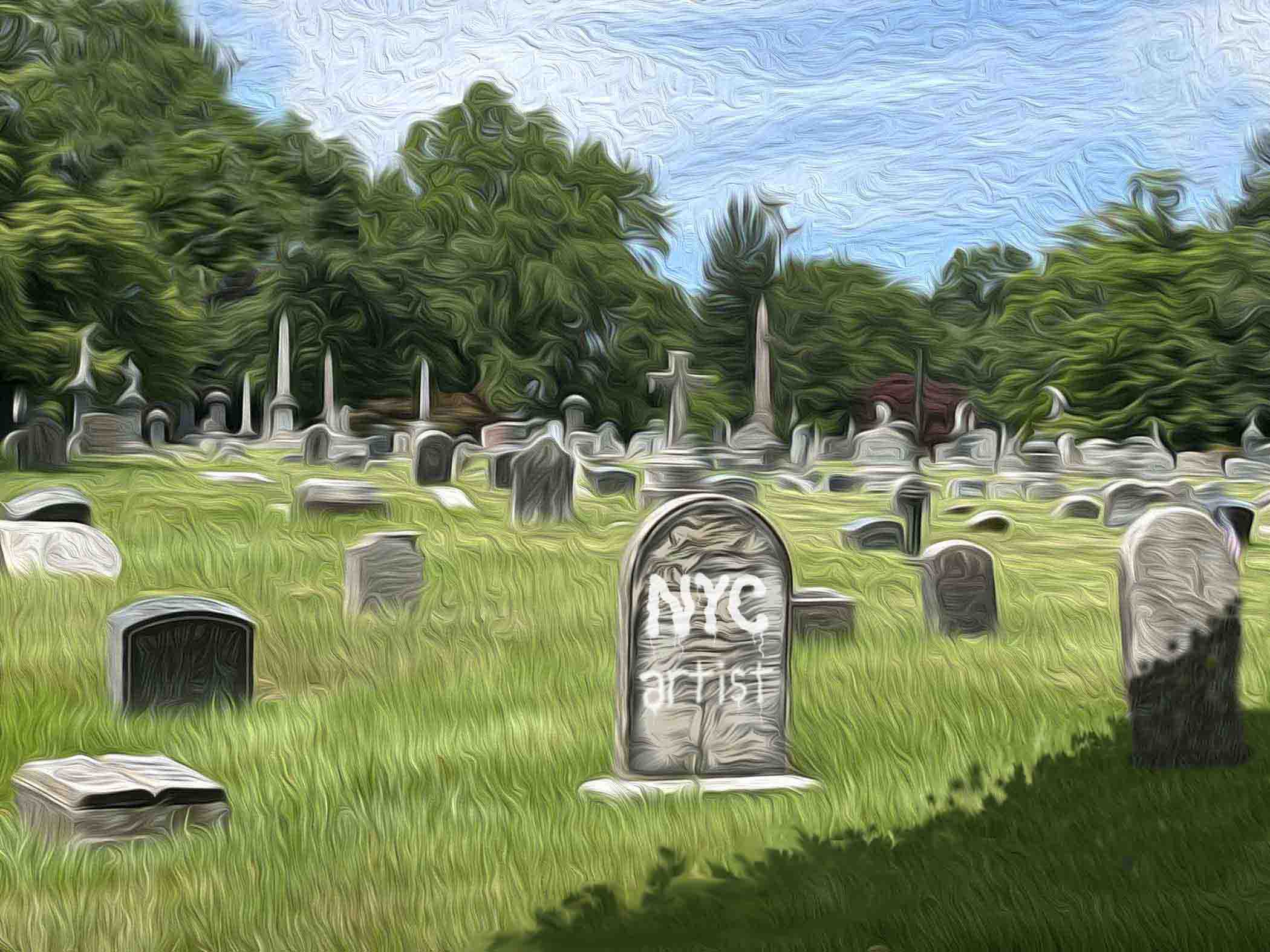
The hope comes from her own desire, which seems to be sparked more by fantasy than reality. “I want to believe poets still speak in narrow rooms with tin ceilings,” she writes. “I want to believe people still go downtown to hear a poet speak.” But hope can also come from just looking around and seeing what’s up. Witness The End, a new literary magazine edited by Ann Manov that had a reading at a Brooklyn loft (wooden ceiling) in June. Witness Brothers Wash & Dry, a gutted laundromat in Maspeth, Queens, that Sampson Dahl bought, lives in, and renovated into a performance space, where you can smoke cigarettes inside. (I remember having to go through his bedroom to get to the bathroom; someone was sleeping in his bed in the dark, but he wouldn’t tell me who it was.) Or, if you want to be geographically strict, witness Poetry Project’s New Year’s marathon of recitations at St. Mark’s Church in-the-Bowery, or Laraaji’s concert there in March that had a line out the door so long we were standing on headstones. It’s the way things are that gives me hope.
Art Monster equivocates on the “Is New York Dead?” question. Kosut’s nostalgia points toward “Yes.” Her fantastic hope points toward “No.” But more than anything, the book may be less about whether New York artists are doomed and more about how it’s impossible to write a book about whether or not New York artists are doomed. Kosut tried. And she failed. But she knows that. If the question weren’t so futile, she might have stood a chance. ❖
Ben Gambuzza is a freelance writer, book editor, researcher, and pianist living in Brooklyn. He is the host of The Best Is Noise, a live classical music show on Radio Free Brooklyn.