




∼ ∼ ∼
This article is part of a series — At 250, Who Will America Be? — reporting on threats to American democracy as we approach the nation’s Semiquincentennial, on July 4, 2026.
∼ ∼ ∼
Bob Good, a Republican congressman from Virginia, made it clear in January just what Donald Trump means to the modern Republican Party.
“It is my privilege to provide my complete and total endorsement for Donald J. Trump as the 47th President of the United States. President Trump was the greatest President of my lifetime, and we need him to reinstate the policies that were working so well for America,” Good wrote on X, formerly known as Twitter.
For Good, the endorsement was effectively damage control. Though he’s chair of the far-right Freedom Caucus, he was no longer in good standing with Trump — no pun truly intended — because he had chosen, at first, to endorse Ron DeSantis, the Florida governor who had failed miserably to topple Trump in the Republican primary. Good’s endorsement came promptly after DeSantis left the race, having trailed Trump 51% to 21% in Iowa.
Trump will only loom larger as the president who said, out loud, what the most enraged Republicans were always thinking.
But Trump’s team still wants Good gone from Congress for his disloyalty. It’s plausible that they’ll get their wish later this year, after Good’s primary.
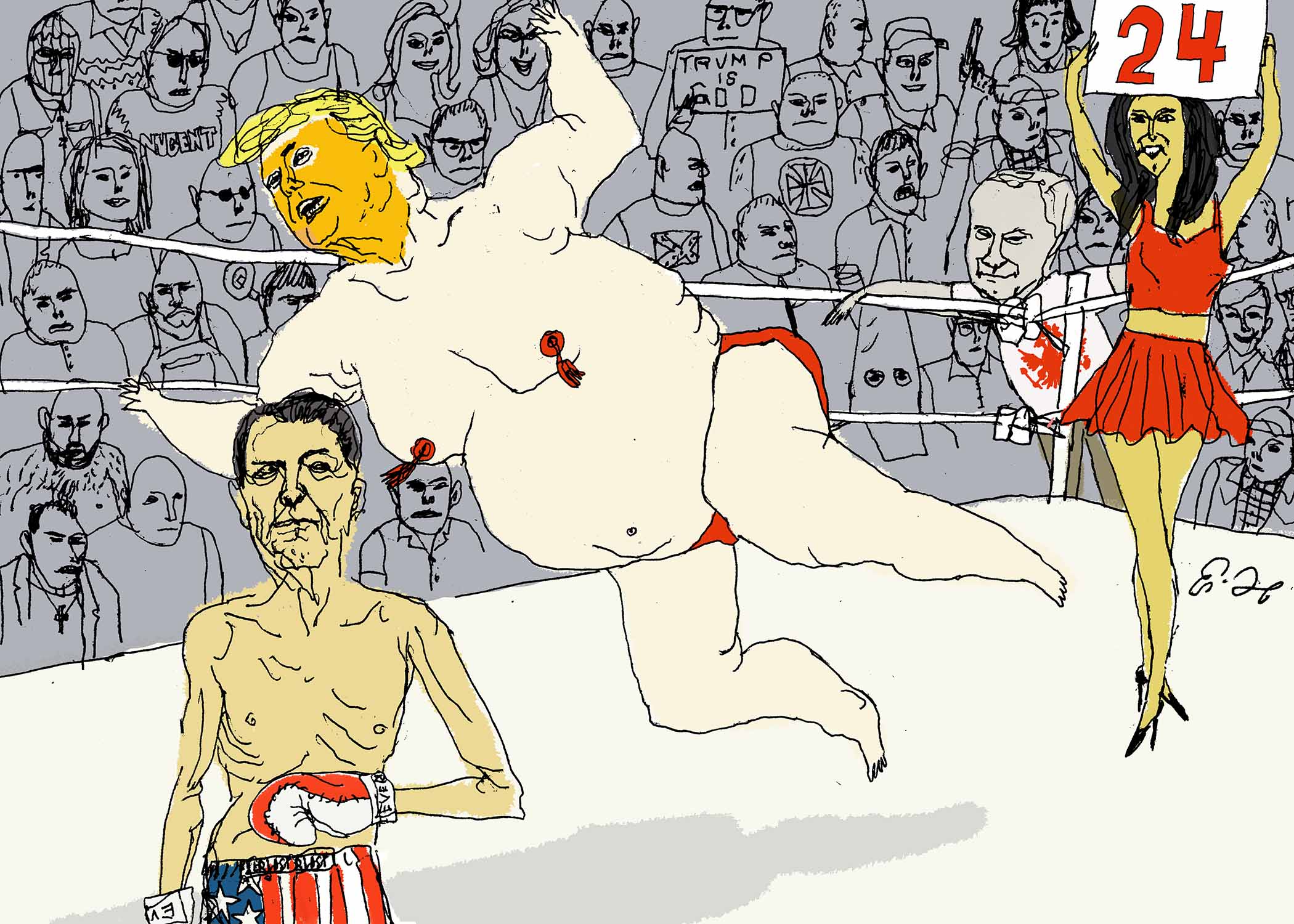
More notable, perhaps, and mostly overlooked by the media, is what Good actually said in his endorsement: Trump was the greatest president of my lifetime. Good was born in 1965. He spent his young adulthood in the shadow of the patron saint of the GOP, Ronald Wilson Reagan.
Trump, at least for this ultra-conservative, had displaced the man who defined conservatism in the second half of the 20th century.
Good is not alone. Talk to enough Republicans today and you’ll understand that Trump will not only control the party until he dies — he is well on his way, even while facing four indictments, to claiming his third consecutive Republican nomination for president — he will also join the pantheon of their most revered presidents. As memories of Reagan fade, Trump will only loom larger as the president who said, out loud, what the most enraged Republicans were always thinking. Genteel patricians such as Mitt Romney can never win their approval again. Trump, the WWE-style brawler and eternal showman, is their man.
Pundits have been late to this realization. After the 2022 midterms, DeSantis was hyped as Trump’s successor, even as Trump, lying tirelessly about the outcome of the 2020 election, had plainly gone nowhere. Trump’s endorsed Senate candidates, including Dr. Oz and conspiratorial ex-general Don Bolduc, were alienating novices, and their losses were thrown onto Trump’s ledger. The thinking went that if Trump sent up so many duds in the midterms, his political stock would be damaged.
The presidential primary has proved all of that wrong. The last candidate standing is Nikki Haley, a Republican in the mold of Romney, or even Reagan himself, a neoconservative who wants to spend lavishly on foreign interventions while slashing spending back home. Haley will lose, in part because she lacks the cult of personality that has hardened around Trump. She is not willing to indulge in his most pernicious falsehoods.
Trump single-handedly obliterated the immigrant-friendly wing of the GOP.
And she is an ill fit for the current Republican Party, one that has embraced Trump’s ideological flexibility. Trump is the president who, through his appointment of three conservatives to the Supreme Court, got Roe v. Wade overturned. Evangelicals, transactional in their approach to electoral politics, will forever be loyal. And Trump is the candidate who is unwilling to embrace a national abortion ban. He even called DeSantis’s six-week abortion ban in Florida “too harsh.”
As president, Trump functioned, on many policy matters, as a conventional fiscal conservative. It’s why party elites now back him. His primary legislative achievement was a lavish corporate tax cut, passed under Paul Ryan’s speakership.
Where Trump differed domestically from prior Republican standard bearers was his abandonment of the cause of privatizing and slashing Social Security and Medicare. George W. Bush tried and failed to privatize Medicare, and most Republicans spent the 2000s and early 2010s floating their own plans for far-reaching entitlement cuts. Trump also repudiated NAFTA, joining organized labor and certain progressives like Bernie Sanders in his populist critiques of a free-trade agreement that sent manufacturing jobs overseas.
Most importantly, there was Trump’s xenophobia, which perfectly matched the mood of the Republican electorate. Before 2016, Republicans like Reagan and Bush had demonstrated an interest in immigration reform — allowing new, low-wage workers into the country was considered, at the time, the pro-business and conservative position to take. Trump upended that calculus and single-handedly obliterated the immigrant-friendly wing of the GOP.
All Republicans today operate beneath Trump. His isolationist foreign policy instincts don’t define the party entirely — hawks like Lindsey Graham and Tom Cotton still command attention — but some of the GOP’s brightest and most incendiary stars, including Marjorie Taylor Greene, make it a part of their brand to oppose foreign military aid, particularly to Ukraine. The most seminal and overlooked moment of Trump’s national political career was his decision, during the 2016 primary, to openly repudiate the Iraq War. At the time he was running against Jeb Bush, brother of the war’s architect, and faced down a South Carolina electorate that was resolutely supportive of the American military. Trump, suddenly anti-war, took every delegate in the state.
Whether Trump can beat Joe Biden now remains to be seen. His fluctuating lead in head-to-head polls may shrink once he’s coronated at the Republican convention and voters begin to pay closer attention to the race. A conviction in any one of his trials could hurt his standing as well.
What is clear, no matter what, is that the Republican Party is his. There is no longer any question. He is conqueror and king. ❖
Ross Barkan is a writer from New York City.
Watch this space for more essays as we count down to America’s Semiquincentennial. What kind of celebration it will be is up to us.