



“I thought he was a very nice gentleman. Soft-spoken. I thought so right up to the moment I cut his throat.”
Thus opined murderer Perry Smith in Truman Capote’s In Cold Blood, an account of the 1959 slaughter of farmer Herb Clutter and family in their Kansas home. That 1966 book chimes in many ways with our own sociopathic times, such as this recent pronouncement from the president of the United States about a double murder:
Rob Reiner, a tortured and struggling, but once very talented movie director and comedy star, has passed away, together with his wife, Michele, reportedly due to the anger he caused others through his massive, unyielding, and incurable affliction with a mind-crippling disease known as TRUMP DERANGEMENT SYNDROME.
As we now know, the couple’s hopelessly troubled son has been charged with the murders, but Trump’s sampler-pillow-from-Hell prose seems very much of our moment. Still, it is possible, in this latest age of anxiety, to move beyond the unrelenting nastiness vomiting forth from on high to the realm of conceptual wit and aesthetic grace on display in a two-person show at Elliott Templeton gallery, “Actual Queers Kissing!,” featuring Alex Jovanovich and David Carrino.
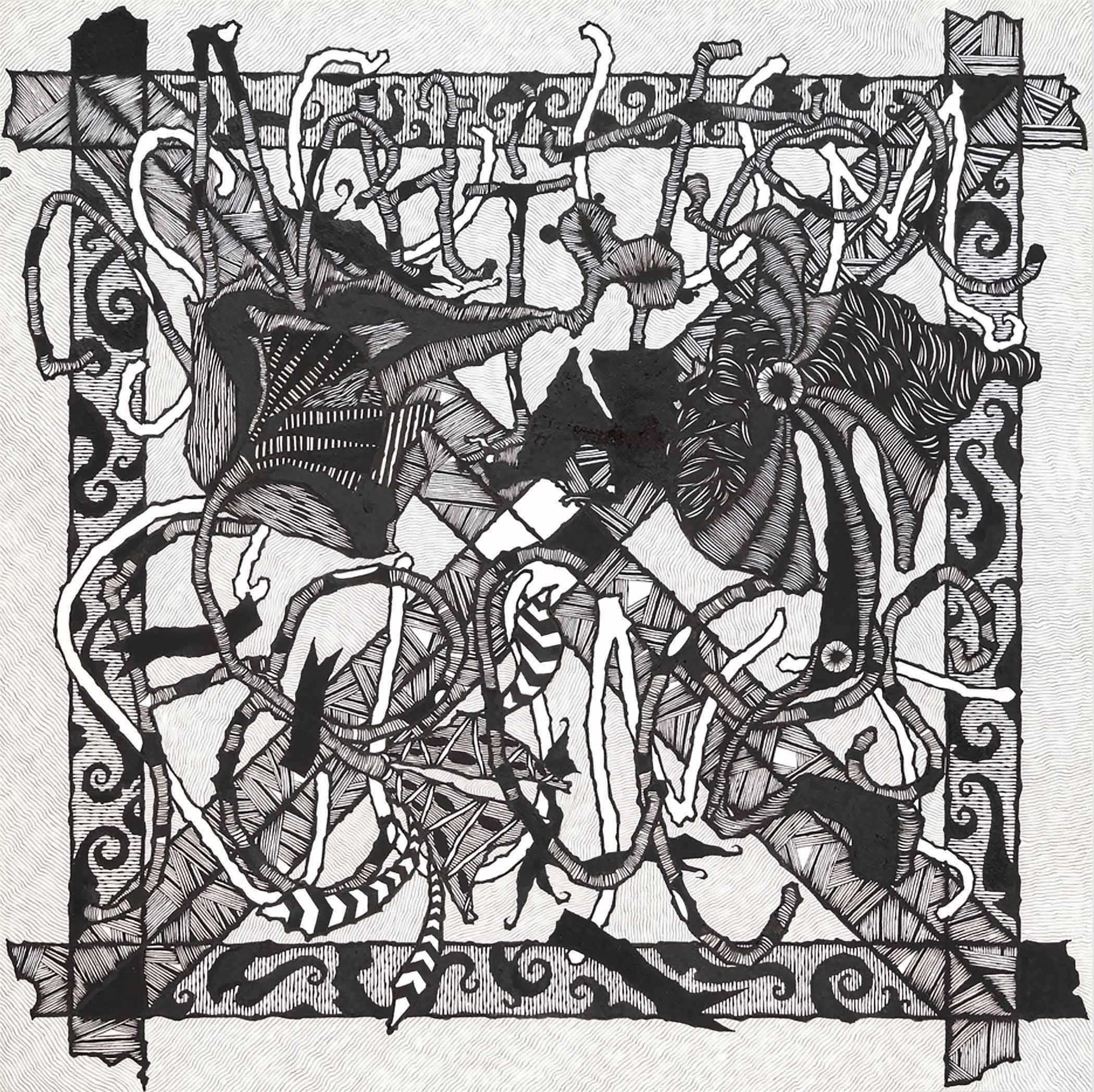
If the title of Jovanovich’s “I Fucked Your Dad Then Slit His Throat (WHITE FECES/SCUM CUNT)” (2025) promises the foulest dregs of decadence, the delicately wrought fields of pencil lines complementing bold black ink designs offer a contrasting vibe of sheer graphic delight. While forming at first glance a neutral background, the gray graphite striations actually pulse and bounce in regimented waves, adding visual buzz that surrounds the wriggling ink entities. Initially, you grasp the strong X shape in “I Fucked Your Dad,” but closer inspection reveals that some of the organic, wormy shapes form the letters of the parenthetical subtitle. Yet rather than reduce his work to a “find the hidden word” jape, Jovanovich’s bold arabesques and furls of ink keep the viewer’s eye in constant motion, the tight crosshatching acting like string lashing the myriad shapes together into a fetish for some ritual — whether of love or death being immaterial, since the two states are eternally entwined.
Carrino presents us with muffled promise, with visions of adversity abutting the will to be somebody, damn it!
And beyond the title’s murderous implications, those with an art history background might wonder about the off-kilter Oedipal narrative, perhaps flashing on Valerie Solanas, the disgruntled playwright and author of the SCUM (Society for Cutting Up Men) Manifesto, who shot and almost killed Andy Warhol in 1968. Certainly, Jovanovich’s intricate pencil webs create a vibrant limbo from which the words “SCUM CUNT” rise off the paper’s surface, white as bones.
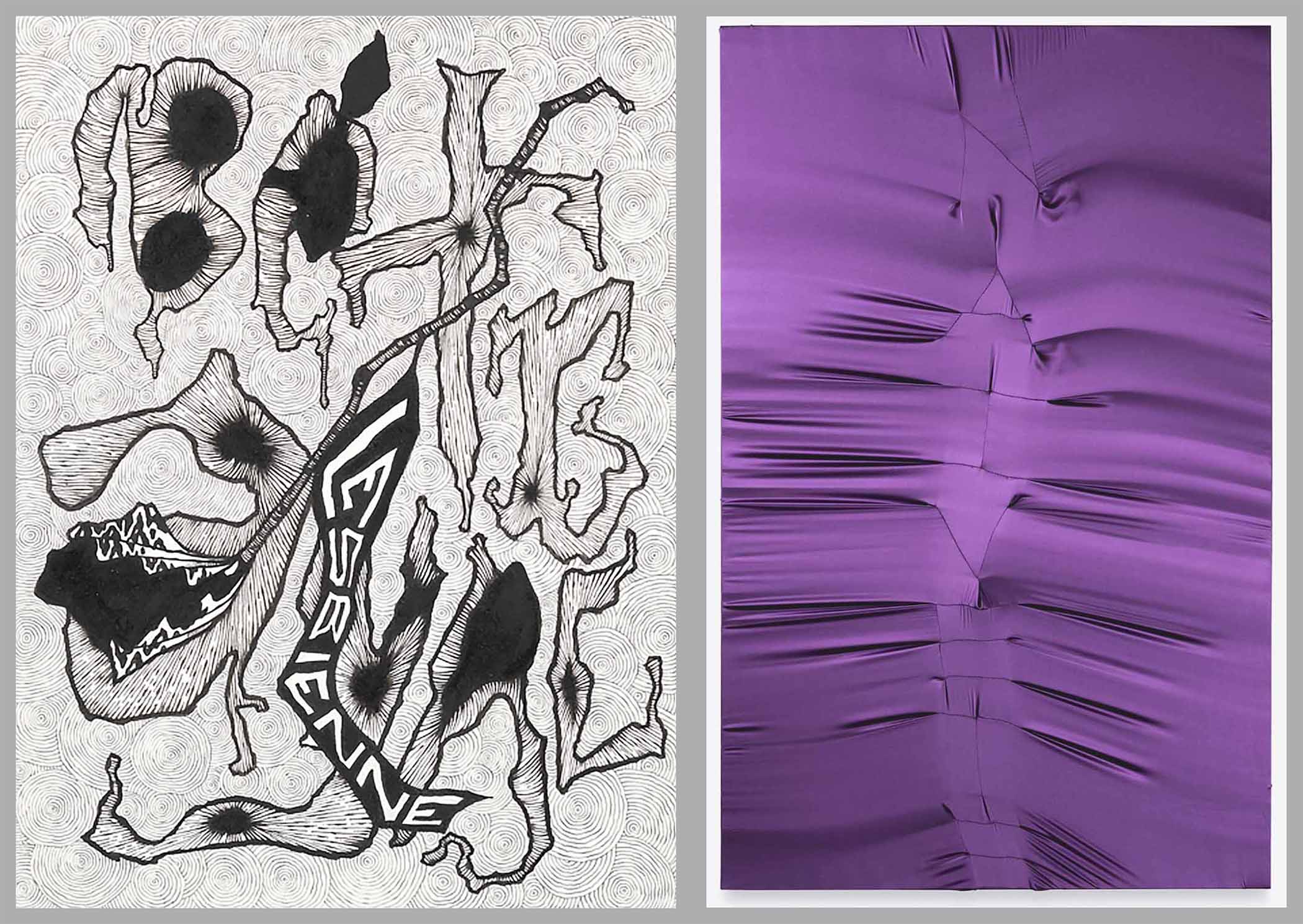
The Pope of Pop is not the only antecedent that might come to mind while perusing these works — there are also ghosts from earlier in the past century, such as Paul Klee’s playful abstract figures or Otto Dix’s diseased streetwalkers, mutilated soldiers, and corrupt officials. (Jovanovich, a senior editor at Artforum and 2014 Whitney Biennial artist, undoubtedly knows his art history.) In “It Didn’t Have to Come Down to This” (2024), the work’s subtitle arises from the words “LESBIENNE” — spelled out on a drooping banner — and “BETRAYAL,” in letters that float like blowing ash across a field of overlapping, radiating graphite circles. There’s comic verve here, reminiscent of the grotesque portraits by the mid-20th-century cartoonist Basil Wolverton, but with the added heft of abstract rigor.
Similarly, Carrino first caresses the eye with sumptuous fabric, as if an Edith Head gown had been stapled onto a painting stretcher. Quickly, the radiant contours of the irregular pleats and folds draw us in for closer perusal, and then the actual words spelling out a title such as “Does Your Mother Know” (2025, and sans question mark) well up into our consciousness, the ersatz letters stitched into the cloth, creating push-pull plains of wrinkles and taut smoothness that add inflections to the chosen phrases. “Mother” greets us in royal purple, while “This Is Not A Brothel” reposes in luminous emerald, the puckered silk as charged with Eros and Thanatos as one of Steven Parrino’s wrenched and restapled canvases — simultaneous rigidity and flaccidness.

The individual letters of “Naiviete” (2025) squirm down the fabric like a misaligned spine, tension to beat the band achieved here literally and metaphorically. The piece reminds you that one who steps into a playground of desire without the armor of — at least — cynicism is spoiling for a fall.
Just as Joseph Beuys covered a grand piano with felt in 1966, a metaphor for, among other insights, the truncated physicality of children deformed by thalidomide, Carrino presents us with muffled promise, with visions of adversity abutting the will to be somebody, damn it! Hence, in “Look What They’ve Done To My Song, Ma” — the title riffing on the oft-covered 1970 Melanie tune — the flashy green silk yanks and buckles like a dream segueing into nightmare. And while a moniker such as “The Miracle Worker” will have some viewers reflecting on Patty Duke’s portrayal of a young deaf and blind Helen Keller lashing out at her teacher, the purple passion of the warped fabric also conveys the spastic — then blissful — sparks of Emma Stone’s Bella Baxter awakening to primal pleasures in the recent Poor Things.
Indeed, Jovanovich’s and Carrino’s works cavort with mortality, joyously dancing on numerous — your enemies’? your friends’? your own? — graves along the way. ❖
David Carrino & Alex Jovanovich: Actual Queers Kissing!
Elliott Templeton Fine Arts
105 Henry Street
Through January 11, 2026