




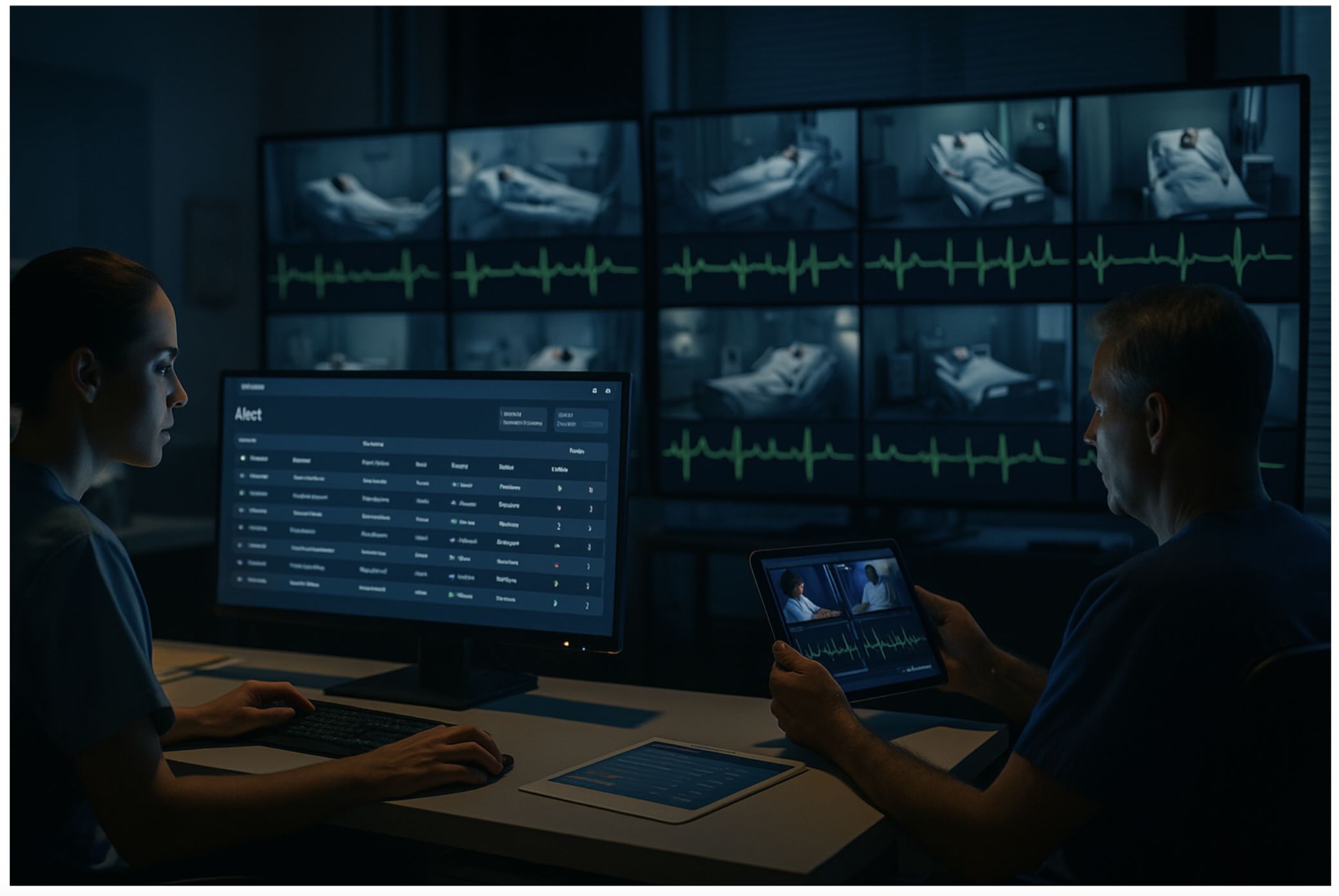
Hospitals, nursing homes, and rehabilitation centers across the United States face severe staffing shortages. The American Health Care Association reports that nearly 60 percent of U.S. nursing homes have restricted admissions because of inadequate staff. Hospitals confront the same reality, where nurses often manage far more patients than recommended.
The consequences are immediate. A fall at night or sudden respiratory crisis can go undetected for minutes. Subtle warning signs may be missed entirely: a strained voice, a moment of unsteadiness. Artificial intelligence tools are being designed to monitor patients 24/7, but their effectiveness depends on the quality of the training data that teaches them to distinguish signal from noise.
Why Better Audio-Video Data Matters
Monitoring AI must learn to separate background activity from true indicators of danger. The creak of a bed frame or the sound of a television should not trigger alarms. Poorly built datasets cause algorithms to flood caregivers with false alerts, consuming attention and eroding trust.
“Models can only learn what they are shown,” said Rohan Agarwal, CEO of Cogito Tech. “If the training data doesn’t capture the difference between routine sounds and real danger, the system will keep flagging events that aren’t critical.”
Datasets must span the full range of clinical environments and behaviors so that systems trained in one location work reliably in another. The challenge is serious: a 2024 study in BMJ Quality & Safety found that nearly 90 percent of hospital alarm signals were false or clinically insignificant, creating “alarm fatigue,” where staff tune out warnings altogether.
Listening and Watching for Early Signs
Sound and motion provide some of the earliest clues to deterioration. Coughing, gasping, or sudden silence may signal respiratory distress. Video can show slumped posture or an unsteady first step that precedes a fall. To train AI to recognize these signals without overreacting, data annotation must be precise, frame by frame for video, signal by signal for audio.
“It’s not enough to label that someone coughed,” Agarwal explained. “You have to capture context, how long it lasted, how often it occurred, and whether other signals appeared at the same time.” Datasets must also reflect different lighting, room layouts, and patient profiles to adapt across care settings.
Evidence is emerging. Pilot programs in European elder care facilities show that multimodal audio-video datasets cut false alarms for falls and respiratory distress by more than 30 percent compared with earlier single-sensor systems, according to a 2025 European Geriatric Medicine Society report.
Privacy and Traceability
Collecting patient audio and video is sensitive. HIPAA in the United States and GDPR in Europe set strict requirements. Developers now use on-device anonymization, audio de-identification, and encrypted pipelines to protect identities while retaining the signals needed for AI training.
Regulators also require transparency. The FDA’s 21 CFR Part 11 standards demand documented records of how datasets are collected and validated. “Healthcare AI will only be accepted if the data behind it can be audited,” Agarwal said. “That means every annotation must be traceable, from raw signal to final label.”
Privacy and Traceability
Using patient audio and video for AI requires more than technical accuracy. It raises questions of consent, trust, and accountability. HIPAA and GDPR rules demand more than anonymization or encryption, they require clear documentation of how data is captured, labeled, and stored. The FDA’s 21 CFR Part 11 standard adds another layer, insisting on audit trails that show exactly how each annotation connects back to the original signal.
The issue is not just legal compliance. If patients or families believe monitoring tools compromise privacy, hospitals may hesitate to adopt them. Trust depends on systems that can demonstrate both safety and respect for confidentiality. Without that, even the most advanced AI will struggle to gain acceptance.
The Role of Clinical and Emergency Expertise
Technical annotation can only go so far without clinical context. Board-certified physicians and nurses can help define what counts as a clinically significant event, distinguishing routine variation from signs of genuine distress. EMS professionals, who regularly manage rare but acute scenarios, can guide how those high-stakes moments are represented in training data. Their input ensures that models are prepared for the events where detection speed matters most.
This expertise also sharpens how annotations are applied. A slow descent into a chair is not the same as a collapse to the floor, and a single cough differs from a persistent fit with shallow breathing. Clinicians and EMS staff bring the nuance that makes those distinctions meaningful, improving both dataset reliability and frontline trust.
Toward Reliable Monitoring
The pressure to extend caregiver capacity will only grow with aging populations and staff shortages. Automated monitoring can help, but only if it avoids the pitfalls of false alarms and narrow training data. A system that cries wolf too often, or fails to recognize risks in diverse settings, is worse than unreliable. It erodes confidence in technology and wastes attention that caregivers cannot spare.
Reliability comes from breadth and balance. Data must represent different patient groups, clinical environments, and risk scenarios, so that models perform consistently outside controlled pilots. Early results, like the reductions in false alarms seen in European trials, suggest this approach works. Adding board-certified and EMS insight into dataset development extends that reliability by embedding clinical judgment directly into the training process.
The next challenge is scale: building datasets broad enough, and transparent enough, to support systems that caregivers trust to act as a true second set of eyes and ears.