






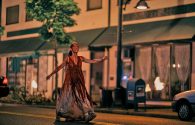


The Hunting Gun’s two stars are native Russian and Japanese speakers, working with a French Canadian director, on a play based on a 1949 Japanese novella by Yasushi Inoue. One of the world’s most famous dancers is close to immobile in his role: silent, behind a semi-transparent screen onstage. A prominent Japanese singer-actress portrays, sequentially, a niece/daughter, a wife, and a mistress/mother, all writing vehement letters to the same man. She never leaves the stage, changing hair and wardrobe for each woman while performing, bringing to life Inoue’s emotionally fraught 184-page novella in 105 minutes. The Hunting Gun — a two-hander starring Miki Nakatani as Shoko, Midori, and Saiko and Mikhail Baryshnikov as Josuke Misuge — is Baryshnikov’s, and the play’s, American debut. Performed in Japanese with English supertitles, the story (sans major spoiler alerts) is described as “Three letters. One tragedy.” Misuge is a businessman and hunter who is having an affair; Nakatani’s Shoko is his distressed niece, Saiko his mistress and Shoko’s mother, Midori his vivacious wife … and Saiko’s stunning younger cousin.
Nakatani has starred in the Canadian and Japanese productions of the show, and knows what’s in store for her emotional state by The Hunting Gun’s dramatic conclusion: “I feel like I’m carving my body with a knife every night.”
At the back of a high-ceilinged Midtown rehearsal studio, 15 days before the March 16 opening night, Baryshnikov meditatively polishes the titular hunting gun. With mesmerizing slowness, he raises the rifle and points it at Nakatani, who, clad in a red slip dress, is crouched on the studio floor, her back to him. Director and creative producer François Girard jumps up and whispers directions into Baryshnikov’s ear. On this rainy day, his silver hair the color of the sky, Baryshnikov, in tweedy trousers with suspenders, is several days into rehearsals with Nakatani. The award-winning actress made her stage debut in these roles under Girard’s direction in Canada, in 2011, followed by Tokyo, in 2016; she first worked with him on his 2007 movie, Silk. (She is likely best known to Americans via her starring role in the Japanese horror film franchise Ring.)
Baryshnikov, 75, might not be replicating his famous 11 pirouettes from the 1985 movie White Nights, but his toned physique is taking on a new challenge: Stillness. Speaking after that day’s rehearsal, he invokes groundbreaking modern dancer–choreographer Martha Graham’s influence on his performance. “[Girard] loves those frozen moments. The long, long moments of total silence, like from me, for example.” In still heavily accented English, the Latvian-born performer continues: “I think that’s kind of familiar to me, a bit, to keep the intensity of a moment without saying it. It’s kind of an interesting challenge to do a role without words; not a dance role.”
“When Misha showed interest to do the run with us, I immediately contacted Miki because I felt that they could meet at the same altitude, and it’s not anyone who can meet Misha.”
It’s Nakatani who has a shape-shifting physical role. While Baryshnikov’s simmering stillness and presence speak volumes, it’s the actress whose words and body are ever-changing. Girard worked with Nakatani using the Alexander Technique, a method of working with the body to establish or reestablish freedom of movement. The technique has been used therapeutically, but many actors utilize it to ensure that their body is completely free and ready to express whatever is called for. In The Hunting Gun, Nakatani’s physicality defines the three women: Her body and language are tense and intense as a just-out-of-her-teens Shoko; dramatic and coy as Midori, 33; and regal and resigned as mistress and mother Saiko, who believes her affair to be a secret from all.
As Girard explains in a post-rehearsal email: “Shoko being introverted and angry and thinking she’s ugly … not as beautiful as Midori and Saiko. We’ve twisted her core bones in a way that doesn’t hurt Miki, of course, but that will define Shoko’s breathing, her walking, her speech, and everything. And then, similarly, we’ve created a completely open, free, and slightly drunk bone twist for Midori that will define everything in her physical behavior. And the same thing for Saiko, who is completely balanced, centered, and free of all human conflict. We use the same techniques for the three women with three very different results.”
It’s early February 2023, less than a month and a half prior to The Hunting Gun’s opening night, and Nakatani is speaking to me via Zoom from Tokyo. It’s before she’s rehearsed with Baryshnikov — she’s never met him and is against the idea of a Zoom introduction.
“I said no, our first context should be more dramatic. I didn’t know him personally, but as an artist, of course, we all admire him,” she explains. “When I was 16 years old, I saw his movie called White Knights. That was shocking for me, to see someone who had to escape from his own country. It’s still sticking into in my brain, my mind, that last scene, that very emotional scene where he went out of his country.”
Inoue’s novella is set in Nakatani’s home country, and both the book and the play are remarkably timeless, with a few giveaways as to the 1930s–’40s time period spanned in the book. On the website Music & Literature, writer Ariel Starling delves into the work’s epistolary nature: “Each account provides a different perspective … the technique is reminiscent of Rashōmon — what is unique here is that the events themselves never change, only their interpretations.”
“It is a Japanese story, but I think it’s kind of worldwide,” says Nakatani. “How do you say … very universal? A universal and fundamental story.” The tale, though, does upend some commonly held tropes. “[There is] the image that we are not showing so much facial expression [in Japan]. Because more than 1,000 years ago, there was an era called the Heian Period. And aristocratic people believed showing a facial expression is not elegant. So they shave their eyebrows, men and woman both. They make the face very white, and draw fake eyebrows on top.” Tradition is strong, Nakatani explains. “We still have this image that showing our emotion is not elegant. But at the same time, we have the emotion.”
A Tokyo native, Nakatani had not been in NYC for several decades prior to rehearsals for The Hunting Gun. That said, she did star in a stage version of Lost in Yonkers — in Tokyo, in Japanese. And she’s very curious about America’s perception of Japanese women. I say that previous generations might have used descriptors like “quiet” or “obedient.” On the Zoom screen, she nods. “That was my idea also. You know, I think most of the Westerners have the image of the Japanese woman as maybe obedient and maybe modest. Actually,” she says with a smile, “we are not.”
The Hunting Gun’s lover, daughter, and cuckolded wife bring a broad spectrum of emotion and insight: Saiko fixated on her idea of sin and the purity of love; Shoko distressed by discovered secrets; and Midori at once prideful and insolent toward her husband and Saiko. Yet each woman shows a core of practicality, sense of self, and painful self-knowledge in their letters to Josuke Misuge.
Girard’s third production of The Hunting Gun is gratifying: “For me it has become my happy place, a home I want to go back to, a super-comfy slipper. It’s a masterpiece, and so true to the human sentiment. It does speak to our current culture, our current era, in the sense that one way to look at it is that this is a story of three women who are taking control of their lives and feel empowered to say ‘stop.’ The credit really goes to Inoue as a forward thinker, and also somebody who loves human beings and had the talent to explore the souls and the minds of all of us.”
In one lyrical passage in The Hunting Gun’s American translation, from Pushkin Press, Midori writes to her husband: “… strangely all it took was a vision of that achingly blue, glittering ocean, heaving itself up in my mind’s eye, and the agony that had burnt my heart — that a second before had been barely under my control, threatening at any moment to explode into madness — would subside, as if it were a thin sheet of paper that I had peeled away.”
On March 2, in New York, several days into rehearsals with Nakatani, Baryshnikov tells me that his onstage compatriot is “like a Greta Garbo in Japan, she’s so well known. I’ve seen a couple of films she’s done, including Silk she did with Girard. She is hugely photogenic. And she’s curious, not afraid to ask, and I love this. Simple people like that, and so complex. I’ve worked in Japan quite a bit with Japanese teams. I already know a lot of rules.” By rules, the actor-dancer-choreographer explains: “It’s all inside. The way every person knows their place, what she or he has to be ready to do. It’s really wonderful.”
Girard, as the architect of the pair’s initial encounter and their Hunting Gun collaboration, has a “very engraved memory of when they first met…. Directors, this is what we can do. We can put a lot of time in the text and this and that and design. But putting the right people on stage or in front of the camera is like half of our contribution. That doesn’t take that much effort or time.” He continues, “It’s a matter of decision. When Misha showed interest to do the run with us, I immediately contacted Miki because I felt that they could meet at the same altitude, and it’s not anyone who can meet Misha.
“We are proud of the Japanese beautiful language and pronunciation. I don’t want to, how do you say, destroy the beautiful stream of the river.”
“I think here we have a balance of charisma, and then also Miki’s completely unknown in New York. Misha is known in Japan, but it’s going to be a different dynamic.”
Baryshnikov, chuckling, responds, “Thank God I don’t have any words to say. It’s a supporting role. All the weight is on Miki’s shoulders. I’m a sidekick.”
On March 16, the stage of the Jerome Robbins Theater was Zen-like and nearly bare, but packed with talent and tautness. The staging, which includes three surfaces — shallow water strewn with lily pads, smooth rocks that clack loudly when Nakatani moves, and thin wooden slats that roll out into a stage — incited theatergoers to examine and photograph the setup post-show. As Nakatani performs in Japanese, the dialogue, in English, runs across a see-through scrim above the stage. Baryshnikov is on a platform in the back, above the stage, his actions and expressions often appearing somewhat misty through the scrim.
Despite the seeming simplicity of the play and its staging, the dialogue from the 1949 book went through numerous iterations. “First I worked a month with Serge [Lamothe, the French Canadian writer who adapted The Hunting Gun for the stage],” Girard tells me. “It was first adapted in French. Then it went to the Japanese writer. We indicated our edits, reductions, versions. All of our editing that we did in French was transported into Japanese through English, because our writer didn’t speak French. Then, now what you see is like back into a phonetic translation … lots of work, fine-tuning and fine-tuning with my team.”

When the play was first staged in Montreal, “François asked me to do this performance with French language,” recalls Nakatani, who is fluent in French. “I said no. Because the beautiful writing style is not able to translate in any other language. We are proud of the Japanese beautiful language and pronunciation. I don’t want to, how do you say, destroy the beautiful stream of the river.”
For that first production, Girard also asked Nakatani which character she wanted to play. Her response? All of them. She explains her ambitious decision: “If I had to choose one, there is no possibility for me to prove what I’m able to do in this performance. I had to do all three characters.”
Girard was surprised but intrigued. “Immediately, he was kind of imagining what he could do. And he said, ‘Oh, it’s much cheaper if I have to pay only you,’” Nakatani remembers the director quipping.
Girard says he first encountered The Hunting Gun in the early 2000s. “A friend of mine put it in my pocket and said, ‘You should make a movie with this book. It’s a marvelous book.’ I read it, and it was indeed marvelous. But for me, it was a play more than a movie.”
For his part, Baryshnikov had already read a lot of Inoue’s work, but only delved into The Hunting Gun when Girard gave him the novella to read. Inoue, a renowned literary figure in Japan who died in 1991, is not well known to American audiences. However, in a preface to the American edition of Inoue’s novel Tun-huang, author-translator Damion Searls called The Hunting Gun Inoue’s “masterpiece,” terming it an “exquisite book showcasing Inoue’s great strengths — his remarkably sympathetic, complex and true female characters.”
Reviews of the show have been generally strong, with The New York Times calling the play’s American debut a “meticulously handsome adaptation.” Yet the amount of reading required proves a challenge for English-speaking attendees; the dialogue-heavy performance demands constant attention, and, as the Times noted, with Baryshnikov “upstage with the supertitles just above him … that pulls focus from Nakatani.”
In any language, however, the actress’s focus, passion, and talent in these juicy but demanding roles speaks loudly. With the play closing on April 15, what’s next on her dance card? “Ohhhhhhhh! I can’t think about that. This is a huge project to me, even though it’s a small theater. I devote all my energy. It’s almost like a religion, The Hunting Gun, where I’m giving whole energy and devotion. I’m a devotee of this project,” Nakatani concludes. “I’m a slave. I’m obedient to this.” ❖
The Hunting Gun
Baryshnikov Arts Center, Jerome Robbins Theater
450 West 37th Street
Through April 15
Katherine Turman has written for Entertainment Weekly, Spin, Variety, and other publications, and is the author of Louder Than Hell: The Definitive Oral History of Metal. She lives in Brooklyn.