








AI is reshaping how sales organizations operate faster than most companies can adapt to it. The tools most teams rely on were built before modern AI existed, which means they were built around limitations that no longer apply.
Hyperbound is positioning itself to fill that void. The AI sales coaching platform ingests calls, deals, emails, and calendar events from an entire sales organization, then runs the information through AI to surface coaching opportunities, flag risks, and tell sales leaders exactly what is and isn’t working. Patrick Dajos, a founding engineer who’s been with the company since it had fewer than eight employees, built much of what makes that possible, and believes the technology is only beginning to show what it can do.
What Hyperbound Does
The sales software market has no shortage of tools that record calls, track deals, and generate reports. What Hyperbound argues, and what its growth appears to support, is that most of those tools were built before modern AI existed, which means they were built around limitations that no longer apply.
Hyperbound works by ingesting calls, deals, calendar events, and emails from across a sales organization, then running AI analysis on all of it. The result is a platform that helps tell a sales leader not just what happened on a given call, but what it meant: whether a deal is progressing well, where a rep is consistently losing momentum, and what patterns separate top performers from the rest. Sales teams can also use the platform to create roleplays drawn directly from their own data, letting reps practice against scenarios that reflect their actual pipeline rather than generic scripts.
“The rise of AI gave us a genuinely new way to compute data,” Dajos says. “We can now analyze the meaning behind calls and understand how a deal is progressing, and we want to use that to solve sales enablement entirely.”
The company’s stated goal is to become what it calls the revenue activation platform for sales teams: a single system that analyzes every touchpoint in the sales process and delivers real-time guidance on what to improve. It is a broad ambition, but one that the company is backing with specific product decisions rather than category-marketing alone.

The Systems Dajos Built
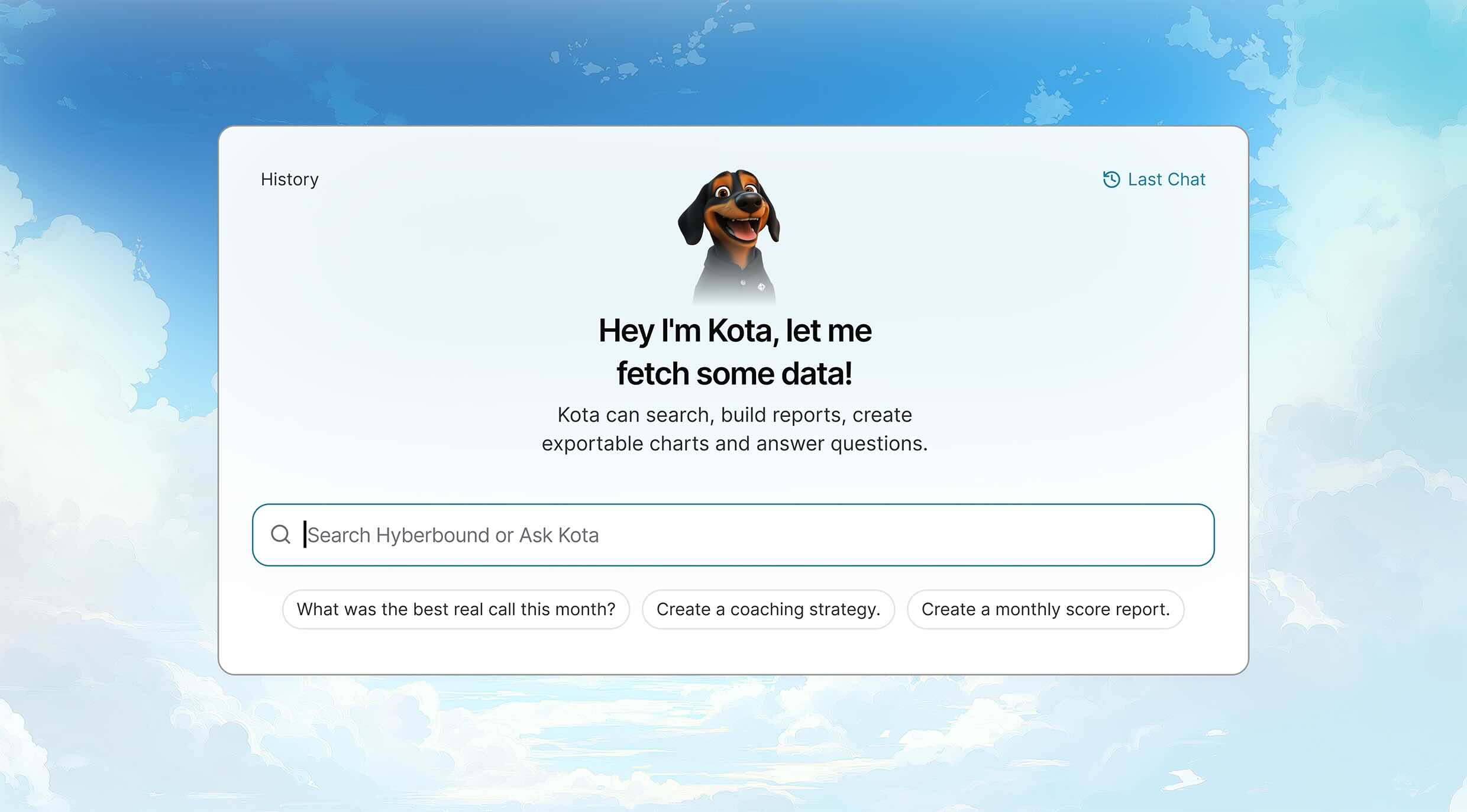
When Dajos talks about his work at Hyperbound as founding engineer, he does not lead with architecture diagrams or engineering abstractions. He leads with what the products actually do for the people using them. “I engineered Kota, the company’s AI analysis chatbot,” he explains. “I also built the real call coaching, and I actively work on the analytics. Those are some of the core features of what Hyperbound does.”
The first project he references is Kota, Hyperbound’s AI chatbot, which Dajos built from scratch. Before tools like Kota existed, a sales manager who wanted to understand why a particular deal stalled, or which reps were consistently losing momentum in the second half of a call, would have needed an analyst to pull the data, structure a query, and produce a report. Kota collapses that process into a conversation. A user can ask, in plain English, what’s happening across their sales organization and get a direct answer.
The call coaching system, on the other hand, operates on a different but related premise. Instead of scoring reps against a generic industry rubric, it measures performance against scorecards that each organization builds for itself. A company running a consultative, relationship-driven sales motion will define good differently than one running high-volume transactional deals, and Hyperbound’s coaching reflects that. The feedback a rep receives is grounded in how they actually performed against standards their own organization set, which makes it actionable in a way that one-size-fits-all benchmarks rarely are.
Underneath both of those products sits the analytics infrastructure Dajos developed to tie everything together, a system that synthesizes activity data across an entire sales organization to surface patterns that would otherwise stay buried in the noise.
What connects all three is a shared conviction: that AI is capable of something fundamentally different from what traditional software could do with sales data. Older tools could track and store. Hyperbound’s systems are built to interpret: to read meaning and intent from unstructured data like conversation transcripts, and turn that into guidance a sales team can actually use.

The Hard Problem: Making AI Work at Scale
Building an AI platform that feels intelligent in a demo is one thing. Building one that stays intelligent as it ingests the full volume of an enterprise sales organization’s data is considerably harder. The core technical obstacle is what engineers refer to as the context window, which is the finite amount of information an AI model can process in a single query.
“The biggest issue right now is the context window,” Dajos explains. “We can’t put all the data into an AI model and just ask what it thinks. So we’re getting really clever about how we inject context.”
For a platform like Hyperbound, this ceiling is a real constraint. There’s far more data in a mature sales organization than can be fed into a model all at once. Feeding everything in indiscriminately would make the system slow, expensive, and less accurate. The challenge is determining, for any given query, which slice of the available data is actually relevant, and surfacing only that.
Dajos and his team are addressing this through a layered retrieval approach that combines vector databases (a way of storing data as mathematical representations of meaning rather than raw text, which makes semantic search possible) with AI-powered search and traditional keyword search running in parallel. Linguistic transformations are applied on top to further refine what gets passed to the model. The goal is to inject the most relevant context into every query without overwhelming it.
He points to Google’s recently launched AI search feature for Maps as a parallel example of the same constraint playing out at a different scale, a system trying to run meaningful AI queries across something in the range of 220 million records. The problem isn’t unique to sales software, but solving it well within a specific domain, before most competitors have seriously attempted it, is what separates a platform that feels intelligent from one that merely feels capable, and Hyperbound, Dajos believes, is building that head start now.

Culture As the Actual Competitive Edge
When describing what separates Hyperbound from larger players in the sales software market with a greater market share, Dajos points to something that might seem innocuous: how the company makes decisions. Hyperbound has stayed deliberately lean, keeping decision-making close to the engineering team and upholding what Dajos describes as a bias toward action that runs through everything the company builds.
The platform’s AI roleplay feature illustrates what that culture actually produces. Generating personalized practice scenarios drawn directly from a company’s real sales data requires a clear product vision and the execution speed to build something technically demanding before the window closes. At a larger organization, a feature like that would typically spend months in planning. At Hyperbound, it shipped.
That pace is also being accelerated by AI coding agents, which the team has folded into its engineering workflow. Dajos is clear-eyed about the tradeoffs, as agents are prone to creating bugs that need to be reviewed and fixed by humans, and the larger a codebase gets, the more discipline that review demands. But used well, they allow a small team to move with a velocity that its headcount would not otherwise support.
Dajos’s own background feeds directly into this. Running a software agency from his early twenties meant learning, without a safety net, how to sell, how to deal with different kinds of clients, and how to ship work under pressure. That experience is part of what made him effective as a founding engineer who could sit on a customer call, translate what they heard into a product requirement, and hand it back to the team the same day.
“We’re still quite young,” he says. “We need to take risky steps and make big bets. Things move faster from the engineering side because our team is still very lean, and that means we can build things that actually get through.”
Where Hyperbound Is Headed
What Hyperbound is building toward goes considerably further than a better call recording tool. The company’s long-term ambition is to handle the full intelligence layer of a sales organization: scoring calls, flagging deal risks, and synthesizing everything happening across reps and pipelines into a single, continuously updated picture of how a sales operation is actually performing. Much of that infrastructure is already in place.
Their recent $15 million Series A positions Hyperbound to push further into that vision. With its core engineering built and commercial traction established, the next phase is about expanding what the platform can see and act on: maturing the AI analysis capabilities that sit beneath everything else and capturing more of the sales stack in the process.
“The rise of AI gave us a genuinely new way to compute data,” Dajos says. “We can now analyze the meaning behind calls and understand how a deal is progressing, and we want to use that to solve sales enablement entirely.” For sales organizations, the proposition is direct: complete visibility into every rep and every deal, with AI-generated guidance on what to do about what it finds, all in one platform. Hyperbound is not building a better version of what already exists. It is building what comes next.
