




Editor’s note, April 9, 2026: Depending on the neighborhood you live in, those big trailers with portable dressing rooms or fat bundles of electric cable rolling out their back doors, along with catering tables crowding the sidewalk — well, that whole movie location scene can get really old, really fast. Sure, it’s nice to know there is only one New York City, and if a production company is shooting a crime drama or a love story or a buddy comedy, sometimes Toronto or some other urban stand-in just won’t cut the hotdog-cart mustard to convey the 24/7 hubbub of the City That Never Sleeps.
But if you’re out walking the dog and it’s been a long day and you return by a different side street and some scruffy 20-something draped with utility belts and wearing an earpiece connected to an old-school walkie-talkie asks you to not only stop where you are but also not to speak and to please keep your dog from barking, because we’re filming episode nth-teen of season high-single-digit of Amazon/Apple/HBO/Hulu/what-have-you’s latest first-responder drama/cult thriller/demimonde comedy, you might very well roll your eyes as you zip your lip and think, “Can I at least get a production T-shirt for having to muzzle Fido?”
Still, when you’ve had more sleep and six months later hit the remote and see that the bodega in your walk-up’s first floor was the scene of a mob hit (and remember that they were closed for half a day cleaning up the “blood” spray), you’ll get a minor jolt of the cultural frisson that attracted you to this mad town to begin with.
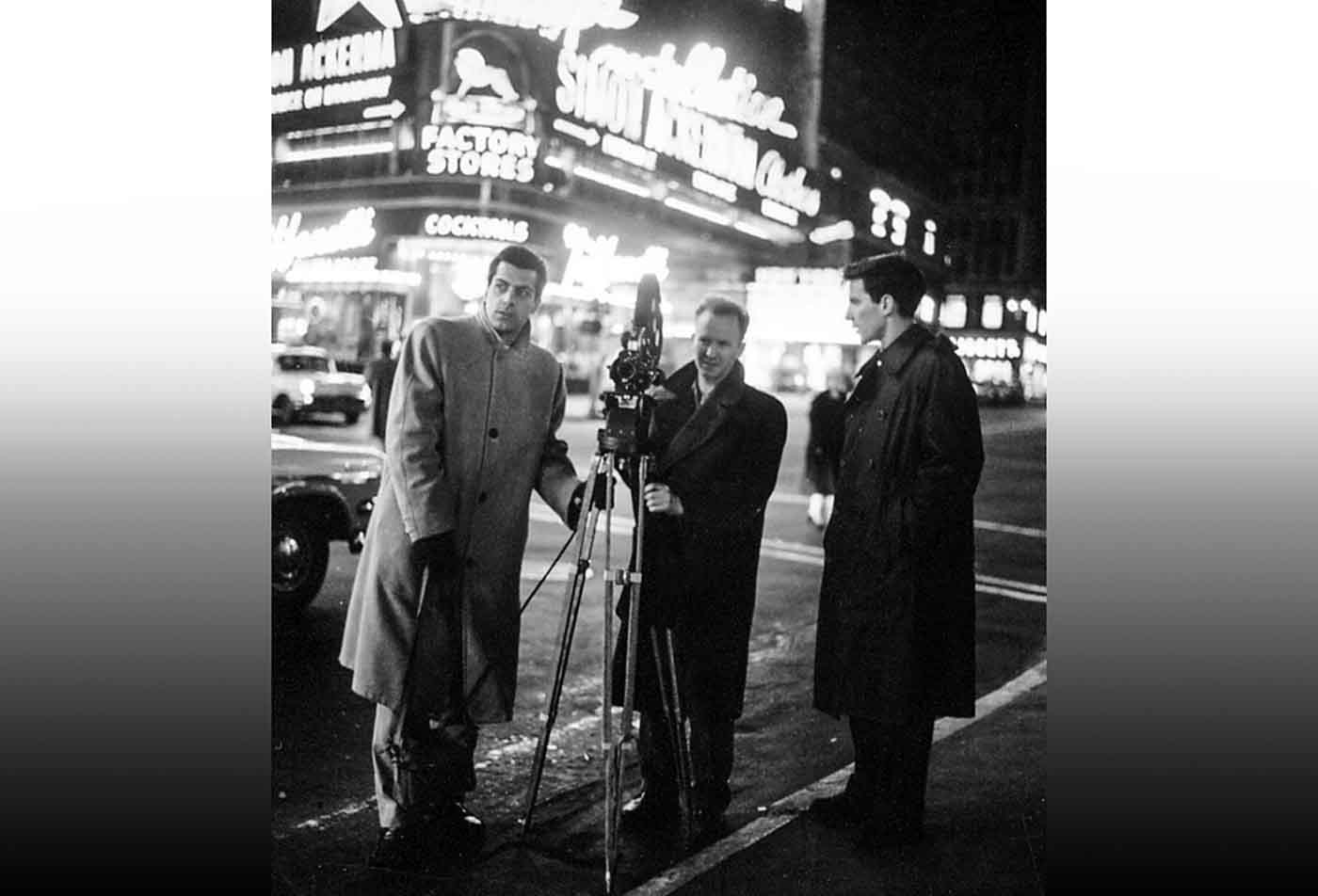
Michael Lee Nirenberg’s just released Cinematic Immunity: An Oral History of New York Filmmaking as Told by the Crews that Got the Shot offers sharp insight (and some killer images from various studio archives) on just how daring — not to say, flat-out crazy — cinematographers, camera operators, scenic artists, electricians, and other crew members have been when helping directors achieve some of the most iconic shots in cinema history. Nirenberg’s down-to-earth interviews with the artisans who set the scenes help readers appreciate both the aesthetic accomplishments and the hair-raising risks crews took to make the car/subway chase in The French Connection or the tragic hijinks on the Verrazzano Bridge in Saturday Night Fever thrillingly emotional.
The book is chock-full of interviews with the off-camera artists who did the nuts and bolts cinematic work that made such films as Midnight Cowboy, The Warriors, The French Connection, The Exorcist, The Godfather, The Taking of Pelham 123 (see below), Annie Hall, When Harry Met Sally, and television powerhouses like The Sopranos and Law and Order classics of location shooting.

Back in October 2024, Nirenberg published an excerpt of his then very much in-progress book here in the Voice. It was the Golden Anniversary of one of the grittiest films ever made on — and beneath — the streets of NYC. Anyone who has ever wriggled their way onto a crowded Lexington Avenue express train and then had their commute delayed by a static-y public address announcement about a “sick passenger” or a “police investigation” up ahead will appreciate that the much greater disruption of hostage-taking for ransom depicted in The Taking of Pelham 123 is just an escalation of the everyday subway experience, a heart-pounding fiction designed to give us an urban thrill ride.
Or so one hopes.
Below, we revisit Nirenberg’s oral history on the straphanging derring-do, both inside and out of speeding subway cars, that went into the making of that NYC on-location masterpiece. —R.C. Baker
» » » » « « « «
On Location in NYC, 1974: “Being 21, you don’t give a !%&* about life.”
Shooting “The Taking of Pelham One Two Three” down in the subways was just as dangerous as the action on the screen.
By Michael Lee Nirenberg
Originally published October 30, 2024
You might visualize the broke and grimy New York City of the 1970s through a prism of iconic films, such as The French Connection, Taxi Driver, or The Taking of Pelham One Two Three, which was released 50 years ago this month. If you haven’t seen it, Pelham is a tightly coiled, nervous-paced thriller about four subway hijackers who take hostages, demand a million-dollar ransom, and threaten to shoot one passenger per minute if kept waiting beyond an hour. This puts the city authorities in an impossible position, which they spend the film trying to navigate.
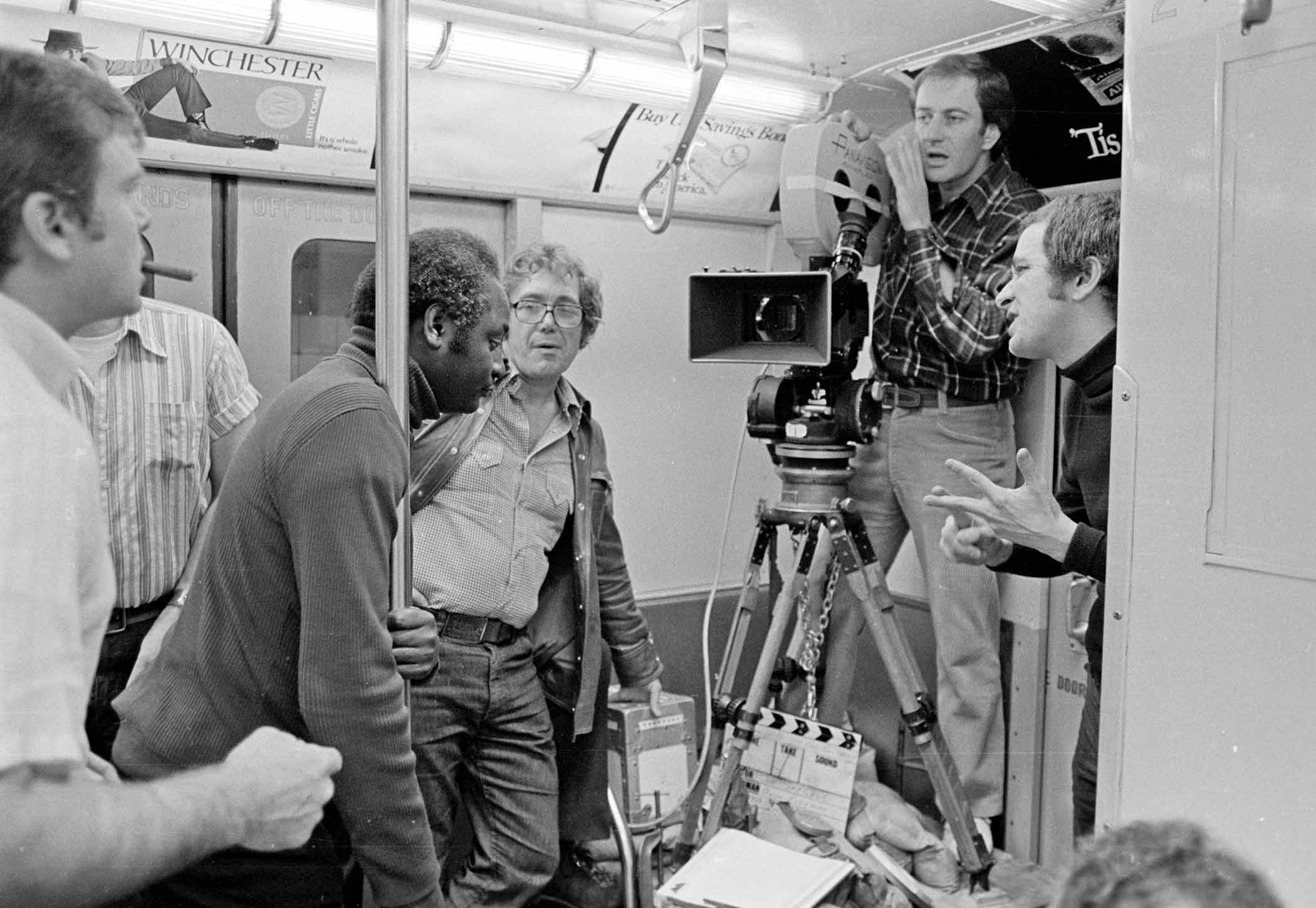
Pelham was shot between November 1973 and late April 1974. The work was physically demanding and dangerous. Even today, filming in the city is challenging (especially in winter), but in the pre-digital era, the cameras and sound recording gear were much heavier than today, not to mention the miles of heavy cables — running through rat piss puddles — needed to light the subway tracks. There was little thought to safety, aside from just staying off that third rail. (I talked to five of the crew members who worked on Pelham; the interviews below have been edited for length and clarity.)

Since 2020, I’ve individually interviewed (mostly) retired film crew members, amassing hundreds of hours of recordings for my upcoming book, Cinematic Immunity, an oral history told exclusively by New York’s crew members — camera operators, makeup artists, prop handlers, set dressers, hair stylists, wardrobe assistants, scenic artists, even an insect wrangler — all of the artisans who are overlooked by most behind-the-scenes media. The stories span from On the Waterfront to The Sopranos, arguably the peak of New York filmmaking. “Cinematic immunity” is an inside term those of us who work on film sets use to describe the feeling of invincibility that comes from working on a film crew.
The Taking of Pelham One Two Three: An oral history
Gary Muller, camera assistant: God. Pelham was a very difficult movie. Joe Sargent was the director. It was a long picture. Winter into spring. I think it was probably one of the biggest pictures in New York for a while in the subway system. It was the only game in town. It didn’t matter when the picture started because we were underground. The weather didn’t matter. We did a lot of scenes outside, but a good portion of it was done underground, or done in the studio replica.
Tom Priestley Jr., camera assistant: [We were shooting in] the subway stations underneath the City Hall in Brooklyn. I believe Hoyt-Schermerhorn, over around that area, Church Street.
Russell Engels, electrician: It was fairly dangerous at times, because you’d have to clear the tracks and let a train go by, and there were only so many places you could get in, like staircase areas or little alcoves like that, and they would actually let you stay down there.
There was a slight bit of training beforehand, but not like they have today. Now you’ve got to go through a whole safety course to get anywhere near the subways.
Craig DiBona, additional camera operator: I’m going to tell you something that people don’t even realize, that I learned only from being down there that night. You had a guy, can’t remember his name, he had glasses and he would take us down where we were going to be, and he would show you, don’t touch this, don’t touch that, you know. No problem.
Gary Muller: You had to go to subway school, don’t touch this, obviously don’t touch that. What you can do. What you couldn’t do.
Craig DiBona: And then you’d see a body, and what would happen is, old bums would go down there to stay warm and they’d be drunk and they’d hit the third rail and they’d fry. You never see it on the news. He said, “Oh yeah, we get them every week.” We never even knew about it. It was eerie.
“You’ve got everything from rodents to dust to steel filings. God knows what we breathed in down there. We weren’t even wearing a mask. This is 1973.”
Gary Muller: I remember this famous electrician, “Salty” Meyerhoff — he was one of the extra electricians on there. He was way in the distance, he was dragging a cable. Somehow it hit the third rail and thank God he let go. But it sparked for what seemed like forever. It was probably a minute to a minute and a half in all. You saw the whole tunnel lit up in silhouette. You’re thinking, Holy shit, this is what happens if you touch the third rail.
The French Connection was dangerous. [Muller was an assistant camera operator on that film; he’s referring to the scene where Gene Hackman’s character, Jimmy “Popeye” Doyle, is chasing French criminals through the subways and on the streets.] But we had really good professional stuntmen. Being 21 you don’t give a shit about life. But now I’m a little bit older and wouldn’t want electricity to kill me. So, that was the fear.
Tom Priestley Jr.: In fact, at lunchtime, we didn’t even leave. We ate lunch down on one of the subway platforms or whatever they had in there. They brought in a couple of ping pong tables so the guys could play ping pong and amuse themselves. Sometimes you went out to lunch. Most of the time you stayed down.
Gary Muller: Some of the train car scenes were done on a set. Some of them were done in a dead-end location where they would have to bring power in. Dusty Wallace I believe was the gaffer. They would have to bring in a whole bunch of power because back then film speed was not what it is today. And the cameraman worked at a low light level, but the ASA of the film was slow, so you needed to bring in a lot of lights. I remember the grips and electricians saying they had a tough time.

Russell Engels: You had to change all the bulbs. And you had to change them five at a time because they’re all on 660 volts. So if you plug one in the wrong way or something like that, they would blow the others up, and you’d change hundreds of these lights, because we’re looking down the track one way and then you’d spray [paint to diffuse] the back of the light or the front of the light toward camera, so it wouldn’t be blowing out. But the back of the light would go into the station.
Then they go down the other end of the station and shoot backward. But you had to change all of the bulbs the other way and take these out and they were sprayed on the opposite side. So you had huge containers of bulbs, one for one direction, one for the other direction. It was so archaic in those days, because that’s the only way you could do it. Now you can post-process most of that. No problem.
Tom Priestley Jr.: On Pelham, I think Owen [Roizman, director of photography] had a vision. The focus is more selective because you’re using what they call longer lenses, focal length lenses, where there’s less depth of field, which is basically you isolate this part of the frame that you want the audience to look at. And the rest of it falls off [out of focus] quickly because, one, you’re working with low light levels you have in the tunnel. And two, the focus is very selective. So everything in the background is kind of blurry and soft and it’s a very different look, but I think it was the proper way to shoot it.
“There was so much dust and crap in the subway system. And it was all turned up by the movement of the train. It was like a fog. The entire train was obliterated, you couldn’t see it. And I was like 4 or 5 feet away from it.”
Angelo Di Giacomo, assistant camera operator: Actually, when New York started to get hot was when the Panaflex came out, because you could move the camera easily, instead of a BNC. [Panaflex was a more ergonomic camera released in the 1970s for more handheld action shooting; the 1940s-era Mitchell BNC was much larger and heavier.] They actually did a lot of Pelham One Two Three on the tracks and with the small camera, because it would have been impossible to do with the big camera.
Gary Muller: I was young, and I worked with [French Connection director William] Friedkin a couple of times by then. I had done Klute [1971, directed by Alan J. Pakula]. So I was more aware of camera movement, and even working on Shaft’s Big Score [1972], how he [director Gordon Parks] would talk about camera position and how important it was. What was the lens going to see? Because he knew. He was a still photographer. So, I became more aware of cameras, angles, and screen direction. It’s like an evolution.
Tom Priestley Jr.: It was a challenge. It kind of wore you down. But like anything else, the film people have to get through it. Get it done somehow. I don’t know how many shooting days were involved in the show. It wasn’t physically as difficult as it was I think mentally difficult to adapt to all the stuff down there.
Gary Muller: It was a physical movie. We were working someplace in Brooklyn, in some square of the Brooklyn train tracks that weren’t used anymore. They were a dead end. And every time he drove by, I don’t know how it didn’t kill us. The dust and the iron ore and all that shit.
Tom Priestley Jr.: We used these tunnels that haven’t been used in 30 years, maybe 40 years, and not well maintained. So you’ve got everything from rodents to dust, to steel filings. God knows what we breathed in down there. We weren’t even wearing masks. This is 1973.
Gary Muller: We were just breathing this crap in. That was like Friedkin on The Exorcist — going back about safety — people were burning fucking rubber tires. Burning rubber tires!

Tom Priestley Jr.: We should have been wearing masks and hazmat. We wore the jumpsuits, we covered our shoes and everything because it was just, every place you turn it winded up being black soot and all kinds of stuff. Gary and I, and the camera guy, we all bought these utility jumpsuits at Sears Roebuck and we put them over our clothes because it was filthy down there. It was absolutely filthy and dangerous as shit.
One shot we did. We went down to the length of this platform. It wasn’t a passenger platform, it was like a service platform and we were in an alcove and we’re going to shoot the train coming down the tracks at us. So we turned the camera on, the train’s about, I don’t know, maybe 200 feet away. By the time the train had got opposite us, we couldn’t see the train at all. There was so much dust and crap in the subway system. And it was all turned up by the movement of the train. It was like a fog. The entire train was obliterated, you couldn’t see it. And I was like 4 or 5 feet away from it.
We said, This is crazy. We’re not going to do this again. You ever worked around trains? It’s dangerous. In the subways it was really bad. There was no safety, there’s no safety switches in there that turn the power on and off at certain areas. So the guy who was in charge, the subway liaison person would call back to the central headquarters where the power comes for these rails. He would tell them we’re working on the tracks so don’t apply any power to these tracks. But as a safety precaution, he took a pipe and wrapped a bunch of chain around the track, the third rail. And if he turned the power on, and that thing explodes, get the hell out of the way from the third rail because it’s power on the track. That was the safety measure we had there. That was all. When you make a film, people are all over the tracks, the car, the thing in and out. I mean, it was difficult.
Craig DiBona: In fact, on the original Taking of Pelham One Two Three [the film was remade in 2009 with John Travolta as the heavy, originally played by Robert Shaw, and Denzel Washington as the MTA dispatcher who negotiates with the criminals, a duty performed by Walter Matthau’s transit cop in the original], the producer was Stephen Keston and they wanted all this footage of the trains going through. So they gave us the Hunts Point line. Remember, when they steal the trains they’re going 70 miles an hour through, because that’s what the top speed is. And I was going to shoot on a Sunday night through the glass where the driver drives, but it was so scratched that the guy that was with me [a camera grip] — I stood on the front of the train, he held onto my belt as I handheld those shots.
And they wanted one of the wheels going by. So I got down in, you know, the little alcoves in the subways, in the walls, and I squatted down and he said, “How much room you got?”
And I go, “Oh good, I’m a good 18 inches from the wheel.”
He goes, “Good.”
So they back all the way up. Young and stupid, the one thing I hadn’t calculated was when this thing got to full speed, it would literally be like a plunger and suck me toward the train. And as hard as I pressed with my left foot and my right foot, as the train was coming toward me — as it was going by — as the train finally went through, when the last unit from the draft — you ever drive on the highway to go by a trailer truck and it sucks your car toward it? I got sucked right into it. Literally fell in by the tracks after the train.
So they packed up, they said that was a shot. I said, “Just let me get in the train.”
I’m telling you. I was so scared, it almost killed me.
I used to do all these things. They put them in the movie — a hundred bucks for the night, cash. I was happy, but you know something — you’re learning. That’s what the whole key is. I would have done it for nothing.
“The nerve center of the subway system with all the lines and all the lights was all fake because we weren’t allowed to go there and shoot. There would have been too much of a distraction. This is serious business, running the subway system. So we had to replicate all this.”
Tom Priestley Jr.: Film tends to sanitize things. You don’t see all the dirt and all the crap, especially at night. So it all looks kind of like nice and safe and pretty, but it really isn’t. All the factors, but it just doesn’t show up as severe as it is when you’re there in person.
There was a second unit sequence, I think, where the guys were driving the money down to the station or something [a car chase scene]. Most of the time we shot in the tunnel and in the studio.
Gary Muller: We had an underground unit and then we had an aboveground unit doing second unit. Just the chase scene, and then if I remember correctly, I think Jack [Priestley] shot the chase scene for Owen, but when they cut it together the studio didn’t like parts of it so we went back and did more of it.

Bruno Robotti, scenic artist: We did a lot of fun stuff. When the car crashes — we carved up the balustrades on the railing there out of styrofoam, carved them all out. In those days, everything was done pretty much by hand. There were no machines making this. Now you can order these things. They cut them by machine and all that. Everything that was in the place was carved. I mean, to the point we used to even paint all the police cars. We used to do all the [silk] screening and apply them on the cars, police and all the police signs and all that stuff. Everything was done by hand.
Tom Priestley Jr.: It was great. I mean, it was a great cast. Joe Sargent was a really great director,
Gary Muller: Robert Shaw was quite the actor. He was very standoffish, but not unpolite. The director, Joe Sargent, I think he was so far over his head. I’m sure in your conversations or your knowledge, some directors really know how to take command of a set and tell actors what to do and discuss the scene, blocking with the DP, what he’s looking for. But Joe had to visually see it before he could work it out with the actors.
Tom Priestley Jr.: Robert Shaw and Marty Balsam [who played one of the other hijackers] went out to lunch one day. They came back loaded. I mean, they were loaded, the two of them, they must have been drinking martinis or something and Shaw had this scene to do so. The director — they propped [Shaw and Balsam] up against the wall and he had to shoot each line one at a time so he could get it out. And people holding his legs and keeping them up. It was embarrassing, but they had to get through it. That’s how they did some things. It wasn’t all the time. But Robert Shaw is an English subject. So he had to leave the country. He couldn’t be in the country, in the United States, for so many days.
So on the weekends, he would fly to Bermuda and fly back to New York. So it’d be two less days in the United States. Some immigration law, English law, he couldn’t be in the states too many days, a certain number of days. I forget what it was. But that was his problem.
We shot in the studio up on 127th Street and Second Avenue, the old Filmways studio.
Bruno Robotti: Even the nerve center, we did that in the studio, it was 127th Street. We used Filmways and it was all fake.
Tom Priestley Jr.: We shot the interiors of the control command center and stuff with Walter Matthau.
Bruno Robotti: The nerve center of the subway system with all the lines and all the lights was all fake because we weren’t allowed to go there and shoot. There would have been too much of a distraction. This is serious business running the subway system. So we had to replicate all this.
We used an abandoned [station], it was Court Street in Brooklyn, which wasn’t running. It was closed at the time and we silk-screened miles of tiles and we kept changing because the grid changed in the different stations that the shots required. The tiles were all silk-screened [on fake walls in a studio]. It was on contact tape and like [sand-]blasting tape, what we called blasting tape anyway, and then just apply it to fake walls and yeah, I mean, it was miles of it.

Gary Muller: There’s an army expression Michael, OJT: On the Job Training. I always felt the movie business paid better than most businesses and paid people who didn’t know anything a lot of money to learn. And that’s how in my brother’s generation and my generation — we came up with trying to teach kids how to be camera assistants and then get them union cards because they felt that if they could pass a union test, they could be a camera assistant.
I would always say, “You know the film book better than I do. You know how to put cameras together better than I do. You know every camera there is.” I said, “That’s not half of it. That’s not even 10% of it. It’s getting on the set and not tripping over a light. Be seen, but not be seen. Make yourself as small as possible.” You know the cliches. That was about the evolution of that, I guess, when I started to learn. That was in 1974.
Tom Priestley Jr.: A tough movie to make. I don’t think the people appreciated how difficult it was to work on that show when they saw the movie.
Gary Muller: It was done very well. A lot of hard work.
Craig DiBona: Making movies in the city, man. Let me tell you, it’s a little bit different than going out in the country. ❖
Michael Lee Nirenberg is the author of Earth A.D.: The Poisoning of the American Landscape (2020), a documentary director, and a scenic artist in IATSE Local 829, who has worked on thousands of hours of TV and movies.