






.
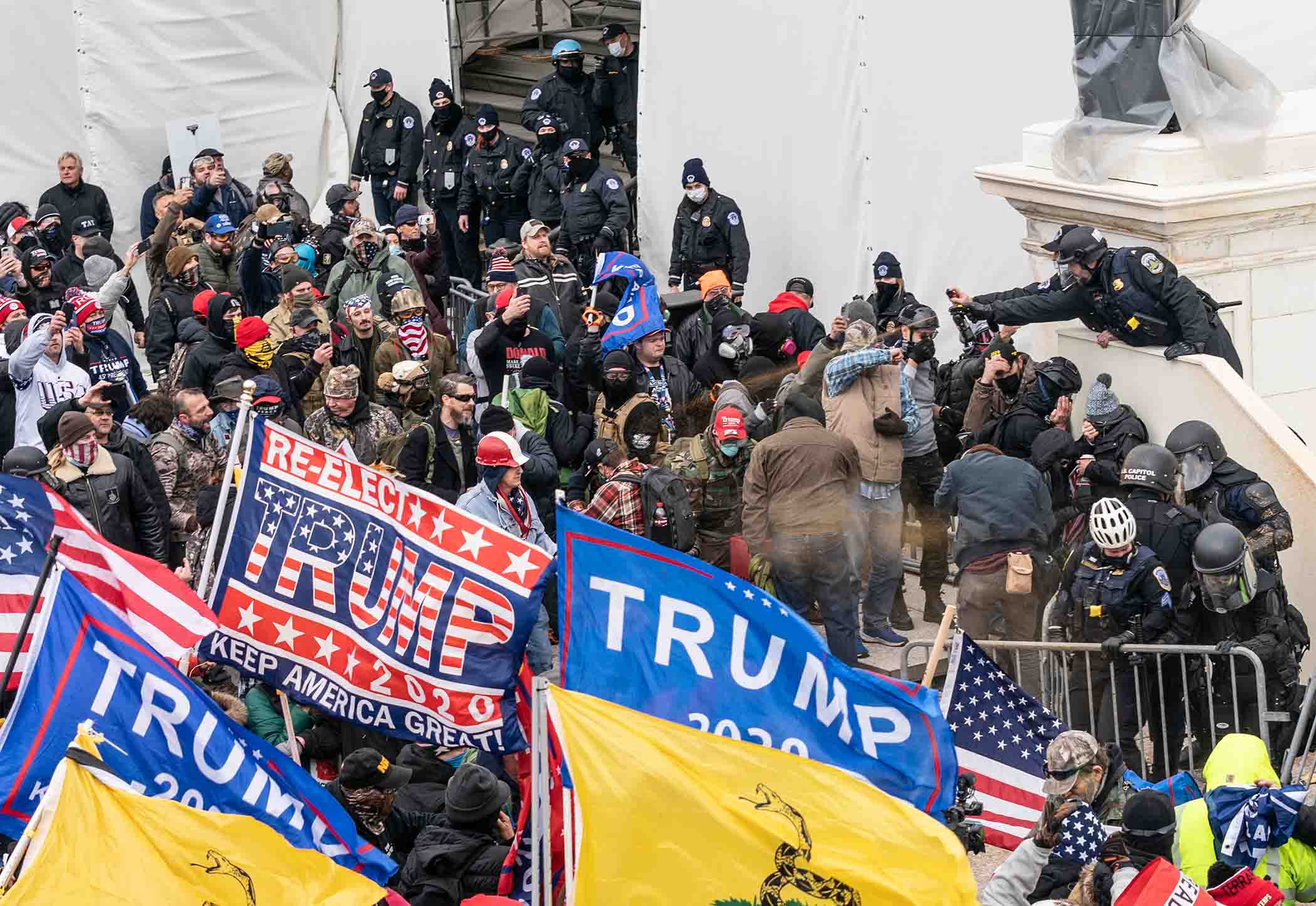
This article is part of a series — At 250, Who Will America Be? — reporting on threats to American democracy as we approach the nation’s Semiquincentennial, on July 4, 2026.
∼ ∼ ∼
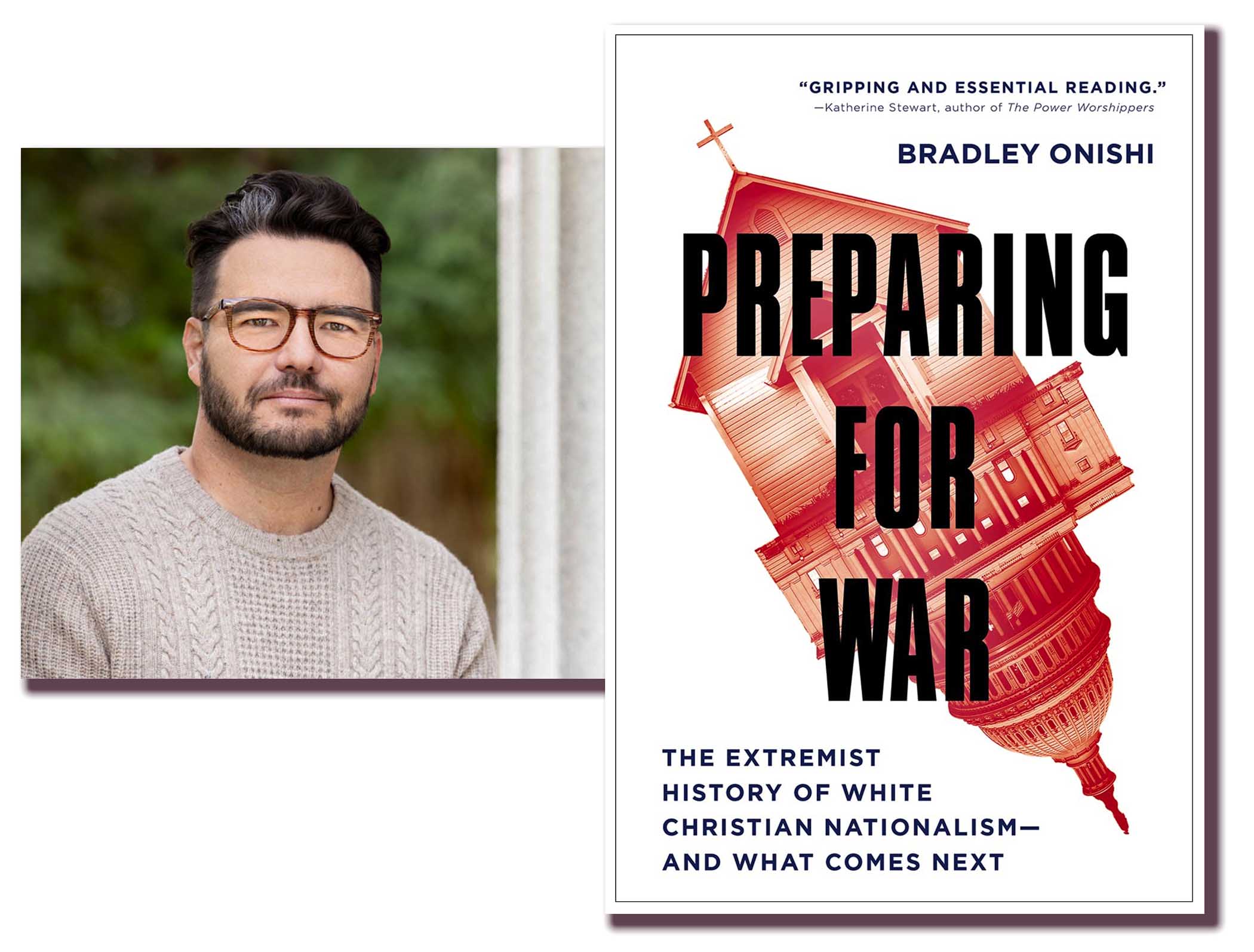
Raised in the traditions of white Christian nationalism, Bradley Onishi served the religious movement for seven years by facilitating youth groups and prayer meetings, before departing after being told he read too many books. His second book, Preparing for War: The Extremist History of White Christian Nationalism — and What Comes Next, is a sobering delineation of the real threats of violence the nation faces as it approaches the 2024 presidential election. Onishi, a University of San Francisco religious scholar, challenges us to examine how shifts in national politics are affecting our lives.
Based on telephone and email conversations, this interview has been edited for length and clarity.
• · • · •
Frank Pizzoli: Two days before our interview, former Arkansas governor Mike Huckabee (R) said that 2024 will be the last election “decided by ballots rather than bullets,” if former president Trump doesn’t win the presidential race because of his numerous and multiplying legal battles. Your [Preparing for War] epilogue is titled “Those with Eyes to See.” If my eyes could see, what would be within my view? The beginnings of our country’s second civil war?
Bradley Onishi: I think Mike Huckabee is a great example of what I’m talking about in my epilogue. People like him are often not taken seriously when they say this may be the last election decided at the ballot box rather than with bullets.
Why aren’t doomsday pundits like Huckabee not taken seriously regarding potential violence?
Because Mike Huckabee is a perfect example of a white Christian man who is not understood as inherently dangerous. If you know anything about him as a public figure, you know he’s kind of goofy, prone to making really bad jokes, a corny country pastor.
And yet?
And yet the things he says are incredibly threatening. When he forecasted bullets in place of ballots, he probably should have had the FBI at his door. If someone from the Black Panthers Party for Self-Defense had said that back in their time [founded in 1966, in Oakland, California, by Huey P. Newton and Bobby Seale] or if someone who was even peripherally involved with Barack Obama’s campaign said something like that, then Fox News and similar outlets would have declared the end of the world.
But instead …
Instead, people respond: Oh, yeah, there they go again, talking crazy, being extreme, they’re just nuts, weirdos. Let’s go back to what we were doing. That sentiment, that reaction embodies my epilogue. I really do think we are arriving at a place where the fabric of American society is so torn that it is not hard to imagine widespread violence in the coming election season.
Aren’t we already seeing the violence?
We are. In Jacksonville, Florida, we had a mass shooting based on racial hatred [August 26, 2023]. Same thing in Buffalo, where the 18-year-old alleged shooter said during his first court appearance that he wanted to prevent “eliminating the white race” when he fatally shot 10 Black individuals in a supermarket [May 15, 2022]. Police reported that he researched the neighborhood’s demographics and spent the day before his rampage doing reconnaissance with the intent of killing as many Black people as possible.
If you’re a Jewish person in Pittsburgh, you’ve witnessed the deadliest U.S. attack on the Jewish community, when a gunman killed 11 people and wounded 6, including several Holocaust survivors [October 27, 2018].
What’s the current level of danger?
We can either anticipate more violence or we can look around right now and say we already live in a society where if you are Black, Jewish, queer — anything other than white — your life may be in danger because of the kinds of political rhetoric that Mike Huckabee and people more important than him are spreading. My shorthand is that the white Christian nationalist movement wants to turn back time to when everyone other than white Christian men knew their place. I think we’re in the eye of the storm.
Everyday people who aren’t political junkies following this activity are in denial?
I think a lot of people are holding on to the idea that Joe Biden is president, and while he’s not their favorite guy he’s at least normal. On the other hand, Donald Trump faces 91 felony charges in four going-to-court legal cases. That’s 44 federal charges and 47 state charges, with Trump denying any wrongdoing in each instance.
Where will we be one year from now?
In about one year we’ll be six months into a Trump trial. We’ll be right up against the election, and the country will be on fire again. Not only literally because of climate change and what summers are like now, but also politically because we’re going to enter the fray one more time. It could be worse than it’s ever been.
George Carlin said the first thing he learned about God was that he needs money.
Let’s unpack how we got here by looking at the history of extremist white Christian nationalism, beginning with Southern California. Did Orange County in-migrations and Southern California’s heavy concentration of defense contractors create a petri dish for more conservative points of view?
Those factors created an environment in which conservativism flourished. In the mid-20th century, we saw what historians call the Sun Belt Migration, a widespread migration when millions of Southerners and Midwesterners left those parts of the country to settle in places like Los Angeles, Orange County, and other Southwest regions. They were drawn there by the post-war defense industry and found a bucolic environment of mostly farmland.
Opportunity abounded?
There were great jobs to be had, cheap real estate, beaches, great weather. Why not go? Disneyland was built by 1955. When they got there, many of them were able, in their minds, to recreate the places they left behind. By the mid-1960s, you had more Southerners in California than any Southern state.
In ways that often happen, nostalgia kicked in and the newly arrived migrators recreated an American life that was even more conservative than where they came from, even more distilled in terms of its conservative Christianity. The milieu is pro-capitalism, anti-communist, and dare I say it’s racist and xenophobic.
Migrators filled in a blank page?
I argue that Southern California was an open lot with no zoning. New arrivals found a place where they could build the America they wanted from scratch with no checks and balances on them.
How did their New Eden differ from what they left behind?
Back in the South, in Louisiana or Georgia, you have large Black populations for obvious historical reasons. There was a sense of racial superiority and supremacy on the part of Southern white people, but there was always this sense of living with minorities, with a Black population that was not going to allow everything to go unchecked. Well, when you get to Southern California, Orange County is 90% white in the mid-20th century. There are no entrenched Jewish or Black communities. There are some Latino communities, but they are deeply segregated and politically powerless. So, the folks in Southern California through the ’50s, ’60s, and ‘70s are able to distill a form of white Christian nationalism and Americanism that is probably the purest form you could find in the U.S. in these decades. With no one around them to object. That’s why generally historians view Orange County as the epicenter of American Conservatism in the mid-20th century.
Others with the same message aren’t grand strategists but they are working parts, cogs, in a political machine that does have a grand strategy.
And emanating from the communities forged in California by the Southern migrators we begin to see their influence on national politics?
It’s no accident that this region strongly pushed U.S. senator Barry Goldwater [R-AZ, 1953–65 and 1969–87] to the 1964 GOP presidential nomination. Pulled from his 1960 book The Conscience of a Conservative, Goldwater’s national campaign message was [basically]: Extremism in the defense of liberty is no vice. And moderation in the pursuit of justice is no virtue.
Orange County is the same region that cultivated Ronald Reagan as a political figure, raising him up as someone who would eventually become California governor and U.S. president. Actor and conservative icon John Wayne was always there campaigning for candidates. The airport is named after him. Singer Pat Boone was in the mix. In 1964, he spoke at a “Project Prayer” rally attended by 2,500 in Los Angeles. The Project wanted to flood Congress with letters supporting mandatory school prayer, following two Supreme Court decisions, in 1962 and 1963, striking down mandatory prayer as conflicting with the Establishment Clause of the Constitution’s First Amendment.
Richard Nixon figures into the story?
I must include Richard Nixon, born in my hometown of Yorba Linda and a member of my own childhood evangelical Quaker church, which his parents helped to start there around World War I. Nixon wasn’t a very good Quaker; he didn’t really love peace or social justice, egalitarianism, or caring for the vulnerable. Well, these Quaker churches got rid of all that. Instead, they wanted to ban abortion and stood against anything LGBTQ-related. They wanted to make sure that their faith in Christianity was treated as a privileged religion in the country. This history is an emblematic story of the ways that Orange County has come to play an outsize role in our politics. And of how the churches there are contoured to this pro-capitalist, pro-America, Christian nationalist view of life and politics.
Did something change along the way? Were the founding generation of Quakers, like Nixon’s parents, traditional practitioners? They believed in promoting peace and social justice and helping the vulnerable? And then Richard Nixon and his generation start championing white Christian nationalism?
I think the story of the Quakers in Orange County is really the story of Orange County itself. In the 1920s this was farmland. It looked more like central Pennsylvania than an affluent suburb of Los Angeles. But as the defense industry moved to the region after World War II, there was a migration of white Southerners and Midwesterners. As historians like Lisa McGirr, John Compton, and Darren Dochuk have shown, this Sunbelt Migration resulted in the development of a militant American conservatism in the region. It became the place that would champion Goldwater, raise up Reagan as a politician, name its airport after John Wayne, be the spiritual home of the John Birch Society, and, yes, raise Richard Nixon into the war hawk he became.
How did you see yourself growing up? Did white nationalism help you explain the world, did it seem kosher to you? How did you move from full acceptance of your faith as you were taught it to a more questioning posture? What led you to read all those books which influenced you to consider alternative points of view?
It wasn’t that white nationalism helped me explain the world. It was that evangelical Christianity provided an answer to every question I ever had — from the meaning of life to why abortion was murder or how to think of other religions, and so on. What I realized as time went on is how that all-encompassing framework included at its core a myth of the American nation. I had converted to a faith that was as much about American nationalism as it was the Gospel of Jesus Christ.
As a college student, the binary answers to life’s most important questions became insufficient. I needed more complexity intellectually, so I studied philosophy and theology and history at my Christian college. The more I studied the Bible the more I tried to build and maintain a coherent evangelical worldview; the more I tried to cohere my beliefs with the fact that Gandhi was eternally damned but the wealthy real-estate broker at my church would live in eternal bliss; the more I came to think that, the center didn’t hold. By the time I left for graduate school, in my early twenties, I wasn’t sure I believed in God, much less the God I had been worshiping for a decade.
Nothing happens in isolation, so eventually this mid-century migration fostered many other developments?
Yes, when you outline the historical period covered in my book, you realize the outsize role Southern California has had not only on our political landscape but in developing white Christian nationalism throughout the country. This includes megachurches, which have had an enormous influence on our culture, even though they are in northern San Diego or in south Orange County or dotted all over California’s Central Valley. Televangelist Robert H. Schuller produced the Hour of Power, which was broadcast weekly to 20 million viewers from Orange County’s Crystal Cathedral, a cut above the drive-in theater where his church started. James Dobson, founder of Focus on the Family, established his beachhead 20 minutes from Orange County.
George Carlin said the first thing he learned about God was that he needs money.
A thorough history includes the Prosperity Gospel, a theologically conservative movement popular in impoverished communities that is aligned with Pentecostalism, Evangelicalism, and charismatic Christianity. Prosperity preachers tell followers they can move beyond poverty or illness through devotion and positive confession. Many Prosperity pastors require heavy tithing. So, my argument is that Southern California is not an enemy to white Christian nationalism. Rather, it is the place we should look to understand it in its modern form.
Lyndon Baines Johnson defeats Goldwater in the 1964 presidential election with 61% of the popular vote. With his inimitable button-hole bullying, Johnson eventually maneuvers Congress into passing the Civil Rights Act of 1964. Regarding his legislative prowess, legendary journalist Bill Moyers said to him, “Quite a day, Mr. President.” Johnson replied, “Well, I think we may have lost the south for your lifetime — and mine.” Now Trump has further advanced this evolution with help from literally scores of other political and elected officials, and millions of followers who vote.
Indeed, the Democrats lost the Solid South. In the current phase, “nationalists” are selling a smoldering rage to an electorate already angry as hell. These forces and all the cogs in their political machine are feeding the fire. And nothing is invisible, in fact, they’re telling us exactly what they want to accomplish.
Which is …
The Heritage Foundation’s Project 2025 plan, endorsed by 70-plus other like-minded organizations, is the playbook to reshape the federal government should a Republican take the White House in 2024.
Some say practically eliminate, not reshape, the federal government.
They have a widespread plan to destroy the State Department, and so many other governmental agencies. The plan makes almost every federal worker an at-will employee, meaning they can get rid of an employee whenever they’d like. We will be a nation without drilling regulations or an Environmental Protection Agency [established by President Nixon]. Maybe no Education Department, or Housing & Urban Affairs.
It is so, so difficult to find a Founding Father who is Christian in the way that an American white evangelical imagines one to be Christian.
What’s the point?
They’re saying basically this — Hey, when Trump was president, it was great on the culture war front. But he didn’t have any idea what he was doing as somebody in government. So, we’re going to write him a plan, or for any Republican who may win. And once in the White House, we hope Trump or another GOP’er will do what we actually wanted to do during Trump’s first term —destroy the federal government as we know it. They know Trump was easily bamboozled by the deeply technical aspects of being president. He didn’t like to read. He never had a Plan B or Plan C. The Foundation is saying they won’t tolerate a Jared Kushner, or, similarly, being in charge of 82 things. We’re not going to have Peter Navarro running around not able to shut up. We’re going to install adults.
So political intervenors like the Heritage Foundation, all the Huckabees and Trump sycophants out there, know precisely what they’re doing and what they want to accomplish?
Sure. Huckabee and those like him are looking into the camera saying, You can trust me. Do I look scary to you? Do I look like I’m trying to do something violent or treasonous? No, I’m Mike Huckabee. Come on. Here’s a dad joke. What did the chicken say to the rooster? At this point, he and others with the same message aren’t grand strategists but they are working parts, cogs, in a political machine that does have a grand strategy.
You stress that Christian nationalism is a spectrum of beliefs about God and country and relies on the work of sociologists Samuel Perry and Andrew Whitehead, authors of Taking America Back for God. For them, Christian nationalism has three foundational components: the myth that the U.S. is a Christian nation, nostalgia for past glory, and an apocalyptic view of the nation’s future. Destroy the myth for readers.
I think we can say very plainly that the United States is not a Christian nation, because the nation was founded on the basis of there being no official religion. From the beginning of this country, there was supposed to be no test to hold public office. When it came to your religious preferences, there was supposed to be no establishment of any church, or other religious institution, as part of the government. So, by definition, America was and remains founded as a secular democratic Republic.
When people say that this is a Christian nation, they’re contemplating a culture and a legal system that reflects their understanding, or rather their misunderstanding, of our history. It is one thing to say that some of our founders were Christian people. And as a professor, I would say: You’re exactly right. Let’s talk about it because if you want to talk about the founders and their Christianity, I’m all in.
What do you point out to students, or anyone, regarding their belief that we’re a Christian nation?
I talk about the Christianity of someone like Thomas Jefferson. He created a Bible reflecting what he wanted his religion to be — namely rational. Accordingly, he took all the miracles out of the Bible. We could talk about Roger Williams, who dissented so sharply with his colleagues in the Massachusetts Bay Colony that he fled to what is now Rhode Island in order to create a society where morality and conduct made you a leader, not your Christian faith. He also wanted to establish peaceful relations with Native American people and to create a colony that was based on liberty of conscience rather than Christian precepts.
How do our Founders’ religious positions compare to what today’s evangelical leaders expound?
It is so, so difficult to find a Founding Father who is Christian in the way that an American white evangelical imagines one to be Christian. The disparities open up a conversation about the Christianities, plural, that existed among the Founders and also the non-Christianities that existed among them. To call us a Christian nation is too simple a view of our actual history and the men who created it. I’d rather do my homework.
What does history homework show us?
If you know your history, you can see how Europe broke out in religious wars in the 1600s because all of the Protestant factions borne of the Reformation were fighting for control of their governments. That’s exactly what our Founding Fathers were trying to get away from.
MSNBC’s John Heilemann says that about 20% to 25% of the American people from our very beginning have been “whack.” Is that what we’re seeing raise its head up again?
I’m not sure what he means by whack, but I do think there are two interrelated phenomena at play in the radicalization of the American right. First, there is now public permission for those who hold racist, misogynist, and xenophobic views not only to express them but to become leaders in the GOP. The former president had dinner with a white supremacist and a self-professed admirer of Hitler. That same president said there were good people on both sides at Charlottesville. Ron DeSantis won’t condemn the Nazis marching and rallying in his state. I could go on, but the point is this: There is a sense of welcome for those who 20 years ago would not have been able to find a platform.
Additionally, we have people who are being activated and groomed by far-right forces. It’s easy to think of voters and citizens, all human beings, as static entities. But we can all be cultivated by our surroundings, by the activation of our emotions and desires. We are seeing many who a decade ago would have been Mitt Romney voters radicalized into folks who think J6 was a positive event, who think all members of the LGTBQ community are pedophiles and are convinced that public school teachers want to groom their kids. Moms for Liberty, the ReAwaken America Tour, megachurch pastors calling for civil war — these forces are activating a group of Americans into extremism.


The opening of the preface in Louis Menand’s The Metaphysical Club: A Story of Ideas in America goes: “It is a remarkable fact about the United States that it fought a civil war without undergoing a change in its form of government. The Constitution was not abandoned during the American Civil War; elections were not suspended; there was no coup d’état.” The January 6 insurrection signals that this round may be different.
It’s a striking observation. There is a longer conversation to be had about not only the structure of government but collective memory surrounding the Civil War — and the Lost Cause myth that still shapes it. However, I think you’re right about J6. I don’t know the future. But I do firmly believe that if Trump gets a second term, we will see him do everything possible to dismantle democracy from within in order to consolidate power and change the United States government forever. His models are Putin, Kim Jong Un, and Viktor Orban. He has people around him with a playbook to implement. There will be no Rex Tillersons or General Kellys this time. There will be a full throttle attempt to reshape the American government into something more akin to autocracy than democracy.
You feel strongly that no “definitive answers” currently exist, but yet you still ask questions. What can readers who are worried for the future of American democracy do?
As we saw in 2020, the state legislatures were seen as a weak point where perhaps the election could be stolen. I’d advise readers to know who runs their state legislature. Get to know your state representative. Know how they vote on issues. Call them to express your views. Make your voice heard regularly, monthly, in an email or a postcard. We should all be asking ourselves how we plan to engage in politics as 2024 approaches. What’s the one thing that you’re going to pay attention to: climate change, education, reproductive rights, systemic racism? Concentrate your energy. Schedule your activities for specific days and times. Why? Because this is a battle that will be going on a long time after any of us have seen the last days of our days. The battle is not going away anytime soon. ❖
Frank Pizzoli is a journalist who has been covering politics, queer issues, healthcare, and literary celebrities for the past 25 years.
Preparing for War: The Extremist History of White Christian Nationalism – and What Comes Next is published by Broadleaf Books.