




Looking over some new graphic novel releases brings to mind a school library, but gone are the days when teachers would side-eye students perusing comics. Reading, in any format, is something to celebrate, and all three of these graphic novels have something worthwhile to offer, to both teens and adults. Let’s check them out before some wannabe thought cops try to ban them.
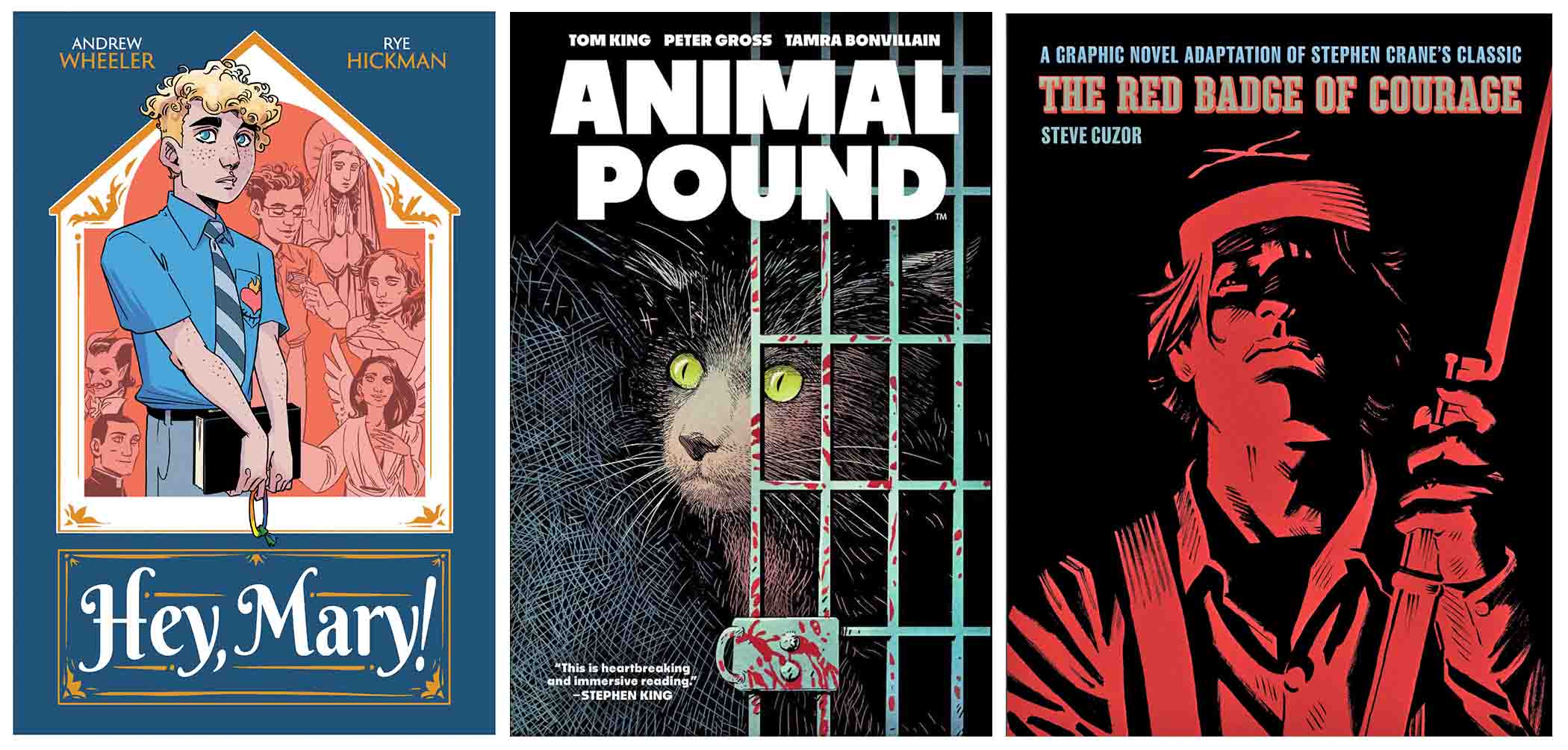
The first book on the docket is Hey, Mary! (Oni Press, $17.99), by writer Andrew Wheeler and artist Rye Hickman. Part coming-out story, part history lesson, with an emphasis on religious studies, Hey, Mary! focuses on Mark, a high school student at a Catholic academy who’s struggling with feelings of same-sex attraction, including toward his friend Luka — who’s out, proud, and soon transferring to another school. Unlike Luka (and most of their classmates), Mark is genuinely devout, taking Catholic scripture and teachings seriously. But is what he’s being taught the whole story? That’s the question Wheeler and Hickman seek to address.
Mark’s conflicted desires manifest themselves in fantasy. A Renaissance painting of hottie martyr Saint Sebastian comes to life in a museum and talks to him, direct as an arrow: “I’ve seen that look on your face before,” he says. “Awakening.” Later, at a family dinner with the parish’s new priest, Mark imagines a debonair devil whispering a sinister counterpoint into his ear: “You must keep yourself a secret. Never act on your sin. Never think on it. Or you will be mine.”
While Wheeler’s script sometimes veers into a queer travelogue through religious history, Hickman’s open layouts and pleasing linework make the trip breezy, heartfelt, and fun.
Are these fantasies temptations, or do they point to a deeper truth? What follows are a series of private conversations — sometimes fantasias with historical figures from the museum or the library, sometimes with trusted flesh-and-blood confidantes — as Mark tries to reconcile his sexuality with his faith.
Unlike many kids in his situation, Mark has all the tools he needs to work things out. While the church casts a large and foreboding shadow over his life, Mark’s community is diverse and vibrant. He connects with Jojo, a nonbinary drag performer who is comfortable with their sexuality but is trying to reengage with Catholicism after years away from the church. Jojo has the same problem as Mark, but is approaching it from a different angle. The new priest is able to give Mark guidance as well, showing a side of the church that wants to be as welcoming as possible. (We don’t hear much from another, older priest, but his glower reminds us that holy water doesn’t offer completely smooth sailing.)
Ultimately, the goal of the book is pedagogical. As Mark wrestles with his faith, he keeps encountering examples of LGBTQ+ saints and other historical figures: at the library, where Joan of Arc introduces him to St. Francis of Assisi (whom she describes as “the first drag mother”) and lesbian nun Hildegard of Bingen, and at queer readings of certain Bible stories, thanks to a workshop of Jojo’s drag production “Twisted Scriptures.” And while Wheeler’s script sometimes veers into a queer travelogue through religious history, Hickman’s open layouts and pleasing linework make the trip breezy, heartfelt, and fun. The colors, by Hank Jones, are well-calibrated to complete the picture, at times marking a sequence as pure fantasy or flashback but at other times keeping the palette realistic, allowing impossible conversations (say, with Joan of Arc) to land with the weight of reality. And the book never sells short the emotional pain Mark is going through in feeling his shame and keeping his secret. If the answers seem a touch pat, that can be chalked up to the story being aimed at a younger audience, who might benefit from a little certainty.
And this book could certainly reach a secondary audience as well. It’s easy to imagine a queer teen handing this to a religious family member who could use a little education on how an LGBTQ+ identity can coexist harmoniously with their faith.
Piggy unabashedly licks his crotch for a live audience. Humans being what we are, donations go through the roof.
Tom King and Peter Gross provide a new take on a familiar library book with Animal Pound (BOOM! Studios, $29.99), a modern reimagining of George Orwell’s 1945 satire, Animal Farm. King and Gross change the setting of the animal revolution from a rural farm to a pound in the suburbs, which, among other things, changes the kinds of animals involved. In Orwell’s story, the lead characters were pigs, horses, and a variety of other farm animals. Animal Pound’s menagerie is divided into three factions: dogs, cats, and rabbits, who join forces to unlock their cages and drive the humans from the facility. And the “Seven Commandments of Animalism” from Orwell’s book are boiled down into one golden rule, painted on the pound wall: THE DOORS WILL REMAIN OPEN.
Likewise, a farm is self-sustaining; a pound is not. But as kibble supplies dwindle, the animals learn how to use the Kitten Cam to their advantage: By performing in front of the webcam, some of the kittens earn donations to the pound, with which they order food. It isn’t long before an oafish bulldog named Piggy gets in on the action, unabashedly licking his crotch for a live audience. Humans being what we are, donations go through the roof, and Piggy is an Internet sensation.
Of course, there’s the matter of who’s in charge. The pound animals are interested in democracy, and they need the dogs to take part in the government — they’re the biggest and strongest, after all. But the canines are canny enough to realize that they’ll never have enough votes on their own to elect a dog leader. The solution is a compromise that takes the name of the book literally. “The cats are more numerous. The dogs are larger,” says Fifi, the cats’ leader, explaining the idea. “What will make us equal is pounds and ounces.” The animals literally begin weighting their votes: The heavier the animal, the more their vote is worth. The dogs, in their bulk, achieve electoral parity with the cats, and the rabbits have the power to sway the election as a tiebreaker. It’s a delicate system, and the flaws soon reveal themselves. (Gruesomely, in some cases.)
King’s script is a knowing tragedy. It’s clear that nothing will end well for these animals, despite their initial aspirations of equality and self-governance. But it’s Gross and colorist Tamra Bonvillain who perform the true magic trick of the book. Orwell wrote in prose, and didn’t have to clear the hurdle of visually depicting creatures who are still recognizable as animals but are somehow able to paint a barn wall or build a windmill. Yet Gross and Bonvillain manage to show the animals painting, voting, using video equipment, and opening locks all without distorting any creature in order to get the job done. Cats, bunnies, and dogs of all breeds roam freely, but none of them ventures anywhere near the uncanny valley.

King and Gross propel the story along with a dread inevitability, ably guiding the reader through the excitement of the revolution and the elation of victory toward the more mundane charms of watching animals build a bureaucracy, even as a few of them recognize the initial signs of the system’s corruption. The rabbits, the pound’s most vulnerable population, feel the rot first, but when the cats begin to recognize the inequality, they prefer to save their own hides rather than forcefully defend the smaller creatures.
As engrossing as it is, Animal Pound isn’t a particularly subtle work. When Piggy vaults from Internet stardom and capitalistic success into leadership, he initially wears a red ball cap he finds as a prop in the Kitten Cam room, leaving no doubt as to his current human analogue in vulgarity, appetite, and raw expression of power. But subtlety is a luxury allegory can’t always afford, especially for an audience that is so easily distracted by the sight of a dopey hound licking its own ass.
Cuzor’s linework is full of textured detail, bringing the realities of regimental routine — chatting in the bunks, digging latrines, sentry duty in the lonely woods — to vivid life.
One more trip to the school library might yield The Red Badge of Courage (Abrams ComicArts, $25.99), Steve Cuzor’s lovingly detailed adaptation of Stephen Crane’s classic tale of the Civil War. Cuzor is best known in Europe, but many of his comics, like the World War II–set Black Cotton Star and O’Boys (a mixture of Huckleberry Finn and blues legends), have focused on Americans. His latest work takes place during the rift that nearly tore this country apart — a conflict whose reverberations we’re still feeling today.
And yet despite taking place in the thick of the Civil War, Cuzor’s adaptation of the Red Badge of Courage is barely concerned with political matters, but instead with matters of the heart. Young soldier Henry Fleming has enlisted in the Union Army in a flourish of patriotism and a need to feel like he matters, but the pride that drove him soon butts up against the mundane exigencies of war. We find him in Virginia, peeling potatoes and digging ditches with the rest of his regiment, restless and itching for battle. He and his fellow soldiers nervously consider the fighting to come, and Henry wonders if he has the mettle to face down a hail of bullets from the Rebel army.
Writing in 1895, Stephen Crane narrated the story from the outside, in the third person — Cuzor narrows the focus. He presents Henry’s internal monologue, bringing us directly into the young man’s head as he tries to bolster his own courage among his fellow soldiers, particularly the headstrong Wilson, and Jim, an affable veteran. And of course there are encounters with the officers — who exude confidence and authority in front of the soldiers they command but who are often found safely in the rear, more concerned with their safety and creature comforts than the welfare of the men they offer up as a sacrifice to the war effort.

Cuzor’s linework is full of textured detail, bringing the realities of regimental routine — chatting in the bunks, digging latrines, sentry duty in the lonely woods — to vivid life. And when the men are finally called to battle, the action explodes with motion, even if the purpose or the outcome is never quite clear. If Henry doesn’t recognize who’s winning a battle, neither does the reader; all we experience is frenzied activity and fear.
Each scene is dominated by shades of a single color: tones of hazy green or a sun-burdened yellow during the day, and a cool, rich blue for action at night. (The only time red is used is on the striking cover.) The monochrome palette allows the linework to take the lead. It also obscures the difference between the Union and Confederate armies — there’s no blue or gray on the field, only gunpowder, confusion, and blood (manifesting as inky shadows on the page).
Henry has reason to confront his inner nature more than once in the war. At one point, he breaks in battle; later, he rejoins his regiment, wounded from an altercation with another fleeing soldier. Cuzor, like Crane, leaves things ambiguous. The infantry are ordered to retreat from the ground they just conquered, their victory dissolving into the mist, as ephemeral and misleading as the bandages adorning Henry’s head. He feels shame about the wound, but eventually lets it drive him to carry his regiment’s flag into battle again, offering himself as a target for the Rebel army. Is this courage, or is this a death wish? Can even Henry say for sure? ❖
Rob Staeger writes largely about comics and entertainment and the way they affect our lives. Follow him at @robstaeger.bsky.social.


